
About this lesson
What students discover
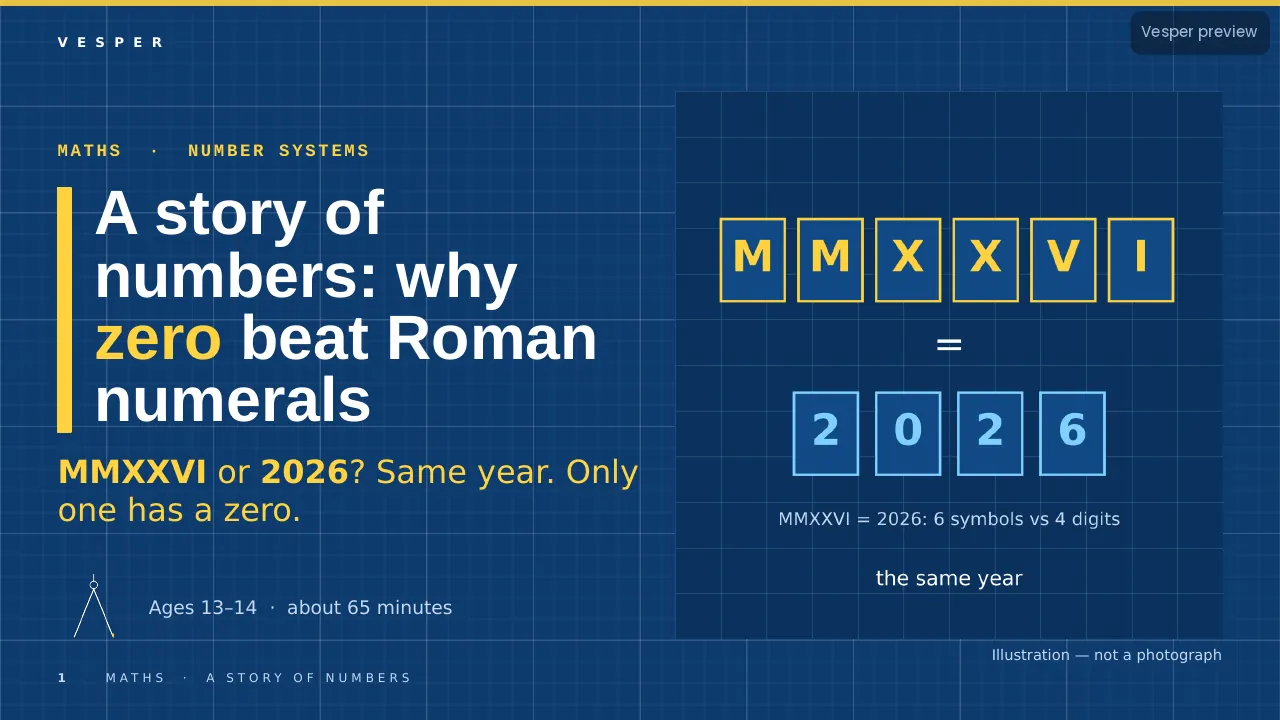
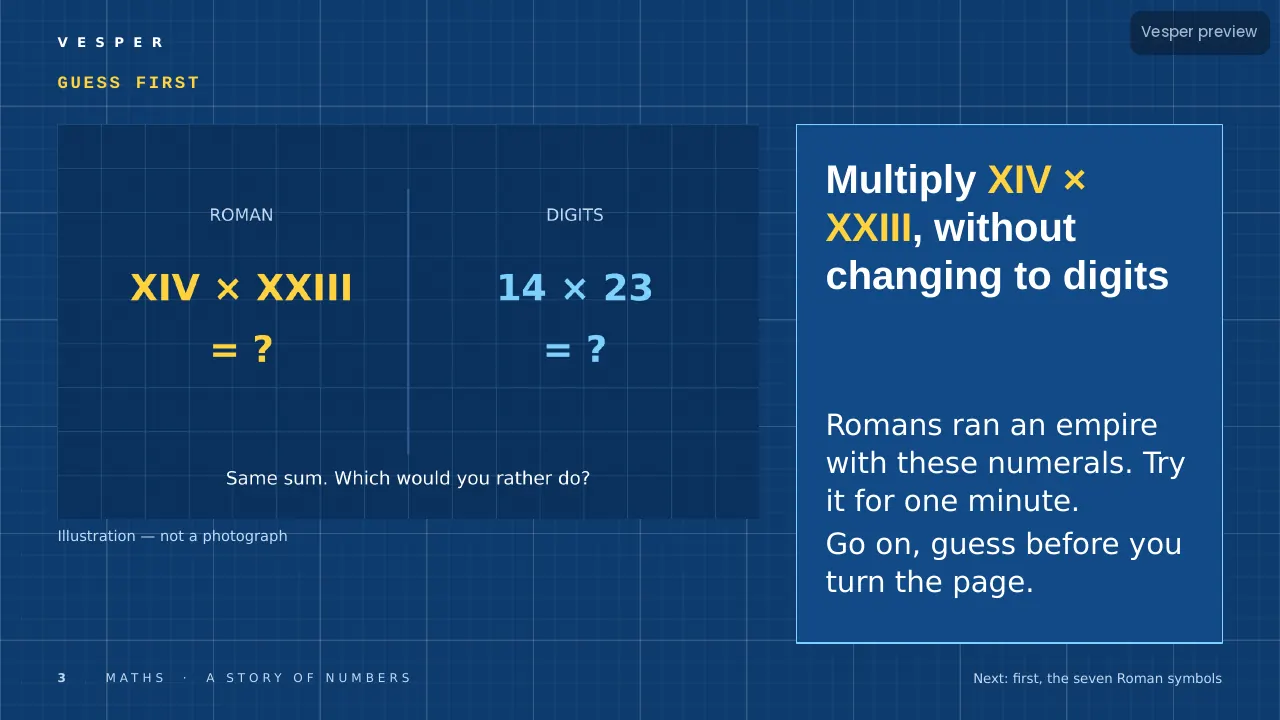
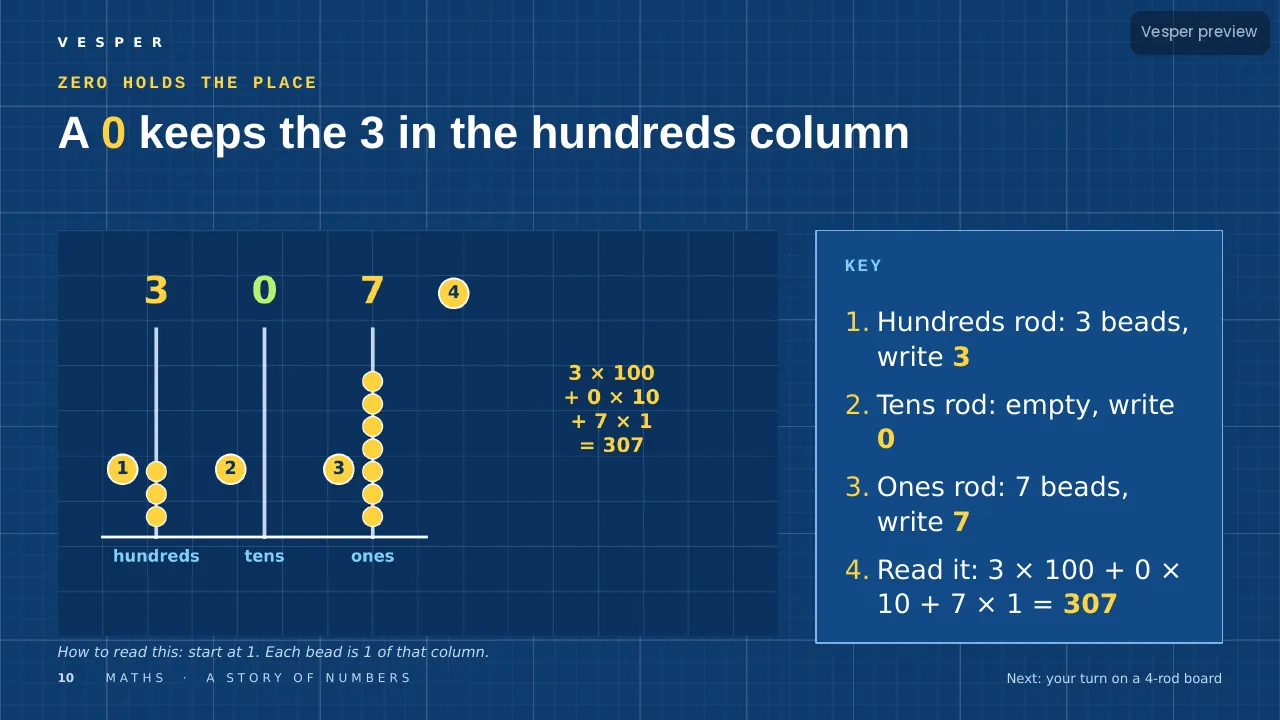
Ask a class to multiply XIV by XXIII without changing to digits, and they soon see the problem. Students read and write Roman numerals, including the subtract rule, and see why 3,888 needs 15 symbols. Then place value takes over: a counting board shows why 307 needs its zero, columns make 2,026 + 307 easy, and an area grid drawn to scale turns 14 × 23 into four small sums.
Zero then becomes a number with its own rules, as Brahmagupta wrote in 628 CE. The history is told with care: a gap mark in Babylon, a dot zero in Cambodia (683 CE), circles carved on a temple wall at Gwalior (876 CE), and a manuscript whose date is still argued over.
Inside the deck
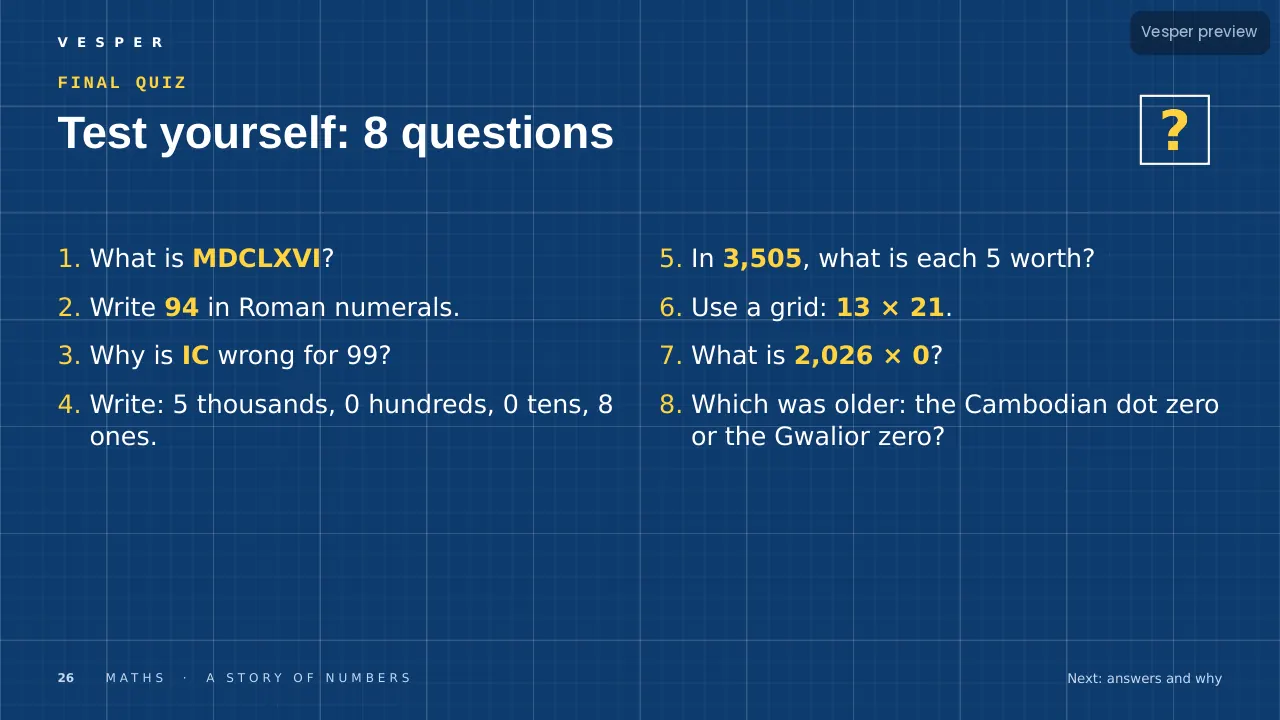
31 slides on the Blueprint template. Three your-turn slides, a poll on showing an empty column, a spot-the-mistake (writing 99 as IC), a myth slide (zero was not invented by one person on one day), a frontier slide on the Bakhshali dot, Roman numerals on clocks and films, two checkpoints and an 8-question quiz with explained answers.
How to teach it
Allow about 65 minutes. Give students two minutes on the XIV × XXIII hook before showing anything. The race on slide 25 pits digits against Roman numerals and can be done in pairs or at home. Notes on every slide give Say, Ask, Watch for and Time.
Who it’s for
For ages 13–14 studying number systems and place value, and for history-of-maths lessons. Editable PowerPoint with named layouts.