Mathematics Ages 13–14

Number tricks that read your mind, and the algebra behind them

Bag in, bag out: why every 'think of a number' trick lands on the same answer.

A 27-slide maths lesson: perform ‘think of a number’ tricks, then prove them with a letter, brackets and like terms, and invent your own.

The short answer

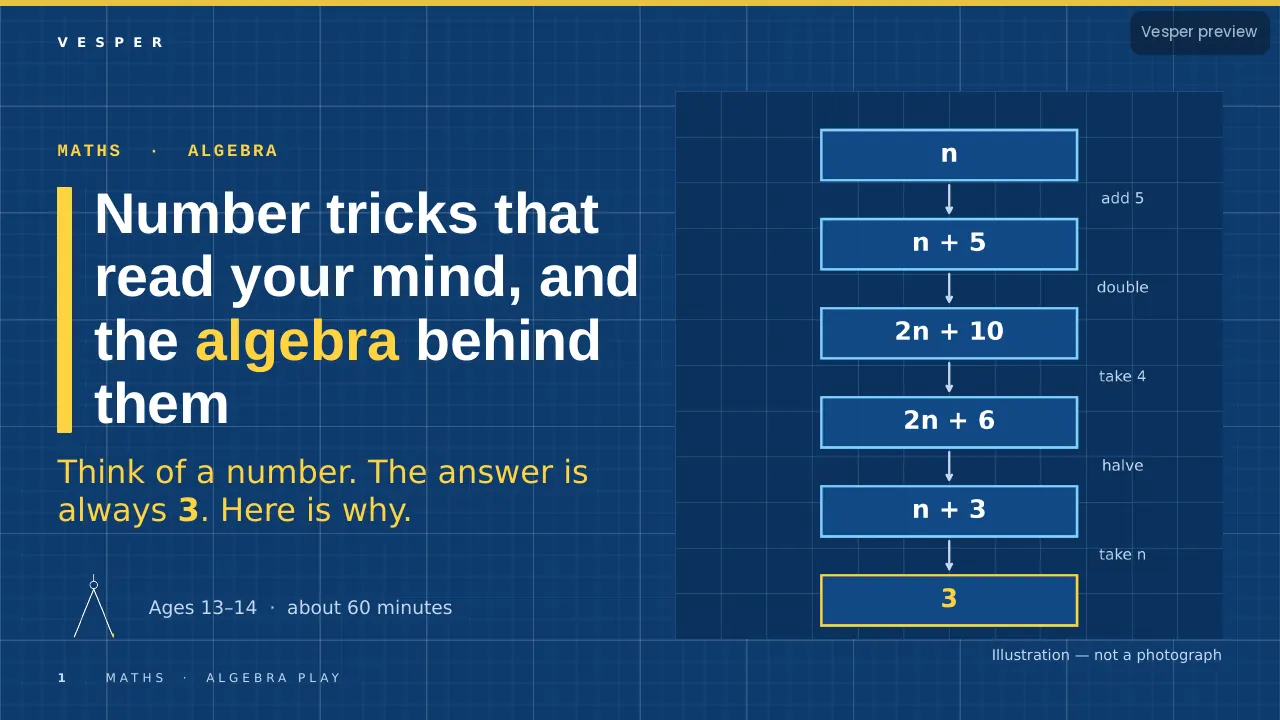
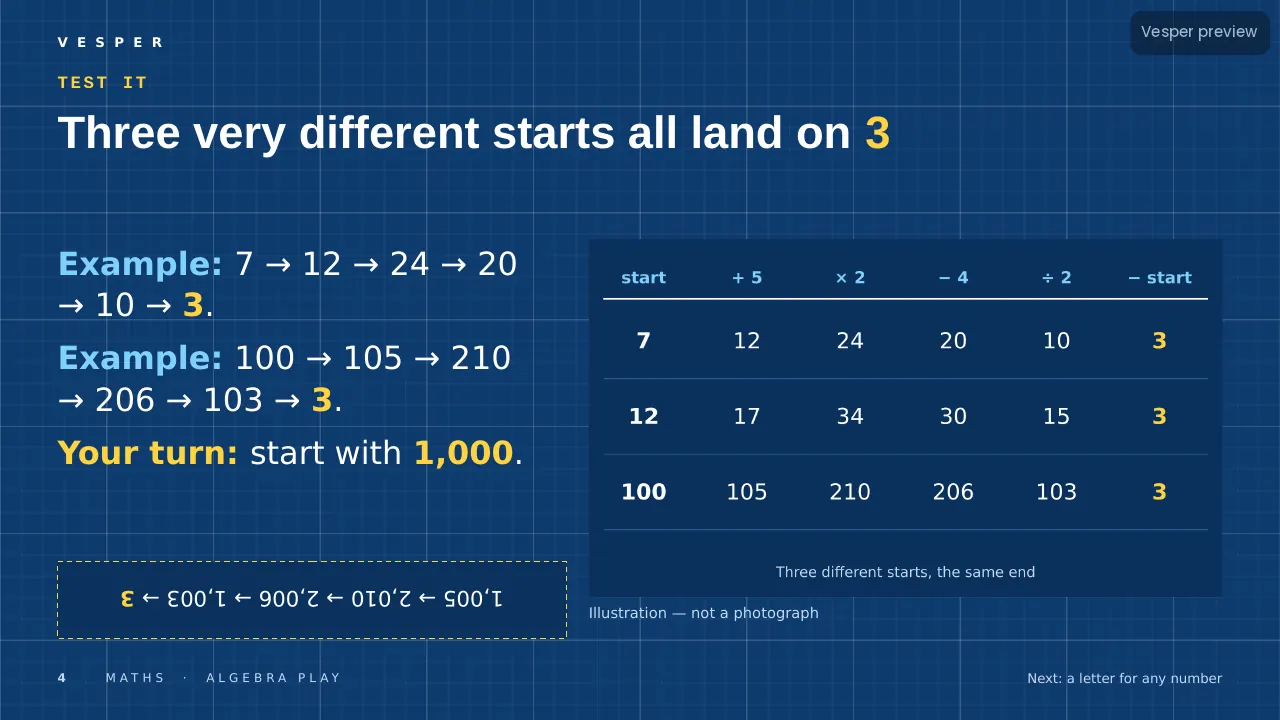
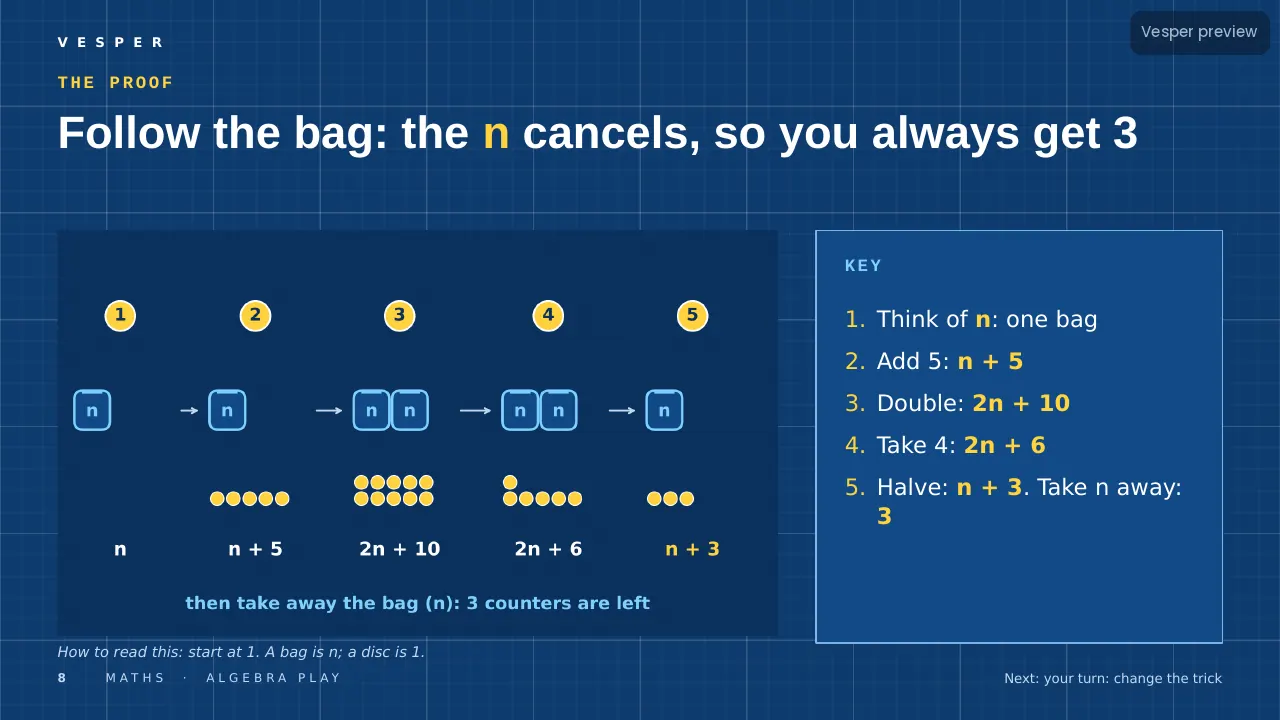
'Think of a number' tricks always work because the number you chose cancels out. Call it n: add 5 and double to get 2n + 10, take 4 to get 2n + 6, halve to get n + 3, then take away n. Whatever n was, the answer is 3. Algebra turns the trick into a proof.

Inside the deck

slides
27
quiz questions
8
minutes
60
your-turn tasks
8

Choose a format

  • Lesson Notes (PDF)Every slide with its teacher notes, as a PDF to read or print.
  • Teacher DeckThe editable PowerPoint with speaker notes on every slide, a PDF copy and the matching Vesper slide template, so you can add slides of your own.
Pricing coming soon

Pricing coming soon

We’ll email you pricing and launch offers shortly.

  • Finished and checked: buying opens soon
  • Sources listed at the end
  • Curriculum links under ‘Curriculum & specs’
  • For one classroom. Campus licences for whole schools

Key facts

  • The opening trick always gives 3, whatever number you choose
  • 2(n + 5) = 2n + 10: doubling doubles both parts
  • Three numbers in a row always add to 3 × the middle one
  • Reverse, subtract, reverse, add: always 1089
  • The subtraction step is always 99 × (a − c)

What students will be able to do

  • Students can use a letter to stand for any number
  • Students can expand a bracket such as 2(n + 5)
  • Students can collect like terms and simplify expressions
  • Students can prove why a 'think of a number' trick always works
  • Students can explain the 1089 trick using 99 × (a − c)

About this lesson

What students discover

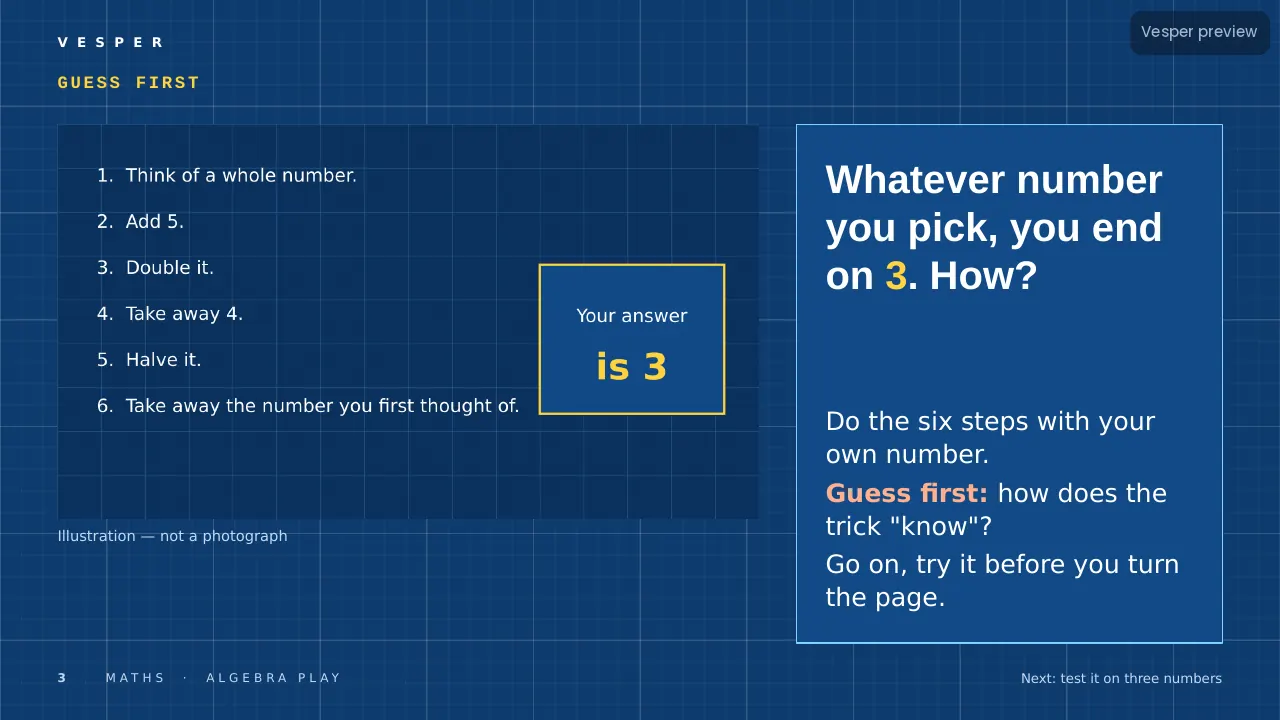
Think of a number, add 5, double it, take away 4, halve it, take away your number: you get 3, every time. Students test it on 7, 12 and 100, then meet a letter as ‘any number’, pictured as a bag of counters. They expand brackets with an area model (2(n + 5) = 2n + 10), collect like terms and halve whole expressions.

Then comes the proof: follow the bag and watch it cancel. More tricks follow: one that always gives 2, three numbers in a row that always add to a multiple of 3, and the famous 1089 trick, explained with 99 × (a − c). A score formula, P = 50 + 15L, shows algebra outside magic.

Inside the deck

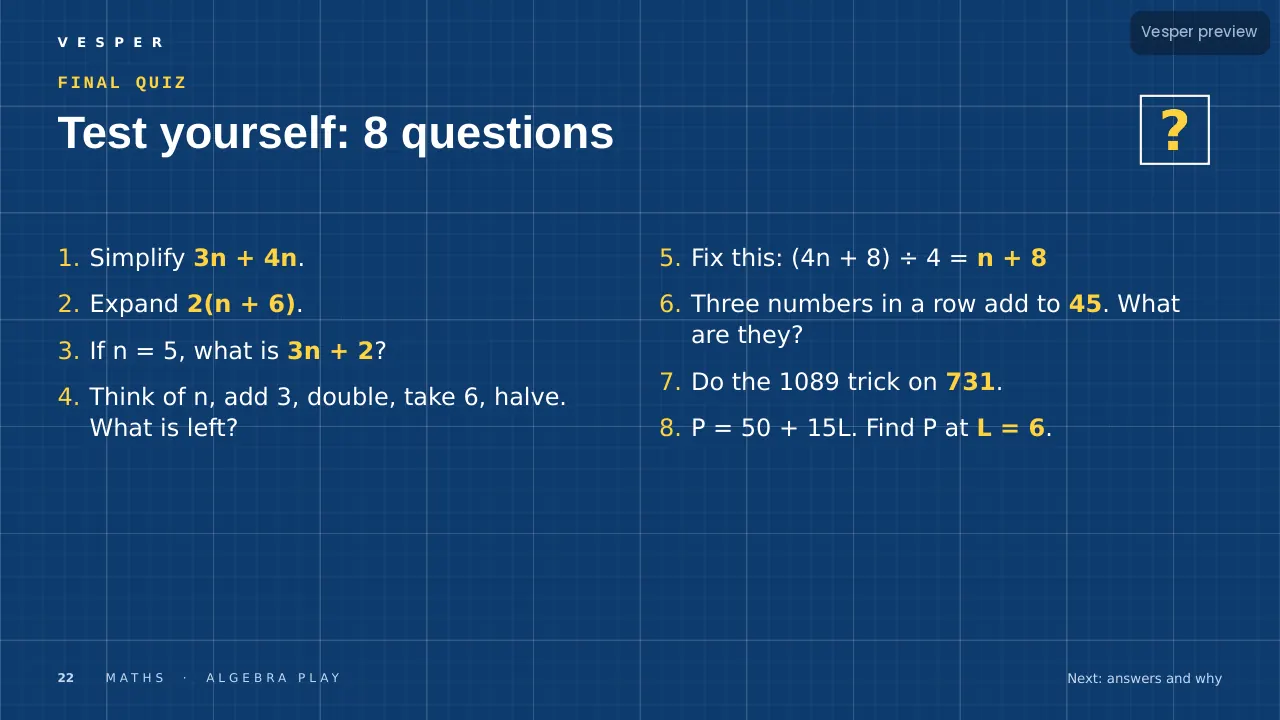
27 slides on the Blueprint template with white-line diagrams on blueprint blue. Three your-turn slides, a poll, a spot-the-mistake (halving 2n + 6 and getting n + 6), a myth slide, two checkpoints and an 8-question quiz with explained answers. The last activity asks students to invent their own trick and prove it.

How to teach it

Allow about 60 minutes. Perform the trick on slide 3 live before showing anything: ask three students to run it with different numbers. The bag-of-counters picture on slide 8 is the key moment, so pause there. Students can perform their own invented trick on a partner at the end. Notes on every slide give Say, Ask, Watch for and Time.

Who it’s for

For ages 13–14 meeting expressions, brackets and simple proof. It also works as a lively first algebra lesson for a younger confident group, or as a maths club session.

Curriculum & specs

CBSE/NCERT (India)Class 8 · Class 8 Ganita Prakash Part II ch 6 Algebra Play
CambridgeLS Maths Stage 7–8 Algebra (expressions)
IB MYPMathematics · KC Form · RC Generalisation · Crit B
Common Core (US)6.EE.A.2; 7.EE.A.1
Ages13–14
LevelMiddle
Slide templateBlueprint
Slides27
Teaching timeAbout 60 minutes
LanguageEnglish (UK)

Questions

Questions, answered

Why do 'think of a number' tricks always work?

Because the steps are built so that the starting number cancels. Written with a letter n, the expression simplifies to a fixed number, such as 3.

How does the 1089 trick work?

Take a three-digit number whose first and last digits differ by at least 2, reverse it and subtract; the result is always 99 × (a − c). Reversing and adding that result always gives 1089.

Why do three consecutive numbers add to a multiple of 3?

If the middle number is n, the three are n − 1, n and n + 1, which add to 3n.

What is a like term?

Terms with the same letter part, such as 2n and 5n. You can add them (7n), but you cannot combine 2n with 6.

What age is this algebra lesson for?

Ages 13–14, about 60 minutes. It works as an introduction to algebraic proof.

Can students make their own number trick?

Yes. The final activity has them invent a trick, test it and prove it with algebra.

Main sources

  1. M. Gardner, Mathematics, Magic and Mystery, Dover, 1956
  2. D. Acheson, 1089 and All That, Oxford University Press, 2002
  3. Every trick was checked for every starting number from 1 to 999

The full source list is on the last slides of the deck. Spotted an error? Tell us.