Mathematics Ages 13–14

Fractions in disguise: the hidden fraction in every discount

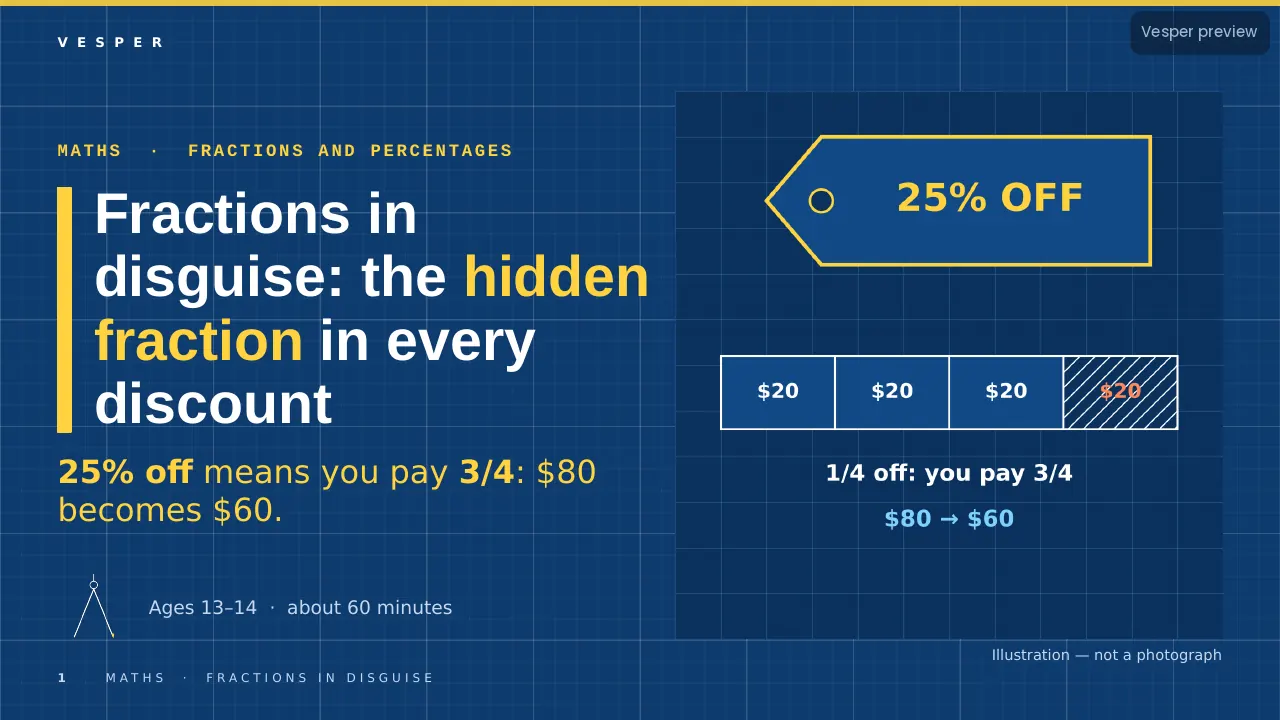
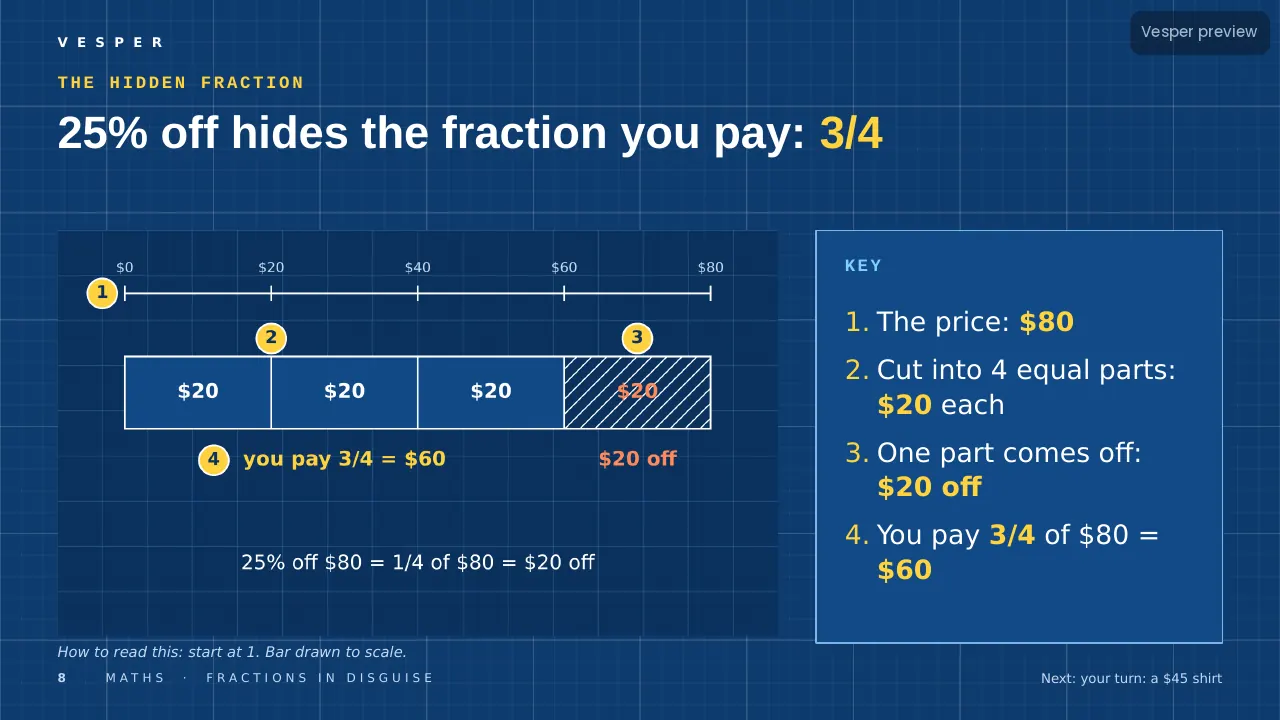
25% off means you pay 3/4: $80 becomes $60.

A 27-slide maths lesson that turns percentages into fractions and finds the fraction you really pay. Students prove why 20% then 10% off is only 28% off.

The short answer

Every discount hides a fraction. Per cent means out of 100, so 25% off is 1/4 off, and you pay 1 − 1/4 = 3/4 of the price: $80 becomes $60. Two discounts multiply rather than add, so 20% then 10% off is 4/5 × 9/10 = 72/100 paid, which is 28% off, not 30%.

Inside the deck

slides
27
quiz questions
8
minutes
60
your-turn tasks
6

Choose a format

  • Lesson Notes (PDF)Every slide with its teacher notes, as a PDF to read or print.
  • Teacher DeckThe editable PowerPoint with speaker notes on every slide, a PDF copy and the matching Vesper slide template, so you can add slides of your own.
Pricing coming soon

Pricing coming soon

We’ll email you pricing and launch offers shortly.

  • Finished and checked: buying opens soon
  • Sources listed at the end
  • Curriculum links under ‘Curriculum & specs’
  • For one classroom. Campus licences for whole schools

Key facts

  • 25% off $80 means paying 3/4 of $80: $60.
  • 20% then 10% off is 4/5 × 9/10 = 72/100 paid: 28% off, not 30%.
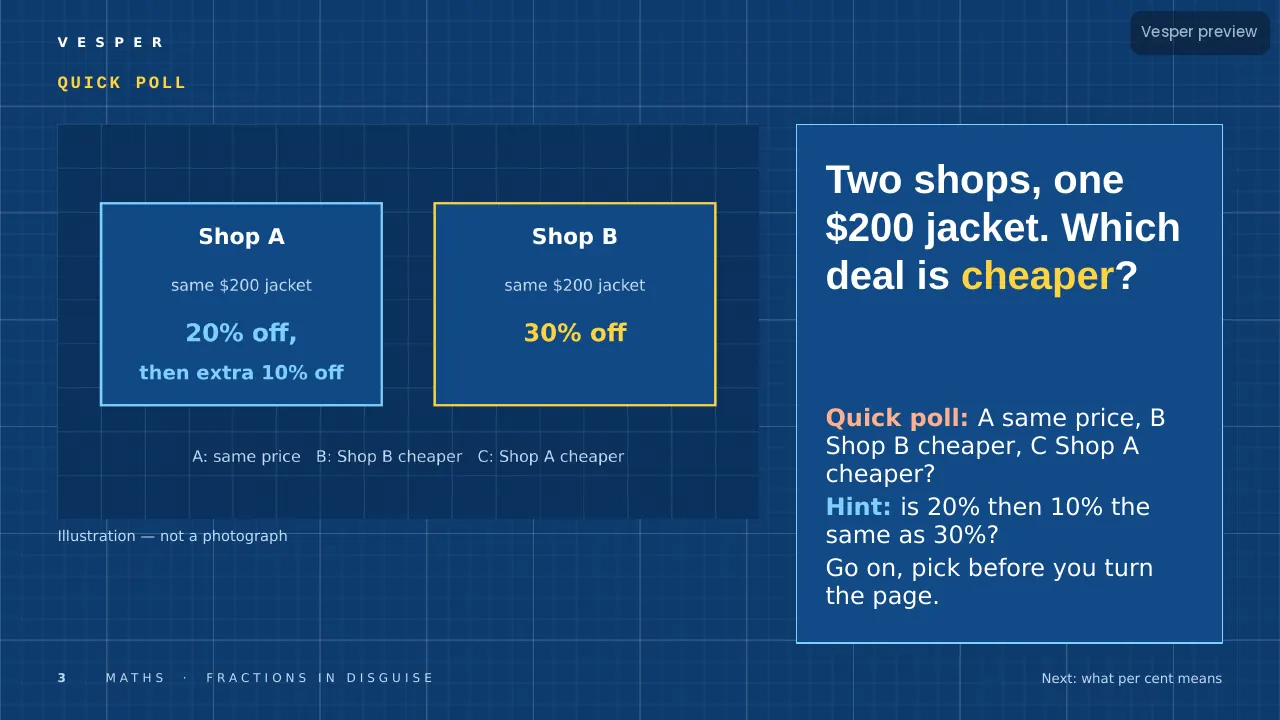
  • On a $200 jacket, 20% then 10% off costs $144; 30% off costs $140.
  • 'Buy 3, pay for 2' is 1/3 off, about 33⅓%.
  • Up 10% then down 10% turns $100 into $99, not $100.

What students will be able to do

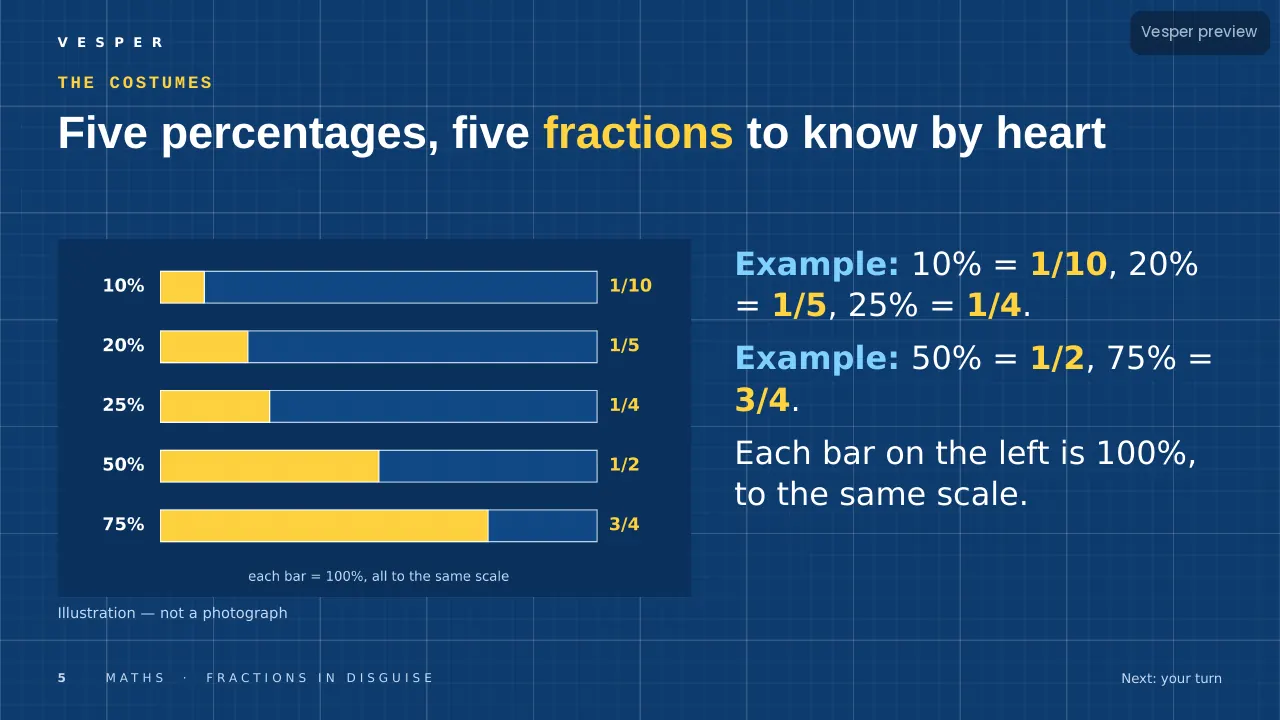
  • Students can write common percentages as fractions in their simplest form.
  • Students can find the fraction of the price paid after a discount and use it in one step.
  • Students can combine two discounts by multiplying the fractions paid.
  • Students can turn offers such as 'buy 3, pay for 2' into a fraction off.
  • Students can work backwards from a sale price to the original price.

About this lesson

What students discover

Shop A takes 20% off a $200 jacket, then another 10%. Shop B takes 30% off. Same price? No, and this lesson shows why. Students learn that per cent means out of 100, match five common percentages to fractions, and cut price bars into equal parts to find a discount. Then the key idea: the fraction you pay is 1 minus the fraction taken off, so 25% off $80 means paying 3/4 of $80.

From there it moves fast. Students multiply by the fraction they pay in one step ($120 × 7/10 = $84), chain discounts by multiplying (4/5 × 9/10 = 72/100), and settle the hook: Shop A charges $144, Shop B $140. Sana’s ‘half off then half off again is free’ gets corrected (you pay 1/4). ‘Buy 3, pay for 2’ turns out to be a 1/3 discount in disguise. Students work backwards from a sale price ($60 after 25% off was $80, not $75) and bust the myth that up 10% then down 10% cancels out: $100 becomes $110, then $99.

Inside the deck

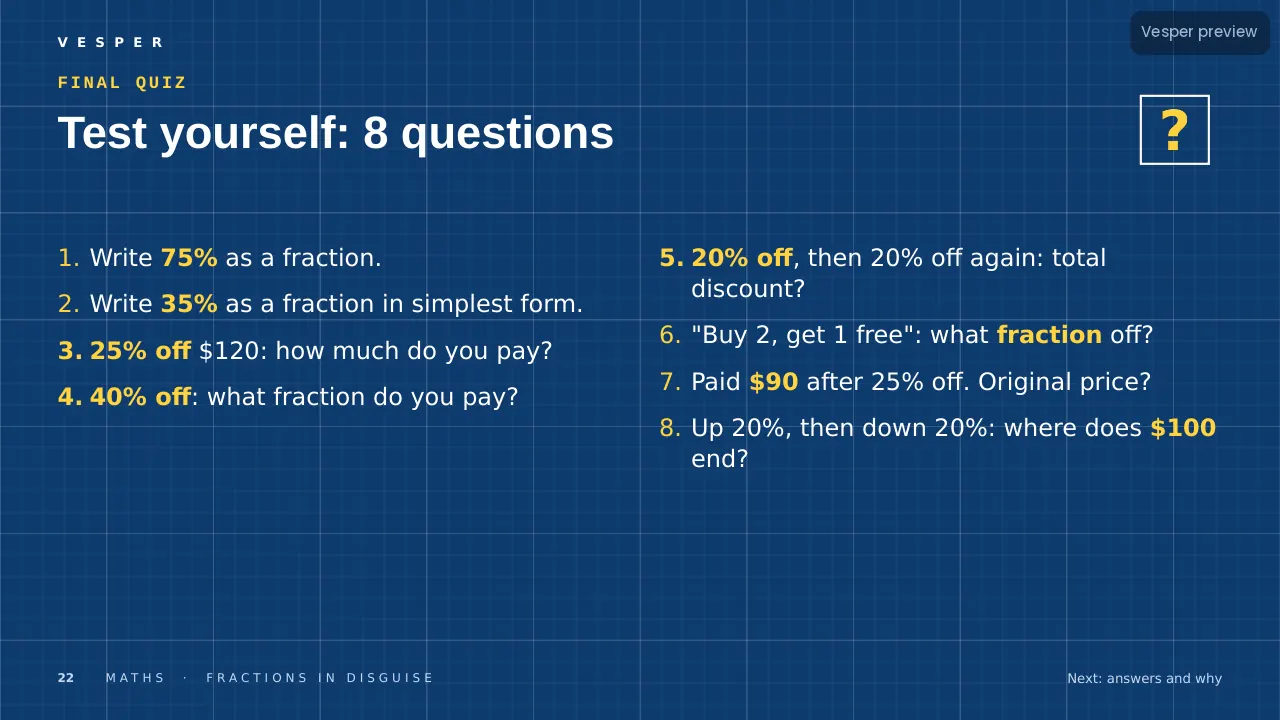
27 slides on the Blueprint template: a quick-poll hook, a primer, a to-scale diagram walk, six your-turn tasks with answers, a spot-the-mistake, a myth slide and two checkpoints. An eight-question quiz has explained answers. All prices are invented examples, and every sum was checked with exact fractions.

How to teach it

About 60 minutes. The home task asks students to find three real offers on a flyer, receipt or website, turn each into the fraction paid and rank them: it makes a strong starter for the next lesson. Speaker notes sit on every slide.

Who it’s for

Learners aged 13–14 working on percentages and fractions, and anyone who has wondered whether a stacked discount is as good as it looks.
Curriculum & specs

CBSE/NCERT (India)Class 8 · Class 8 Ganita Prakash Part II ch 1 Fractions in Disguise
CambridgeLS Maths Stage 8 Number (percentages); IGCSE 0580 E1.13 Percentages
IB MYPMathematics · KC Relationships · RC Equivalence · Crit D
Ages13–14
LevelMiddle
Slide templateBlueprint
Slides27
Teaching timeAbout 60 minutes
LanguageEnglish (UK)

Questions

Questions, answered

Is 20% off then 10% off the same as 30% off?

No. You pay 4/5 and then 9/10 of that, which is 72/100 of the price, so the total discount is 28%.

How do you work out a discount using fractions?

Turn the percentage into a fraction, subtract it from 1 to find the fraction you pay, then multiply the price by it. 25% off $80 is 3/4 × $80 = $60.

How do you find the original price before a discount?

Work out what fraction the sale price is. If $60 is 3/4 of the price after 25% off, one quarter is $20, so the original was $80.

What discount is 'buy 3, pay for 2'?

You pay 2/3 of the price, so it is a 1/3 (about 33%) discount, as long as you wanted three.

Does a 10% rise followed by a 10% fall cancel out?

No. $100 rises to $110, then falls 10% of $110 to $99.

What age is this percentages lesson for?

Ages 13–14. It takes about 60 minutes and includes an eight-question quiz.

Main sources

  1. Cambridge IGCSE Mathematics 0580 syllabus, E1.13 Percentages
  2. Common Core State Standards for Mathematics, 7.RP.A.3
  3. All prices are invented examples; every sum checked with exact fractions (src/verify.py)

The full source list is on the last slides of the deck. Spotted an error? Tell us.