Mathematics Ages 13–14

Fold a paper 42 times and reach the Moon

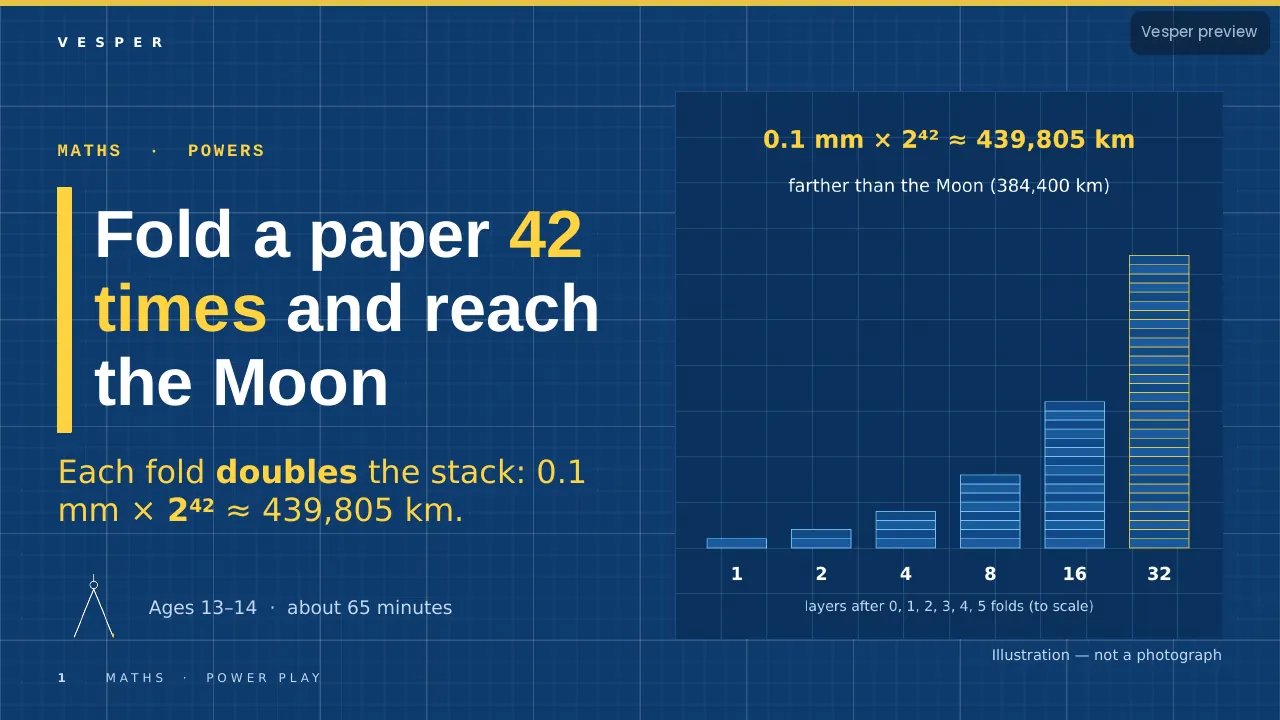
Each fold doubles the stack: 0.1 mm × 2⁴² ≈ 439,805 km.

A 30-slide maths lesson on powers: doubling paper layers, adding exponents, estimating 2⁴² and writing it in standard form. The stack overtakes the Burj Khalifa, Everest and then the Moon.

The short answer

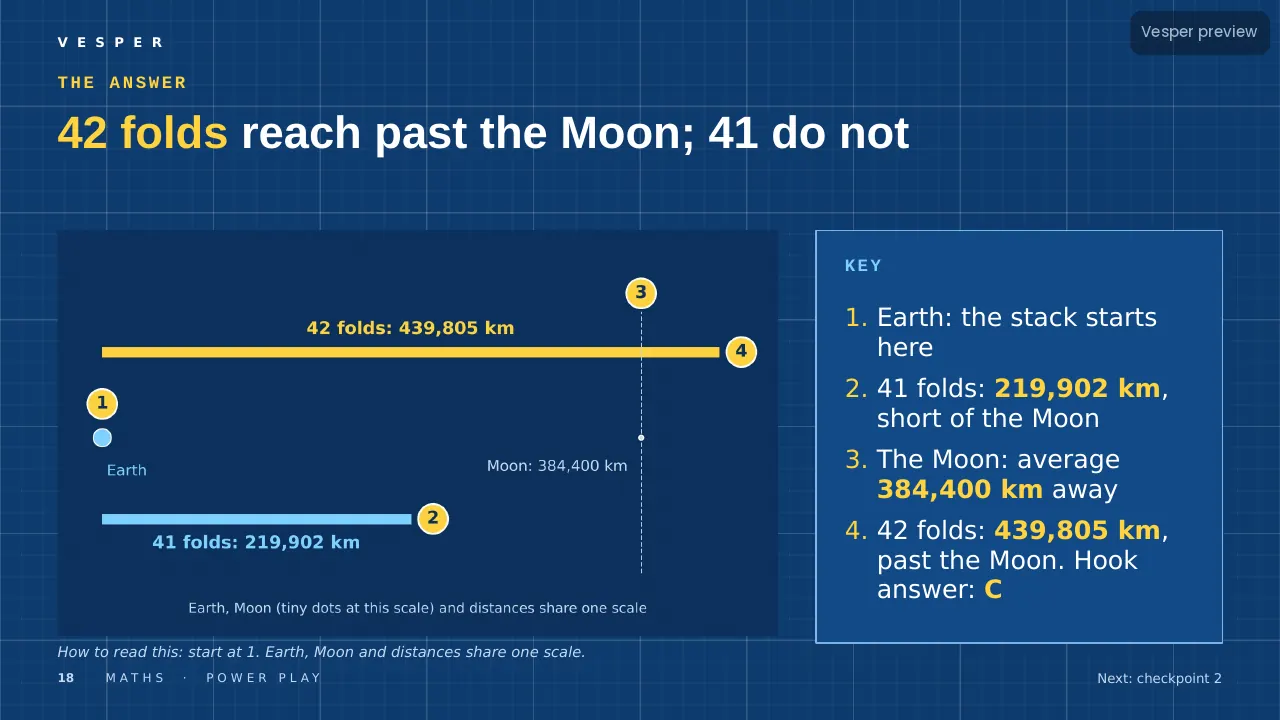
Yes, on paper. Each fold doubles the layers, so a 0.1 mm sheet folded 42 times is 0.1 mm × 2⁴² thick: about 439,805 km, past the Moon's mean distance of 384,400 km. Forty-one folds reach only 219,902 km. In real life, the record is 12 folds, set by Britney Gallivan in 2002.

Inside the deck

slides
30
quiz questions
8
minutes
65
your-turn tasks
6

Choose a format

  • Lesson Notes (PDF)Every slide with its teacher notes, as a PDF to read or print.
  • Teacher DeckThe editable PowerPoint with speaker notes on every slide, a PDF copy and the matching Vesper slide template, so you can add slides of your own.
Pricing coming soon

Pricing coming soon

We’ll email you pricing and launch offers shortly.

  • Finished and checked: buying opens soon
  • Sources listed at the end
  • Curriculum links under ‘Curriculum & specs’
  • For one classroom. Campus licences for whole schools

Key facts

  • 42 folds of 0.1 mm paper make a stack about 439,805 km tall; 41 folds reach 219,902 km.
  • The Moon's mean distance from Earth is 384,400 km.
  • 23 folds give 838.9 m, above the 828 m Burj Khalifa.
  • 2¹⁰ = 1,024 ≈ 1,000, so 2⁴² is about 4 × 10¹² layers.
  • Britney Gallivan folded paper 12 times in 2002.

What students will be able to do

  • Students can write repeated doubling as a power of 2 and evaluate it.
  • Students can calculate the thickness of folded paper with 0.1 mm × 2ⁿ.
  • Students can multiply powers with the same base by adding exponents.
  • Students can estimate large powers of 2 using 2¹⁰ ≈ 1,000.
  • Students can write large numbers in standard form.

About this lesson

What students discover

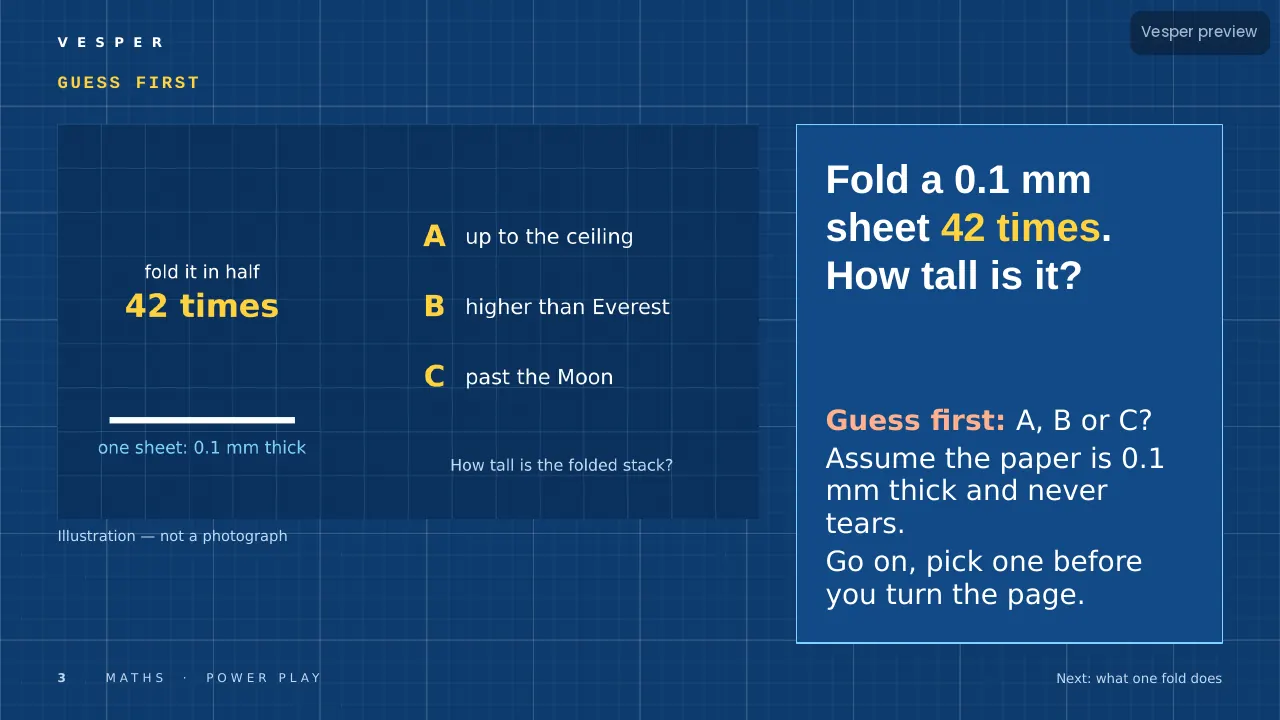
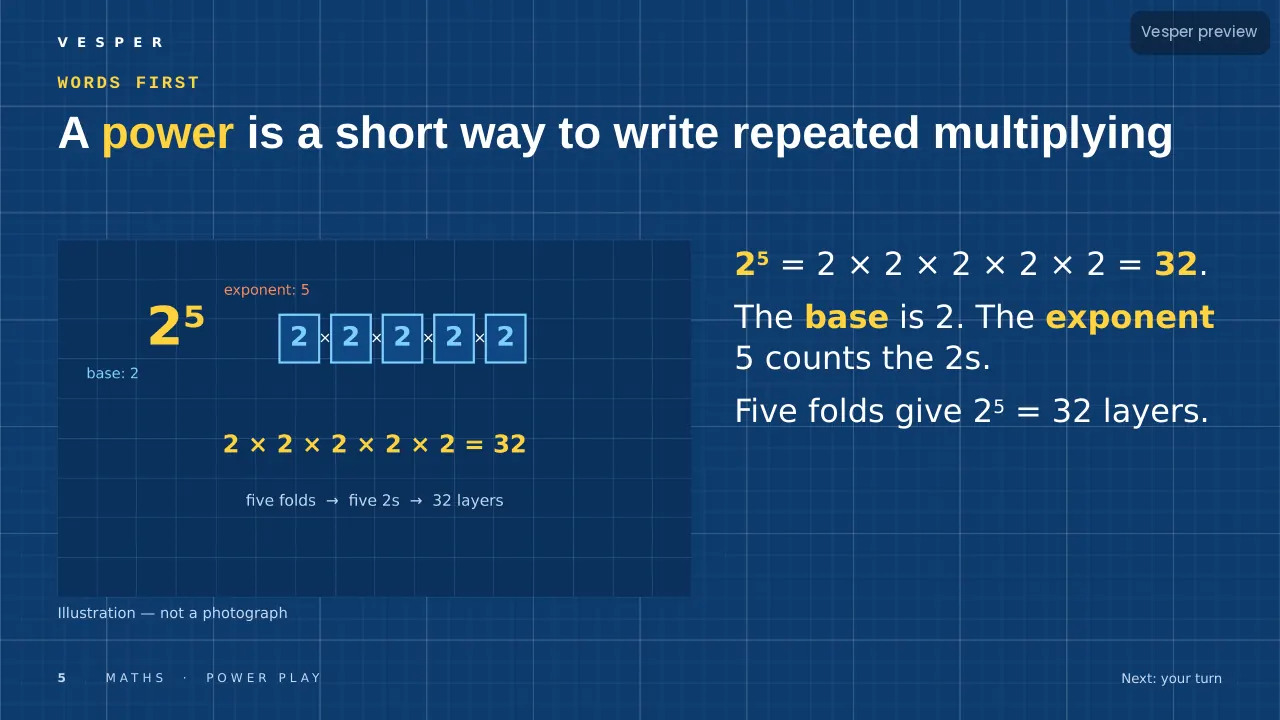
One sheet of paper is 0.1 mm thick. Fold it in half 42 times and, on paper, the stack passes the Moon. Students see each fold double the layers (1, 2, 4, 8, 16, 32), write it as a power (2⁵ = 32), and turn layers into millimetres and metres. Twenty folds give 104.9 m, past the 72.5 m Qutub Minar. Twenty-three folds give 838.9 m, above the 828 m Burj Khalifa. Then they find which fold first passes Everest.

Leo’s ‘2⁴² = 2 × 42 = 84’ is the spot-the-mistake, and stacking 42 sheets (4.2 mm) against folding 42 times shows why doubling explodes while adding plods. Students multiply powers by adding exponents (2³ × 2⁴ = 2⁷), estimate 2⁴² using 2¹⁰ ≈ 1,000, and write 439,805 km in standard form as 4.4 × 10⁵ km. Then reality: the myth of the seven-fold limit meets Britney Gallivan’s 12 folds in 2002, and her model shows each extra fold needs about four times the paper length. Computer memory and doubling bacteria close the loop.

Inside the deck

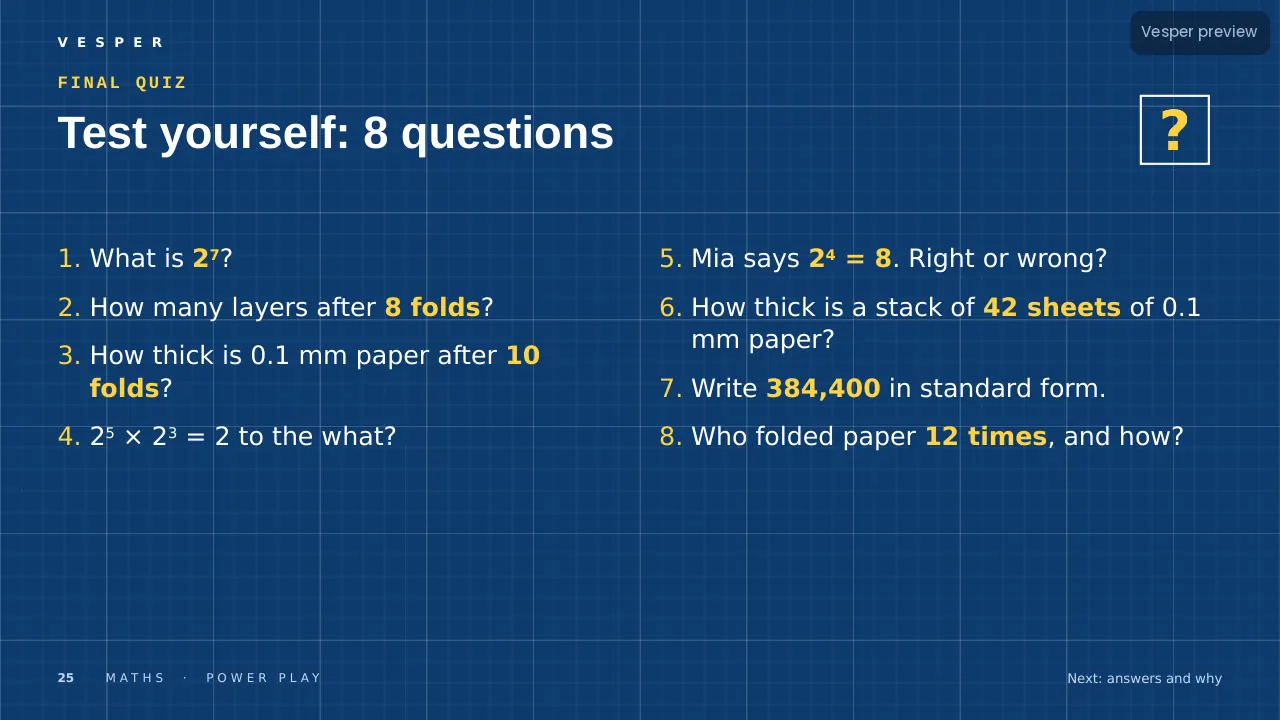
30 slides on the Blueprint template: a guess-first hook, a primer, six your-turn tasks with answers, a quick poll, a to-scale diagram walk from Earth to the Moon, two checkpoints, a myth slide and an evidence slide. An eight-question quiz has explained answers.

How to teach it

About 65 minutes. Start with real paper: fold an A4 sheet five times, count 32 layers and measure about 3.2 mm, then see how far you get. Speaker notes sit on every slide.

Who it’s for

Learners aged 13–14 meeting powers, indices and standard form, and anyone who has heard the 42-fold claim and wanted the working.

Curriculum & specs

CBSE/NCERT (India)Class 8 · Class 8 Ganita Prakash Part I ch 2 Power Play
CambridgeLS Maths Stage 8–9 Number (indices); IGCSE 0580 E1.7 Indices
IB MYPMathematics · KC Relationships · RC Change, Quantity · Crit D
Ages13–14
LevelMiddle
Slide templateBlueprint
Slides30
Teaching timeAbout 65 minutes
LanguageEnglish (UK)

Questions

Questions, answered

Can you really reach the Moon by folding paper 42 times?

In theory, yes: 0.1 mm × 2⁴² is about 439,805 km, more than the 384,400 km to the Moon. In practice no one can fold paper anywhere near 42 times.

What is the most times paper has been folded?

Twelve. Britney Gallivan did it in 2002 using a very long strip of paper.

Is it true you can't fold paper more than 7 times?

No, that is a myth. Each fold needs about four times the paper length of the last, which makes it hard, not impossible.

How do you multiply powers with the same base?

Add the exponents: 2³ × 2⁴ = 2⁷, because 3 folds then 4 more is 7 folds.

Why isn't 2⁴² the same as 2 × 42?

The exponent counts how many 2s are multiplied together. 2³ = 2 × 2 × 2 = 8, not 6.

What age is this powers lesson for?

Ages 13–14. It takes about 65 minutes and includes an eight-question quiz.

Main sources

  1. B. C. Gallivan, How to Fold Paper in Half Twelve Times: An Impossible Challenge Solved and Explained, Historical Society of Pomona Valley, 2002
  2. I. Peterson, 'Folding paper in half, twelve times', Science News, 2004
  3. NASA, Moon fact sheet: mean Earth–Moon distance 384,400 km

The full source list is on the last slides of the deck. Spotted an error? Tell us.