Cosmos Ages 11–13

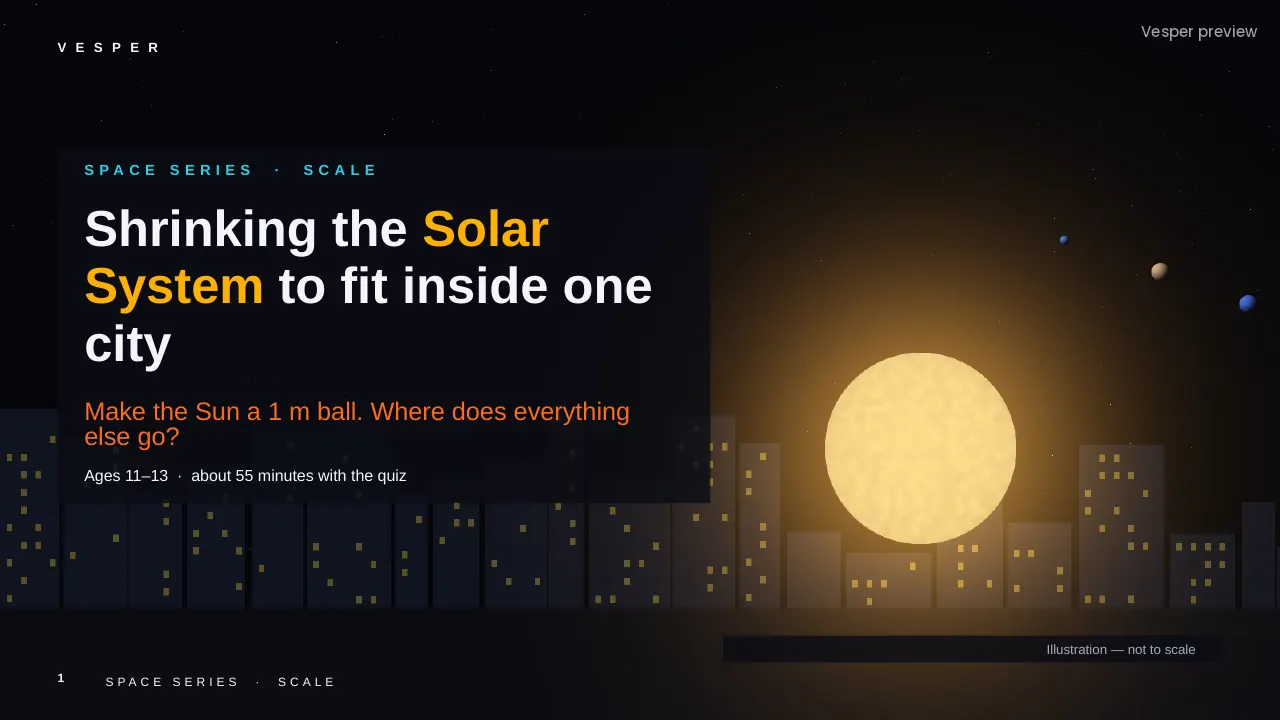
Shrinking the Solar System to fit inside one city

A pea, a football pitch away from a ball: the Solar System at true scale.

A 29-slide scale-model lesson for ages 11–13: make the Sun a 1 m ball and work out, with NASA numbers, that Earth is a pea 107 m away and Neptune sits 3.2 km out.

The short answer

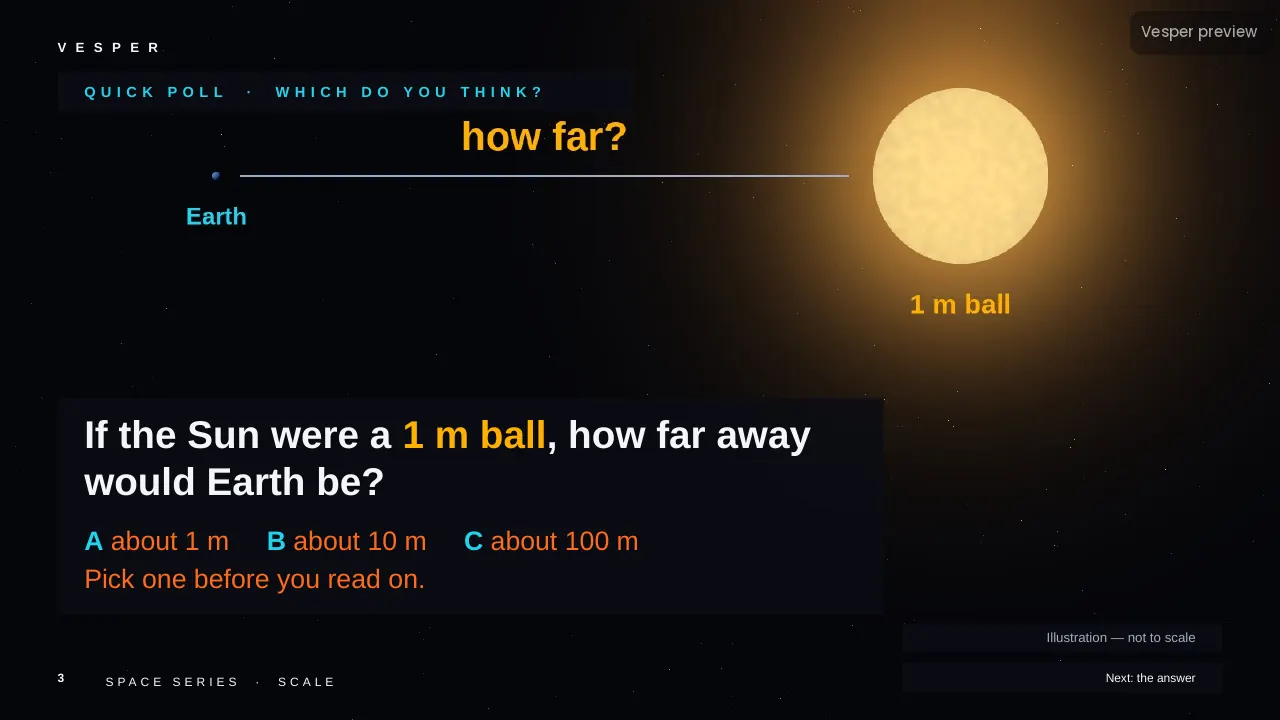
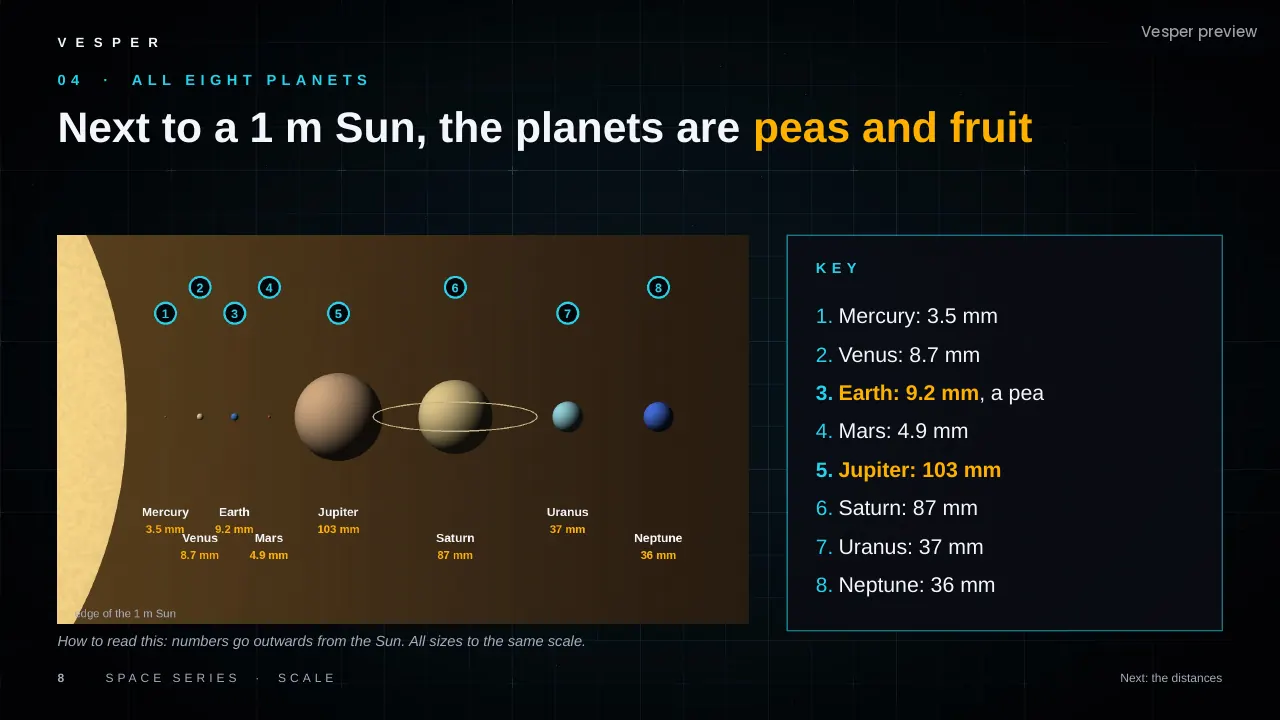
If the Sun were a 1 m ball, Earth would be a 9 mm pea about 107 m away, the length of a football pitch. Jupiter would be a grapefruit about half a kilometre out and Neptune a ping-pong ball 3.2 km away. The whole model fits in a city, but the nearest star would be 28,900 km away.

Inside the deck

slides
29
quiz questions
8
minutes
55
your-turn tasks
4

Choose a format

  • Lesson Notes (PDF)Every slide with its teacher notes, as a PDF to read or print.
  • Teacher DeckThe editable PowerPoint with speaker notes on every slide, a PDF copy and the matching Vesper slide template, so you can add slides of your own.
Pricing coming soon

Pricing coming soon

We’ll email you pricing and launch offers shortly.

  • Finished and checked: buying opens soon
  • Sources listed at the end
  • Curriculum links under ‘Curriculum & specs’
  • For one classroom. Campus licences for whole schools

Key facts

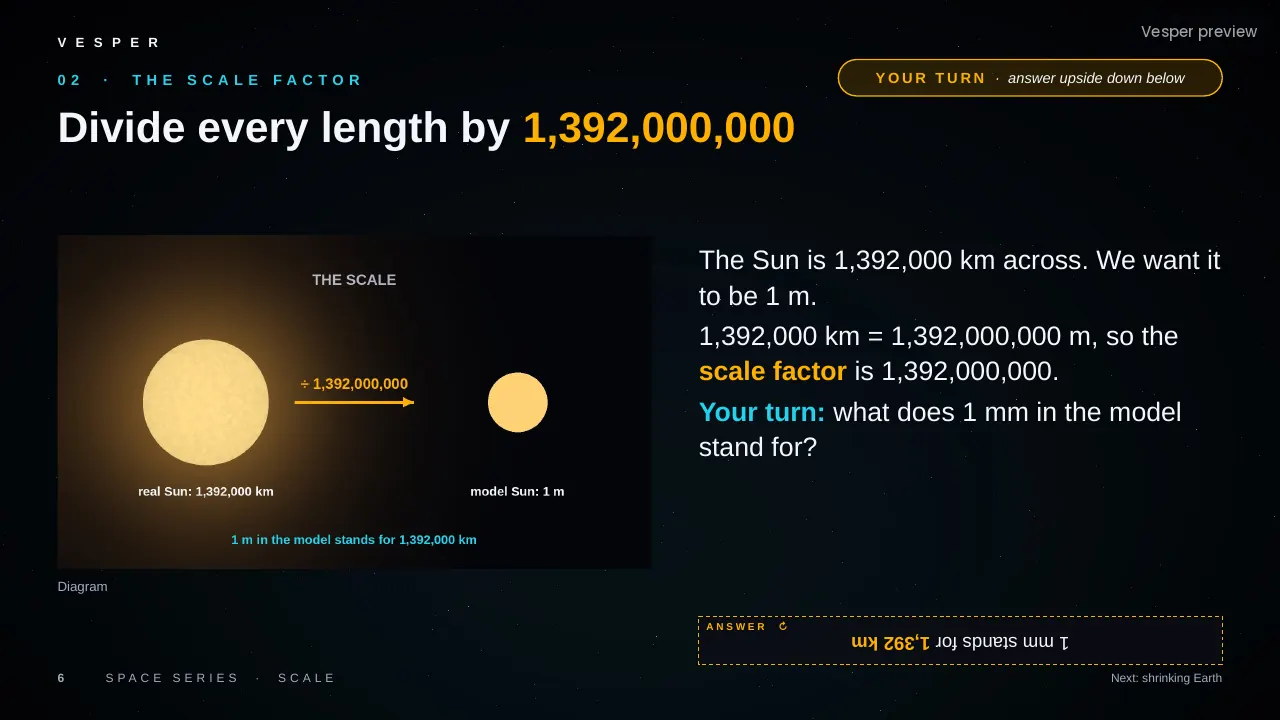
  • Scale factor: divide every length by 1,392,000,000
  • Earth becomes a 9 mm pea about 107 m from a 1 m Sun
  • Neptune sits 3.2 km out; the walk takes about 39 minutes
  • The Moon is 28 cm from the Earth pea
  • In the model, light crawls at 0.22 m/s
  • The nearest star would be 28,900 km away

What students will be able to do

  • Students can use a scale factor to shrink real sizes and distances
  • Students can describe the sizes and spacing of the planets in a 1 m Sun model
  • Students can explain why posters showing planets side by side mislead
  • Students can compare distances within the Solar System with the distance to the nearest star

About this lesson

What students discover

Most pictures of the Solar System crowd the planets beside the Sun. This lesson fixes that with one scale factor. Make the Sun a 1 m ball and divide every length by 1,392,000,000: Earth becomes a 9 mm pea about 107 m away, Jupiter a grapefruit half a kilometre out, and Neptune a ping-pong ball 3.2 km from the centre.

Students lay the model over a city map 6.5 km across, time the walk to each planet (about 39 minutes to Neptune), put the Moon 28 cm from the Earth pea, and find that light, shrunk to the model, crawls at 0.22 m/s. Then the twist: the nearest star would be 28,900 km away, three-quarters of the way round the real Earth.

Inside the deck

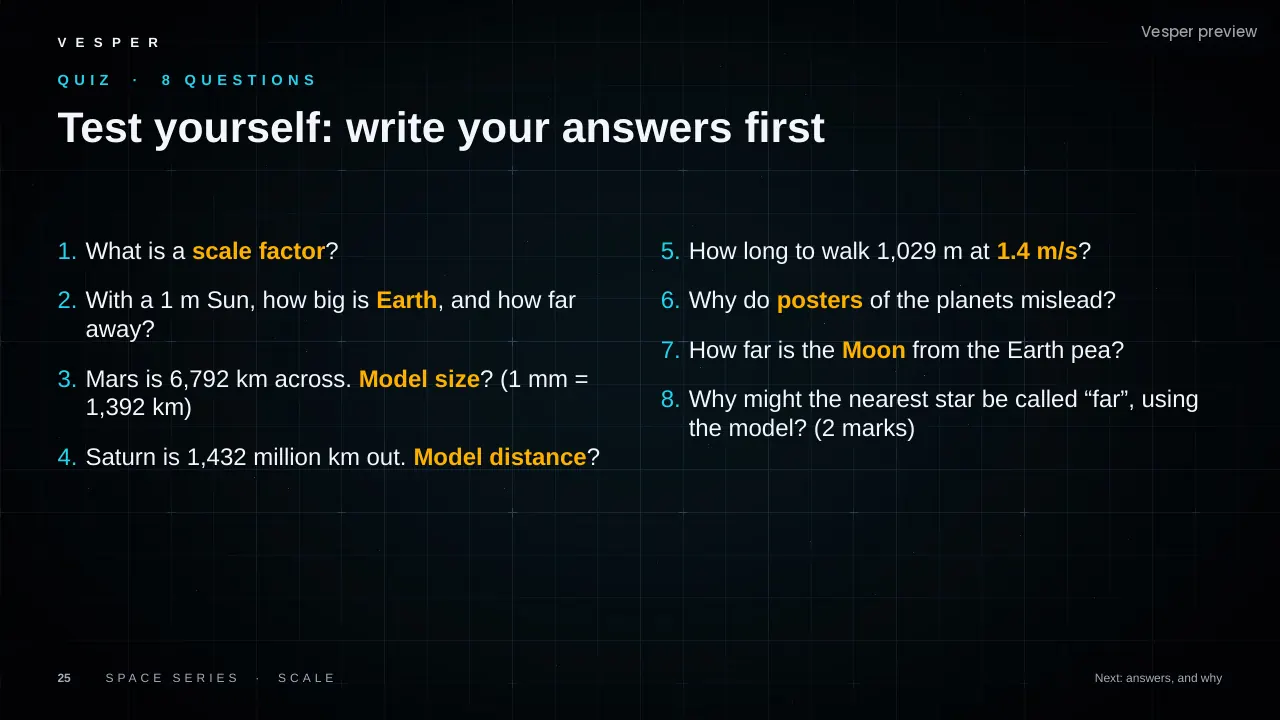
29 slides on the Nova template, every picture drawn in code from NASA data. Polls, your-turn sums with upside-down answers, a spot-the-mistake on planet posters, Sweden’s country-sized model, a football-Sun pocket model, a frontier slide on Planet Nine, two checkpoints and an 8-question quiz with explained answers.

How to teach it

Allow about 55 minutes. Take guesses for the hook (how far is Earth from a 1 m Sun?) and write them up before slide 4. The football-Sun activity on slide 20 scales everything down again so it fits a school field. If you can, walk 107 m outside with a pea. Notes on every slide give Say, Ask, Watch for and Time.

Who it’s for

For ages 11–13 studying the Solar System, and for maths lessons on scale factors and ratio. The PowerPoint is editable, so you can swap the generic city for a map of your own town.
Curriculum & specs

CBSE/NCERT (India)Class 6-7 · Class 6 Curiosity ch 12 Beyond Earth
CambridgeLS Stage 7 Earth & Space
NGSS (US)MS-ESS1-3
IB MYPSciences · KC Systems · RC Models, Patterns
Common Core (US)7.G.A.1 (scale drawings); 7.RP.A.2
Ages11–13
LevelMiddle
Slide templateNova
Slides29
Teaching timeAbout 55 minutes
LanguageEnglish (UK)

Questions

Questions, answered

How big is the Solar System to scale?

With the Sun as a 1 m ball, Earth is a 9 mm pea 107 m away and Neptune is 3.2 km out. The whole model fits inside a city about 6.5 km across.

How far is Earth from the Sun in a scale model?

About 107 m if the Sun is 1 m across, roughly the length of a football pitch.

How do you make a Solar System scale model?

Choose a size for the Sun, work out the scale factor, then divide every planet's diameter and distance by it. The lesson includes a football-Sun version that fits a school field.

Why are Solar System posters wrong?

They put the planets side by side to fit the page. At true scale the gaps are enormous compared with the planets.

How far away is the nearest star in the model?

Proxima Centauri would be 28,900 km away, about three-quarters of the way round the real Earth.

What age is this lesson for?

Ages 11–13. It takes about 55 minutes and uses only multiplication and division.

Main sources

  1. Williams, D. R. Planetary Fact Sheets (Sun, planets, Moon). NASA Space Science Data Coordinated Archive. Diameters and mean distances.
  2. NASA. Proxima Centauri: 4.24 light-years. science.nasa.gov.
  3. Speed of light 299,792 km/s; sunlight to Earth about 499 s.

The full source list is on the last slides of the deck. Spotted an error? Tell us.