Cosmos Ages 11–14

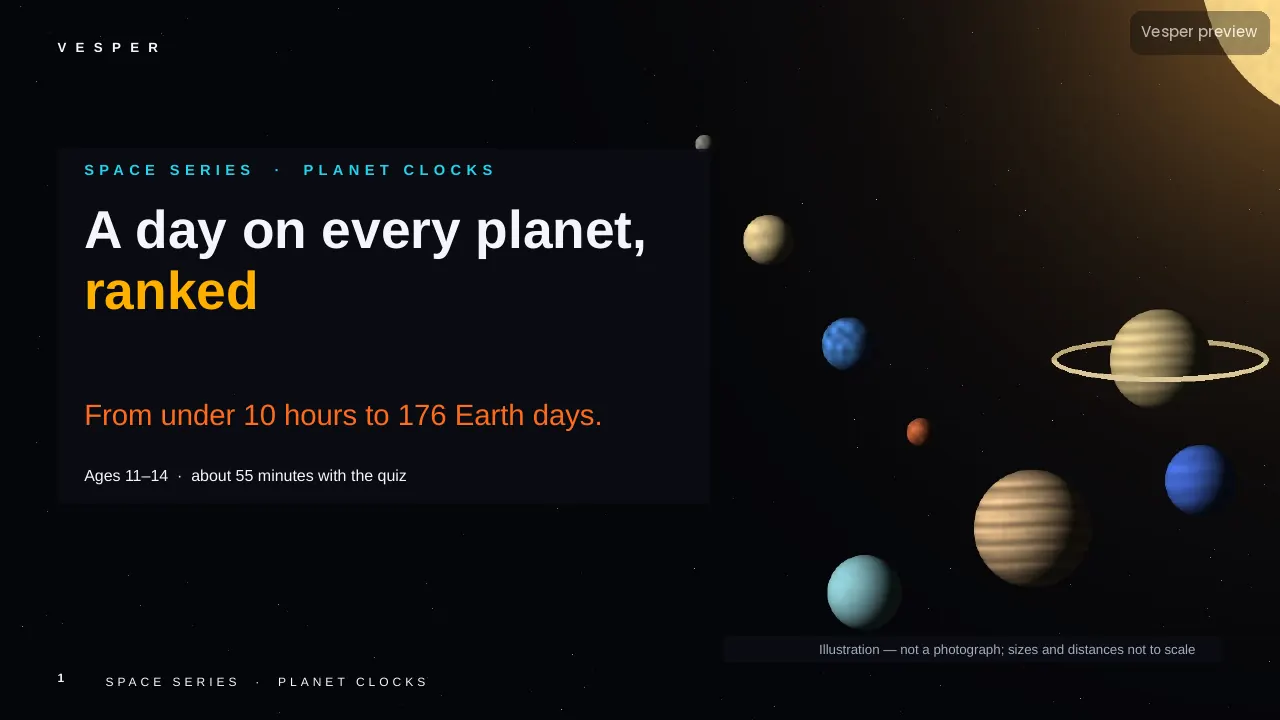
A day on every planet, ranked

From under 10 hours on Jupiter to 176 Earth days on Mercury.

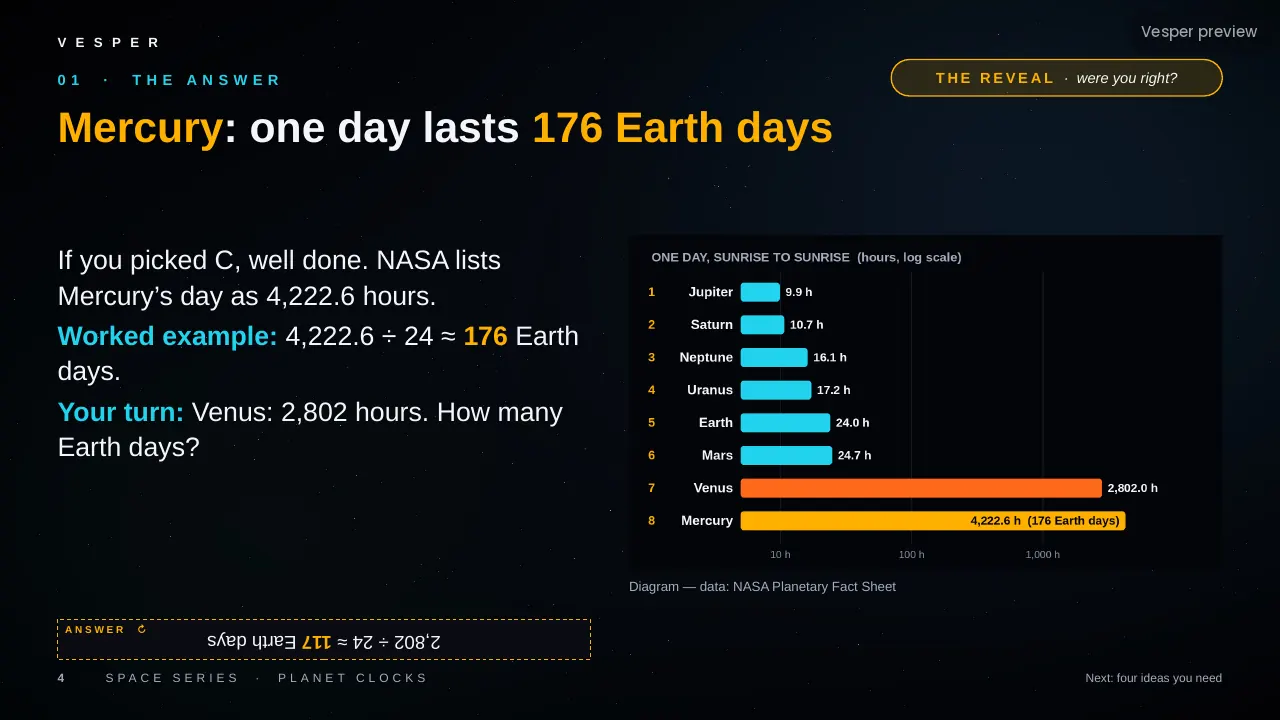
A 26-slide space lesson that times one day on all eight planets with NASA numbers, from Jupiter’s 9.9 hours to Mercury’s 176 Earth days. Students rank them, then find out why Venus’s Sun rises in the west.

The short answer

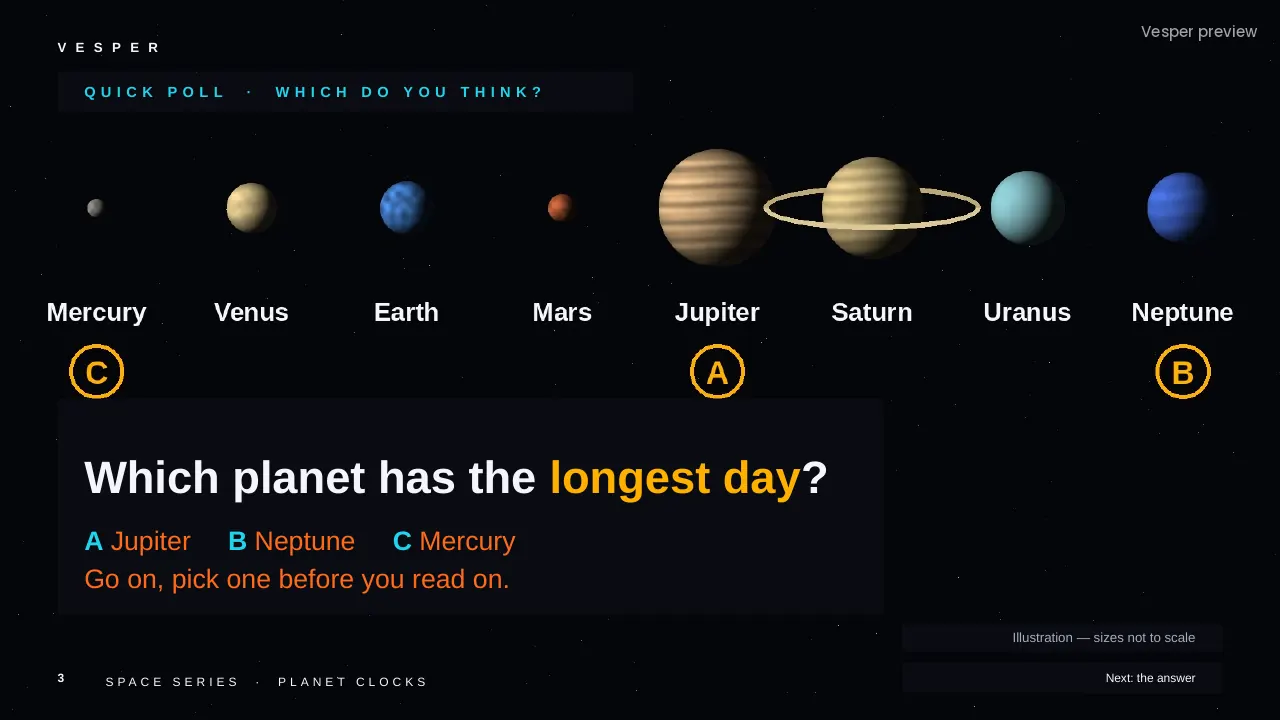
Jupiter has the shortest day, about 9.9 hours. Earth's is 24 hours and Mars's 24 hours 40 minutes. Mercury has the longest, 176 Earth days from noon to noon, which is two of its own years. Venus spins backwards once every 243 days, longer than its 224.7-day year, so its Sun rises in the west.

Inside the deck

slides
26
quiz questions
7
minutes
55
your-turn tasks
6

Choose a format

  • Lesson Notes (PDF)Every slide with its teacher notes, as a PDF to read or print.
  • Teacher DeckThe editable PowerPoint with speaker notes on every slide, a PDF copy and the matching Vesper slide template, so you can add slides of your own.
Pricing coming soon

Pricing coming soon

We’ll email you pricing and launch offers shortly.

  • Finished and checked: buying opens soon
  • Sources listed at the end
  • Curriculum links under ‘Curriculum & specs’
  • For one classroom. Campus licences for whole schools

Key facts

  • Jupiter has the shortest day: about 9.9 hours.
  • Mercury's day is 4,222.6 hours, about 176 Earth days: two Mercury years.
  • Venus spins once in 243 days, longer than its 224.7-day year, and spins backwards.
  • A Mars day, called a sol, is 24 h 40 min.
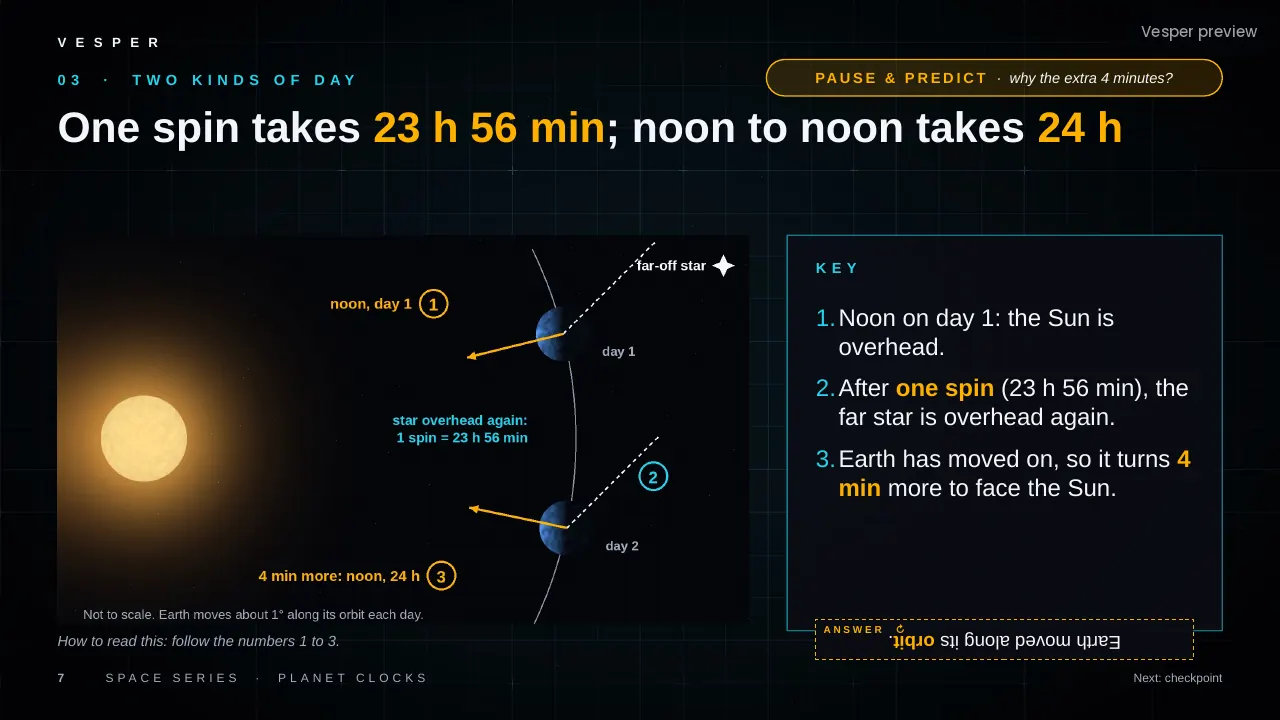
  • One Earth spin takes 23 h 56 min; noon to noon takes 24 h.

What students will be able to do

  • Students can rank the length of a day on all eight planets.
  • Students can explain why Earth's noon-to-noon day is 24 hours although one spin takes 23 h 56 min.
  • Students can convert planet day lengths between hours and Earth days.
  • Students can explain how scientists time a planet with no solid surface.
  • Students can explain why the Sun rises in the west on Venus.

About this lesson

What students discover

How long is a day on Jupiter? On Mercury? Students rank all eight planets using NASA’s own figures, and meet some real surprises. Jupiter spins once in under ten hours, so fast that it is 142,984 km across the middle but only 133,708 km pole to pole. Mercury’s day lasts two of its own years. Venus spins backwards, so the Sun rises in the west, and one turn takes longer than its year.

Along the way students learn what a day actually is. One spin of Earth takes 23 hours 56 minutes, but noon to noon takes 24 hours, because Earth moves along its orbit and must turn about 4 minutes more to face the Sun again. Giant planets have no ground to watch, so Voyager 2 timed Uranus and Neptune by listening to the radio waves their magnetic fields send out. Saturn’s day is still debated, and the deck labels that as a hypothesis. Rover teams on Earth have lived on Mars time, starting about 40 minutes later each day.

Inside the deck

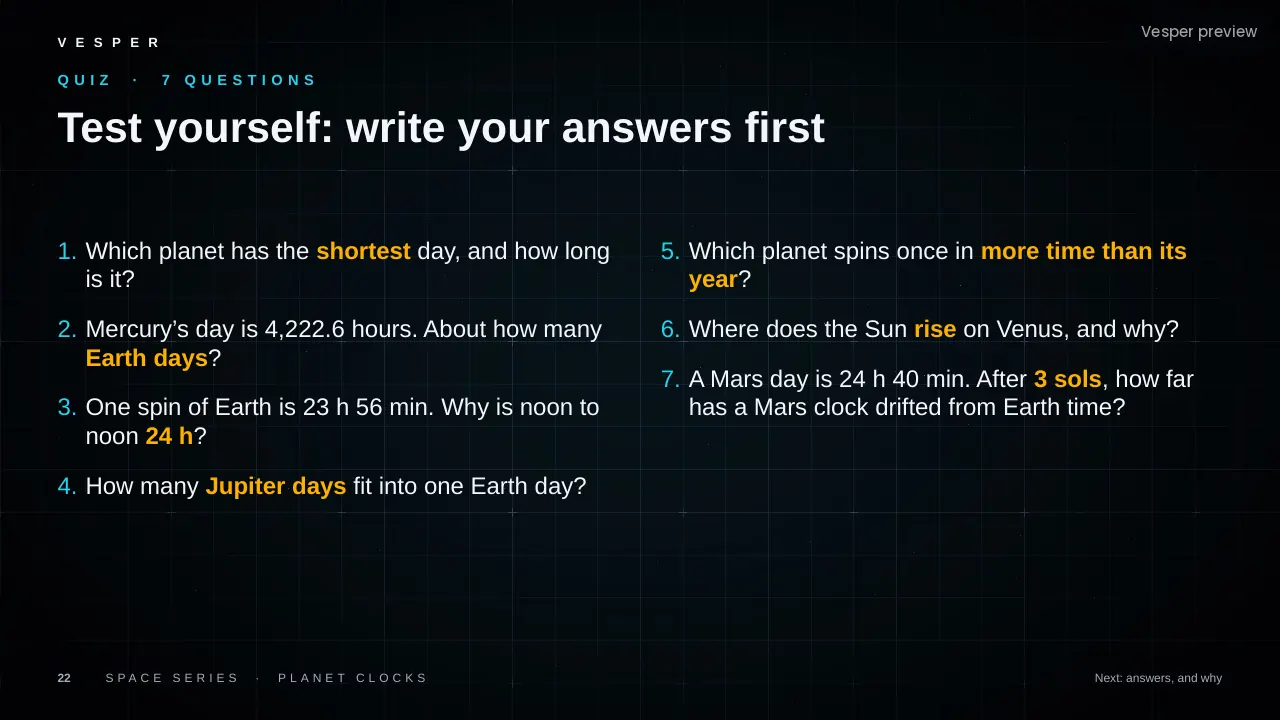
26 slides on the Nova template: a guess-first hook, a four-idea primer, a diagram walk of solar and sidereal days, six your-turn calculations, an evidence slide, a frontier slide, a myth slide (‘the Sun always rises in the east’) and two checkpoints. A seven-question quiz has explained answers.

How to teach it

About 55 minutes with the quiz. The lamp-and-orange activity, with a sticker for ‘you’ and a pencil for the axis, makes the 4-minute difference visible in a dark room. Speaker notes sit on every slide.

Who it’s for

Learners aged 11–14 studying the Solar System, and anyone who likes a ranking with a twist at the bottom.
Curriculum & specs

CBSE/NCERT (India)Class 6-7 · Class 6 Curiosity ch 12 Beyond Earth
CambridgeLS Stage 7 Earth & Space; IGCSE 0625 §6.1.2
NGSS (US)MS-ESS1-3; MS-ESS1-2
IB MYPSciences · KC Systems · RC Movement, Patterns
Ages11–14
LevelMiddle
Slide templateNova
Slides26
Teaching timeAbout 55 minutes
LanguageEnglish (UK)

Questions

Questions, answered

Which planet has the longest day?

Mercury, at about 176 Earth days from noon to noon. Venus takes longest to spin once (243 days), but its noon-to-noon day is about 117 Earth days.

Which planet has the shortest day?

Jupiter, at about 9.9 hours.

Why does the Sun rise in the west on Venus?

Venus spins backwards compared with most planets, so its Sun rises in the west and sets in the east.

Why is a day on Earth 24 hours if Earth spins in 23 hours 56 minutes?

While Earth spins, it also moves along its orbit, so it has to turn about 4 minutes more for the Sun to be overhead again.

How long is a day on Mars?

About 24 hours 40 minutes. A Mars day is called a sol.

How do scientists measure a day on gas giants?

They time the radio waves from the planet's magnetic field, which repeat with each spin. Voyager 2 did this at Uranus and Neptune.

Main sources

  1. Williams, D. R. Planetary Fact Sheet (metric). NASA Space Science Data Coordinated Archive, nssdc.gsfc.nasa.gov/planetary/factsheet. Fetched 18 Nov 2026: length of day, rotation period, orbital period, diameters.
  2. NASA Science. Planet pages for Mercury, Venus, Mars, Jupiter, Saturn, Uranus and Neptune. science.nasa.gov.
  3. NASA JPL. Voyager 2 at Uranus (1986) and Neptune (1989): rotation periods from planetary radio astronomy.

The full source list is on the last slides of the deck. Spotted an error? Tell us.