Cosmos Ages 11–13

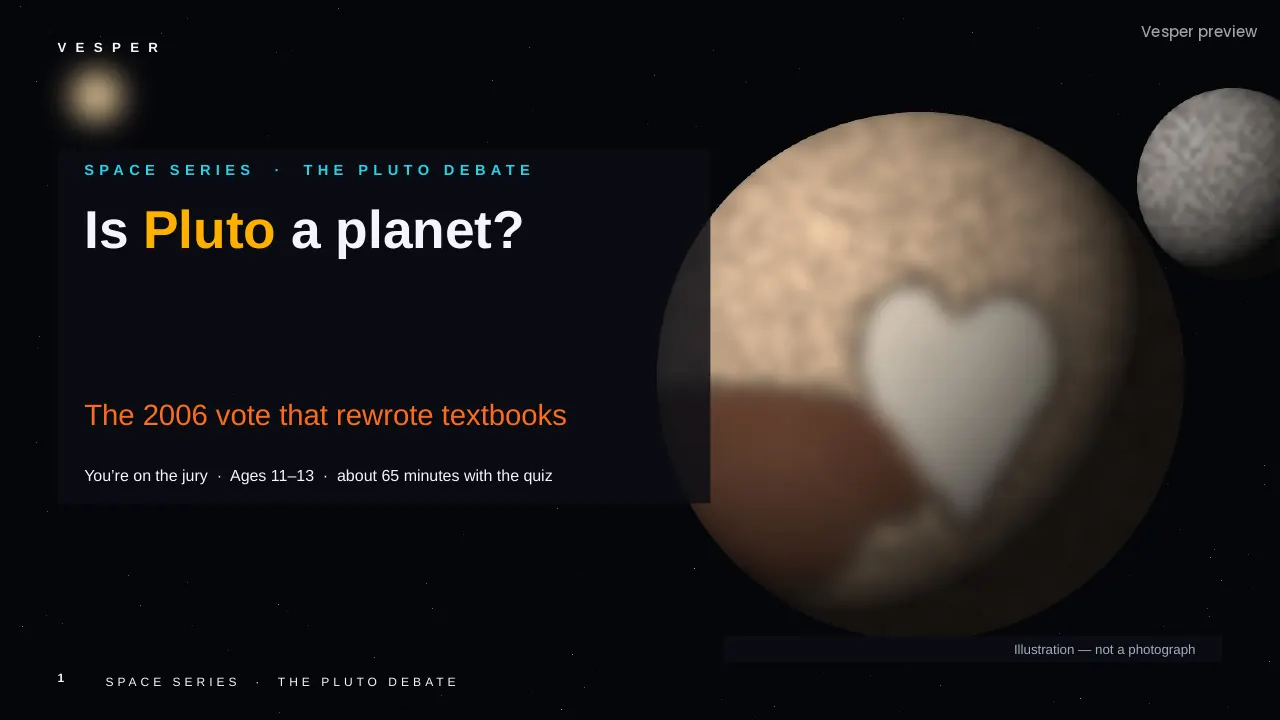
Is Pluto a planet? The 2006 vote that rewrote textbooks

You're on the jury. Orbit, round, clear: now judge any world.

A 32-slide space lesson run as a debate. Students vote, weigh the evidence, apply the IAU’s three tests themselves, then vote again.

The short answer

Since 24 August 2006, Pluto has been classed as a dwarf planet. The International Astronomical Union set three tests: a planet orbits the Sun, is made round by its own gravity, and has cleared its orbital neighbourhood. Pluto passes the first two but fails the third. Some experts still argue for a different definition.

Inside the deck

slides
32
quiz questions
7
minutes
65
your-turn tasks
5

Choose a format

  • Lesson Notes (PDF)Every slide with its teacher notes, as a PDF to read or print.
  • Teacher DeckThe editable PowerPoint with speaker notes on every slide, a PDF copy and the matching Vesper slide template, so you can add slides of your own.
Pricing coming soon

Pricing coming soon

We’ll email you pricing and launch offers shortly.

  • Finished and checked: buying opens soon
  • Sources listed at the end
  • Curriculum links under ‘Curriculum & specs’
  • For one classroom. Campus licences for whole schools

Key facts

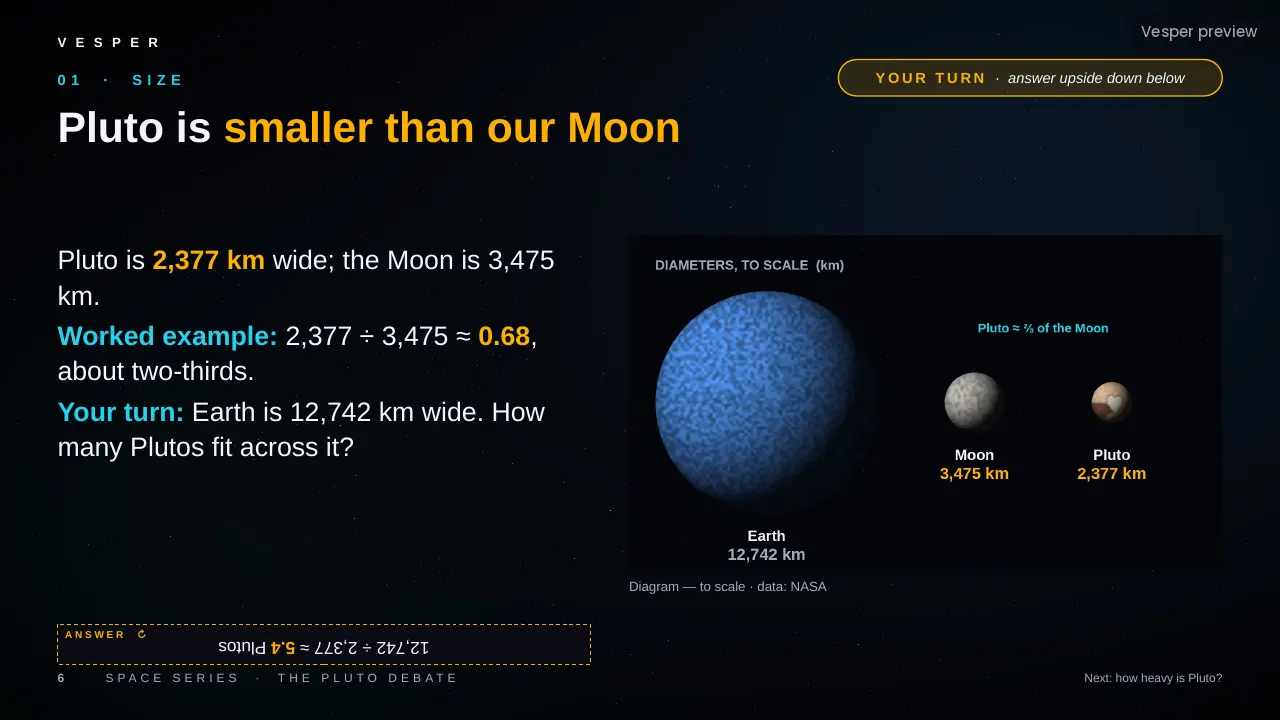
  • Pluto is 2,377 km wide; our Moon is 3,475 km.
  • Pluto has about 0.2% of Earth's mass: about 460 Plutos per Earth.
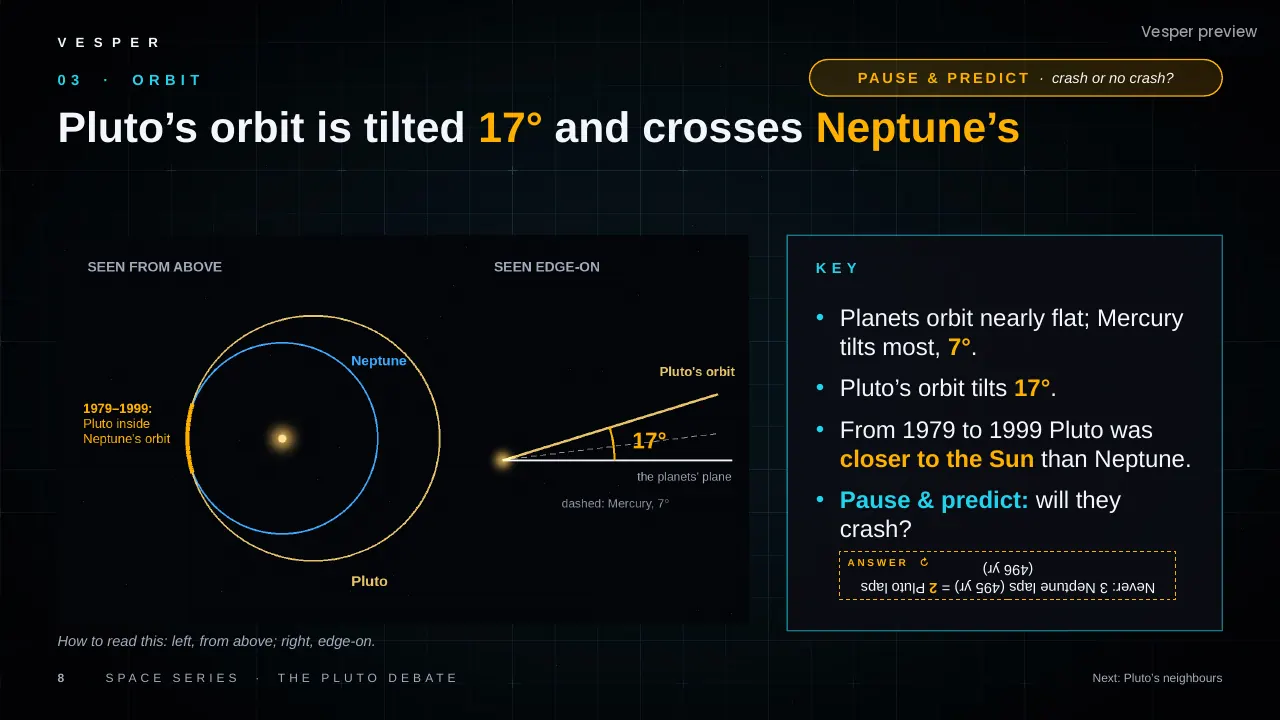
  • Pluto's orbit is tilted 17° and crosses Neptune's.
  • On 24 August 2006 the IAU voted 237 for and 157 against on the Pluto resolution.
  • Earth outweighs the rest of its lane about 1.7 million to 1; Pluto scores 0.077.

What students will be able to do

  • Students can name the IAU's three tests for a planet.
  • Students can explain which test Pluto fails and by how much.
  • Students can compare Pluto's size and mass with the Moon and Earth.
  • Students can explain why the discovery of Eris forced a definition.
  • Students can argue either side of the Pluto debate using claim, evidence and reasoning.

About this lesson

What students discover

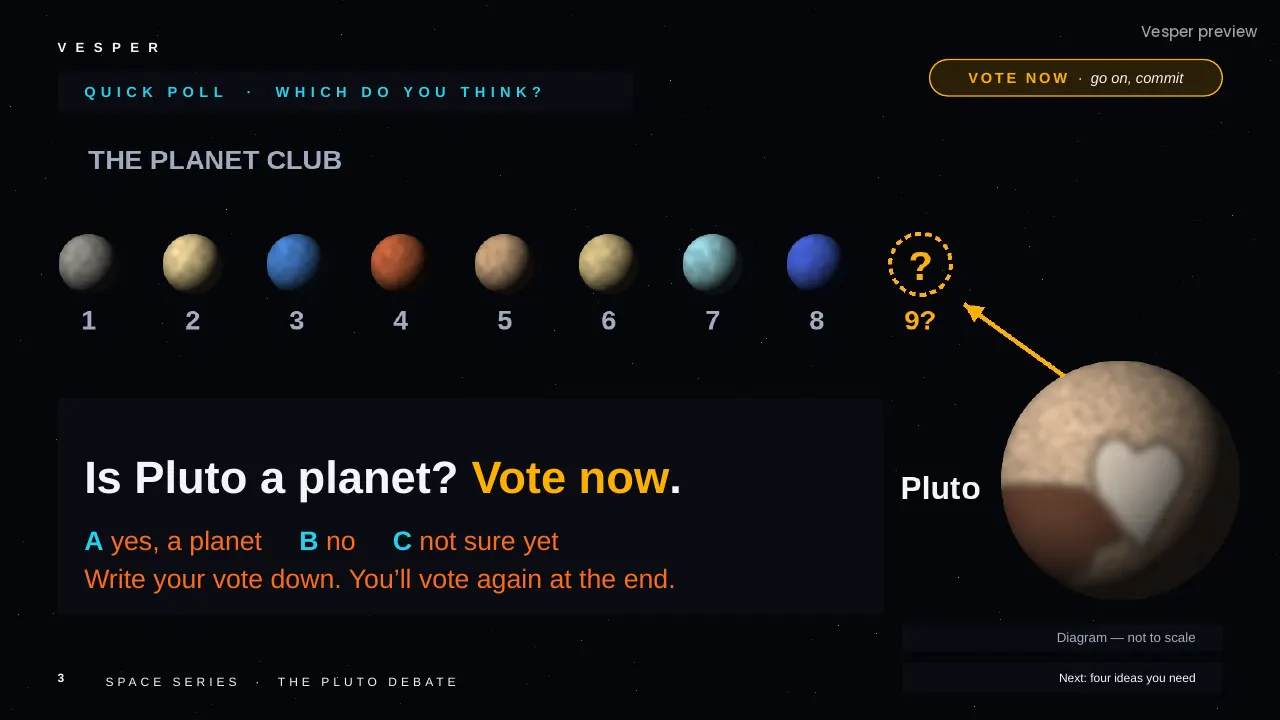
Is Pluto a planet? Students start by voting, then act as the jury. They weigh real evidence. Pluto, found by Clyde Tombaugh on 18 February 1930, is 2,377 km wide, about two-thirds the width of our Moon, with just 0.2% of Earth’s mass: about 460 Plutos would match one Earth. Its orbit is tilted 17° and crosses Neptune’s, and it shares the Kuiper Belt with more than a thousand icy objects found since 1992.

Then came Eris, announced in 2005 and 27% heavier than Pluto, which forced astronomers to define the word ‘planet’ for the first time. Students follow the vote in Prague on 24 August 2006 (237 for, 157 against), learn the IAU’s three tests, and see ‘clearing the neighbourhood’ as a simple mass ratio: Earth outweighs everything else in its lane about 1.7 million to 1, while Pluto scores 0.077. A myth slide fixes ‘Pluto lost because it’s too small’. New Horizons’ 2015 flyby, with a heart whose left half is a slowly flowing plain of nitrogen ice, shows Pluto is a fascinating world whatever we call it.

Inside the deck

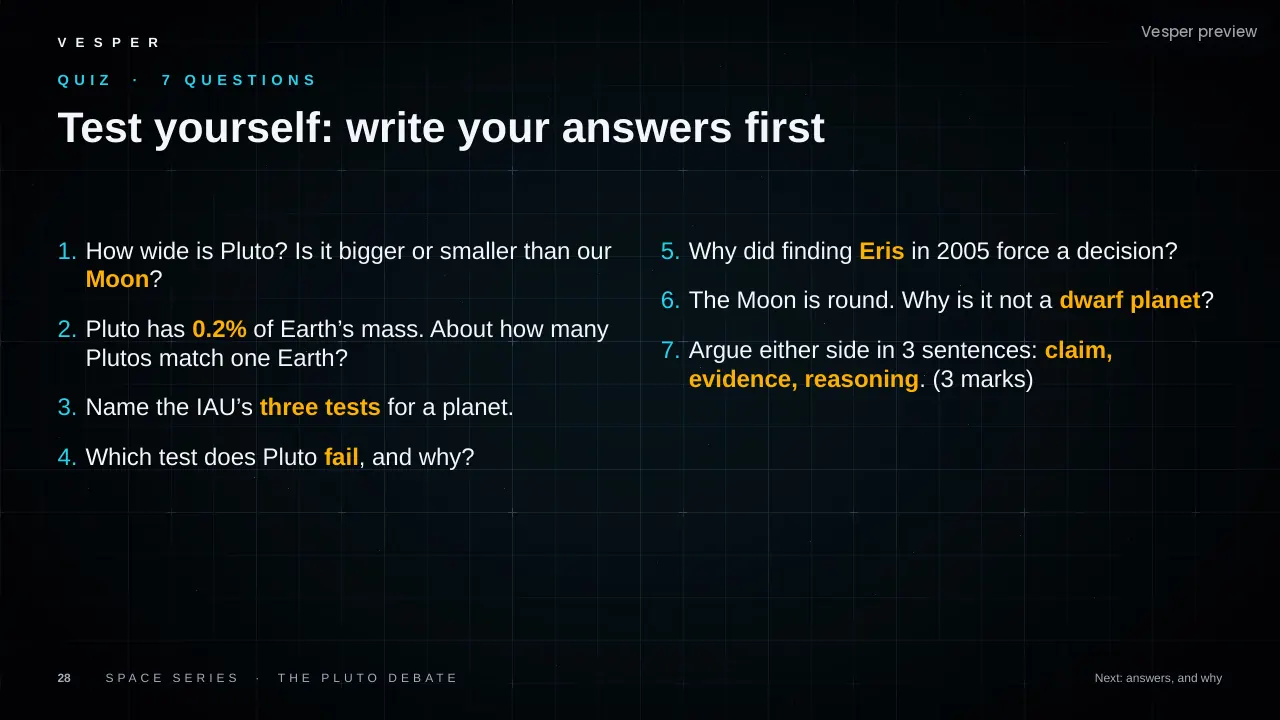
32 slides on the Nova template: a voting hook, a primer, a people slide, two diagram walks, three evidence slides, five your-turn tasks, two checkpoints and a judging activity on four worlds (Jupiter, Ceres, Eris and the Moon). A frontier slide lays out two expert opinions, clearly labelled as opinions. A seven-question quiz has explained answers.

How to teach it

About 65 minutes. Keep the slide 3 votes and compare them on slide 25. The closing task asks students to argue either side in three sentences (claim, evidence, reasoning), which makes this a strong lesson for teaching scientific argument as well as astronomy.

Who it’s for

Learners aged 11–13, and any class that enjoys a good argument settled by evidence.
Curriculum & specs

CBSE/NCERT (India)Class 6-7 · Class 6 Curiosity ch 12 Beyond Earth
CambridgeLS Stage 7 Earth & Space; Thinking and Working Scientifically
NGSS (US)MS-ESS1-3 (+ nature of science)
IB MYPSciences · KC Relationships · RC Evidence · Crit D
Ages11–13
LevelMiddle
Slide templateNova
Slides32
Teaching timeAbout 65 minutes
LanguageEnglish (UK)

Questions

Questions, answered

Is Pluto a planet?

Not by the International Astronomical Union's 2006 definition. It is classed as a dwarf planet, though some experts still argue for a different definition.

Why is Pluto not a planet anymore?

It fails the third test: it has not cleared its orbital neighbourhood. The other objects in its lane outweigh it.

What are the three rules for being a planet?

A planet orbits the Sun, is made round by its own gravity, and has cleared its orbital neighbourhood.

When was Pluto reclassified as a dwarf planet?

On 24 August 2006, at the International Astronomical Union's meeting in Prague.

Was Pluto dropped because it is too small?

No. No test sets a size. Pluto is round, so it passes tests 1 and 2; it fails only the third.

Is the Moon a dwarf planet?

No. It is round, but it orbits Earth rather than the Sun, so it fails the first test.

Main sources

  1. IAU (2006). Press release iau0603: IAU 2006 General Assembly: Result of the IAU Resolution votes. Resolutions 5A and 6A; 6A: 237 for, 157 against, 17 abstentions. iau.org.
  2. NASA Science. Pluto: Facts (2,377 km; 1979–1999 closer than Neptune; mountains 2–3 km; Venetia Burney). science.nasa.gov.
  3. Williams, D. R. Pluto, Moon and Earth Fact Sheets. NASA NSSDCA (mass, orbit, inclination 17.2°).

The full source list is on the last slides of the deck. Spotted an error? Tell us.