Cosmos Ages 11–14

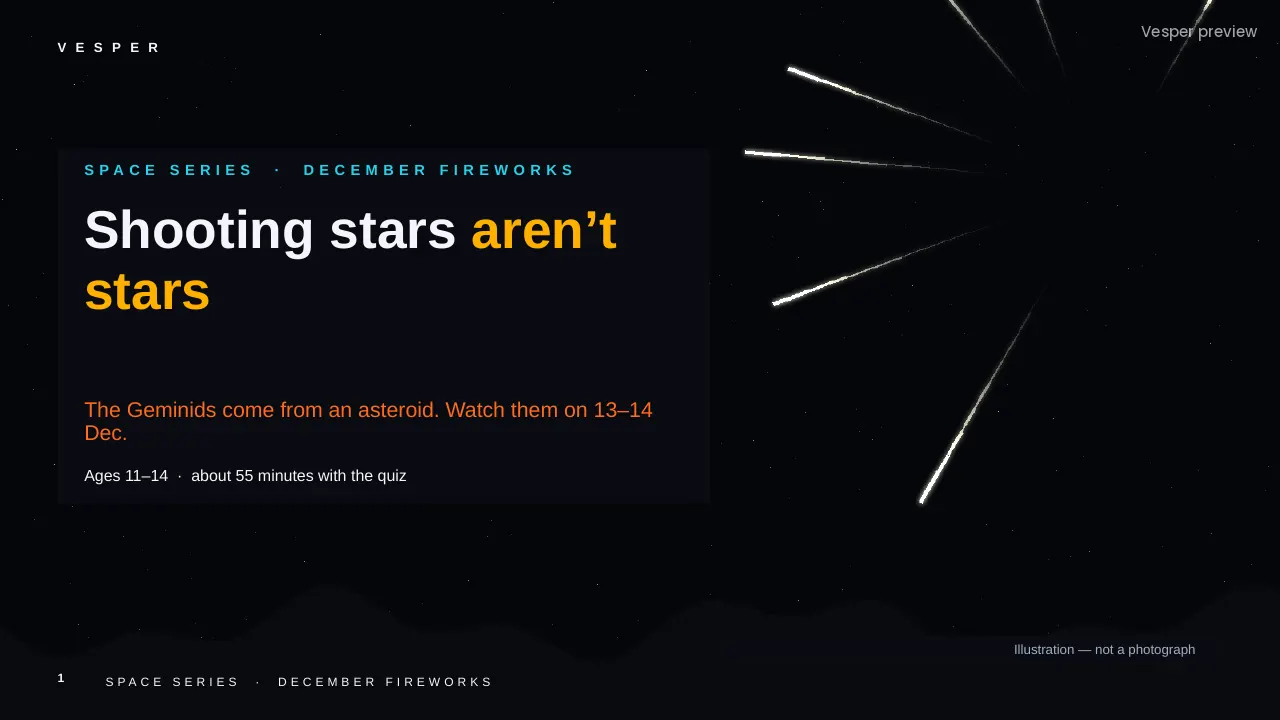
Shooting stars aren't stars: the Geminids come from an asteroid

Not a star, a speck of asteroid. Peak night: 13–14 December 2026.

A 25-slide lesson on meteors and the Geminid shower of 13–14 December 2026, whose grains come from asteroid 3200 Phaethon. It ends with a counting activity students can do on the night.

The short answer

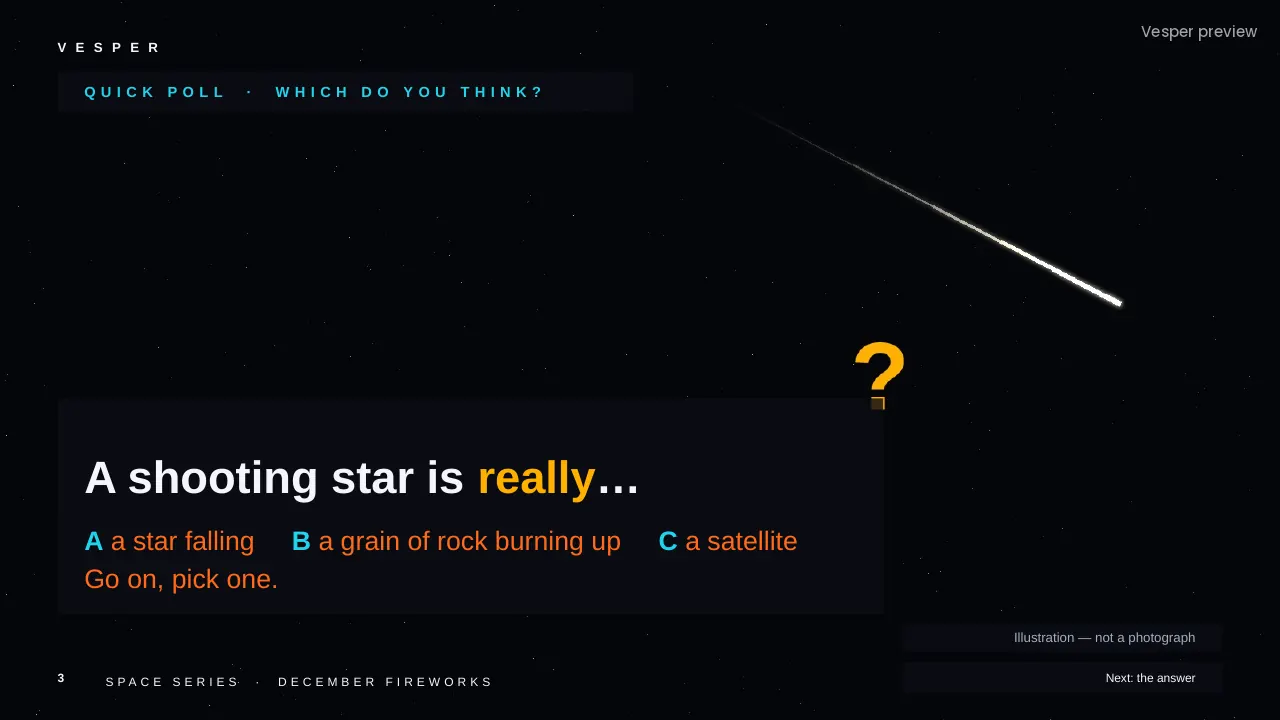
A shooting star is not a star. It is a grain of rock, often smaller than a grain of rice, hitting our air at about 35 km/s and glowing about 100 km up. Most meteor showers come from comet dust, but the Geminids come from an asteroid, 3200 Phaethon. In 2026 they peak on 13–14 December.

Inside the deck

slides
25
quiz questions
7
minutes
55
your-turn tasks
5

Choose a format

  • Lesson Notes (PDF)Every slide with its teacher notes, as a PDF to read or print.
  • Teacher DeckThe editable PowerPoint with speaker notes on every slide, a PDF copy and the matching Vesper slide template, so you can add slides of your own.
Pricing coming soon

Pricing coming soon

We’ll email you pricing and launch offers shortly.

  • Finished and checked: buying opens soon
  • Sources listed at the end
  • Curriculum links under ‘Curriculum & specs’
  • For one classroom. Campus licences for whole schools

Key facts

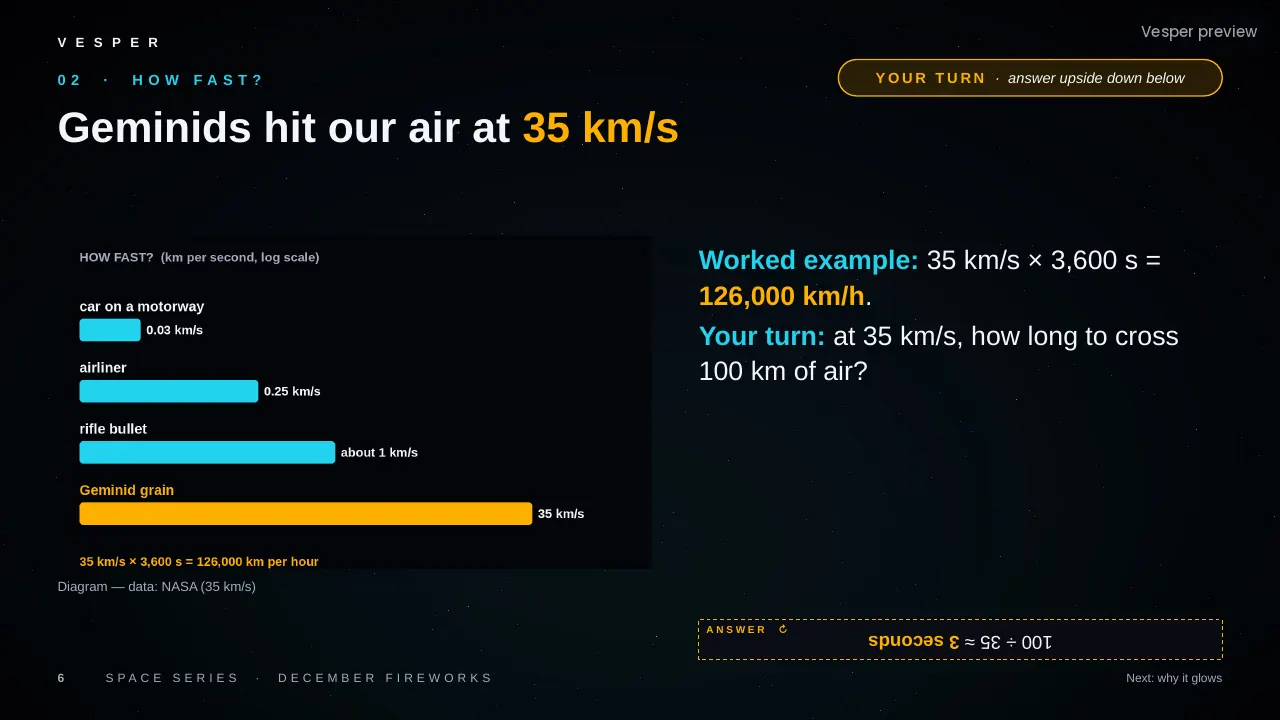
  • Meteors glow about 100 km up; Geminid grains arrive at about 35 km/s (126,000 km/h).
  • The Geminids' parent is asteroid 3200 Phaethon, about 5.1 km across, found in 1983.
  • Phaethon orbits the Sun every 1.4 years and passes closer to the Sun than Mercury.
  • In 2026 the shower is active 4–17 December and peaks on 13–14 December.
  • NASA: 40–50 meteors an hour under dark skies, up to 120 in perfect conditions.

What students will be able to do

  • Students can explain what a shooting star really is.
  • Students can tell a meteoroid, a meteor and a meteorite apart.
  • Students can explain why the Geminids come from an asteroid and happen every December.
  • Students can convert meteor speeds and work out an hourly rate from a 15-minute count.
  • Students can plan a safe meteor-watching session.

About this lesson

What students discover

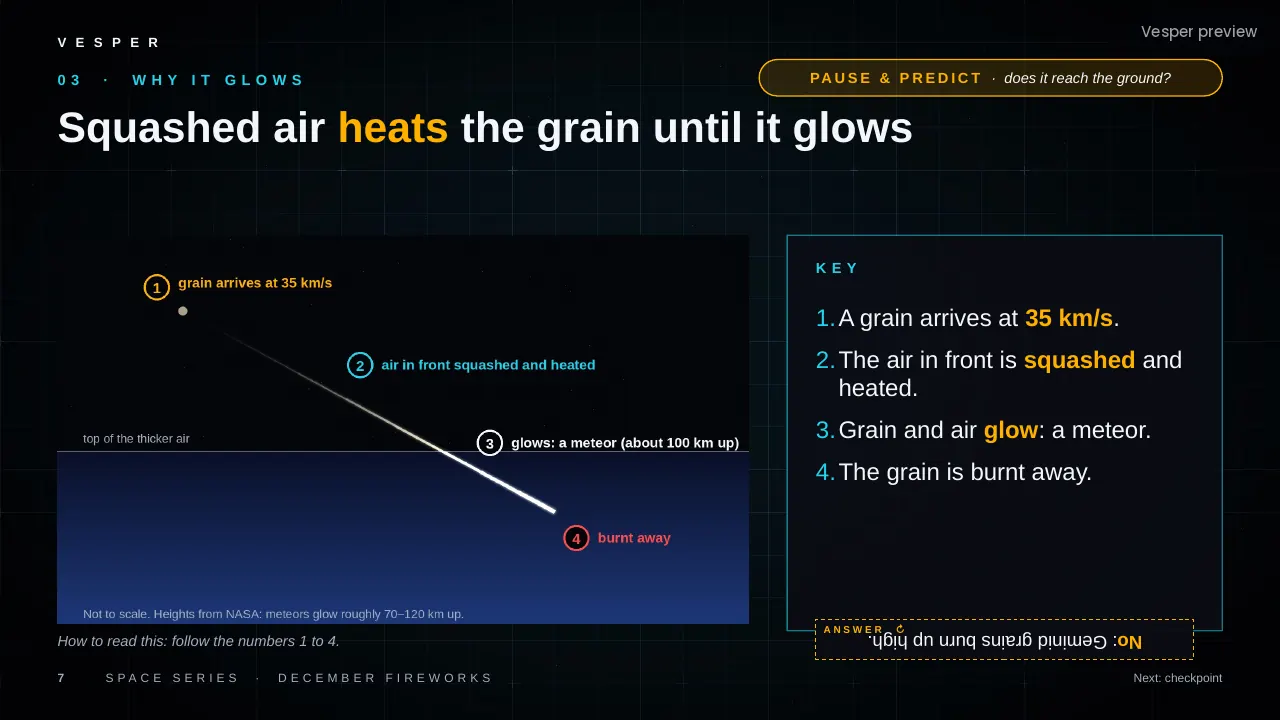
A shooting star is not a star: it is a grain of rock burning up about 100 km above your head, while the nearest star is 40 trillion km away. Students see what really happens using NASA’s numbers. Geminid grains arrive at 35 km/s (126,000 km/h), the air in front of them is squashed and heated, and the grain glows. The words meteoroid, meteor and meteorite get sorted once and for all: in space, in the air, on the ground.

Then the twist. Most meteor showers come from comets, but the Geminids come from an asteroid, 3200 Phaethon, about 5.1 km across, found in 1983 by the IRAS satellite. Its long oval orbit takes 1.4 years and dives closer to the Sun than Mercury does, and Earth crosses its dust every mid-December. Geminid grains are dense rock (2–3 g/cm³), which is part of the evidence. Whether Phaethon is a ‘rock comet’, baked until it cracks, is labelled as a hypothesis. A myth slide fixes ‘meteor showers always come from comets’.

Inside the deck

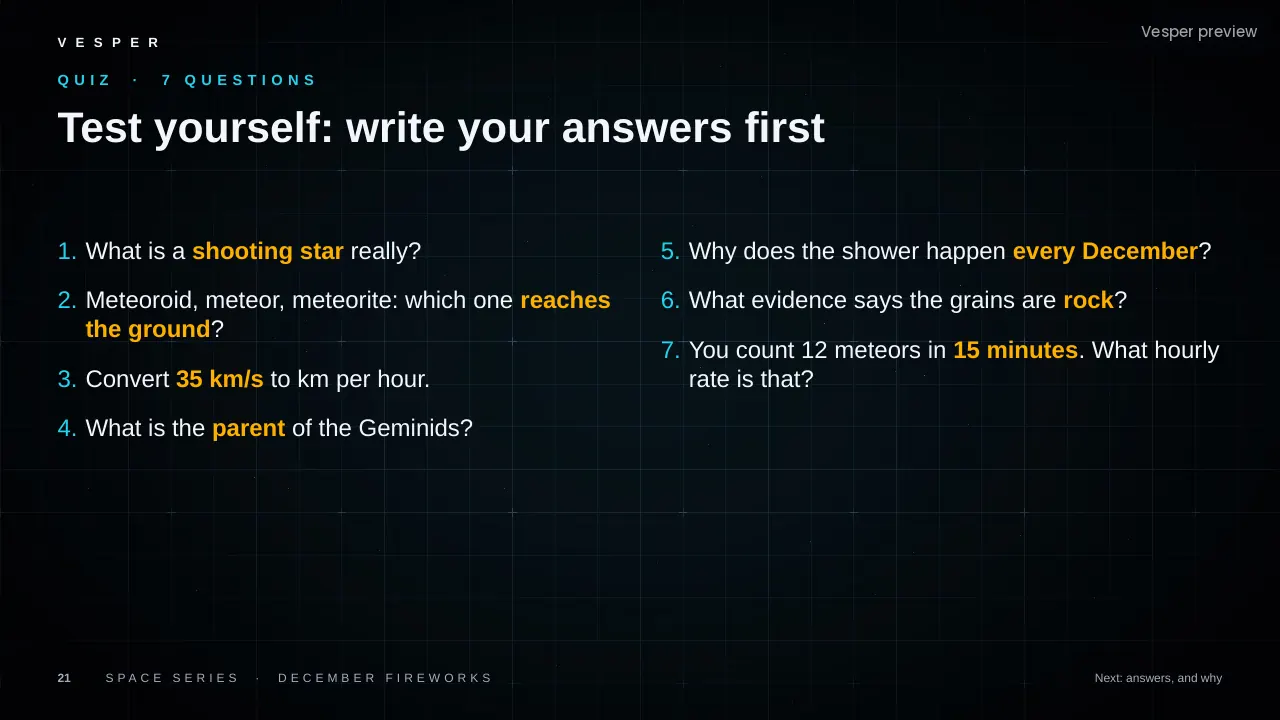
25 slides on the Nova template: a guess-first hook, a four-word primer, three diagram walks (the glowing grain, Phaethon’s orbit, the radiant near Castor in Gemini), five your-turn calculations, two checkpoints and a seven-question quiz with explained answers. Facts were checked against NASA and Royal Museums Greenwich on 18 Nov 2026.

How to teach it

About 55 minutes with the quiz. Then send students out: the shower is active 4–17 December 2026, a thin crescent Moon sets early on peak night, and the activity asks them to go somewhere dark with an adult, give their eyes 30 minutes, and tally meteors in 15-minute blocks. A city-light slide explains why they may see far fewer than the 120 an hour possible in perfect skies.

Who it’s for

Learners aged 11–14, astronomy clubs and families planning a December night under the sky.
Curriculum & specs

CBSE/NCERT (India)Class 6-8 · Class 6 Curiosity ch 12 Beyond Earth; Class 8 Curiosity ch 11 Keeping Time with the Skies
CambridgeLS Stage 7–8 Earth & Space; IGCSE 0625 §6.1.2
NGSS (US)MS-ESS1-2; MS-ESS1-3
IB MYPSciences · KC Change · RC Evidence, Movement
Ages11–14
LevelMiddle
Slide templateNova
Slides25
Teaching timeAbout 55 minutes
LanguageEnglish (UK)

Questions

Questions, answered

What is a shooting star?

A grain of rock, often smaller than a grain of rice, burning up in our air about 100 km above the ground. It is not a star.

What is the difference between a meteor, a meteoroid and a meteorite?

A meteoroid is the grain in space, a meteor is the streak of light as it burns in our air, and a meteorite is a rock that reaches the ground.

Where do the Geminids come from?

From asteroid 3200 Phaethon. Earth passes through its trail of dust every mid-December.

When is the Geminid meteor shower in 2026?

It is active from 4 to 17 December 2026 and peaks on the night of 13–14 December.

How many Geminids can you see in an hour?

About 40–50 an hour under dark skies, and up to 120 in perfect conditions, according to NASA. City lights hide most of them.

How should students watch the Geminids?

Go somewhere dark with an adult, wrap up warm, lie back, give your eyes 30 minutes to adjust and count in 15-minute blocks.

Main sources

  1. NASA Science. Geminids (science.nasa.gov/solar-system/meteors-meteorites/geminids). Checked 18 Nov 2026: active 4–17 Dec 2026, peak 13–14 Dec; 40–50/h dark sky, up to 120/h perfect conditions; 35 km/s; 3200 Phaethon 5.10 km, orbit about 1.4 years, found 11 Oct 1983 by IRAS; Fred Whipple; rock comet; grains 2–3 g/cc v 0.3 g/cc; viewing tips.
  2. Royal Museums Greenwich. Geminid meteor shower 2026. Checked 18 Nov 2026: peak 14 Dec; radiant near Castor; waxing crescent Moon setting about 21:20 (UK).
  3. Phaethon perihelion about 0.14 AU (NASA JPL Small-Body Database).

The full source list is on the last slides of the deck. Spotted an error? Tell us.