Cosmos Ages 11–14

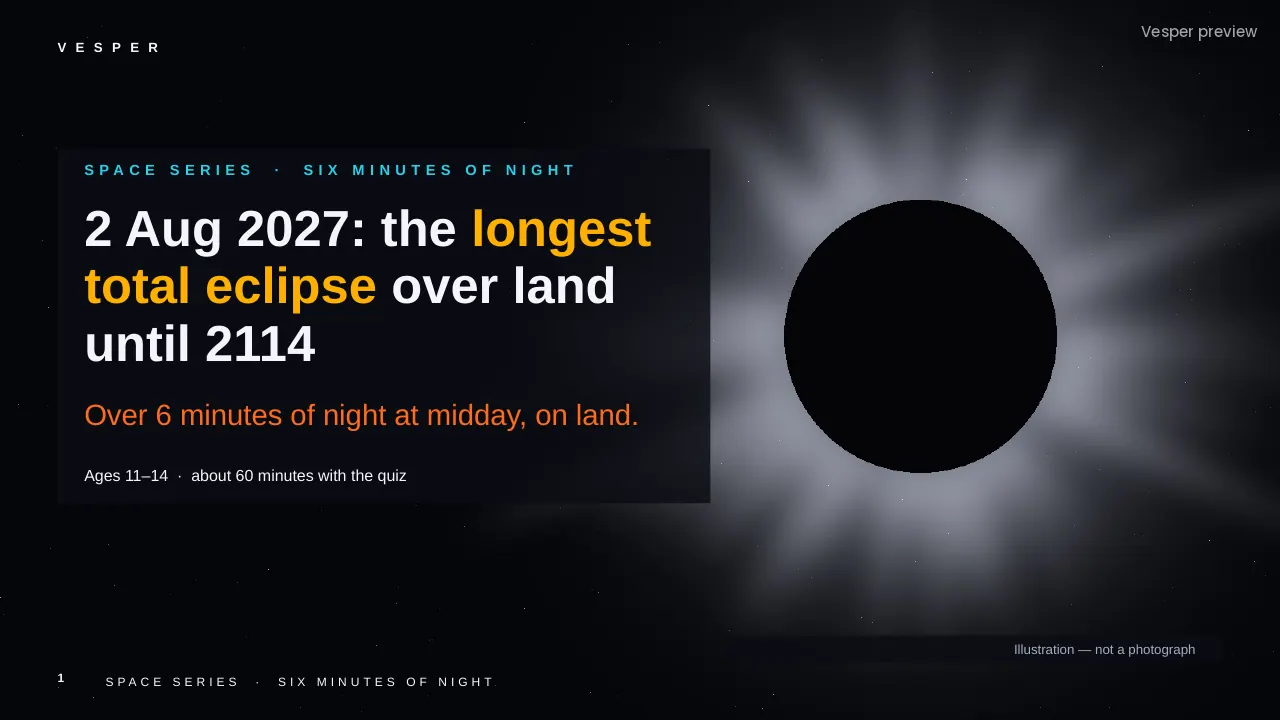
2 Aug 2027: the longest total eclipse over land until 2114

Big Moon, small Sun, slow shadow: six minutes of night at midday.

A 26-slide lesson on the total solar eclipse of 2 August 2027: why it lasts up to 6 min 23 s, where to see it and how to watch safely. NASA’s own figures drive every calculation.

The short answer

On 2 August 2027 the Moon will hide the Sun for up to 6 minutes 23 seconds near Luxor, Egypt. Totality lasts so long because the Moon is near its closest and looks 7.9% wider than the Sun, the Sun is near its farthest, and the shadow moves slowly under an almost overhead Sun.

Inside the deck

slides
26
quiz questions
7
minutes
60
your-turn tasks
7

Choose a format

  • Lesson Notes (PDF)Every slide with its teacher notes, as a PDF to read or print.
  • Teacher DeckThe editable PowerPoint with speaker notes on every slide, a PDF copy and the matching Vesper slide template, so you can add slides of your own.
Pricing coming soon

Pricing coming soon

We’ll email you pricing and launch offers shortly.

  • Finished and checked: buying opens soon
  • Sources listed at the end
  • Curriculum links under ‘Curriculum & specs’
  • For one classroom. Campus licences for whole schools

Key facts

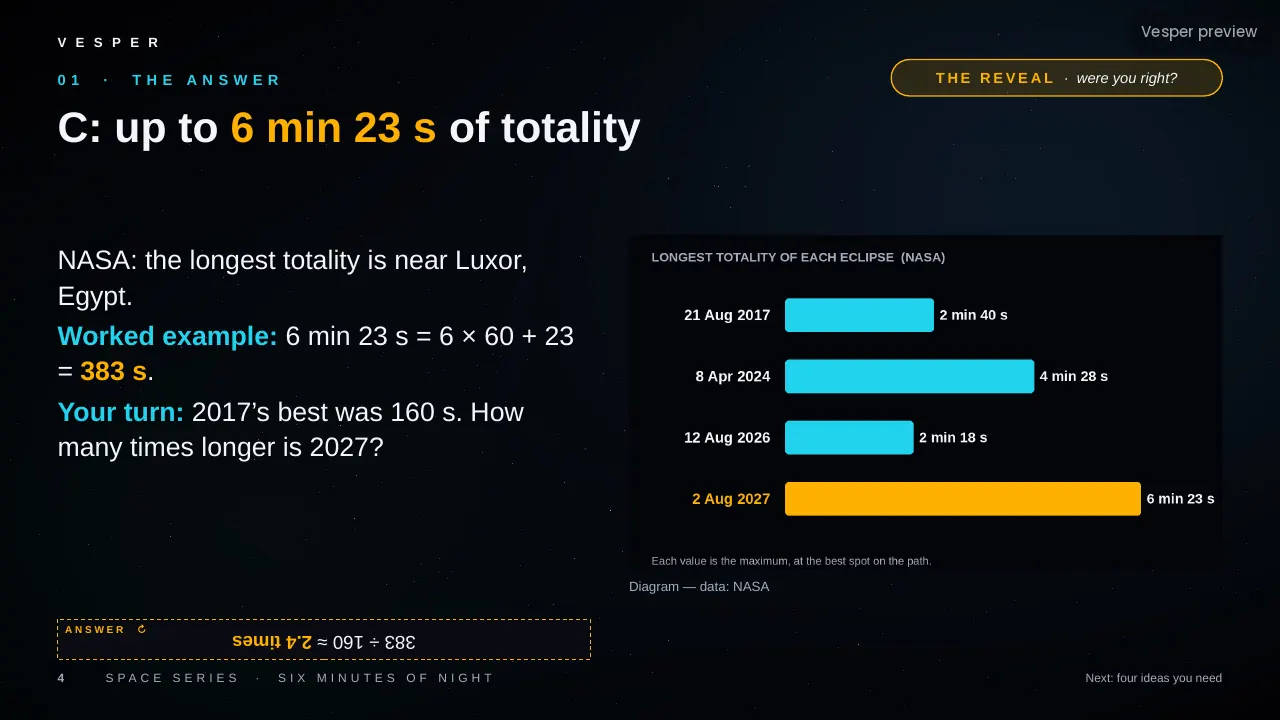
  • Totality near Luxor lasts up to 6 min 23 s: 383 seconds.
  • The Sun is about 400 times wider than the Moon and about 390 times farther away.
  • Eclipse magnitude 1.079: the Moon looks 7.9% wider than the Sun.
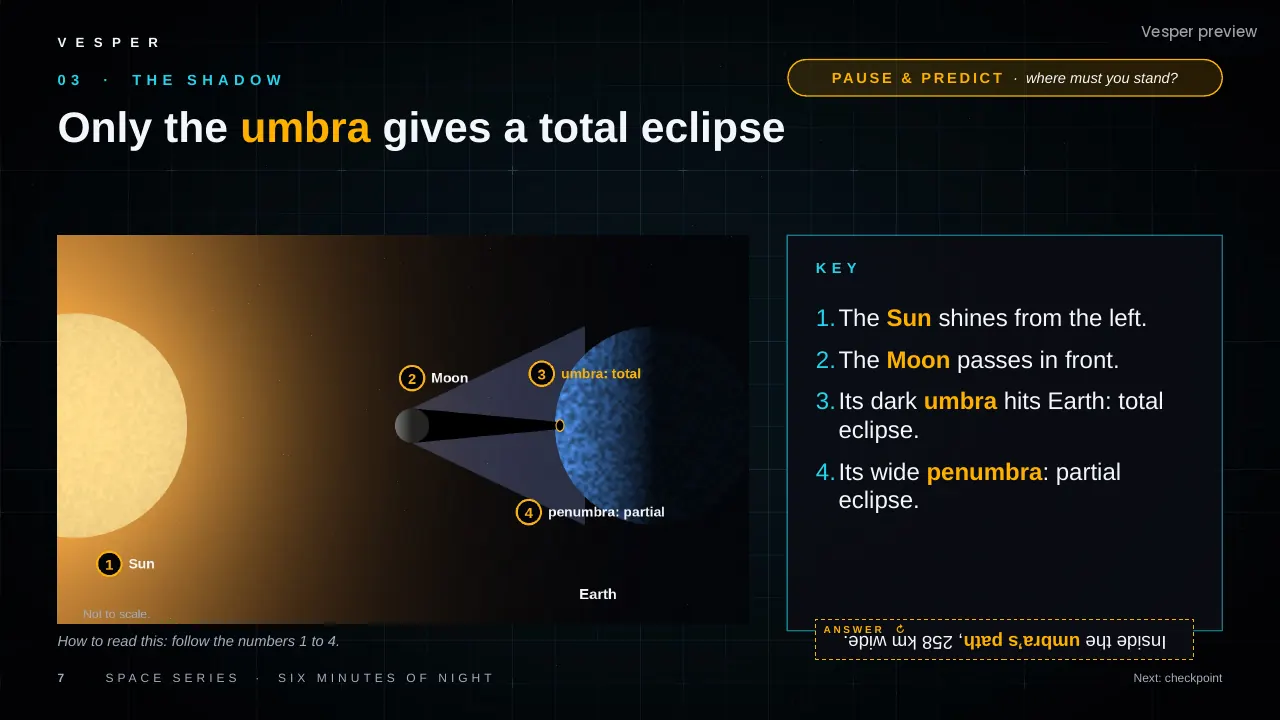
  • The path of totality is about 258 km wide; the shadow moves at about 0.67 km/s.
  • The 22 July 2009 eclipse lasted 6 min 39 s, but at its best over the sea.

What students will be able to do

  • Students can explain why a small Moon can hide the much larger Sun.
  • Students can give the reasons the 2 August 2027 totality lasts up to 6 min 23 s.
  • Students can estimate the speed of the Moon's shadow from the path width and the duration.
  • Students can describe where the path of totality runs.
  • Students can say when it is safe to remove eclipse glasses, and when it is not.

About this lesson

What students discover

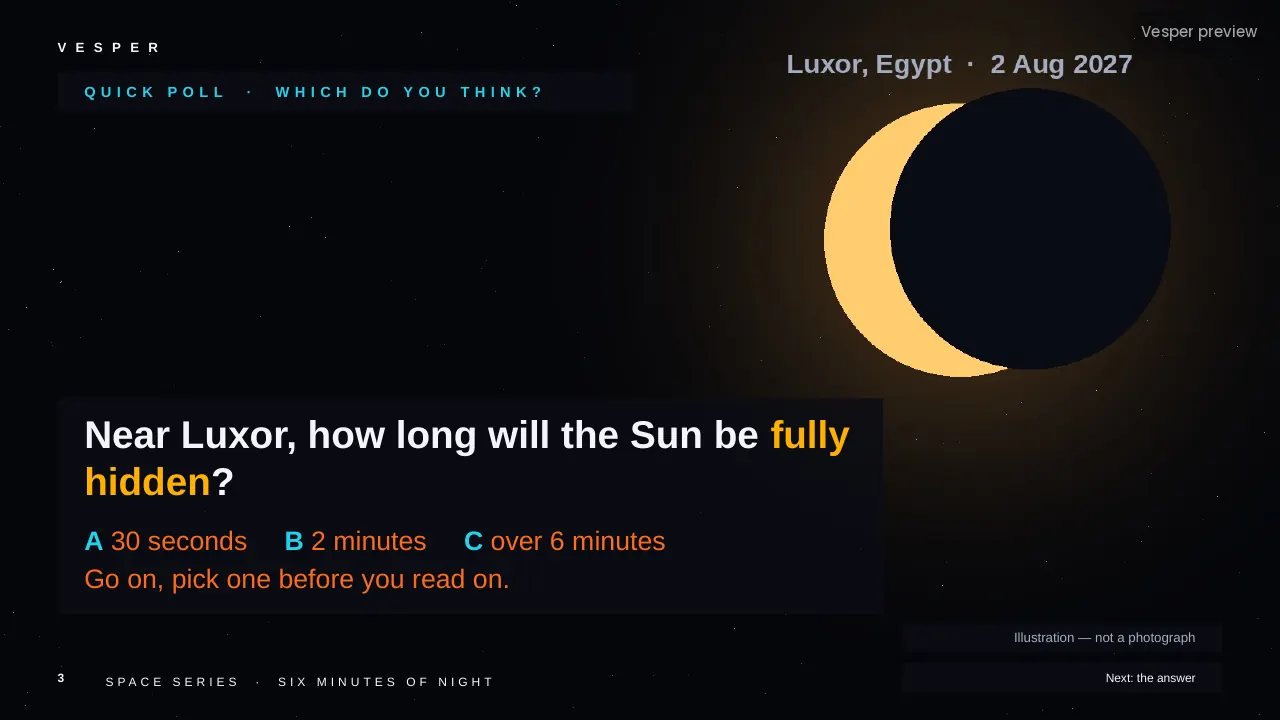
On 2 August 2027 the Moon will hide the Sun for up to 6 minutes 23 seconds near Luxor in Egypt: 383 seconds of night at midday. Students start with the coincidence that makes total eclipses possible: the Sun is about 400 times wider than the Moon and about 390 times farther away, so the two look almost the same size.

Then they use NASA’s figures to explain why this totality is so long. In early August the Sun is near its farthest and looks small, while the Moon is near its closest and looks 7.9% wider (magnitude 1.079). The Sun is almost overhead, and Earth’s spin carries the ground along with the shadow, so students estimate its speed at about 0.67 km/s across a 258 km path. The path runs from the tip of Spain across North Africa and Arabia to the Horn of Africa. A myth slide is honest about the title: 22 July 2009 lasted 6 min 39 s, but at its best over the sea. The 1919 eclipse that backed Einstein is the evidence slide.

Inside the deck

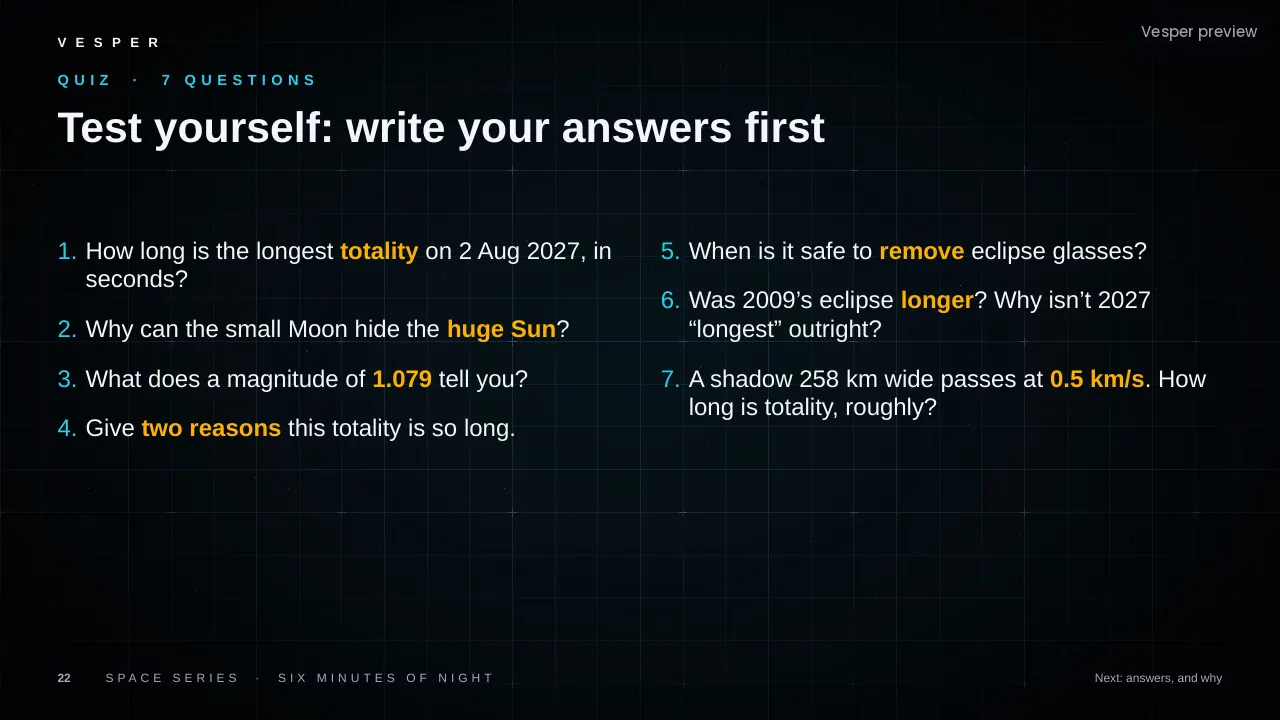
26 slides on the Nova template: a guess-first hook, two diagram walks (umbra and penumbra; partial, diamond ring, totality), seven your-turn calculations, two checkpoints, a frontier slide on the Moon drifting 3.8 cm a year, and a seven-question quiz with explained answers.

How to teach it

About 60 minutes with the quiz. The coin-and-lamp activity, standing about 6 m from a lampshade, shows how a small near object covers a big far one. Safety is built in: glasses stay on for every partial phase and come off only during totality. Speaker notes sit on every slide.

Who it’s for

Learners aged 11–14, eclipse chasers in the making, and schools planning a viewing in 2027.
Curriculum & specs

CBSE/NCERT (India)Class 6-10 · Class 7 Curiosity ch 12 Earth, Moon, and the Sun
CambridgeLS Stage 7–9 Earth & Space; IGCSE 0625 §6.1.1
NGSS (US)MS-ESS1-1; HS-ESS1-4
IB MYPSciences · KC Systems · RC Movement, Evidence
Ages11–14
LevelMiddle
Slide templateNova
Slides26
Teaching timeAbout 60 minutes
LanguageEnglish (UK)

Questions

Questions, answered

When is the next total solar eclipse in 2027?

On 2 August 2027. Totality reaches up to 6 minutes 23 seconds near Luxor, Egypt.

Where can you see the 2 August 2027 eclipse?

The path of totality crosses the tip of Spain, North Africa, Arabia and the Horn of Africa. Much of Europe, Africa, the Middle East and parts of South Asia see a partial eclipse.

Why is the 2027 eclipse so long?

The Moon is near its closest and looks big, the Sun is near its farthest and looks small, and the shadow moves slowly under an almost overhead Sun.

Is it the longest eclipse of the century?

Not quite. It is the longest total eclipse over land until 2114, with up to 6 min 23 s near Luxor. The 22 July 2009 eclipse lasted 6 min 39 s, but at its best over the ocean.

When can you take eclipse glasses off?

Only during totality, when the Sun is completely covered. Outside the path, glasses stay on the whole time.

What age is this eclipse lesson for?

Ages 11–14. It takes about 60 minutes with the quiz.

Main sources

  1. NASA GSFC. Eclipses During 2027 (eclipse.gsfc.nasa.gov/OH/OH2027.html). Checked 18 Nov 2026: total solar eclipse 2 Aug 2027, Saros 136, greatest eclipse 10:07 UT (TD 10:07:50), duration 6 min 23 s, path 258 km, magnitude 1.079, gamma 0.142, Sun altitude 82°, point 25.5° N 33.2° E.
  2. Wikipedia, Solar eclipse of August 2, 2027 (citing NASA GSFC path tables). Checked 18 Nov 2026: countries on the path; 22 Jul 2009 6 min 39 s at sea; next longer on land 3 Jun 2114.
  3. NASA: 2017 (2 min 40 s), 2024 (4 min 28 s), 2026 (2 min 18 s) maximum durations.

The full source list is on the last slides of the deck. Spotted an error? Tell us.