Cosmos Ages 15–16

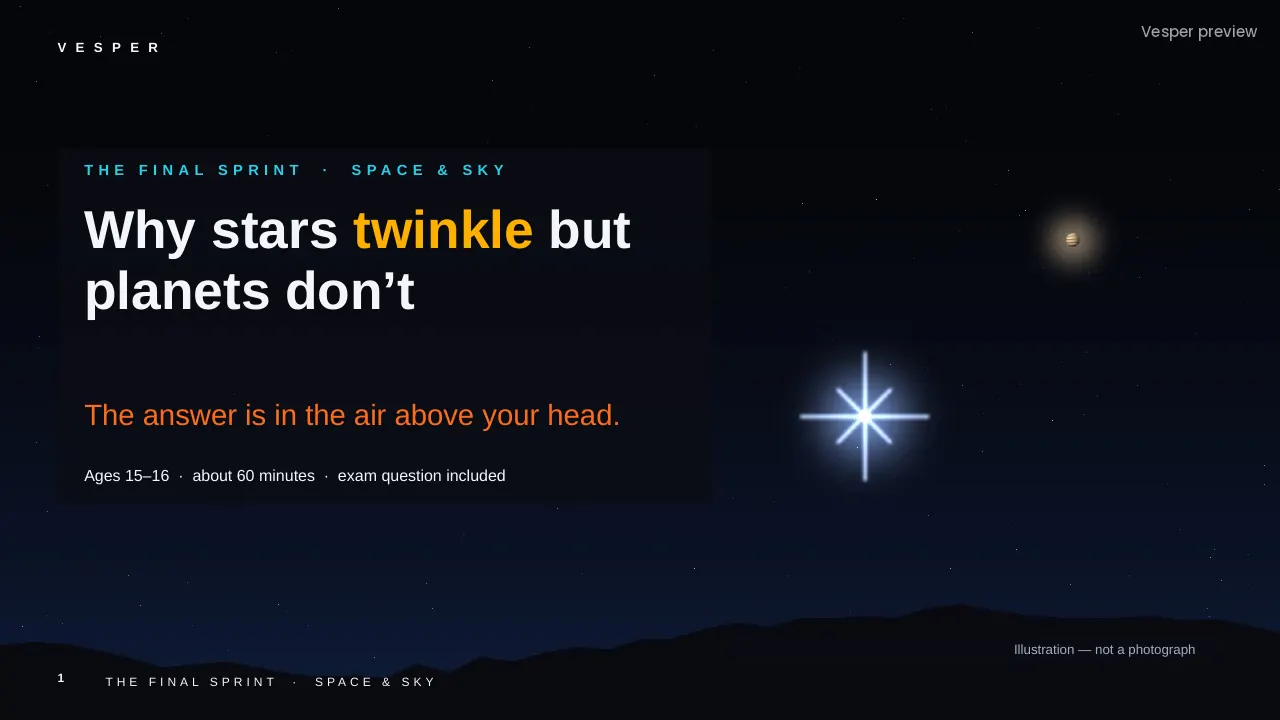
Why stars twinkle but planets don't

Points twinkle. Discs average.

A 32-slide lesson for ages 15–16 that builds the full-mark answer step by step: refraction, moving air, point sources and discs, with a 5-mark exam question and mark scheme.

The short answer

Stars twinkle because moving pockets of warmer and cooler air refract their light by slightly different amounts. A star looks like a point (Sirius is 0.006 arcseconds wide), so its light crosses one air pocket and flickers. A planet is a small disc (Jupiter is 46 arcseconds), so the flickers average out.

Inside the deck

slides
32
quiz questions
8
minutes
60
your-turn tasks
8

Choose a format

  • Lesson Notes (PDF)Every slide with its teacher notes, as a PDF to read or print.
  • Teacher DeckThe editable PowerPoint with speaker notes on every slide, a PDF copy and the matching Vesper slide template, so you can add slides of your own.
Pricing coming soon

Pricing coming soon

We’ll email you pricing and launch offers shortly.

  • Finished and checked: buying opens soon
  • Sources listed at the end
  • Curriculum links under ‘Curriculum & specs’
  • For one classroom. Campus licences for whole schools

Key facts

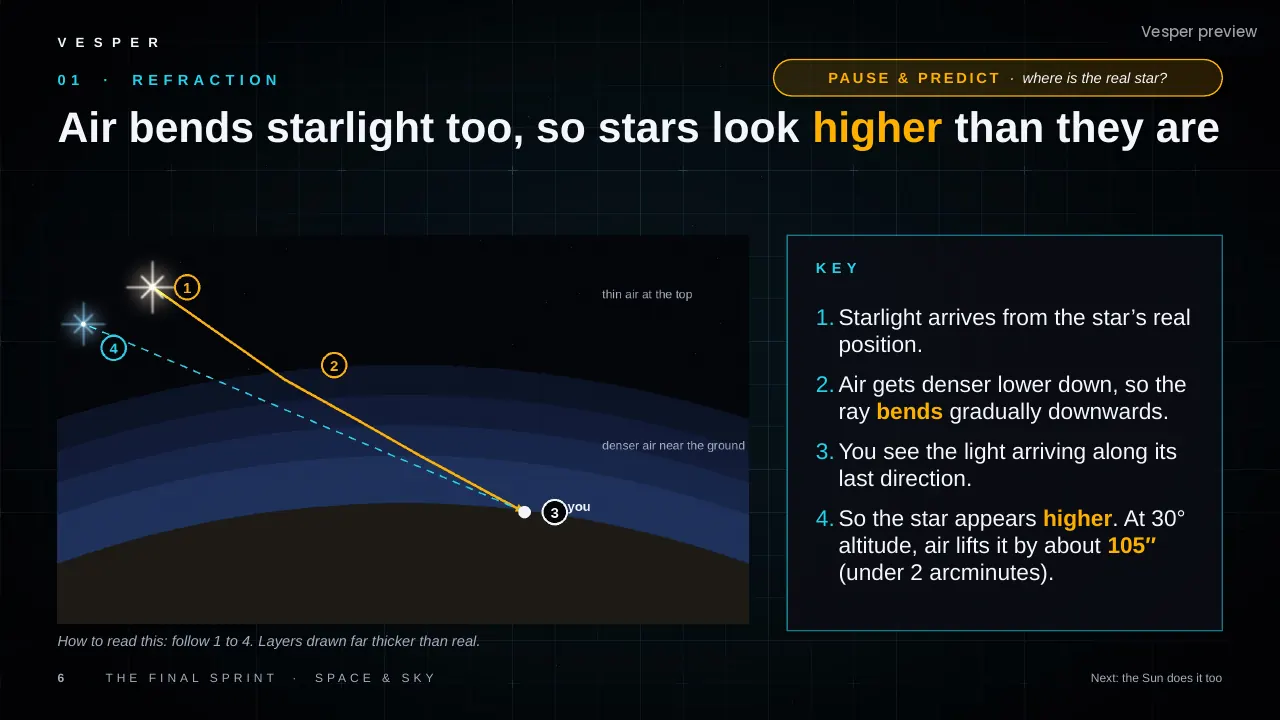
  • The Sun is seen about 2 minutes before it rises, thanks to refraction
  • A pocket of air 3 °C warmer bends starlight by about 1 arcsecond
  • Jupiter looks 46″ wide; Sirius just 0.006″
  • Averaging N light paths cuts the flicker by √N
  • Ends with a 5-mark exam question and mark scheme

What students will be able to do

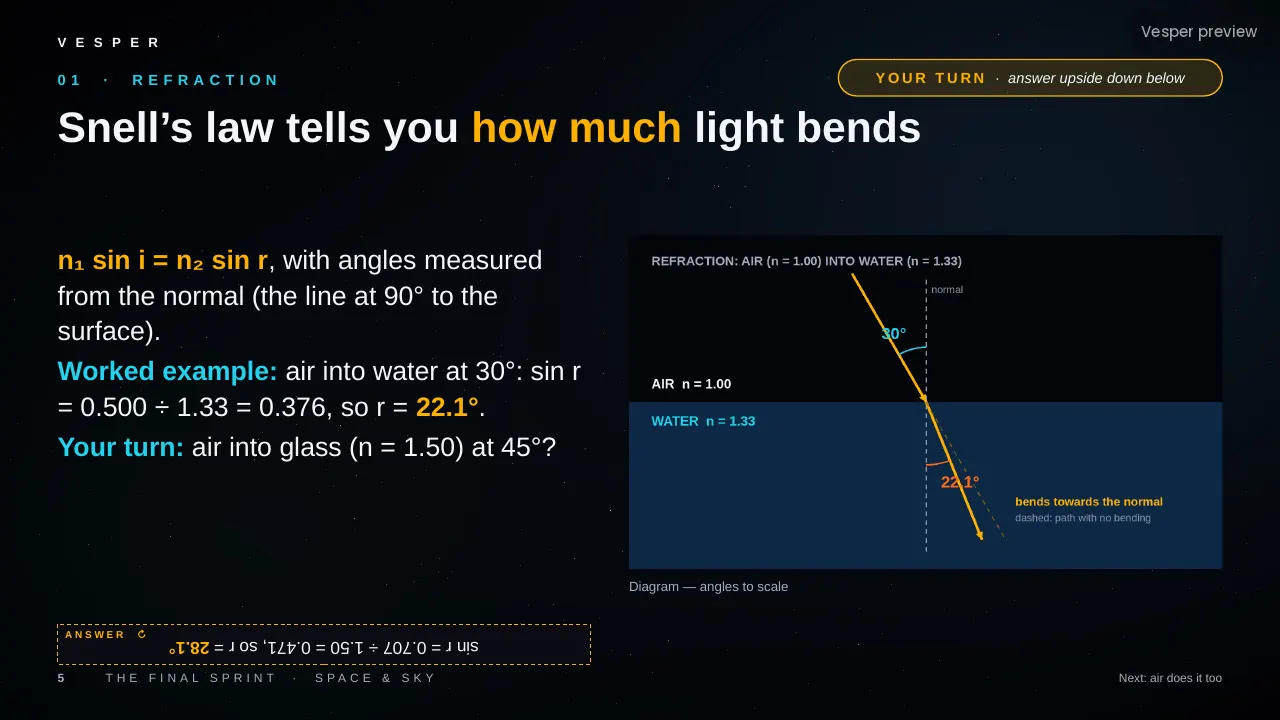
  • Students can use Snell's law to explain how air bends starlight
  • Students can explain why warm air bends light less than cool air
  • Students can explain why stars twinkle and planets do not
  • Students can explain why stars low in the sky twinkle most
  • Students can write a full-mark exam answer on twinkling

About this lesson

What students discover

Why does a star flicker while a planet beside it shines steadily? Students build the answer from the ground up, with real numbers at every step. They use Snell’s law, see how air bends starlight so stars appear higher (and the Sun is seen about two minutes before it rises), and work out that a pocket of air 3 °C warmer bends light by about one arcsecond.

Then they measure the sky: Jupiter looks 46 arcseconds wide, Sirius just 0.006, about 7,600 times smaller. A star’s light crosses one air pocket while a planet’s crosses hundreds, and averaging N paths cuts the flicker by √N. Low stars twinkle most because their light crosses more air.

Inside the deck

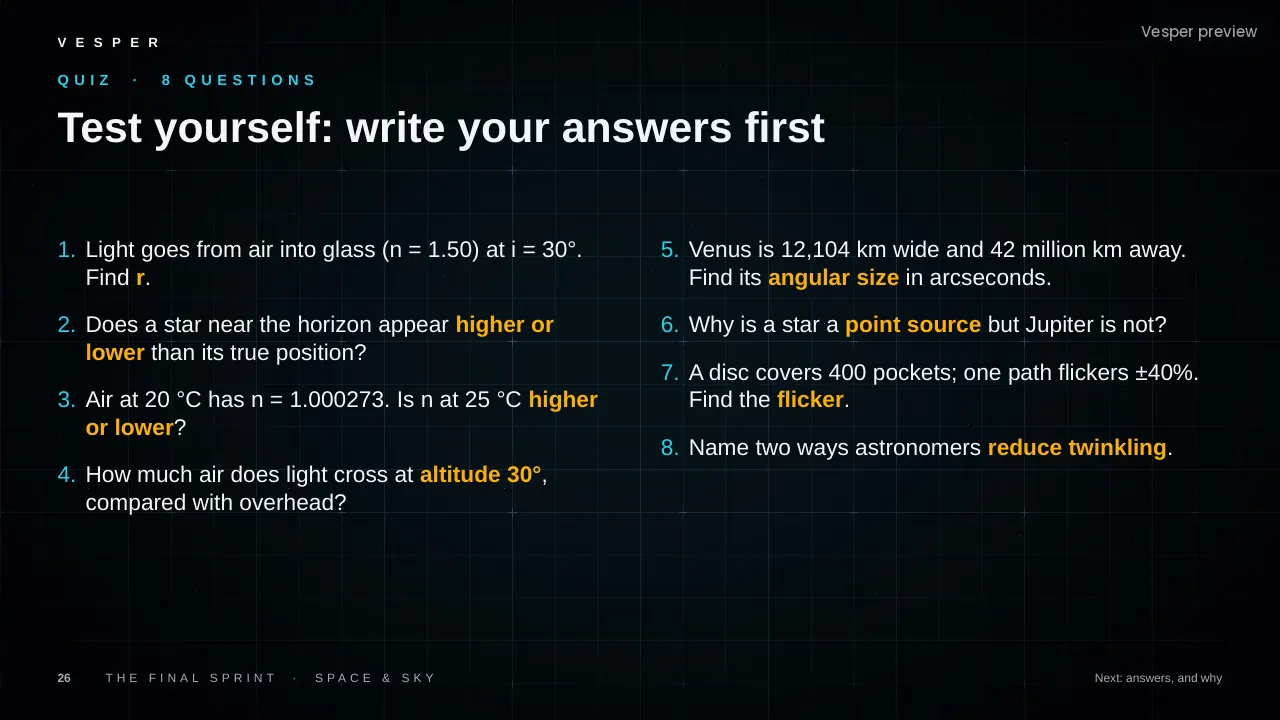
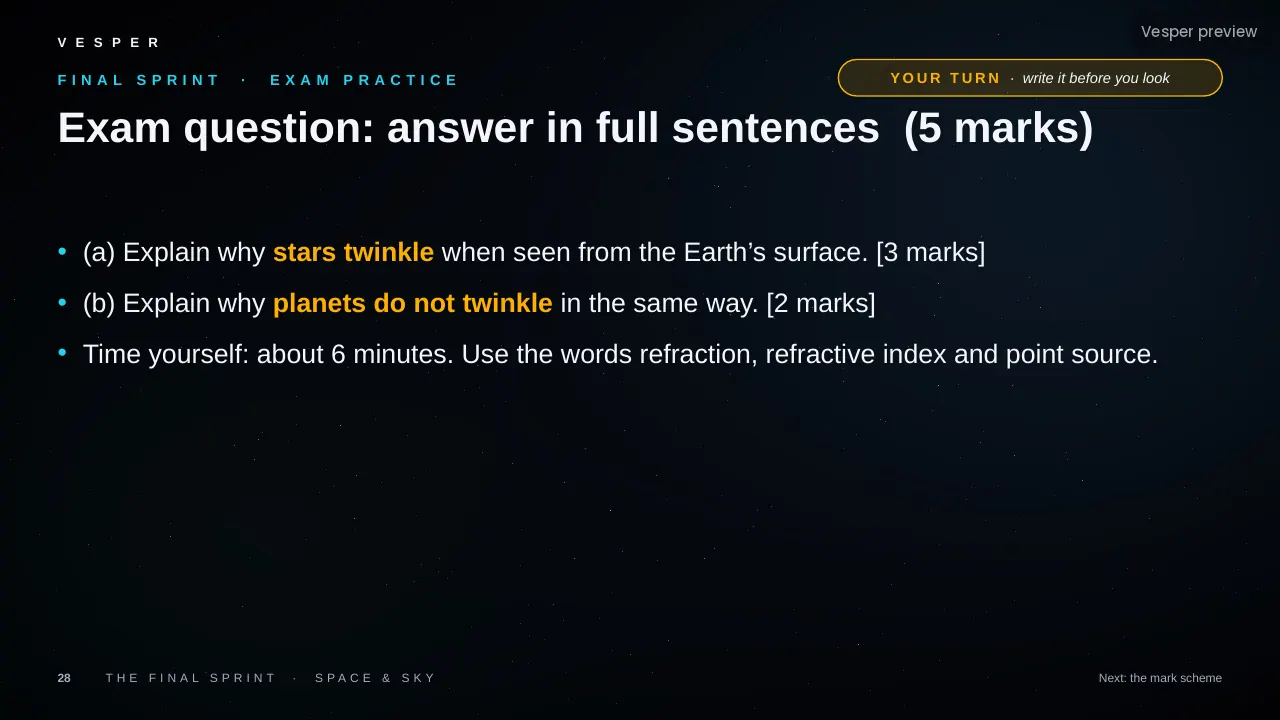
32 slides on the Nova template. Polls, guess-first prompts, your-turn questions with upside-down answers, a safe observing activity to score the twinkle of a star and a planet tonight, a spot-the-mistake (‘stars twinkle because they flicker’), the bending mirrors big telescopes use to cancel twinkling, two checkpoints, an 8-question quiz with explained answers, and a 5-mark exam question with a point-by-point mark scheme.

How to teach it

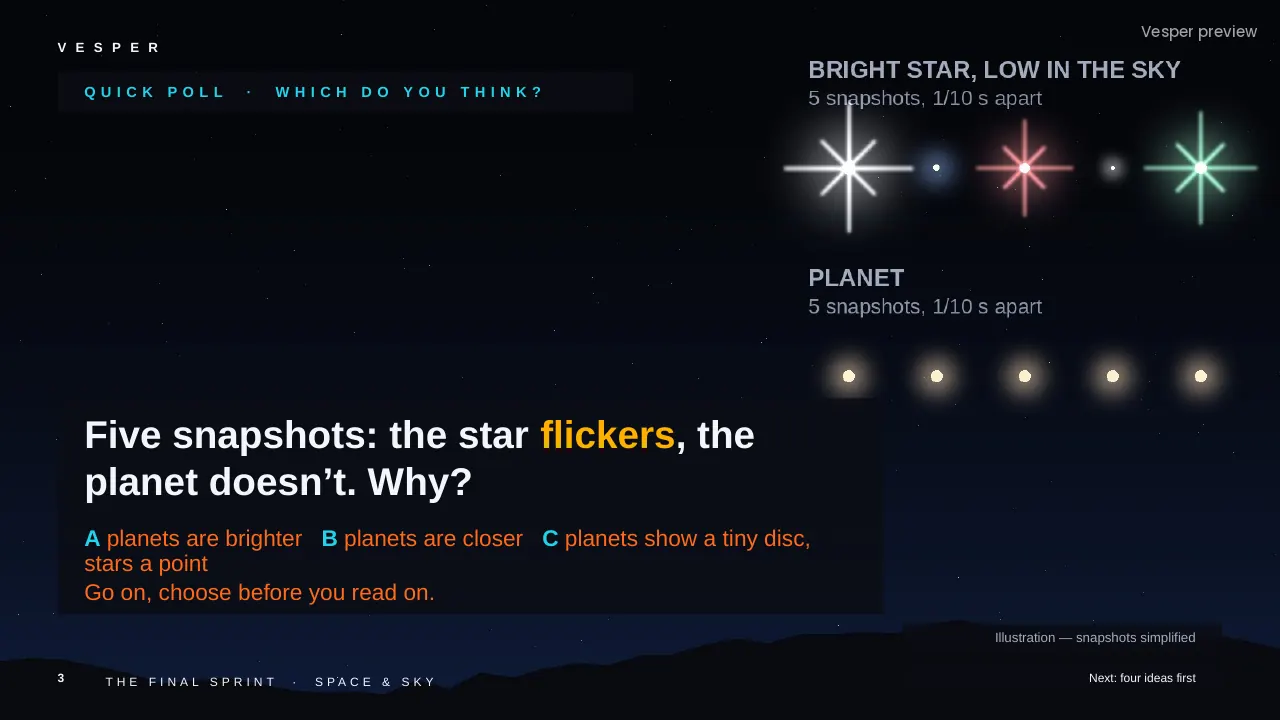
Allow about 60 minutes. Show the five snapshots on slide 3 and ask for explanations before any physics. Set the observing activity on slide 20 as homework on a clear night. Give students time to write the exam answer in full sentences before slide 29. Notes on every slide give Say, Ask, Watch for and Time.

Who it’s for

For ages 15–16 revising refraction and light. Part of The Final Sprint, 15 exam lessons that each end with an exam-style question and mark scheme. Editable PowerPoint with named layouts.
Curriculum & specs

CBSE/NCERT (India)Class 10 · Class 10 Science ch 10 The Human Eye and the Colourful World (atmospheric refraction)
CambridgeIGCSE 0625 §3.2.2 Refraction of light
NGSS (US)MS-PS4-2; HS-PS4-1
IB MYPSciences · KC Relationships · RC Form, Evidence
Ages15–16
LevelSenior
Slide templateNova
Slides32
Teaching timeAbout 60 minutes
Exam-style questionYes, with a model answer
LanguageEnglish (UK)

Questions

Questions, answered

Why do stars twinkle?

Moving pockets of air with different temperatures refract starlight by slightly different amounts. A star is a point source, so its brightness and position flicker.

Why don't planets twinkle?

Planets look like tiny discs, not points. Light from different parts of the disc passes through different air pockets, and the flickers average out.

Do stars twinkle in space?

No. Twinkling is caused by Earth's atmosphere, which is why big telescopes use bending mirrors to cancel it.

Why do stars near the horizon twinkle more?

Their light passes through much more air, so it crosses more moving pockets.

Is twinkling a sign that stars flicker?

No. The lesson's spot-the-mistake slide shows the star's light is steady; the air makes it flicker.

Does this lesson include an exam question?

Yes. A 5-mark question on why stars twinkle and planets do not, with a mark scheme giving one mark per point.

Main sources

  1. Newton, I. (1704). Opticks. Book I, Part I, Proposition VIII. London: Smith & Walford.
  2. Edlén, B. (1966). The refractive index of air. Metrologia 2, 71–80.
  3. Ciddor, P. E. (1996). Refractive index of air: new equations for the visible and near infrared. Applied Optics 35, 1566–1573.

The full source list is on the last slides of the deck. Spotted an error? Tell us.