Physics Ages 14–16

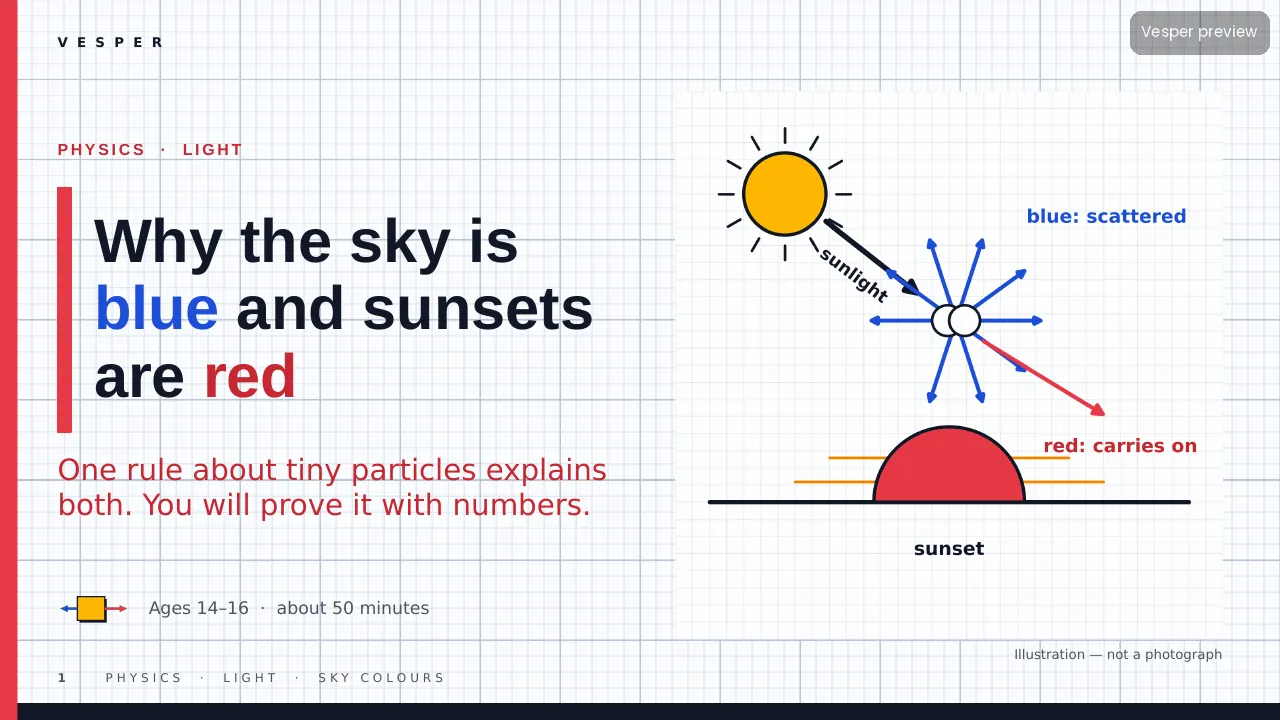
Why the sky is blue and sunsets are red

Short waves scatter, long waves last: one rule for noon and sunset.

A 33-slide physics lesson that proves, with a calculator, why air scatters blue light 5.9 times more than red, and why sunsets turn red.

The short answer

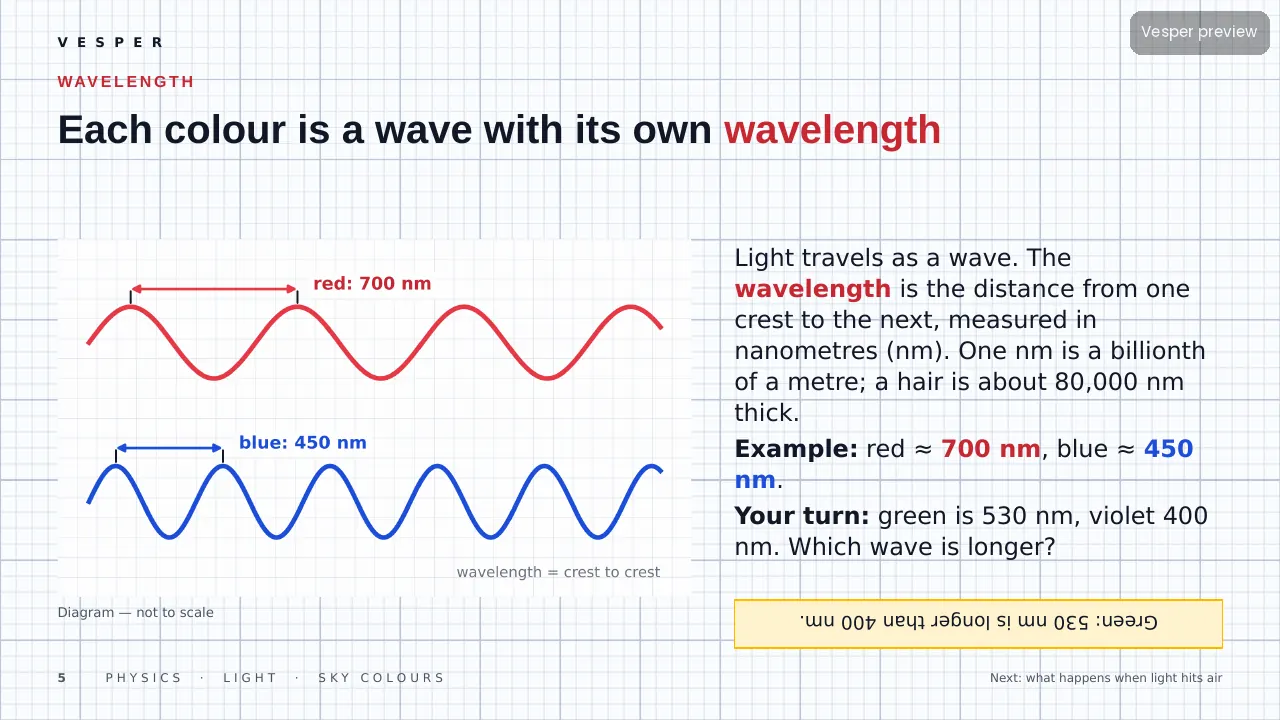
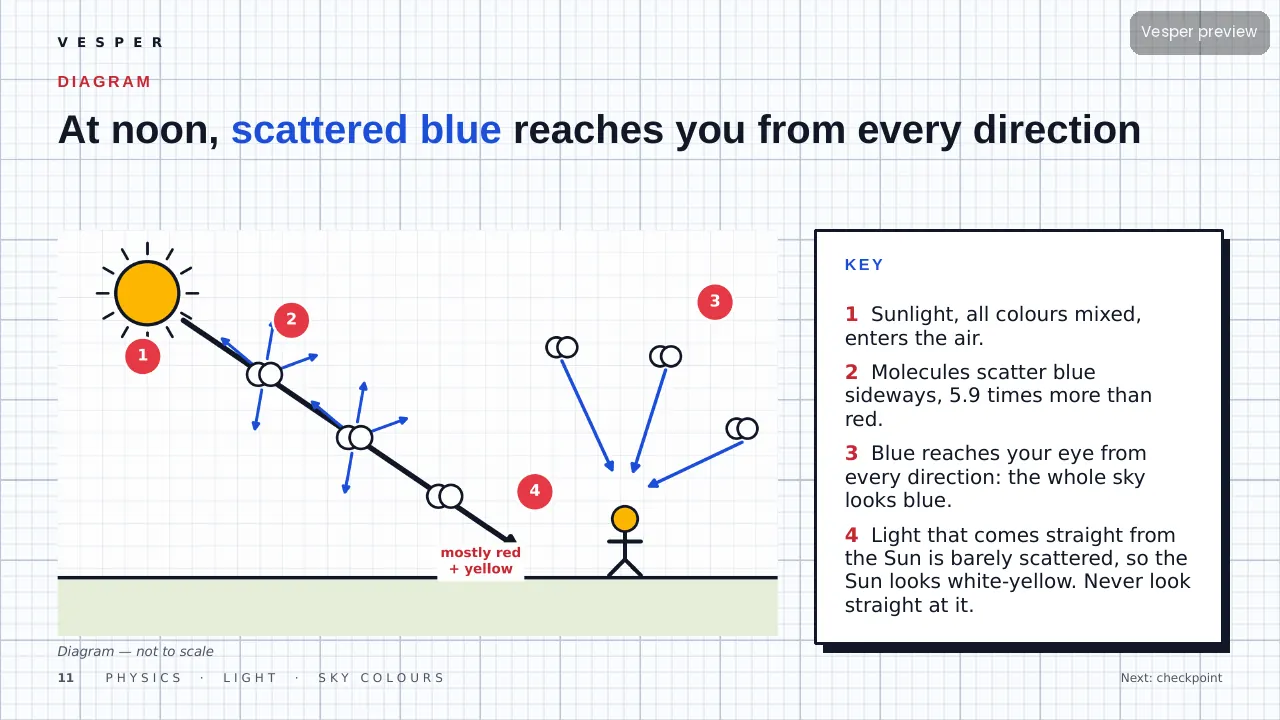
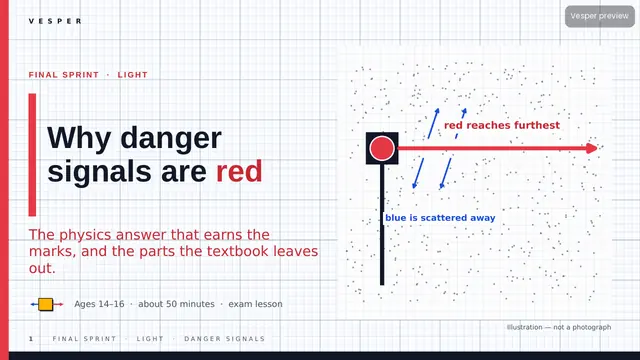
The sky is blue because air molecules scatter short wavelengths far more than long ones: by Rayleigh's 1/λ⁴ rule, blue (450 nm) scatters about 5.9 times more than red (700 nm). At sunset, light crosses about 38 times more air, so almost all the blue is scattered away before it reaches you and the Sun looks red.

Inside the deck

slides
33
quiz questions
8
minutes
50
your-turn tasks
8

Plenty to extend into a second lesson (about 77 minutes of activities in the notes).

Choose a format

  • Lesson Notes (PDF)Every slide with its teacher notes, as a PDF to read or print.
  • Teacher DeckThe editable PowerPoint with speaker notes on every slide, a PDF copy and the matching Vesper slide template, so you can add slides of your own.
Pricing coming soon

Pricing coming soon

We’ll email you pricing and launch offers shortly.

  • Finished and checked: buying opens soon
  • Sources listed at the end
  • Curriculum links under ‘Curriculum & specs’
  • For one classroom. Campus licences for whole schools

Key facts

  • Blue (450 nm) scatters about 5.9 times more than red (700 nm)
  • Violet scatters 9.4 times more than red, but our eyes barely see it
  • At sunset, light crosses about 38 times more air
  • Each air mass passes 80% of blue and 96% of red
  • On the horizon, red beats blue by about 1,000 to one

What students will be able to do

  • Students can explain scattering and how it depends on wavelength
  • Students can use the 1/λ⁴ rule to compare blue and red scattering
  • Students can explain why the sky is not violet
  • Students can calculate how much blue survives through several air masses
  • Students can explain why clouds are white and sunsets red

About this lesson

What students discover

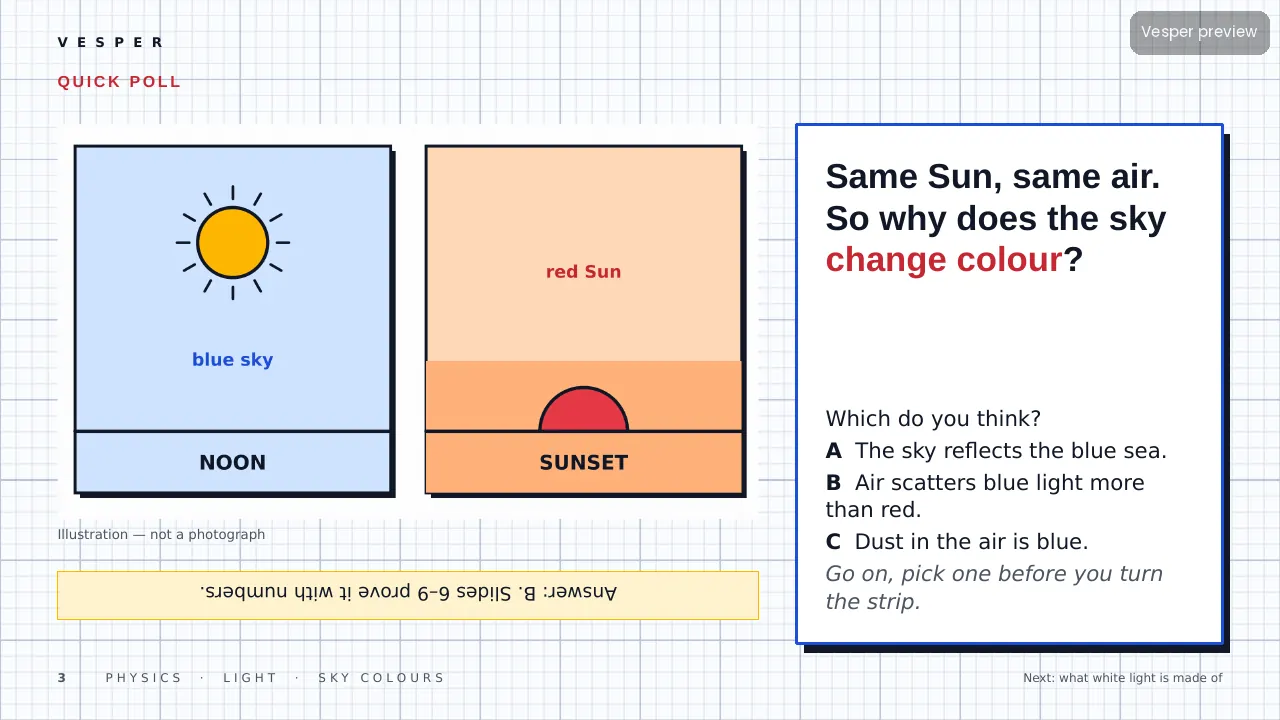
Why is the sky blue at noon and the Sun red at sunset? Same Sun, same air. Students meet wavelength and scattering, then use Rayleigh’s 1/λ⁴ rule to show that blue (450 nm) scatters about 5.9 times more than red (700 nm). A puzzle follows: violet scatters 9.4 times more than red, so why isn’t the sky violet? The answer involves the human eye and the sunlight itself.

Next, students trace sunlight through 1, 2, 10 and 38 air masses. Each air mass lets through 80% of blue but 96% of red, so on the horizon red beats blue by about 1,000 to one. Clouds, blue-looking hills and Tyndall and Rayleigh’s history complete the picture.

Inside the deck

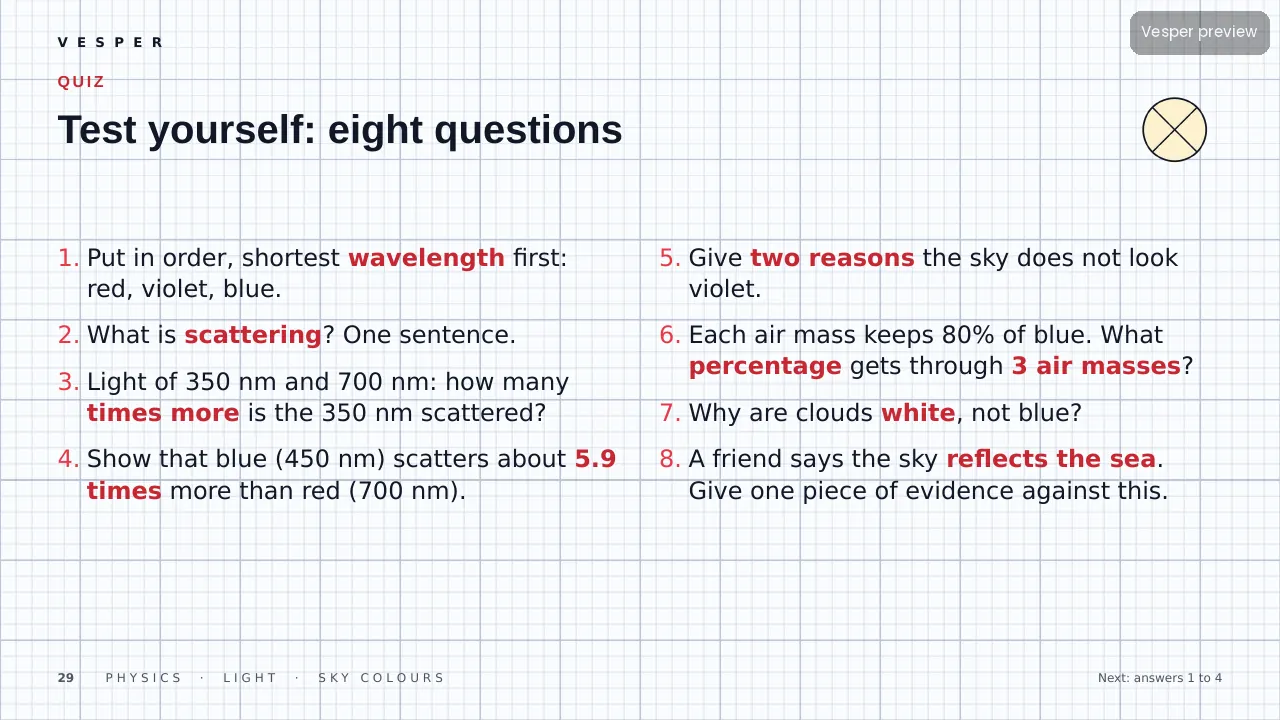
33 slides on the Vector template. Every rule has a worked example and a your-turn with its answer. There are two hook questions, a myth on violet, a spot-the-mistake (‘the sky reflects the sea’), a milk-in-water sunset you can make in a glass, two checkpoints and an 8-question quiz with explained answers. Full sources include Rayleigh (1871) and Tyndall (1869).

How to teach it

Allow about 50 minutes, as the cover says. With every activity in the notes it runs to about 77 minutes, so it also splits into two lessons: the blue sky (slides 1–14) and the red sunset (15–33). The sunset-in-a-glass activity on slide 24 needs a clear glass of water, a few drops of milk and a torch: shine it through the side and look end-on. Notes on every slide give Say, Ask, Watch for and Time.

Who it’s for

For ages 14–16 studying light, waves and the atmosphere, and for anyone who has ever been asked the question by a child. The PowerPoint is editable, with named layouts.
Curriculum & specs

CBSE/NCERT (India)Class 10 · Class 10 Science ch 10 The Human Eye and the Colourful World (scattering)
CambridgeIGCSE 0625 §3.2.4 Dispersion of light; §3.3
NGSS (US)MS-PS4-2; HS-PS4-1
IB MYPSciences · KC Relationships · RC Form, Energy
Ages14–16
LevelSenior
Slide templateVector
Slides33
Teaching timeAbout 50 minutes
LanguageEnglish (UK)

Questions

Questions, answered

Why is the sky blue?

Air molecules scatter short-wavelength light much more than long. Blue light is scattered across the whole sky and reaches your eyes from every direction.

Why are sunsets red?

When the Sun is low, its light passes through about 38 times more air. Most of the blue is scattered out on the way, leaving mainly red and orange.

Why isn't the sky violet if violet scatters more?

Sunlight contains less violet, and our eyes are much less sensitive to it, so the sky looks blue.

What is Rayleigh scattering?

Scattering of light by particles much smaller than its wavelength, such as air molecules. Its strength goes as 1/λ⁴, so halving the wavelength gives 16 times more scattering.

Why are clouds white?

Cloud droplets are much bigger than air molecules, so they scatter all colours about equally, which looks white.

Is the sky blue because it reflects the sea?

No. The lesson's spot-the-mistake slide shows that scattering in the air, not the sea, makes the sky blue.

Main sources

  1. Rayleigh, Lord (J. W. Strutt) (1871). On the light from the sky, its polarization and colour. Philosophical Magazine 41, 107–120 and 274–279.
  2. Tyndall, J. (1869). On the blue colour of the sky, the polarization of skylight, and on the polarization of light by cloudy matter generally. Proceedings of the Royal Society 17, 223–233.
  3. Einstein, A. (1910). Theorie der Opaleszenz von homogenen Flüssigkeiten und Flüssigkeitsgemischen in der Nähe des kritischen Zustandes. Annalen der Physik 33, 1275–1298.

The full source list is on the last slides of the deck. Spotted an error? Tell us.