About this lesson
What students discover
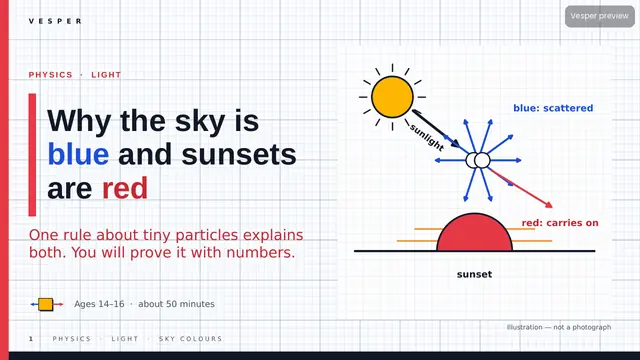
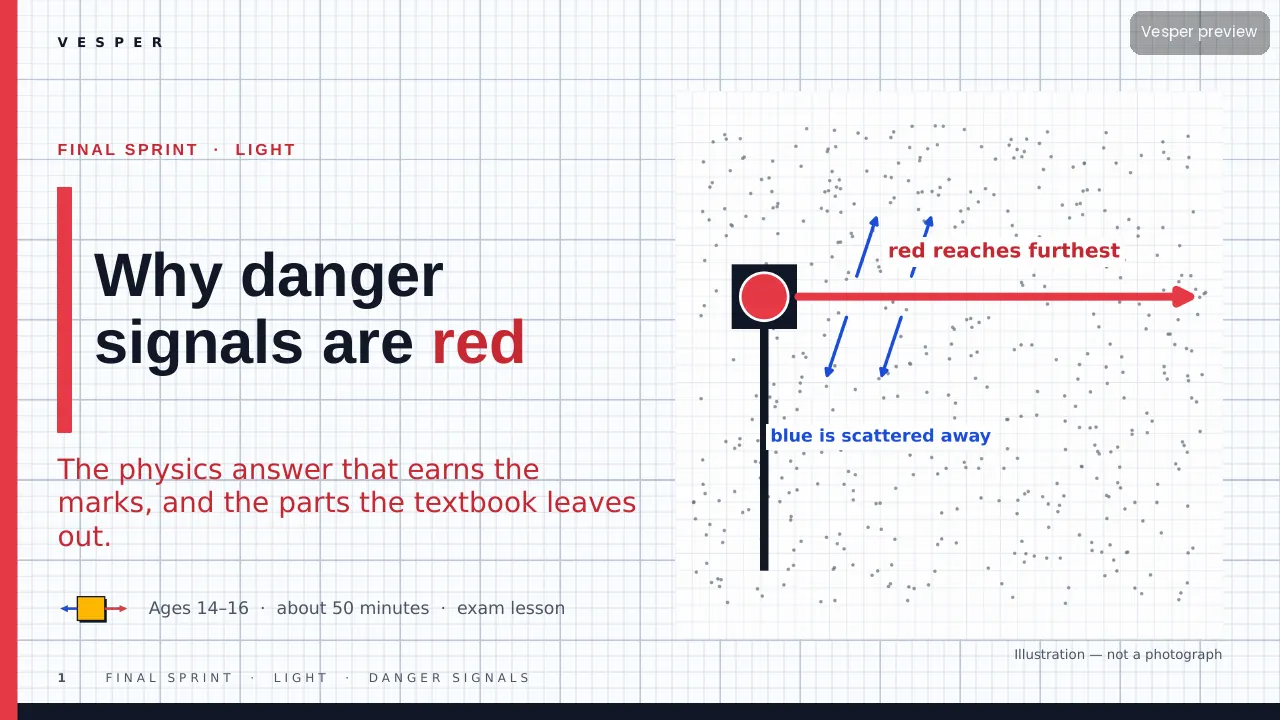
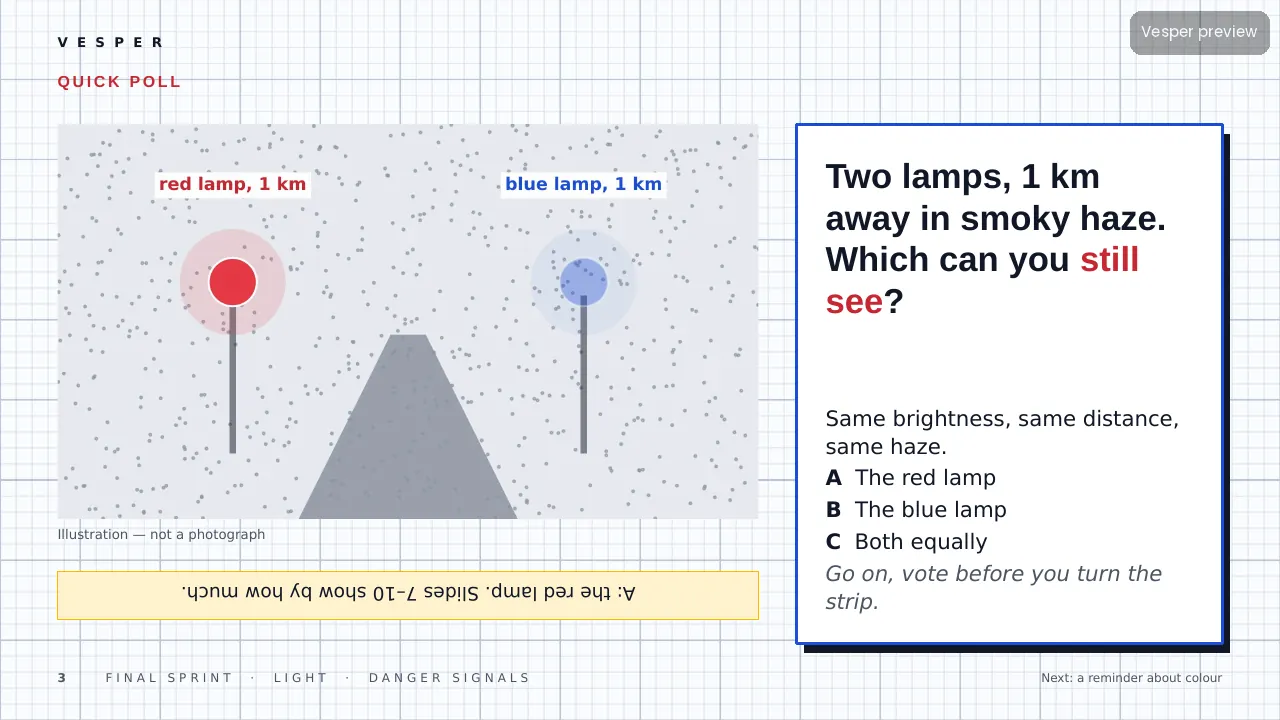
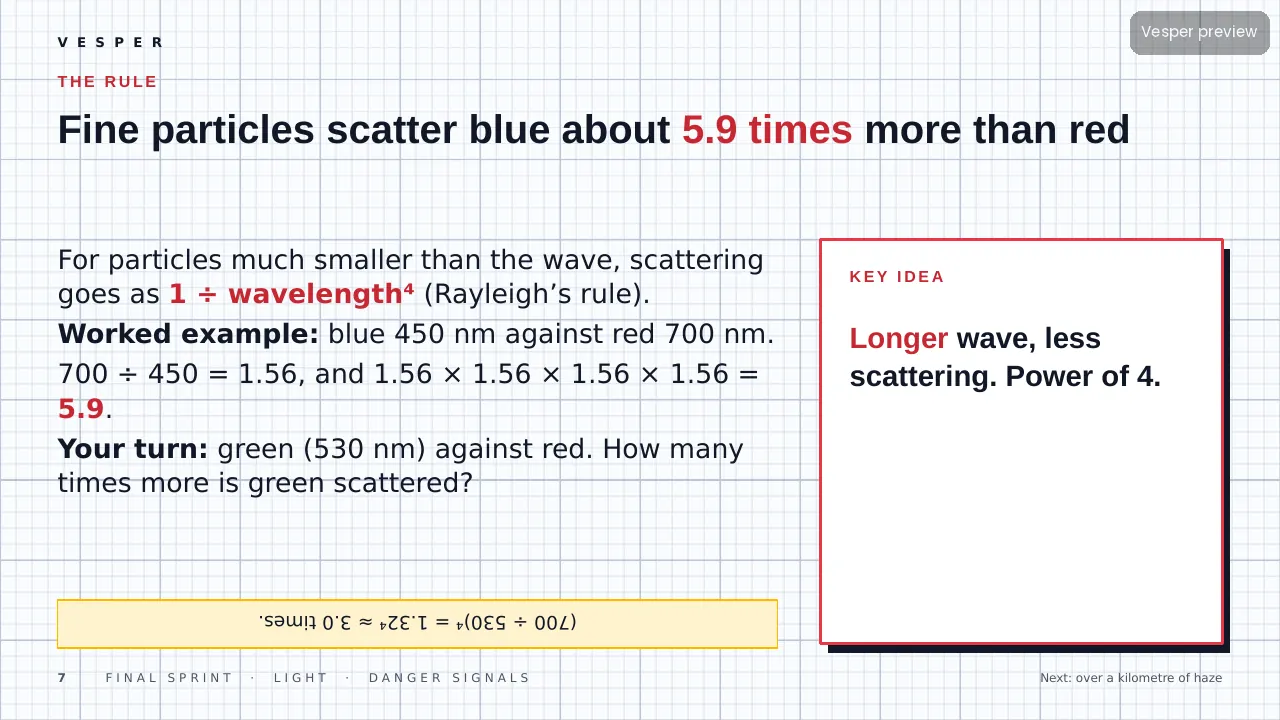
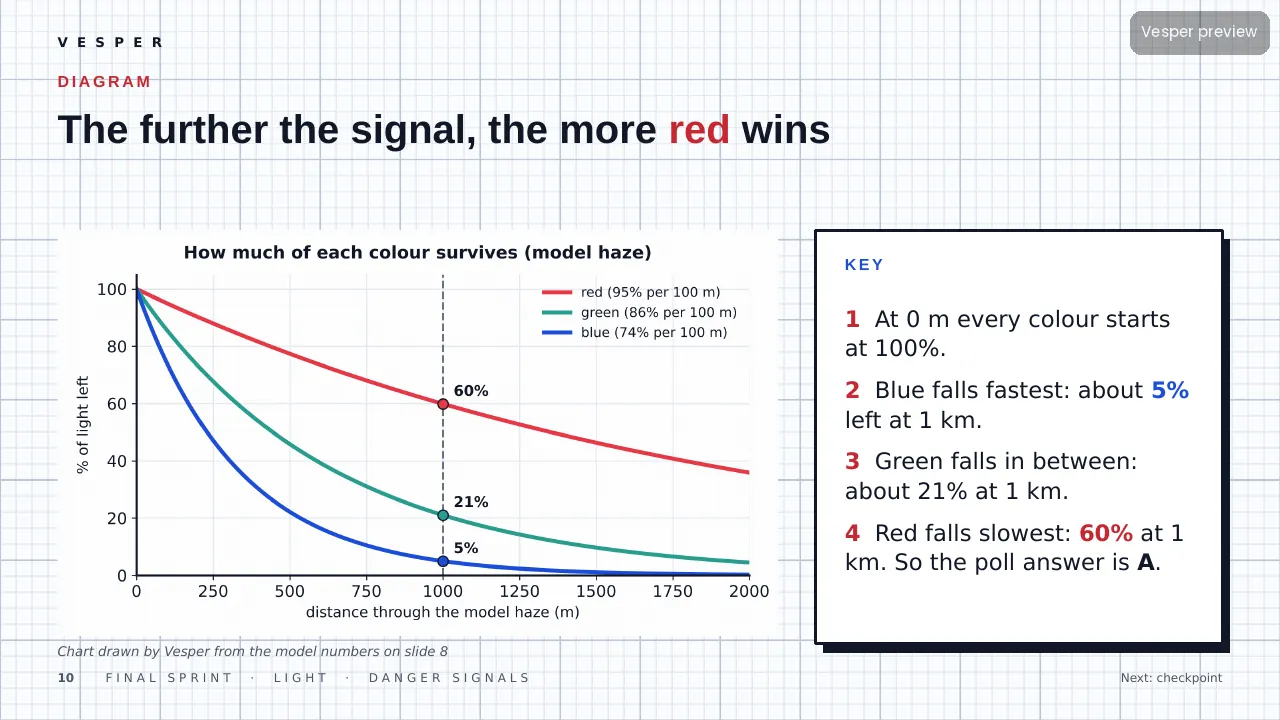
Two lamps, the same brightness, 1 km away in smoky haze. Which can you still see? Students learn the answer that earns full marks, then the numbers behind it. Red has the longest wavelength we can see, and particles much smaller than the wave scatter light as 1/λ⁴ (Rayleigh’s rule), so blue at 450 nm is scattered about 5.9 times more than red at 700 nm. Following two lamps through a model haze, 100 m at a time, students find 60% of the red left after a kilometre and only 5% of the blue.
Then the lesson asks where the rule stops. Fog droplets, about 10 µm across, scatter every colour equally, so ‘red cuts through fog’ is a myth. Red also matters for contrast against greens and greys, and for history: the first traffic signal, in December 1868, showed red for stop. In the dark, the eye’s rods are almost blind to red. About 1 in 12 men has red–green colour vision deficiency, which is why red sits on top. A 1995 study of lime-yellow fire engines adds a twist.
Inside the deck
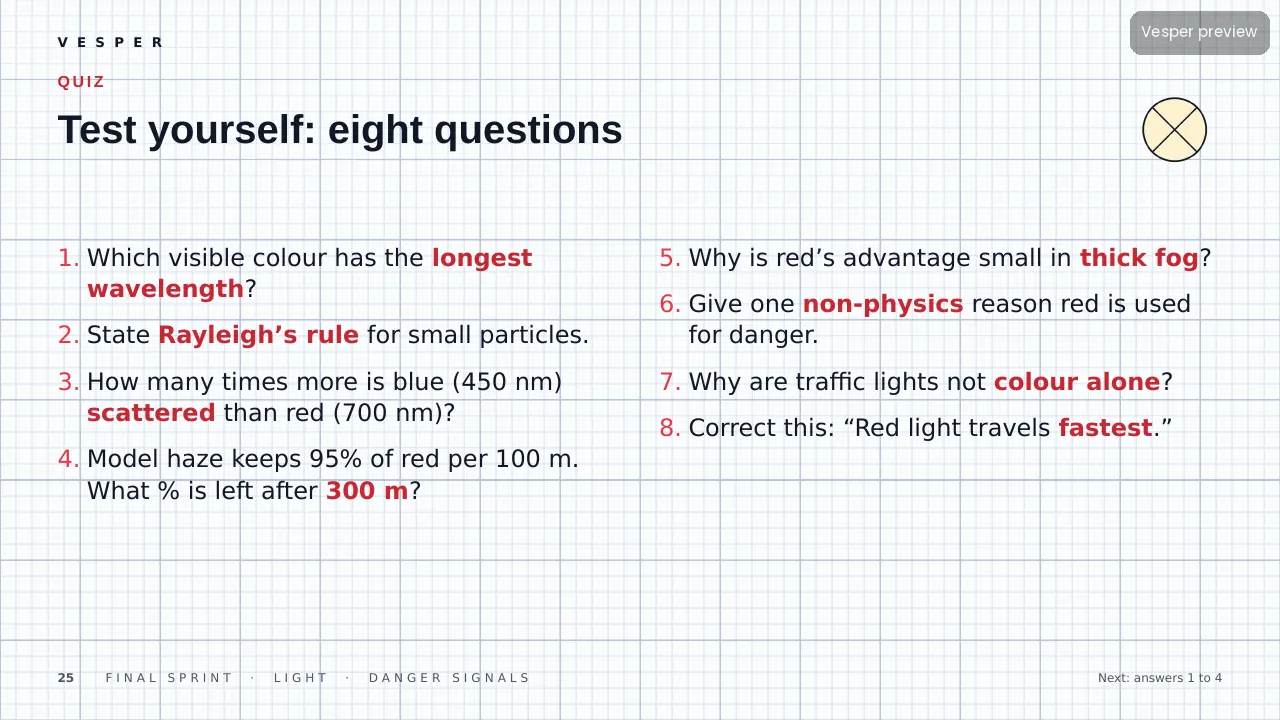
31 slides on the Vector template: a poll hook, a primer on wavelength, five your-turn calculations, a diagram walk, two myth slides including a 1-out-of-3 answer to fix, two checkpoints and an eight-question quiz with answers. The 6-mark exam question has a full mark scheme, and the 3-mark answer is modelled as three linked points.
How to teach it
About 50 minutes, including a 6-minute timed exam question. The milky-water activity (a teaspoon of milk in a litre of water, red and blue torches) shows the scattering live. Part of the Final Sprint collection.
Who it’s for
Learners aged 14–16 revising light and scattering, and teachers who want students to write the full-mark answer and understand its limits.