About this lesson
What students discover
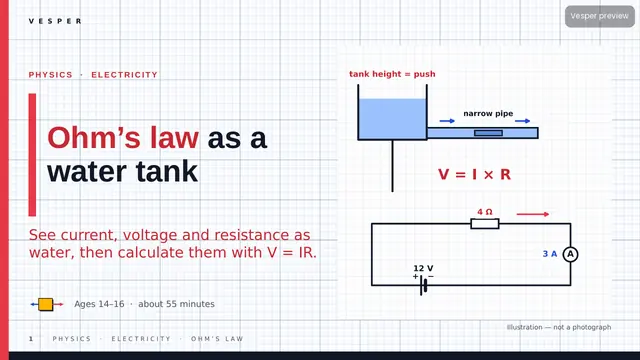
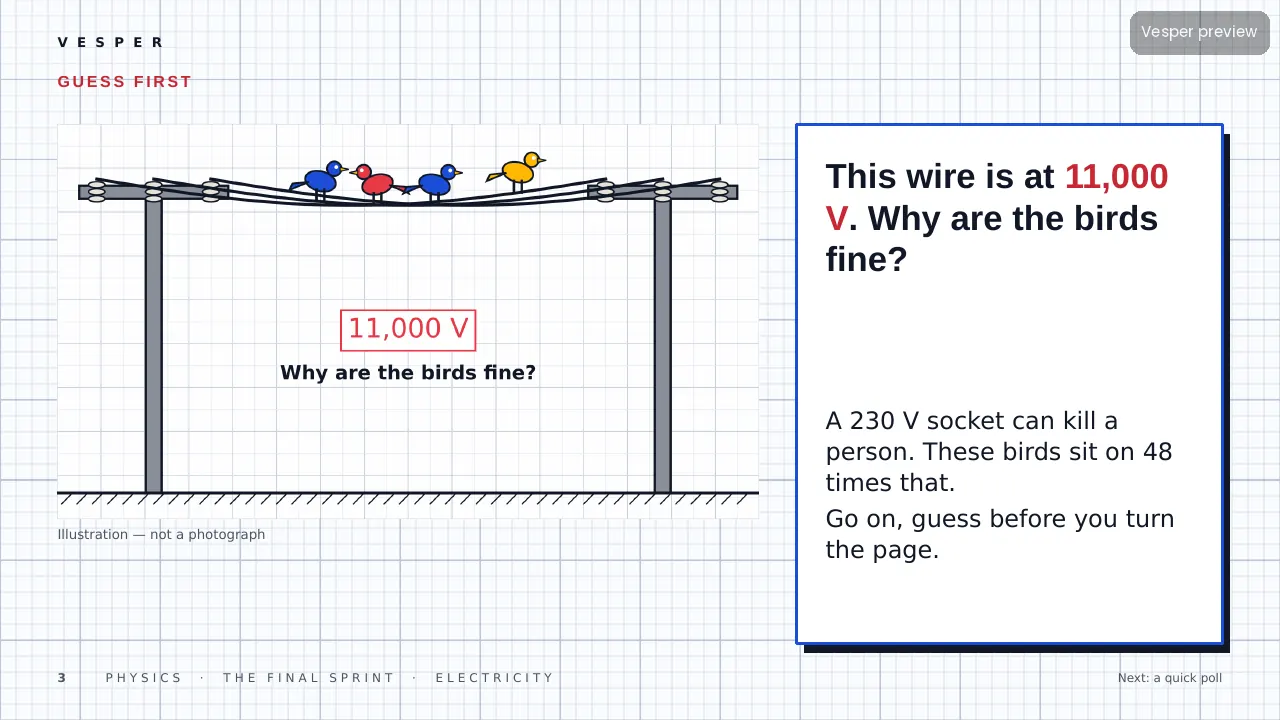
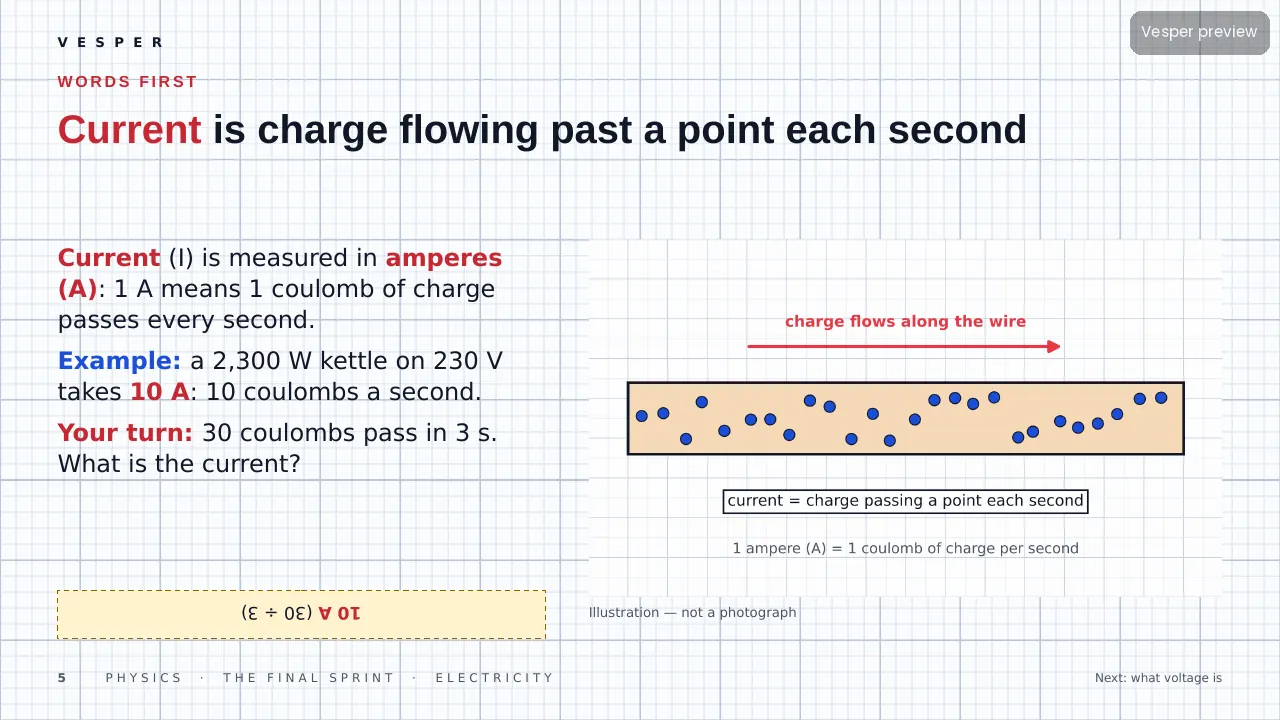
A bird sits on an 11,000 V line and nothing happens, while a 230 V socket can kill a person. This lesson turns that puzzle into exam-ready physics. Students meet current, potential difference and resistance with real numbers (a 2,300 W kettle on 230 V takes 10 A; 12 V across 4 Ω gives 3 A), then learn that current needs a complete loop and a difference between two points.
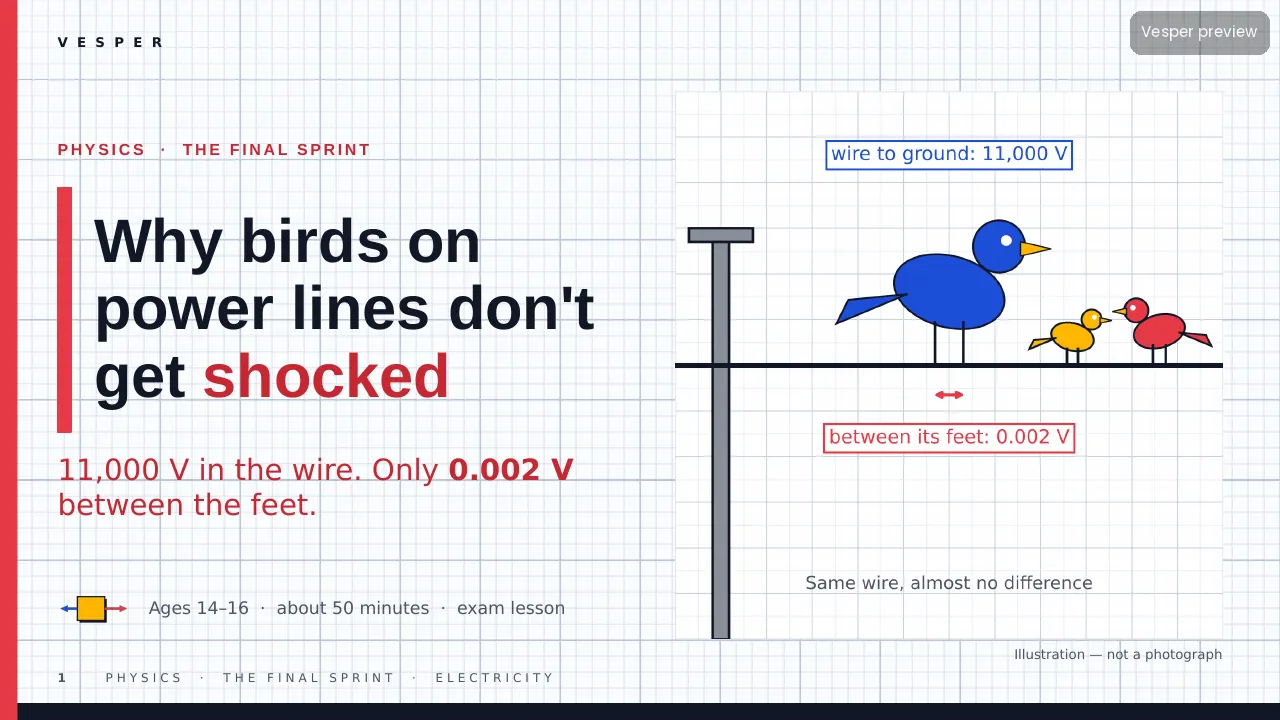
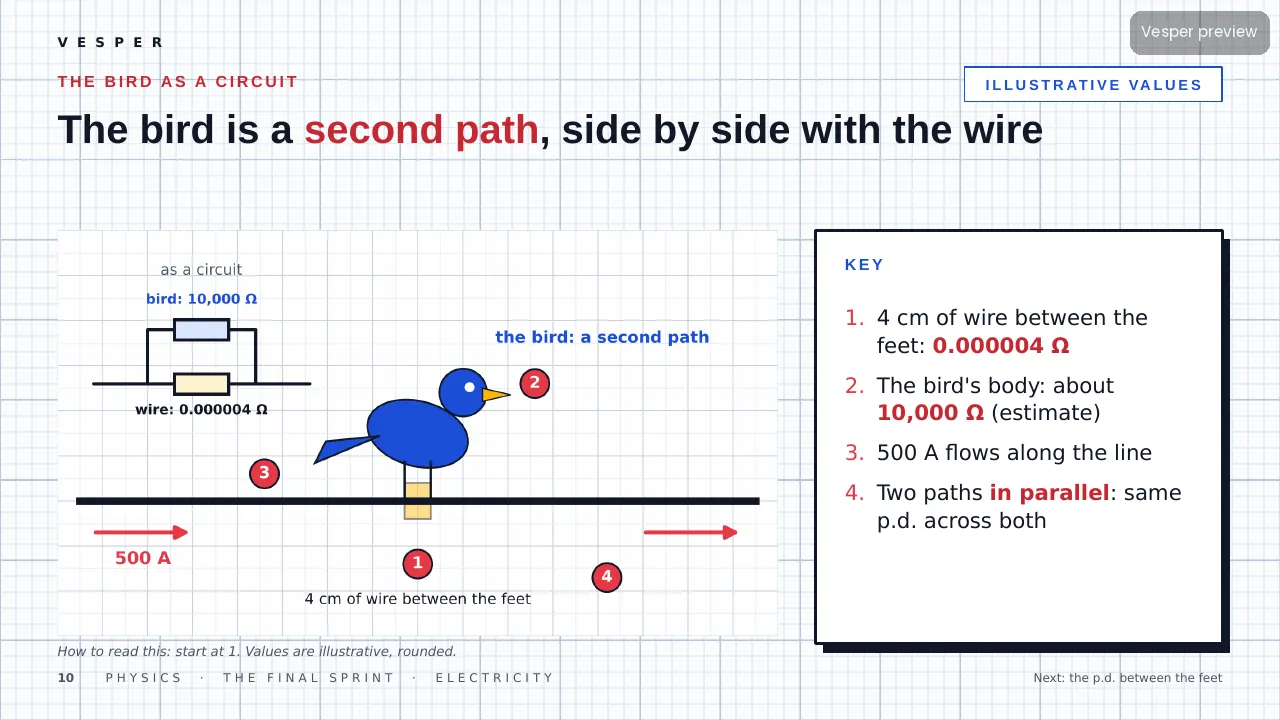
Next they treat the bird as a second path beside the wire. With 500 A in the line and 0.000004 Ω of wire between the feet, V = IR gives just 0.002 V, and about 0.0000002 A flows through the bird: 5,000 times less than the smallest current a person can feel. A myth slide clears up insulated feet (even at 100 Ω the bird would carry only 0.00002 A). Then the danger cases: an eagle’s wing touching a second wire puts 11,000 V across it and drives about 1.1 A, 5.5 million times more; a person on a ladder touching a 230 V wire takes about 0.23 A. Ravi’s I = V × R slip is the spot-the-mistake, and specialist lineworkers bonded to a live 400,000 V wire are the bet-you-didn’t-know.
Inside the deck
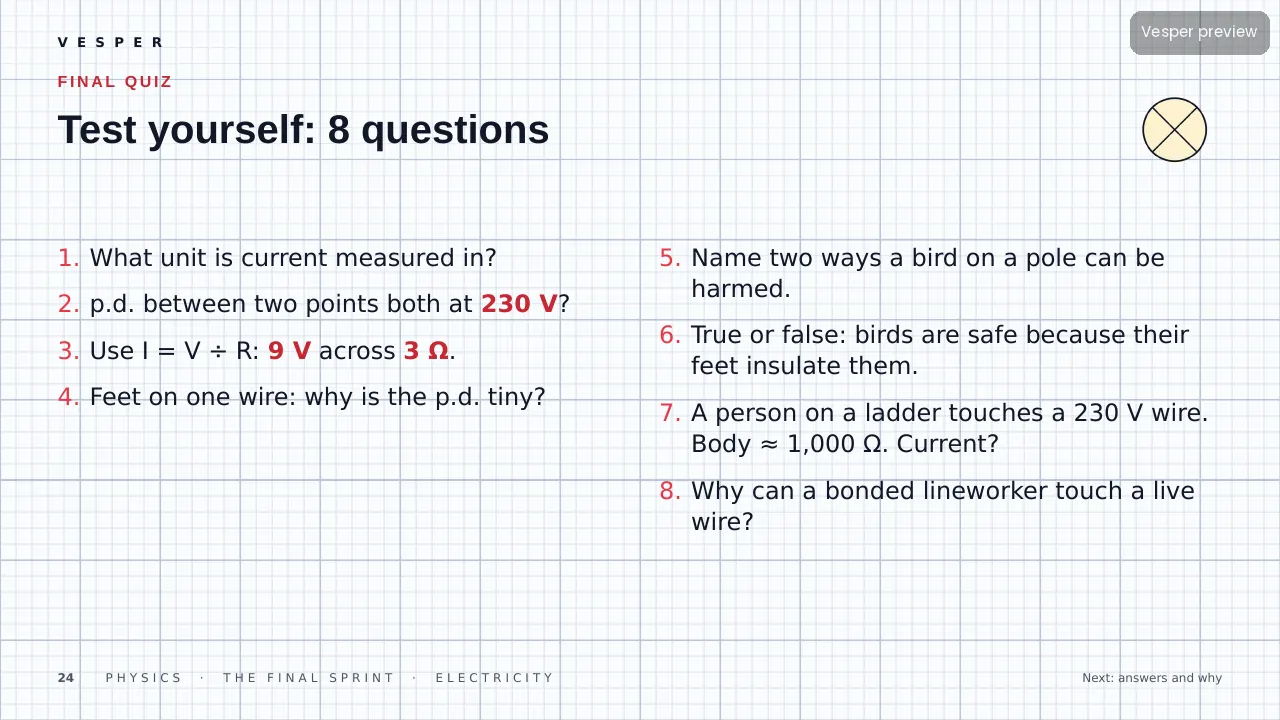
29 slides on the Vector template: a guess-first hook, a quick poll, a primer, a diagram walk of the bird as a circuit, six your-turn tasks, a pause-and-predict, two checkpoints, bird-safe pole design and an eight-question quiz with explained answers. A 6-mark exam-style question comes with a full mark scheme. Rounded estimates, such as the bird’s resistance, are labelled.
How to teach it
About 50 minutes. The safe home model uses two AA cells, a bulb and bare wire, with a second 2.5 V torch bulb as the ‘bird’. Part of the Final Sprint collection; speaker notes sit on every slide.
Who it’s for
Learners aged 14–16 revising electric circuits and electrical safety, and anyone who has looked up at a row of birds on a wire and wondered.