About this lesson
What students discover
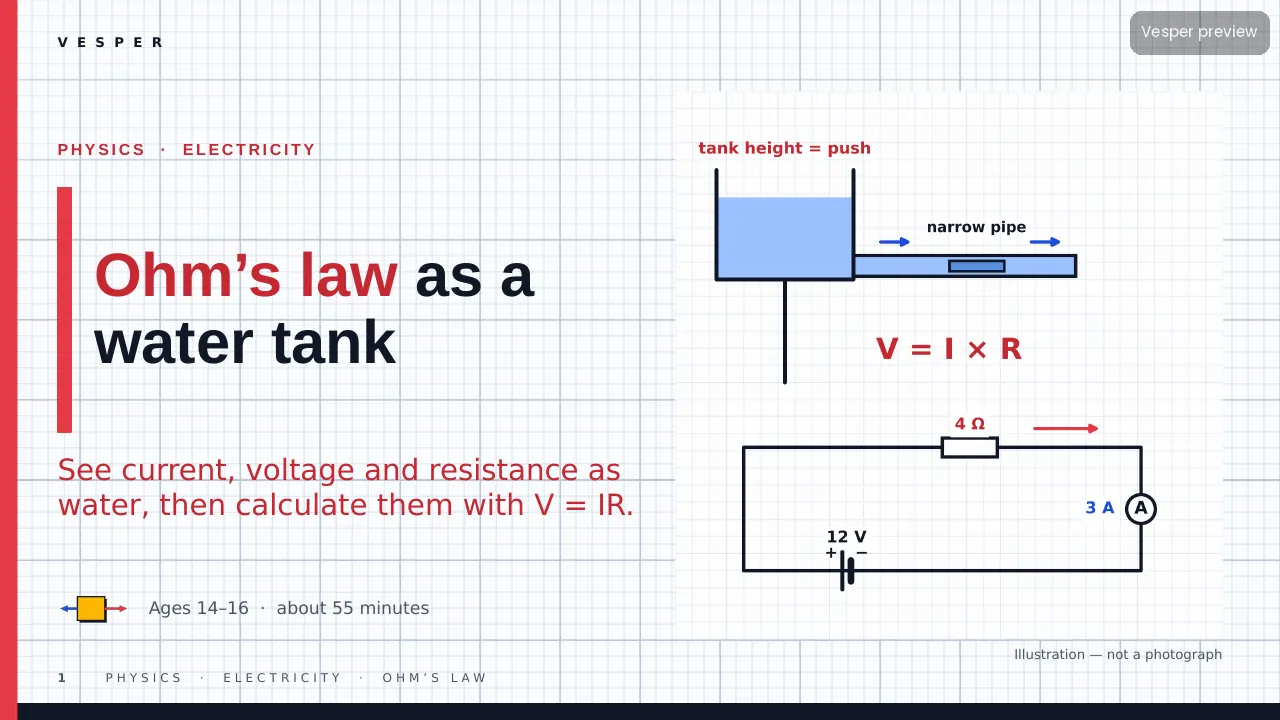
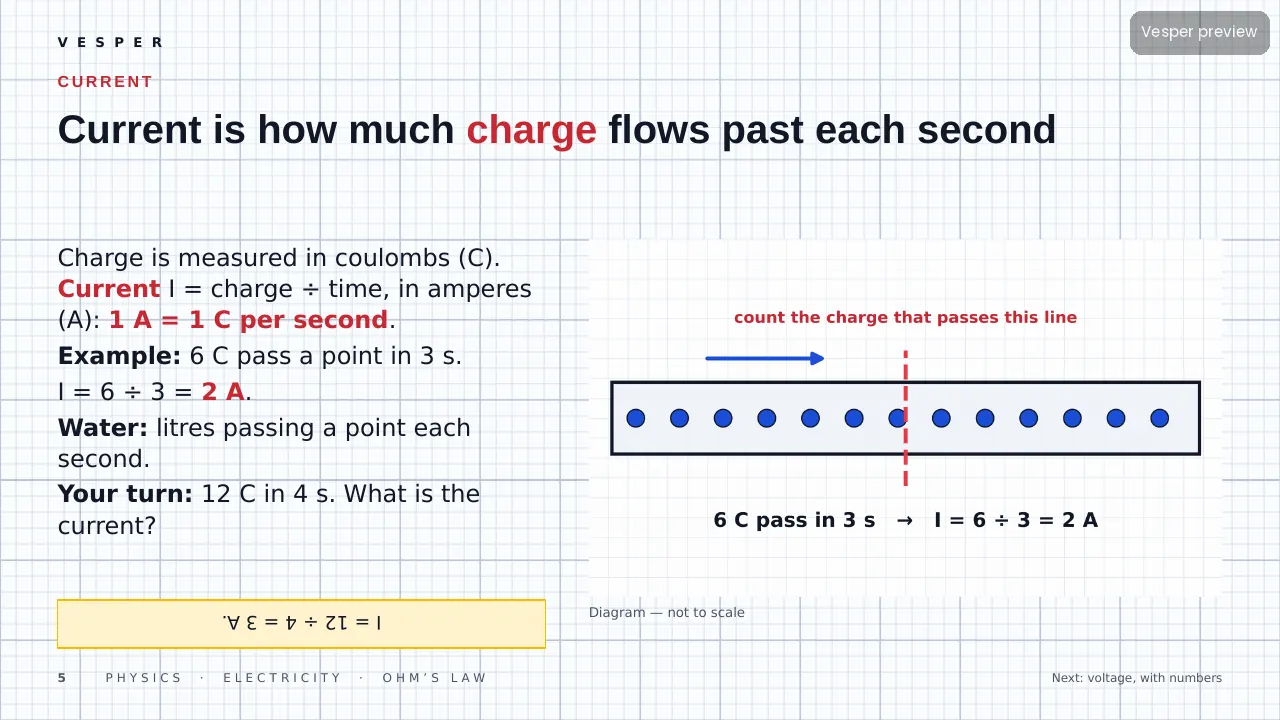
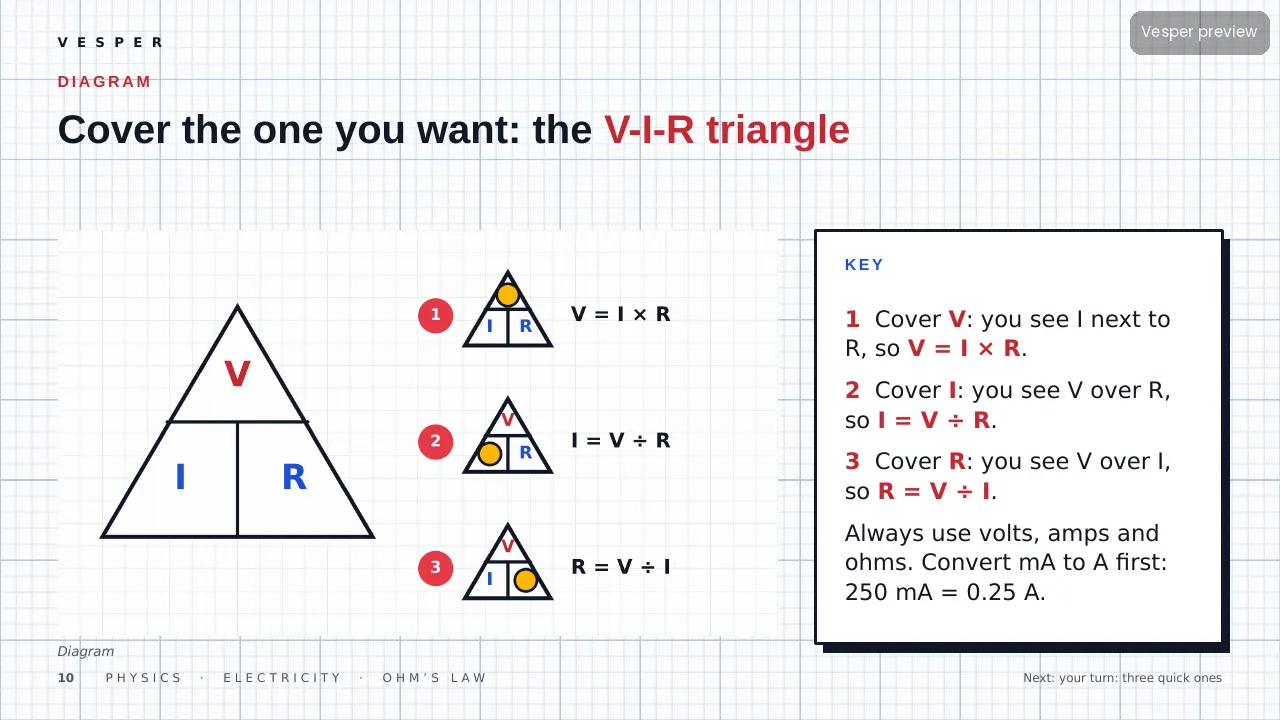
You can’t see a volt, but you can picture a tank of water. Students map every part of a circuit onto a water model: the pump is the cell, tank height is voltage, flow is current and a narrow pipe is resistance. Then the picture becomes numbers. They calculate current from charge and time, energy from voltage, and use V = IR in all three forms with a cover-up triangle.
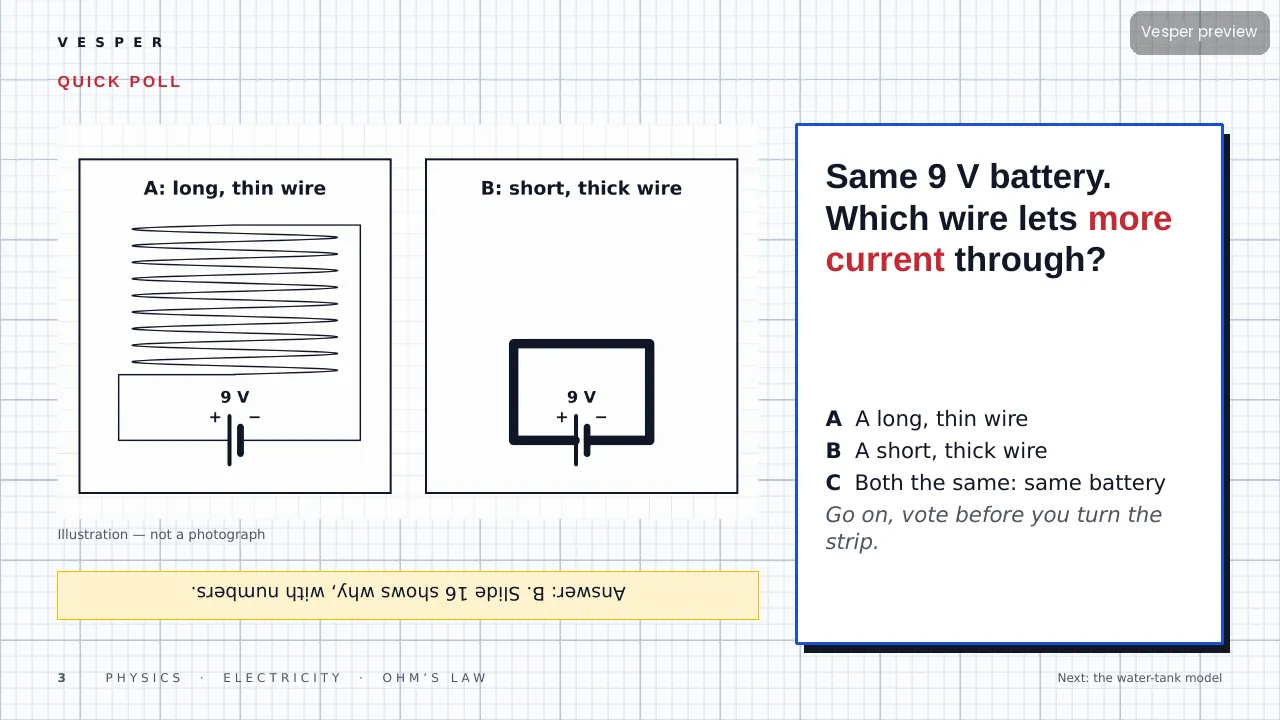
A real V–I graph proves the rule and a filament lamp shows where it fails. Students work out how length, thickness and material change resistance (nichrome resists about 65 times more than copper), then add resistors in series (2 Ω + 4 Ω = 6 Ω) and in parallel (6 Ω and 3 Ω make 2 Ω).
Inside the deck
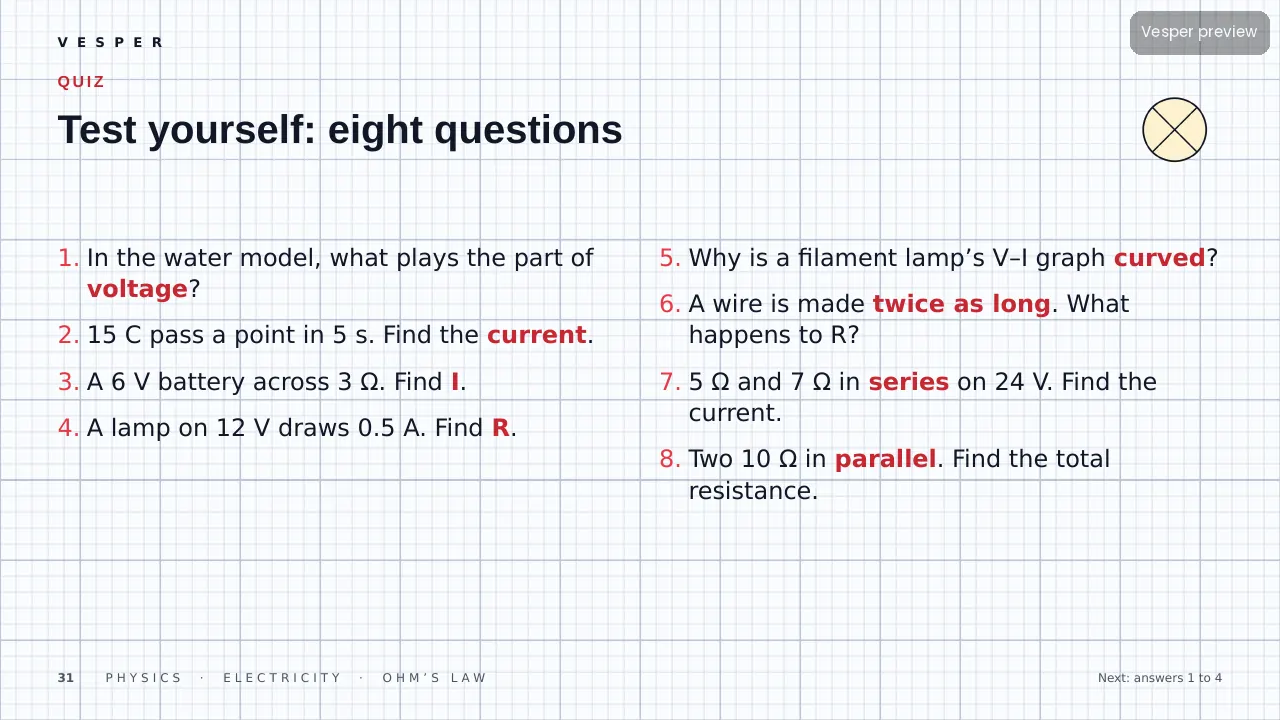
35 slides on the Vector template with eleven your-turn problems, each with its answer. There are two myth slides, electrons that drift at about 0.07 mm a second, a frontier slide on where the water model breaks, Georg Ohm’s 1827 measurements, a 230 V kettle drawing about 10 A, a drinking-straw experiment to feel resistance, two checkpoints and an 8-question quiz with explained answers.
How to teach it
Allow about 55 minutes, as the cover says. With every activity in the notes it runs to about 81 minutes, so it also splits into two lessons: the model and V = IR (slides 1–14), then resistance, series and parallel (15–35). The straw activity on slide 28 needs one wide and one thin straw per student. Notes on every slide give Say, Ask, Watch for and Time.
Who it’s for
For ages 14–16 studying current electricity, resistance and circuits. Useful for students who find circuits abstract, and as revision before exams. The PowerPoint is editable, with named layouts for your own slides.