About this lesson
What students discover
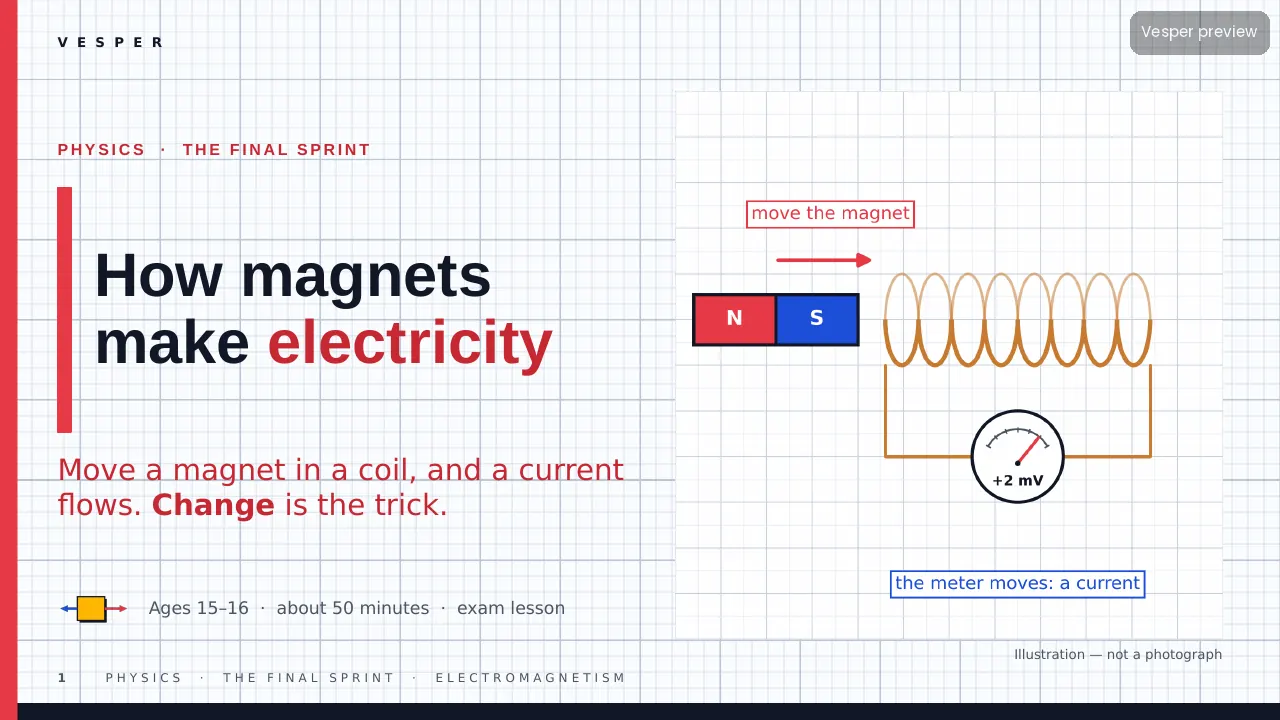
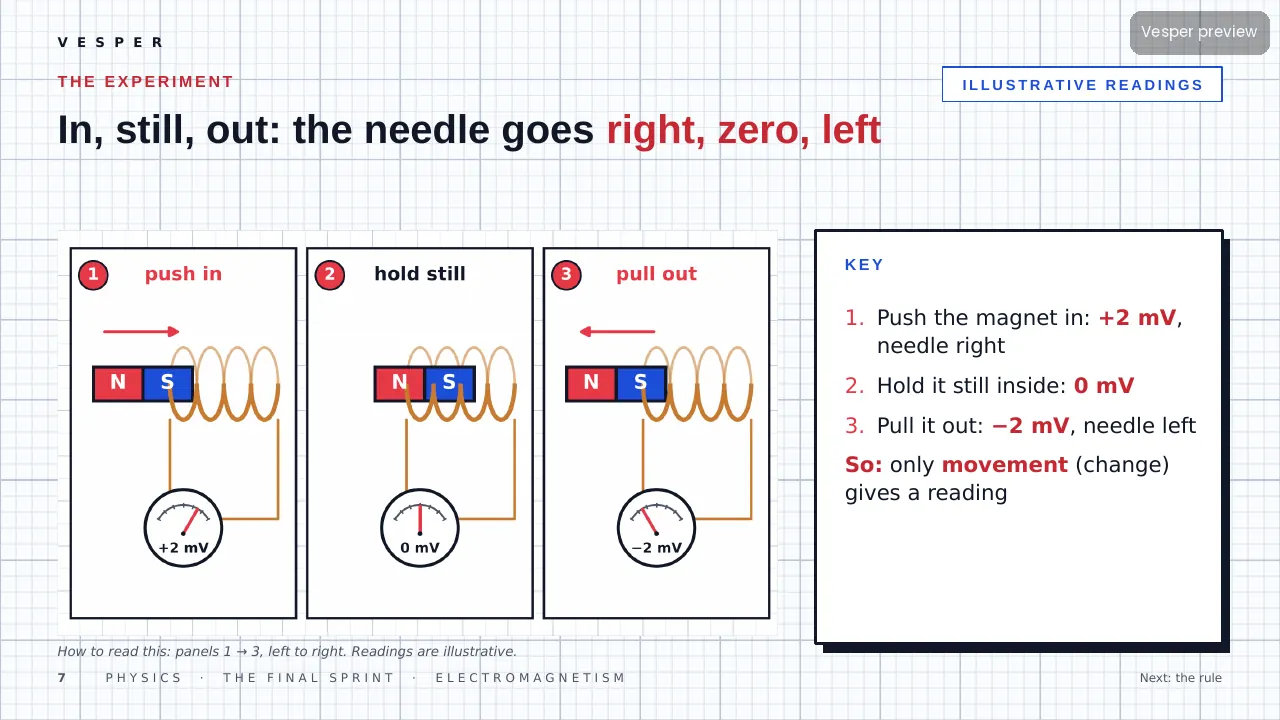
Push a magnet into a coil and the meter flicks right; hold it still and it reads zero; pull it out and it flicks left. This lesson builds electromagnetic induction from that one experiment. Students learn the rule (a changing magnetic field through a coil induces an e.m.f.), meet Michael Faraday’s iron ring of August 1831, and see three factors at work with real readings: twice as fast, 2 mV becomes 4 mV; twice the turns, 4 mV again; a stronger magnet, bigger still. Priya’s ‘a resting magnet gives a steady current’ is the spot-the-mistake.
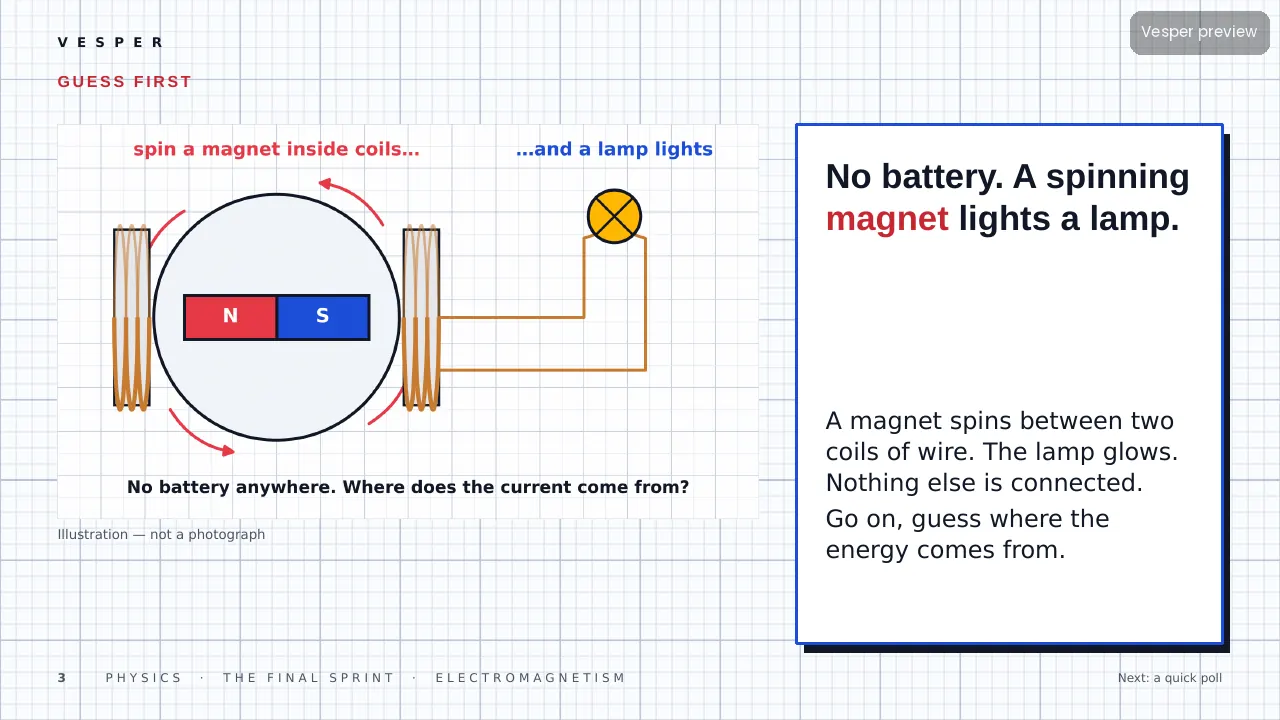
Then direction and energy: the induced current always pushes back against the change, which is why the energy has to come from whoever moves the magnet, and why magnets don’t give free electricity. A spinning coil between magnets makes alternating current, and mains in India and the UK reverses 50 times a second. Fleming’s right-hand rule gives the direction. Real-world slides cover power stations spinning generators 3,000 times a minute, a 6 V, 3 W bike dynamo, the transformer (230 V in, 1,000 turns to 50, gives 11.5 V) and wireless phone charging.
Inside the deck
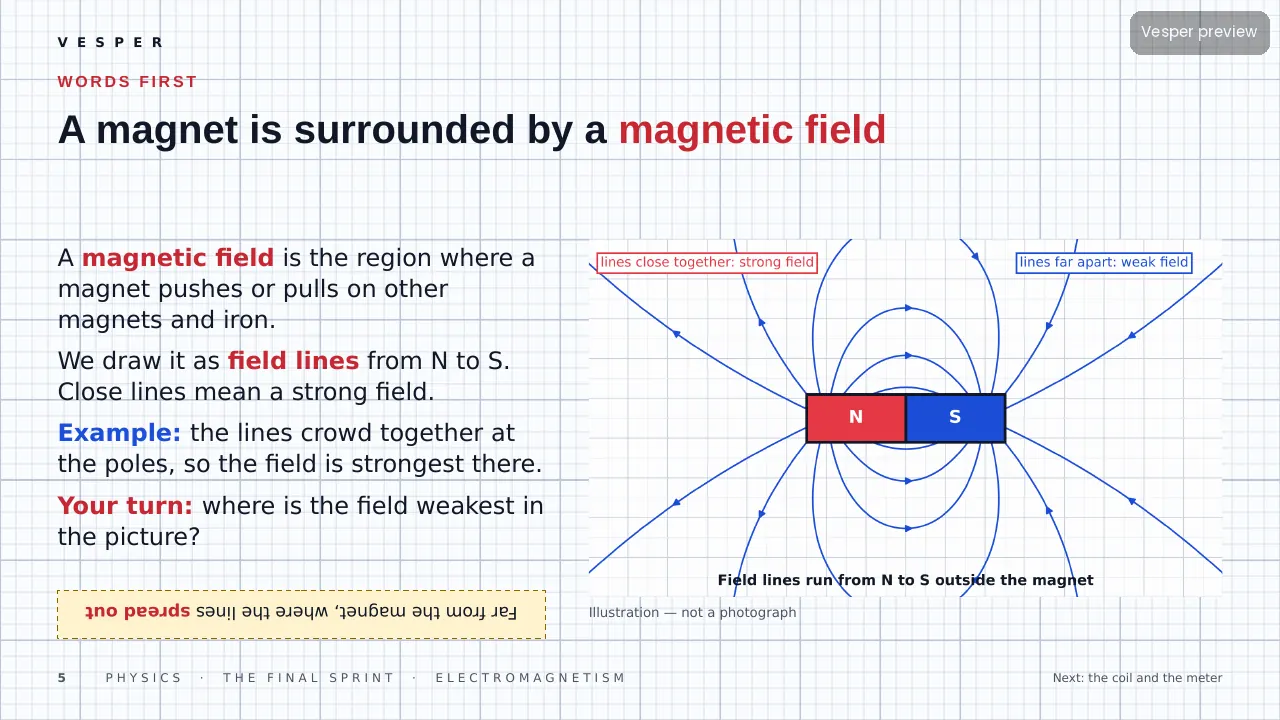
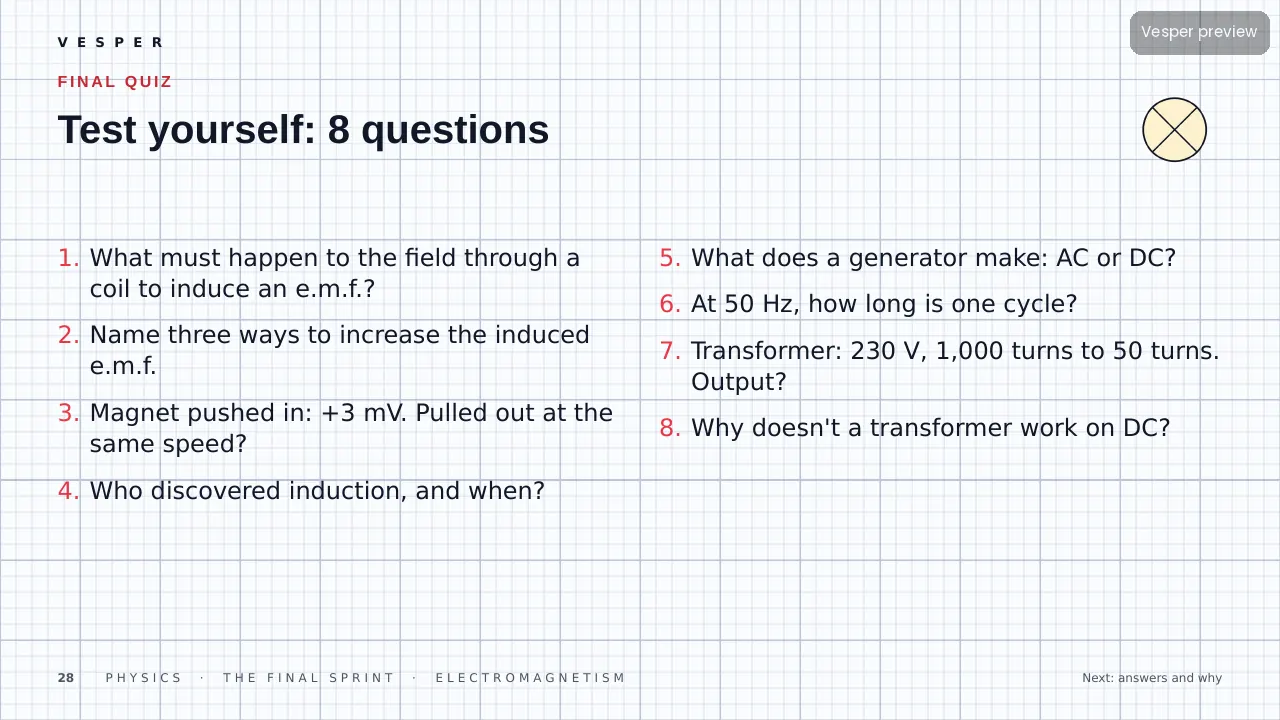
33 slides on the Vector template: a hook, a quick poll, two primers, two diagram walks, a people slide, nine your-turn moments, a pause-and-predict, a myth slide, two checkpoints and an eight-question quiz with explained answers. A 6-mark exam question on a magnet and coil comes with a mark scheme.
How to teach it
About 50 minutes. The copper-pipe activity, with an adult present, is memorable: a steel bolt falls through 1 m of pipe in about 0.45 s, and a strong magnet takes far longer, because induced currents push back. Part of the Final Sprint collection; speaker notes sit on every slide.
Who it’s for
Learners aged 15–16 revising electromagnetic effects, and teachers who want induction rooted in one clear experiment.