Physics Ages 13–14

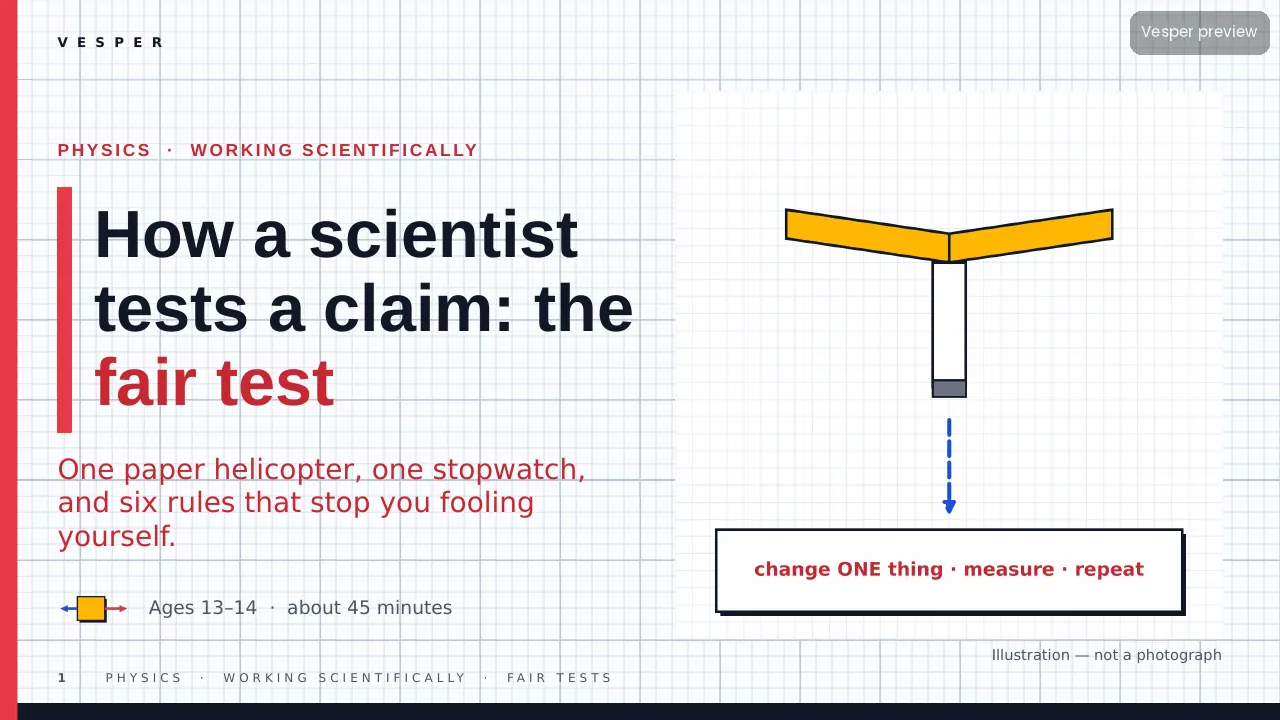
How a scientist tests a claim: the fair-test checklist

One paper helicopter, one stopwatch, and six rules that stop you fooling yourself.

A 24-slide lesson that builds a six-point fair-test checklist using paper helicopters, means, anomalies and graphs. Students fix a broken test before running their own.

The short answer

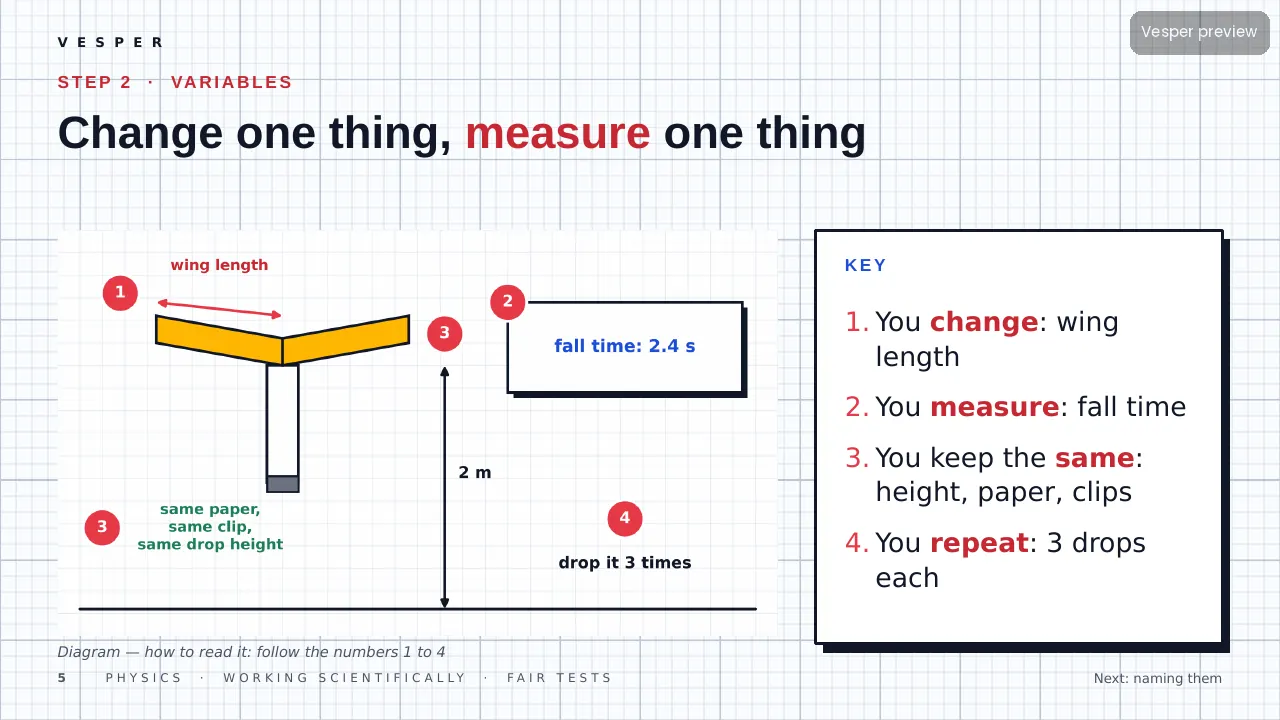
A fair test changes one thing (the independent variable), measures one thing (the dependent variable) and keeps everything else the same (the control variables). Repeat each measurement at least three times, take the mean, check any odd result rather than hiding it, and only then draw a conclusion from the pattern.

Inside the deck

slides
24
quiz questions
8
minutes
45
your-turn tasks
3

Choose a format

  • Lesson Notes (PDF)Every slide with its teacher notes, as a PDF to read or print.
  • Teacher DeckThe editable PowerPoint with speaker notes on every slide, a PDF copy and the matching Vesper slide template, so you can add slides of your own.
Pricing coming soon

Pricing coming soon

We’ll email you pricing and launch offers shortly.

  • Finished and checked: buying opens soon
  • Sources listed at the end
  • Curriculum links under ‘Curriculum & specs’
  • For one classroom. Campus licences for whole schools

Key facts

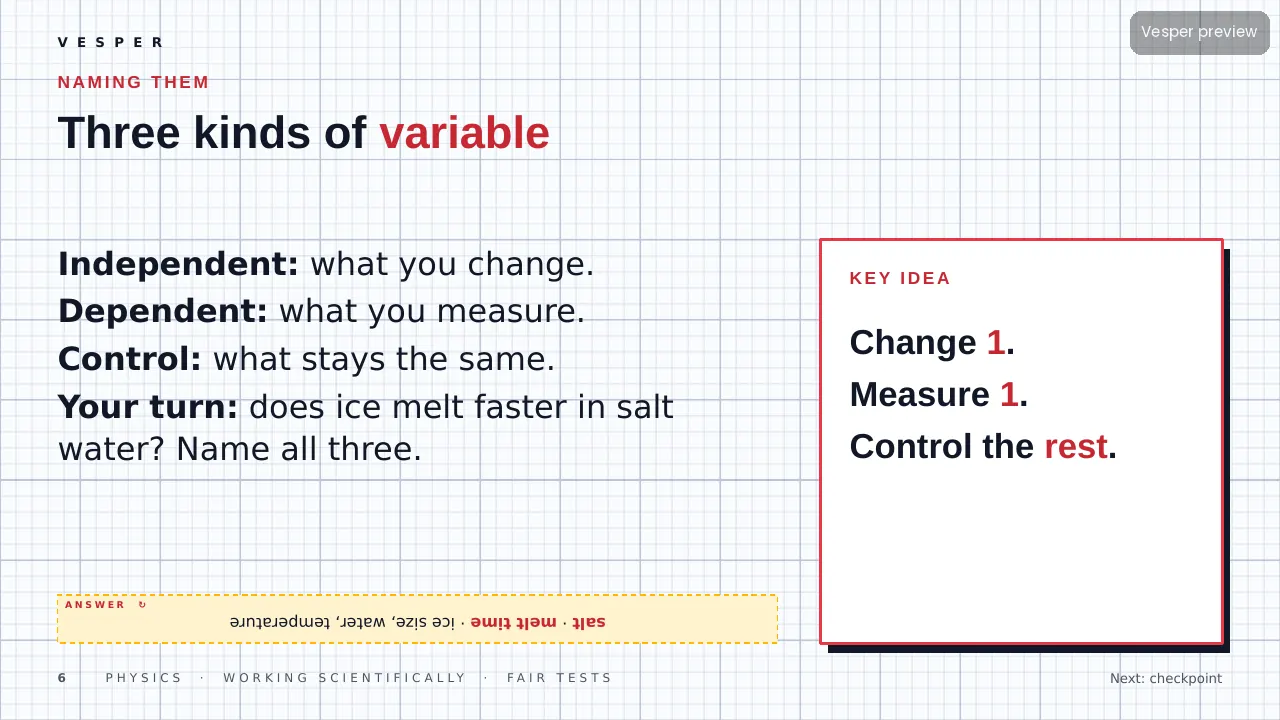
  • Independent variable: what you change. Dependent: what you measure. Control: what stays the same.
  • Repeat at least 3 times: drops of 2.1, 2.3 and 2.2 s give a mean of 2.2 s.
  • A catch at about 20 cm on the ruler test means a reaction time of about 0.2 s.
  • In the sample data, wings from 4 cm to 10 cm slow the fall from 1.7 s to 2.9 s.
  • Galileo timed balls rolling down ramps around 1604 because free falls were too fast to time.

What students will be able to do

  • Students can decide whether a claim is testable.
  • Students can identify the independent, dependent and control variables in an investigation.
  • Students can calculate a mean from repeated results and handle an anomaly honestly.
  • Students can explain how reaction time adds error to a timing measurement.
  • Students can use a six-point checklist to judge whether a result can be trusted.

About this lesson

What students discover

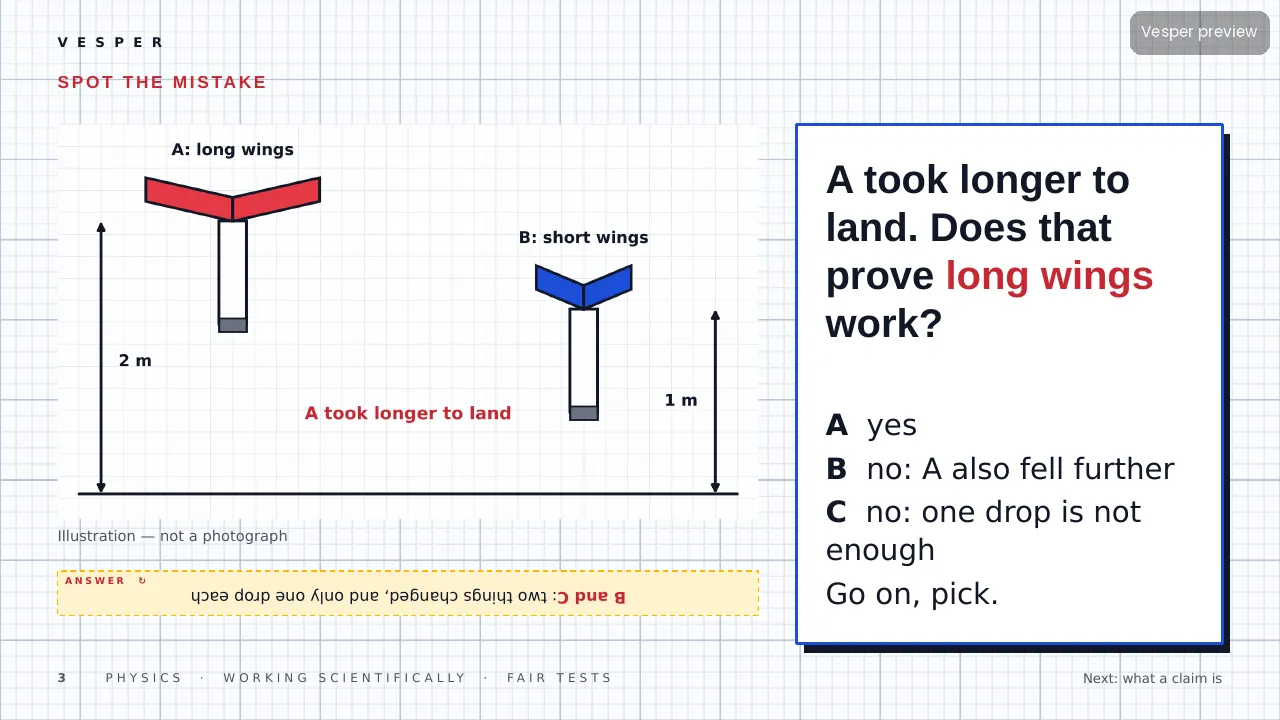
‘Longer wings make a paper helicopter fall more slowly.’ Is it true? This lesson teaches students how to find out without fooling themselves. The hook test goes wrong in two ways: helicopter A had longer wings but was also dropped from higher, and each was dropped once. Students fix it step by step. A claim must be testable (‘music helps plants grow taller’ can be; ‘cats are cuter’ can’t). Change one thing, measure one thing, and keep the rest the same: independent, dependent and control variables.

Then the numbers. Students spot an unfair comparison by counting paper clips, calculate a mean from three drops (2.1, 2.3 and 2.2 s give 2.2 s), and treat a 4.0 s drop as an anomaly to check and repeat, never to hide. A ruler-drop test shows that thumbs add about 0.2 s of reaction-time error, a real problem on a 2 s fall. A graph shows the pattern: wings from 4 cm to 10 cm, fall times from 1.7 s to 2.9 s. Galileo slowing falls down with a ramp around 1604, and a myth slide on ‘one amazing result’, round it off.

Inside the deck

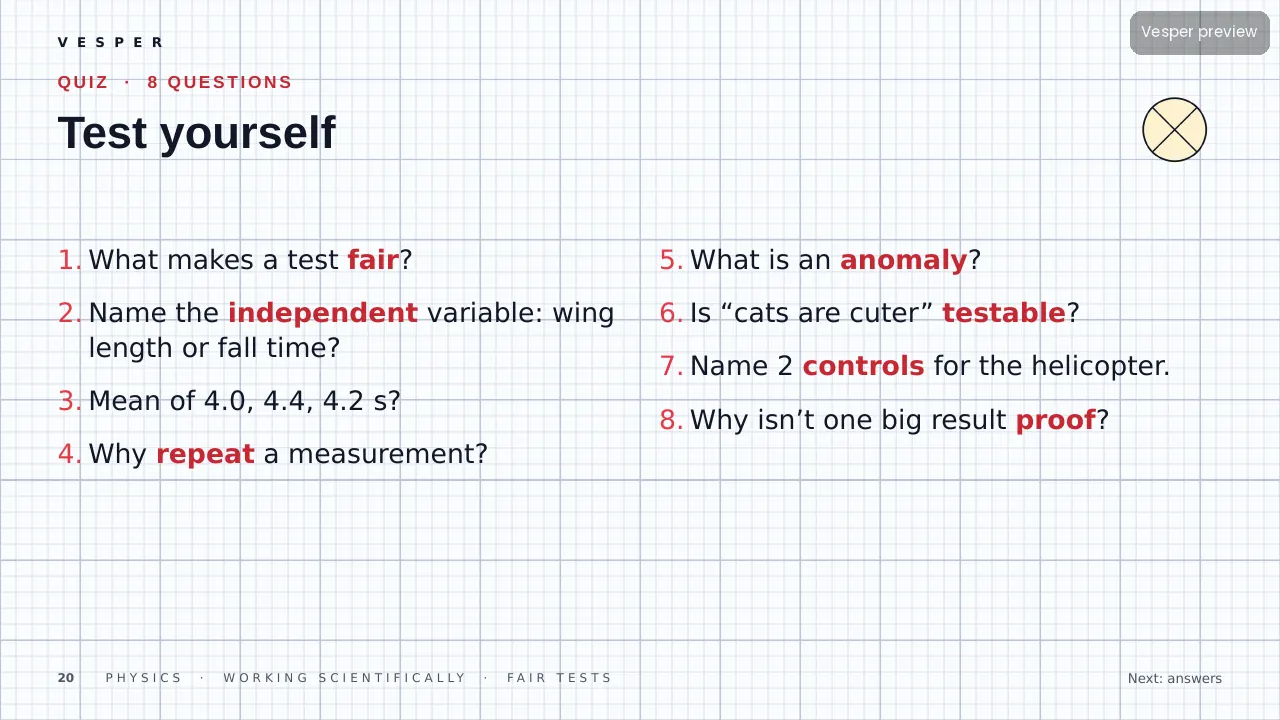
24 slides on the Vector template: a spot-the-mistake hook, a quick poll, a diagram walk, three your-turn tasks, two checkpoints, an evidence slide and a six-tick checklist summary that works for any claim in any subject. An eight-question quiz has explained answers. The helicopter results are labelled as sample teaching data.

How to teach it

About 45 minutes. The activity uses 4, 6 and 8 cm wings, one clip each, dropped from 2 m three times: it runs in class with paper, clips and a phone stopwatch. Speaker notes sit on every slide.

Who it’s for

Learners aged 13–14 starting investigations, and any teacher who wants one checklist students can carry into every practical.
Curriculum & specs

CBSE/NCERT (India)Class 8 · Class 8 Curiosity ch 1 Exploring the Investigative World of Science
CambridgeLS Thinking and Working Scientifically (all stages)
NGSS (US)MS-ETS1-3 (+ SEP 3 Planning and carrying out investigations)
IB MYPSciences · KC Relationships · RC Evidence · Crit B, C
Ages13–14
LevelMiddle
Slide templateVector
Slides24
Teaching timeAbout 45 minutes
LanguageEnglish (UK)

Questions

Questions, answered

What is a fair test in science?

A test where only one thing is changed and one thing is measured, while everything else is kept the same.

What are independent, dependent and control variables?

The independent variable is what you change, the dependent variable is what you measure, and control variables are kept the same so the test stays fair.

Why do scientists repeat experiments?

One result can be a fluke. Repeating at least three times and taking the mean shows the real pattern and helps you spot anomalies.

What should you do with an anomalous result?

Check it and repeat the measurement. Don't hide it; report it and explain how you handled it.

Why isn't one amazing result proof?

It could be a fluke or a trick. You need a fair comparison and repeated results before you trust a claim.

Is there a practical activity?

Yes. Students build paper helicopters with 4, 6 and 8 cm wings and drop each three times from 2 m.

Main sources

  1. Galileo Galilei (1638). Discourses and Mathematical Demonstrations Relating to Two New Sciences, Third Day (inclined-plane experiments).
  2. Reaction-time ruler test: d = ½gt²; 20 cm ≈ 0.20 s (calculation, g = 9.8 m/s²).
  3. Helicopter results on slides 9–13 are sample data made for teaching; your own results will differ.

The full source list is on the last slides of the deck. Spotted an error? Tell us.