Physics Ages 12–15

What's inside the Earth, and how we know without digging

Nobody has been there. Earthquake waves told us anyway.

A 26-slide lesson on Earth’s layers and the earthquake-wave evidence for them. Scale models and timing problems turn the evidence into numbers students can work with.

The short answer

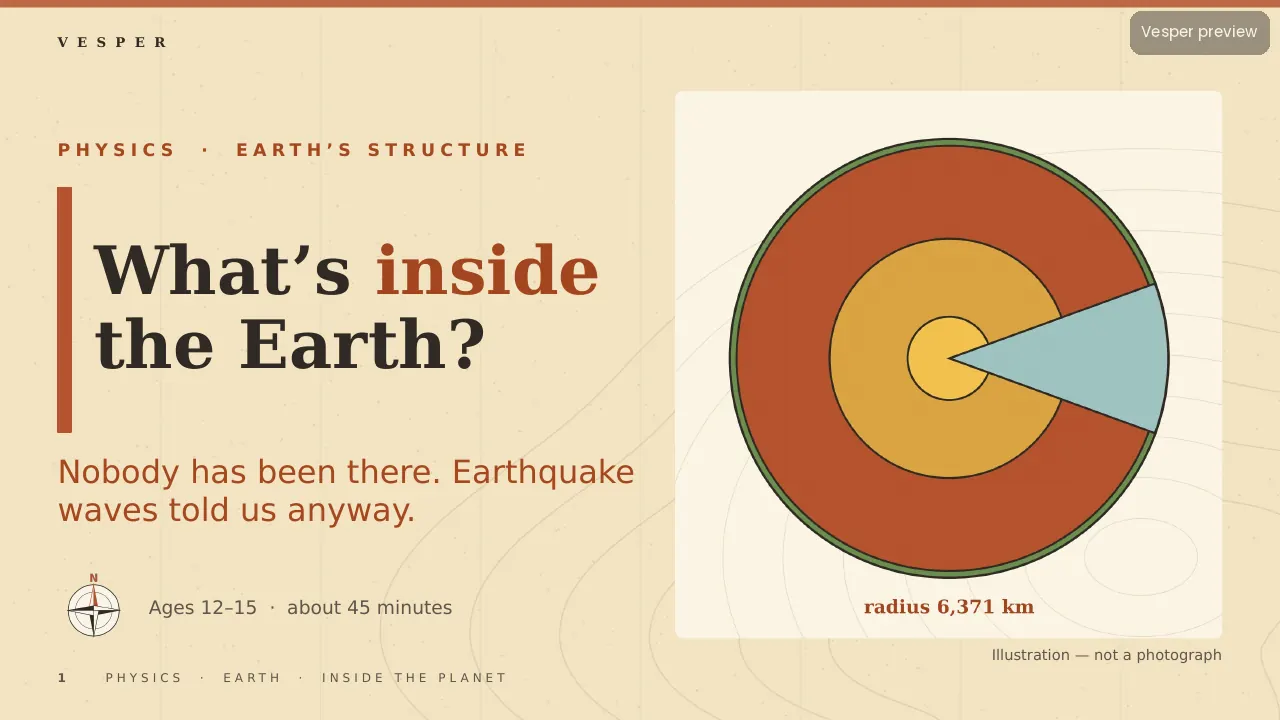
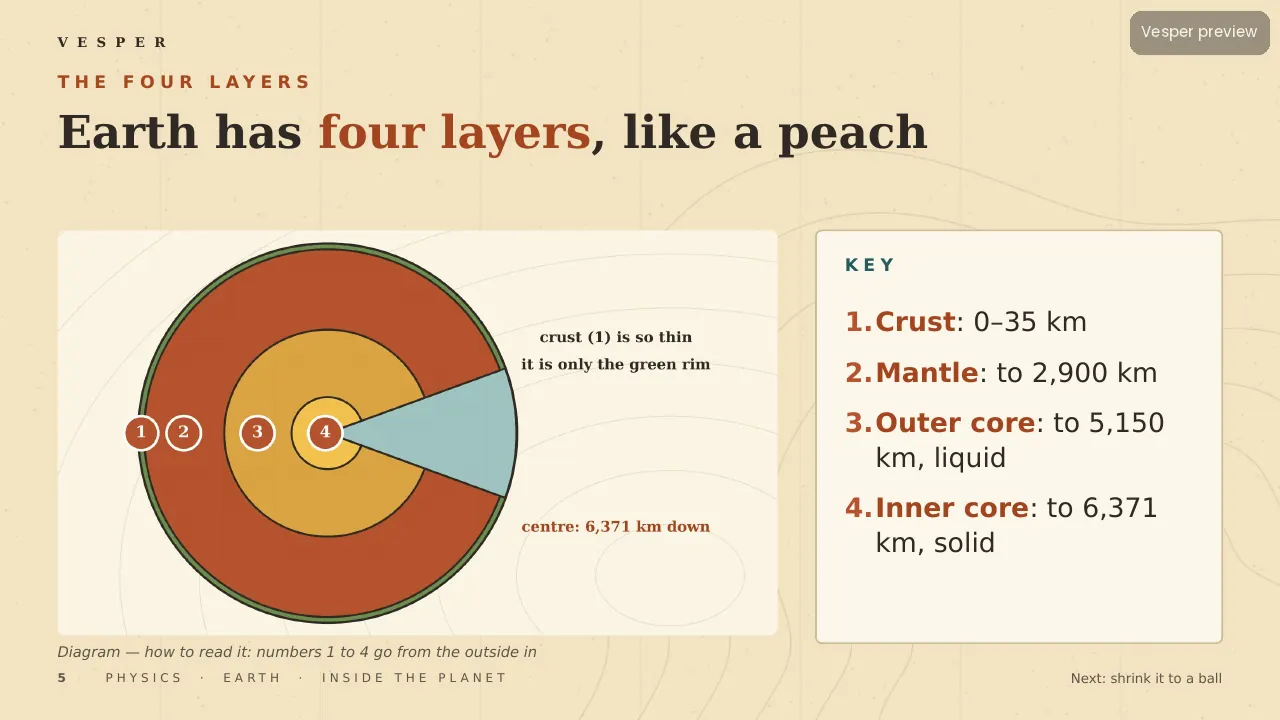
Earth has four layers: a thin rocky crust (to about 35 km), a solid but creeping mantle (to 2,900 km), a liquid iron outer core (to 5,150 km) and a solid inner core (to 6,371 km). We know because earthquake waves bend, slow and vanish inside Earth: S waves can't cross the liquid outer core, leaving a shadow zone.

Inside the deck

slides
26
quiz questions
8
minutes
45
your-turn tasks
4

Choose a format

  • Lesson Notes (PDF)Every slide with its teacher notes, as a PDF to read or print.
  • Teacher DeckThe editable PowerPoint with speaker notes on every slide, a PDF copy and the matching Vesper slide template, so you can add slides of your own.
Pricing coming soon

Pricing coming soon

We’ll email you pricing and launch offers shortly.

  • Finished and checked: buying opens soon
  • Sources listed at the end
  • Curriculum links under ‘Curriculum & specs’
  • For one classroom. Campus licences for whole schools

Key facts

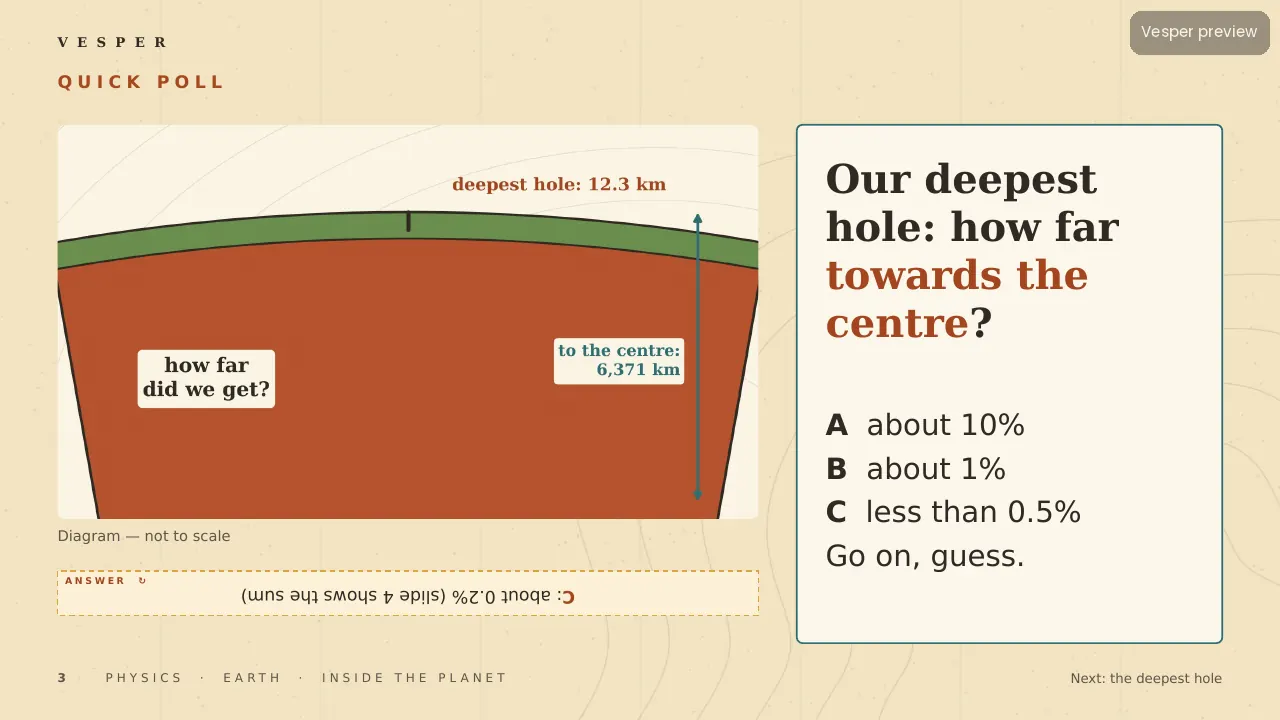
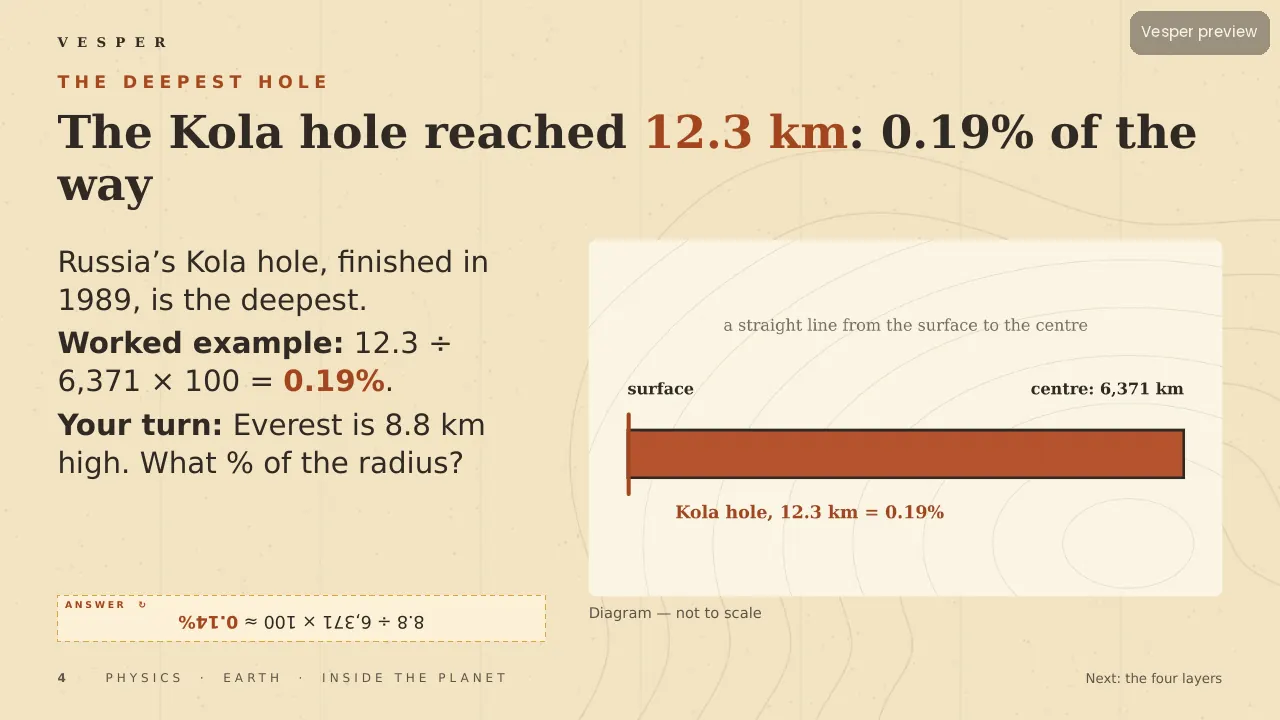
  • The Kola borehole reached 12.3 km in 1989: 0.19% of the way to Earth's centre.
  • On a 1 m model Earth, the crust would be 3 mm thick.
  • Earth averages 5.5 g/cm³; surface rock is about 2.7 g/cm³.
  • P waves travel at about 6 km/s and S waves at about 3.5 km/s; for a quake 600 km away the gap is 71 s.
  • Gutenberg found the core's edge at 2,900 km in 1913; Lehmann found the solid inner core in 1936.

What students will be able to do

  • Students can name Earth's four layers with their depths and states.
  • Students can explain how Earth's average density shows that its interior is denser than its rocks.
  • Students can describe P and S waves and use their arrival gap to find a distance.
  • Students can explain how the S-wave shadow shows a liquid outer core.
  • Students can describe what Gutenberg and Lehmann discovered.

About this lesson

What students discover

Our deepest hole, Russia’s Kola borehole, reached 12.3 km in 1989: 0.19% of the way to Earth’s centre. So how do we know what is down there? This lesson follows the evidence. Students meet the four layers with real depths, then shrink Earth to a 1 m ball, where the crust becomes just 3 mm thick. Clue one: the whole Earth averages 5.5 g/cm³ but its surface rocks only 2.7, so something much denser, iron, hides inside.

Clue two: earthquake waves. P waves push and pull at about 6 km/s; S waves shake sideways at about 3.5 km/s. The gap between their arrival times gives the distance to a quake (71 s for 600 km). S waves cannot pass through liquid, so beyond 103° from a quake there is a shadow with no S waves. In 1913 Beno Gutenberg used it to put the core’s edge 2,900 km down; in 1936 Inge Lehmann spotted faint P waves inside the shadow and found the solid inner core. Earth’s centre is about 5,200 °C, close to the Sun’s surface, and a myth slide fixes ‘under the crust is a sea of lava’: the mantle is solid rock. The same trick worked on Mars in 2021.

Inside the deck

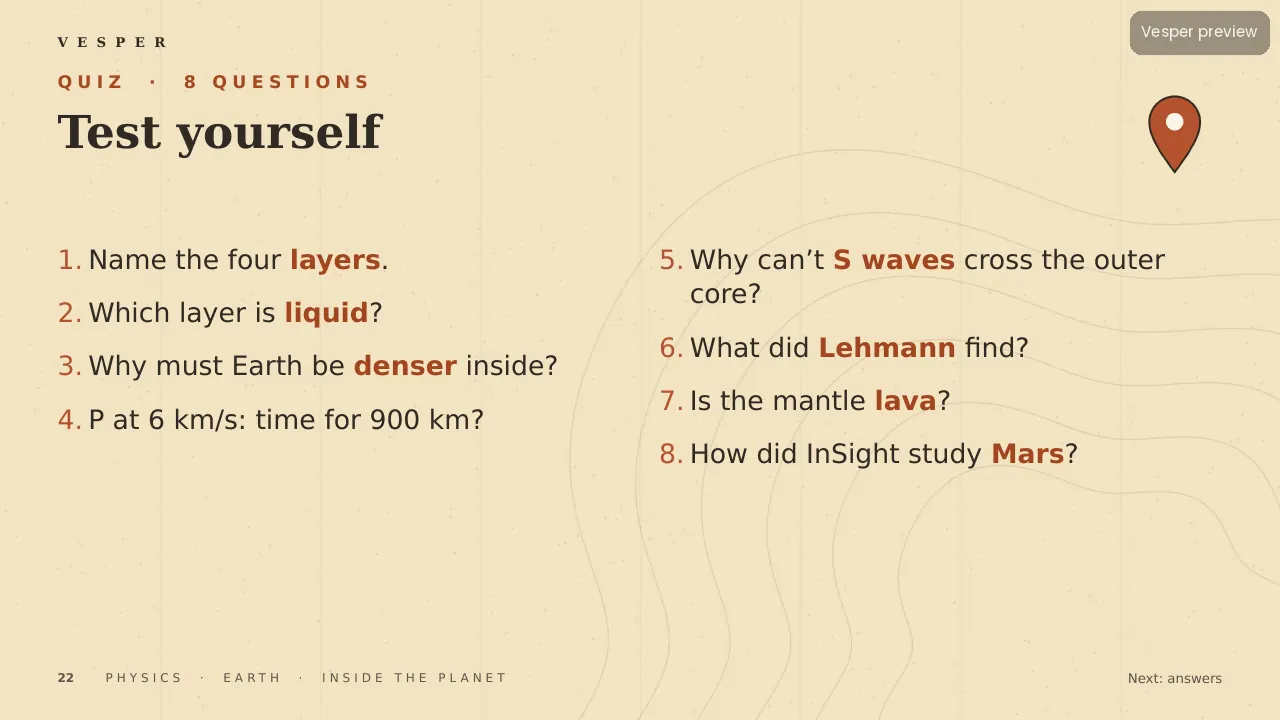
26 slides on the Atlas template: a poll hook, two diagram walks, four your-turn calculations, a pause-and-predict, an evidence slide, two people slides, two checkpoints and an eight-question quiz with explained answers.

How to teach it

About 45 minutes. The egg activity, spinning a raw and a boiled egg and stopping each with a fingertip, shows how you can detect liquid inside without opening anything. A slinky makes P and S waves visible. Speaker notes sit on every slide.

Who it’s for

Learners aged 12–15 studying Earth’s structure, and teachers who want the ‘how do we know?’ as well as the labels.
Curriculum & specs

CBSE/NCERT (India)Class 7-9 · Class 9 Exploration ch 13 Earth as a System: Energy, Matter, and Life
CambridgeLS Stage 8–9 Earth & Space (Earth's structure)
NGSS (US)MS-ESS2-1; HS-ESS2-3
IB MYPSciences · KC Systems · RC Evidence, Models
Ages12–15
LevelMiddle
Slide templateAtlas
Slides26
Teaching timeAbout 45 minutes
LanguageEnglish (UK)

Questions

Questions, answered

What are the layers of the Earth?

The crust (to about 35 km), the mantle (to 2,900 km), the liquid outer core (to 5,150 km) and the solid inner core (to 6,371 km).

How do we know what is inside the Earth?

Mostly from earthquake waves. Their speeds, paths and shadow zones show where the layers change and which layers are liquid.

Why can't S waves travel through the outer core?

S waves shake sideways, and a liquid can't pass on a sideways shake. Their shadow on the far side of Earth shows the outer core is liquid.

Is the mantle made of lava?

No. S waves pass through the mantle, so it is solid rock, though hot enough to creep very slowly.

What is the deepest hole ever dug?

The Kola borehole in Russia, finished in 1989, at about 12.3 km deep.

Who discovered the Earth's inner core?

Inge Lehmann, a Danish seismologist, in 1936, from faint P waves that appeared where none should be.

Main sources

  1. Kola Superdeep Borehole: 12,262 m (1989).
  2. Cavendish, H. (1798). Experiments to determine the density of the Earth. Phil. Trans. 88.
  3. Gutenberg, B. (1913–14): core boundary about 2,900 km.

The full source list is on the last slides of the deck. Spotted an error? Tell us.