Physics Ages 13–16

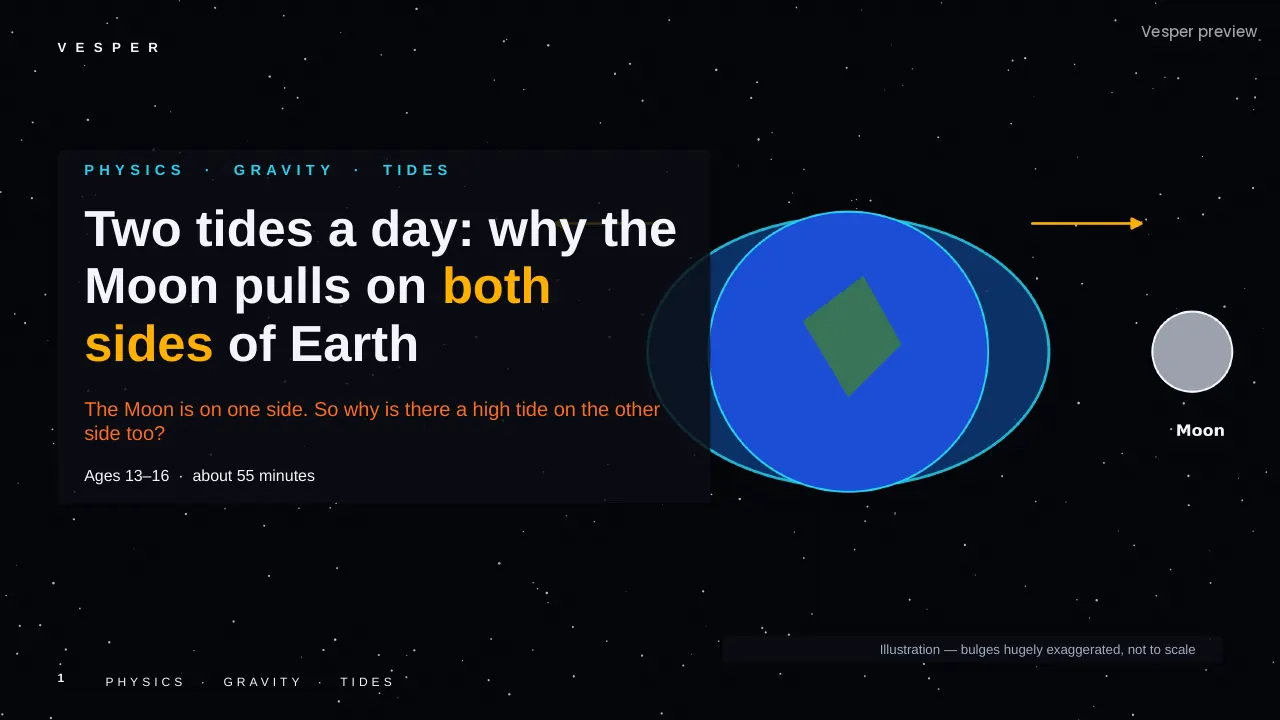
Two tides a day: why the Moon pulls on both sides of Earth

Pulled more, pulled less: the ocean stretches both ways.

A 29-slide lesson on tides: the inverse-square rule, the far-side bulge, the 12 h 25 min rhythm, and spring and neap tides, with numbers.

The short answer

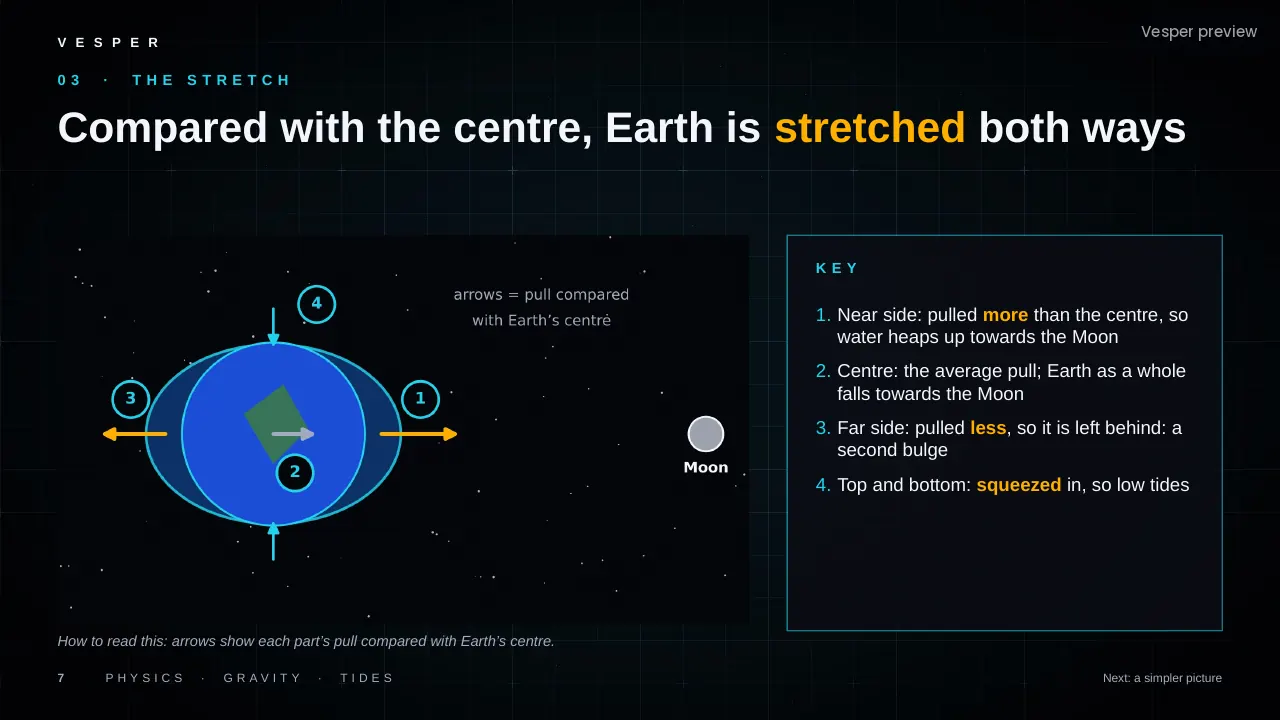
There are two tides a day because the Moon stretches Earth. It pulls the near side 3.4% harder than Earth's centre and the far side 3.2% less, so the ocean bulges on both sides. As Earth spins through the two bulges, a beach gets two high tides, about 12 h 25 min apart.

Inside the deck

slides
29
quiz questions
8
minutes
55
your-turn tasks
7

Choose a format

  • Lesson Notes (PDF)Every slide with its teacher notes, as a PDF to read or print.
  • Teacher DeckThe editable PowerPoint with speaker notes on every slide, a PDF copy and the matching Vesper slide template, so you can add slides of your own.
Pricing coming soon

Pricing coming soon

We’ll email you pricing and launch offers shortly.

  • Finished and checked: buying opens soon
  • Sources listed at the end
  • Curriculum links under ‘Curriculum & specs’
  • For one classroom. Campus licences for whole schools

Key facts

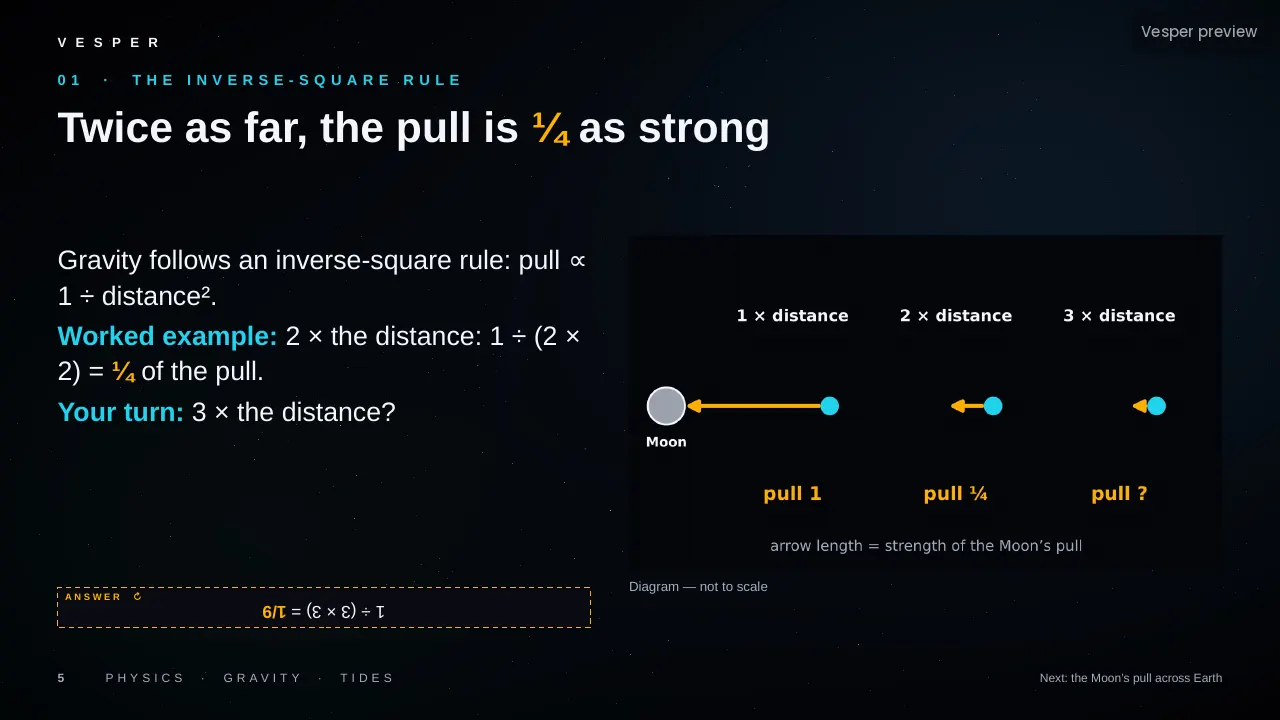
  • Twice as far, the pull is ¼ as strong
  • The Moon pulls the near side 3.4% harder than the centre and the far side 3.2% less
  • High tides come about 12 h 25 min apart, about 50 minutes later each day
  • The Sun's tides are about 0.46 of the Moon's
  • The Bay of Fundy's tides rise about 16 m
  • The Moon moves away 3.8 cm a year

What students will be able to do

  • Students can use the inverse-square rule to compare pulls
  • Students can explain why there is a tidal bulge on the far side of Earth
  • Students can explain why high tides are about 12 h 25 min apart
  • Students can explain spring and neap tides
  • Students can explain why the Moon is slowly moving away

About this lesson

What students discover

Everyone knows the Moon causes tides. Fewer can explain why the side of Earth facing away from the Moon gets a high tide too. Students use the inverse-square rule (twice as far, a quarter of the pull) to find that the Moon pulls Earth’s near side 3.4% harder than its centre and the far side 3.2% less. A numbered diagram shows the stretch: two bulges, two highs and two lows as Earth spins.

The Moon moves on about 13° a day, which explains why high tides come 12 h 25 min apart and about 50 minutes later each day, read off a tide graph. Then the Sun joins in: its tides are about half the Moon’s, giving spring tides when they line up and neap tides at right angles.

Inside the deck

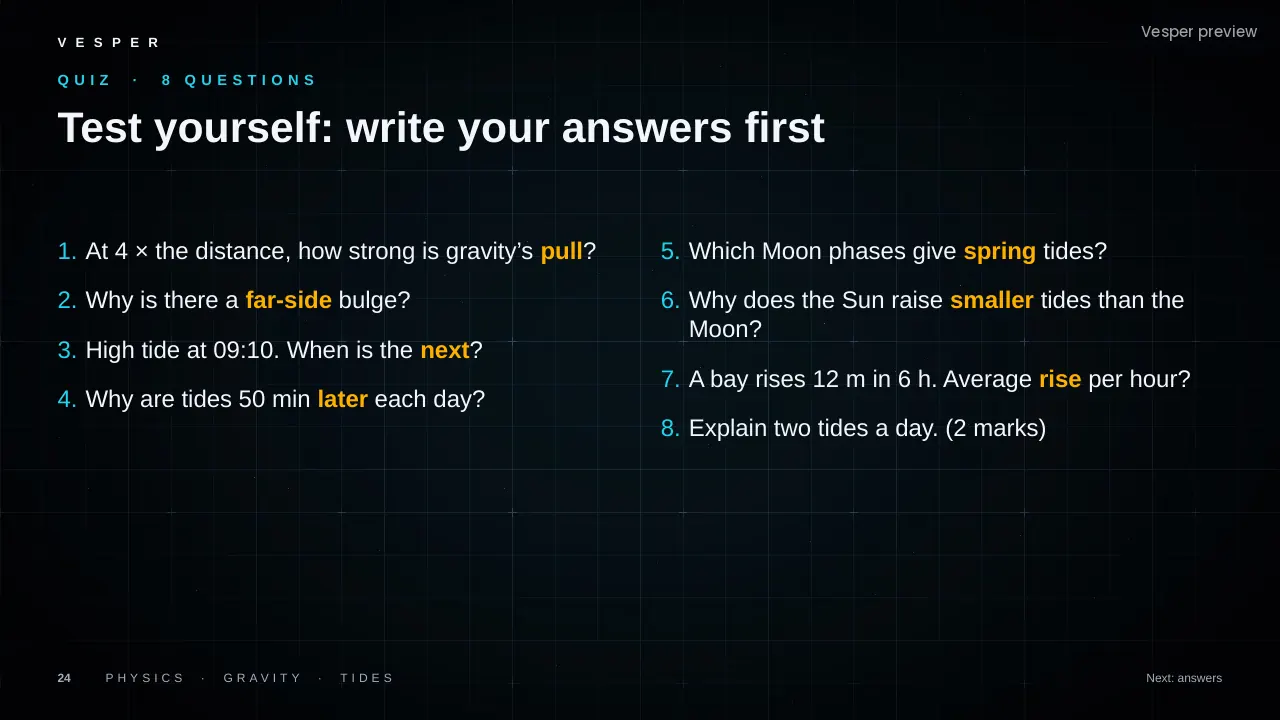
29 slides on the Nova template. The Bay of Fundy’s 16 m tides, Galileo’s wrong theory and Newton’s right one (1687), the Moon drifting 3.8 cm a year, and Jupiter’s tides keeping Europa’s ocean liquid. A spot-the-mistake (‘spring tides happen in spring’), a three-ball model, two checkpoints, polls and an 8-question quiz with explained answers.

How to teach it

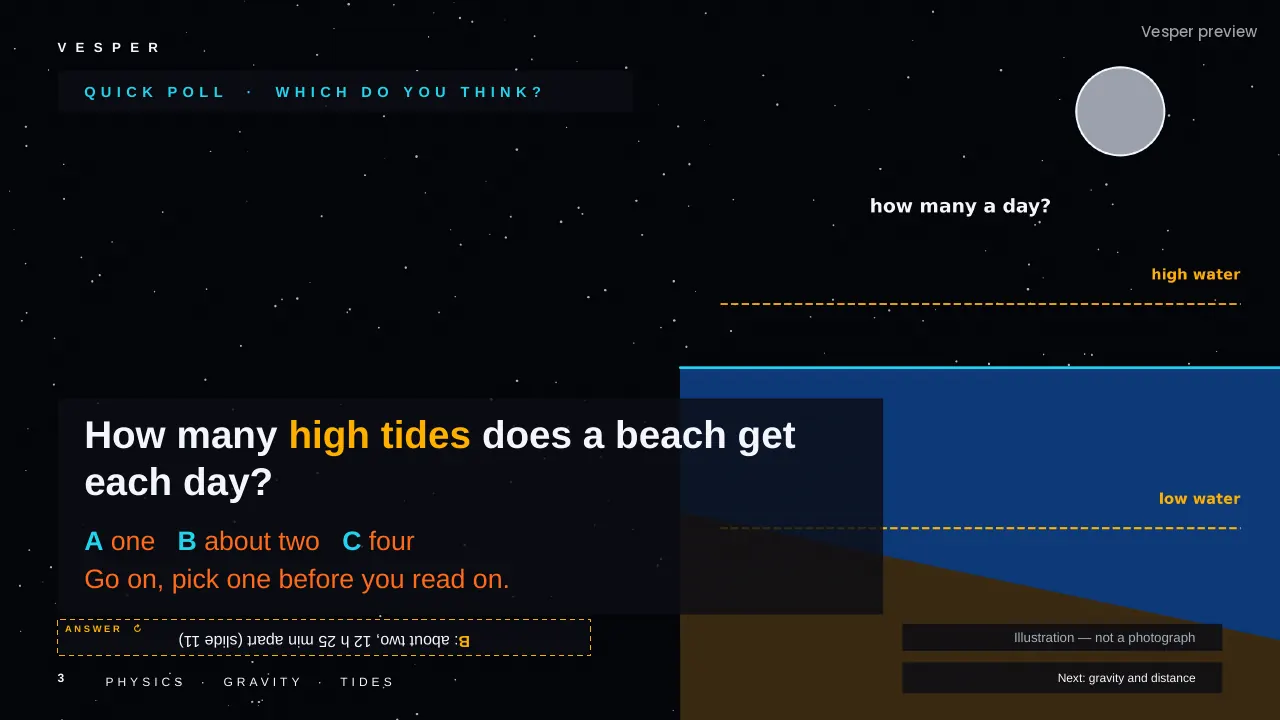
Allow about 55 minutes. Take a vote on the hook (how many high tides does a beach get each day?). For the activity on slide 20, print a real tide table for a port near you and have students check the 12 h 25 min rule. The slide’s own tide times are a simple model; real tables vary by port. Notes on every slide give Say, Ask, Watch for and Time.

Who it’s for

For ages 13–16 studying gravity, the Earth–Moon system and the inverse-square law. Coastal schools can link it to their own tide tables. Editable PowerPoint with named layouts.
Curriculum & specs

CBSE/NCERT (India)Class 8-10 · No direct chapter. Links: Class 7 Curiosity ch 12 Earth, Moon, and the Sun; Class 9 Exploration ch 6
CambridgeLS Stage 9 Earth & Space; IGCSE 0625 §6.1.1
NGSS (US)MS-ESS1-2; HS-PS2-4
IB MYPSciences · KC Systems · RC Interaction, Patterns
Ages13–16
LevelSenior
Slide templateNova
Slides29
Teaching timeAbout 55 minutes
LanguageEnglish (UK)

Questions

Questions, answered

Why are there two tides a day?

The Moon pulls the near side of Earth more and the far side less than the centre, stretching the oceans into two bulges. Earth spins through both each day.

Why is there a high tide on the side away from the Moon?

The far side is pulled 3.2% less than Earth's centre, so it is left behind and bulges outwards.

Why are tides about 50 minutes later each day?

The Moon moves about 13° along its orbit each day, so Earth needs about 50 minutes more to face it again.

What are spring and neap tides?

Spring tides are extra high and low tides when the Sun and Moon line up. Neap tides are smaller ones when they are at right angles.

Do spring tides happen in spring?

No. Spring tides happen whenever the Sun and Moon line up, all year round.

Where are the biggest tides in the world?

The Bay of Fundy in Canada, where the tidal range reaches about 16 m.

Main sources

  1. Newton, I. (1687). Principia, Book III (the theory of tides).
  2. Galileo Galilei (1632). Dialogue Concerning the Two Chief World Systems, Day 4 (tides).
  3. Ohio State University, Astronomy 161: Tides (near–far difference about 7%; Sun about half the Moon; Moon recedes 3.8 cm a year).

The full source list is on the last slides of the deck. Spotted an error? Tell us.