About this lesson
What students discover
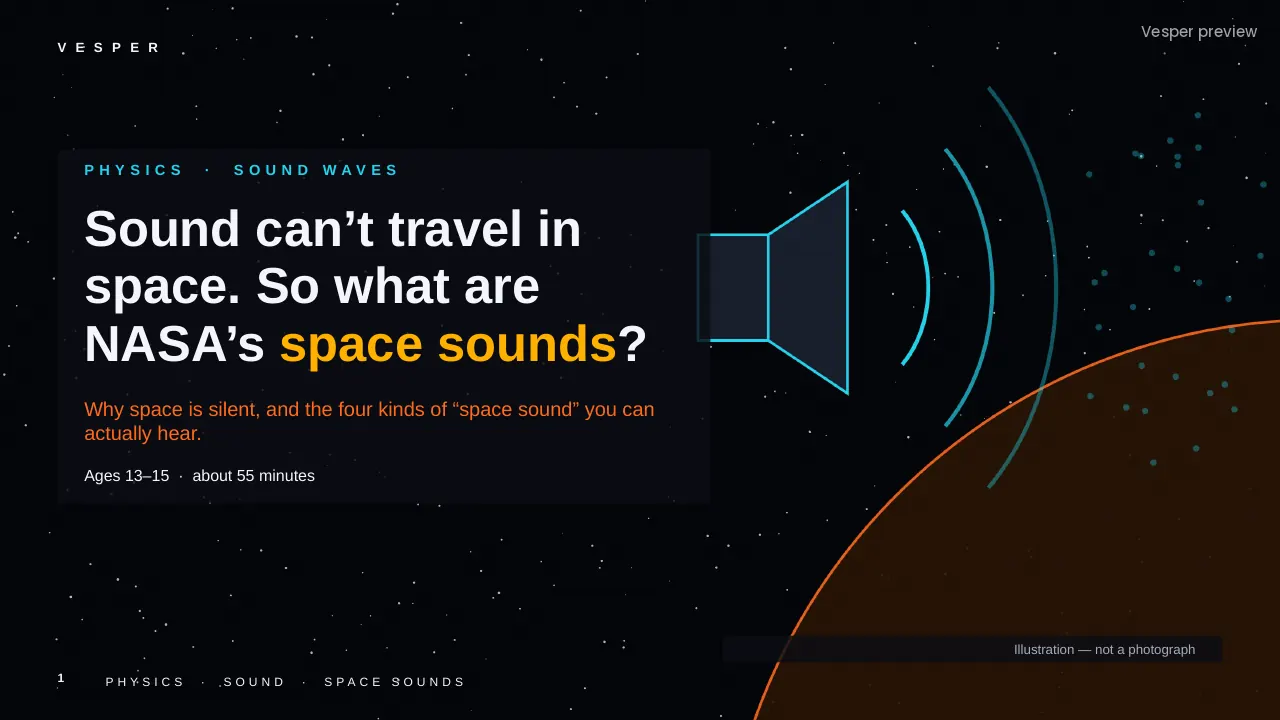
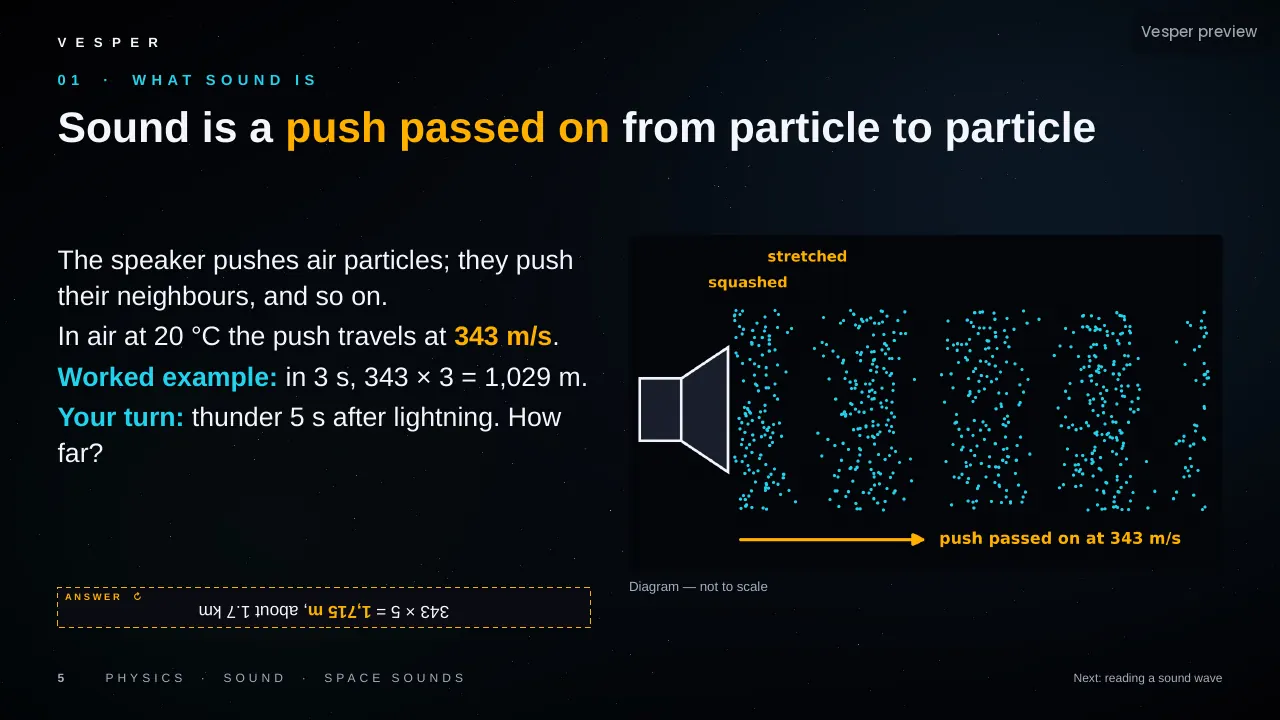
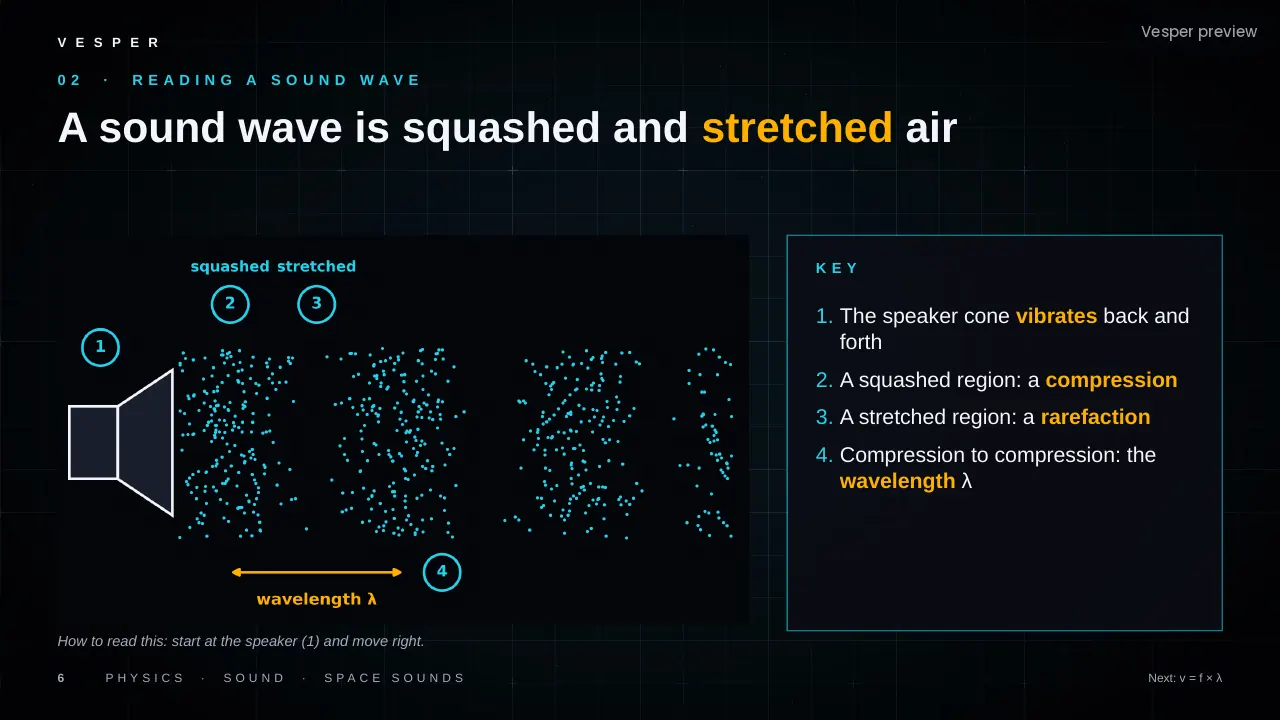
Films make space battles boom; real space is silent. Sound is a push passed from particle to particle at 343 m/s in air. Students use it to time thunder (5 s means about 1.7 km), read compressions, rarefactions and wavelength on a labelled diagram, and apply v = f × λ: a 440 Hz note is 0.78 m long. They compare air, water and steel, and see the evidence: Boyle’s 1660 bell jar and space with about 5 particles per cm³.
Then the four kinds of space sound: real sound on Mars at about 240 m/s, real pressure waves around the Perseus black hole pitched up 57 octaves, sonifications that translate data, and radio and plasma waves from probes.
Inside the deck
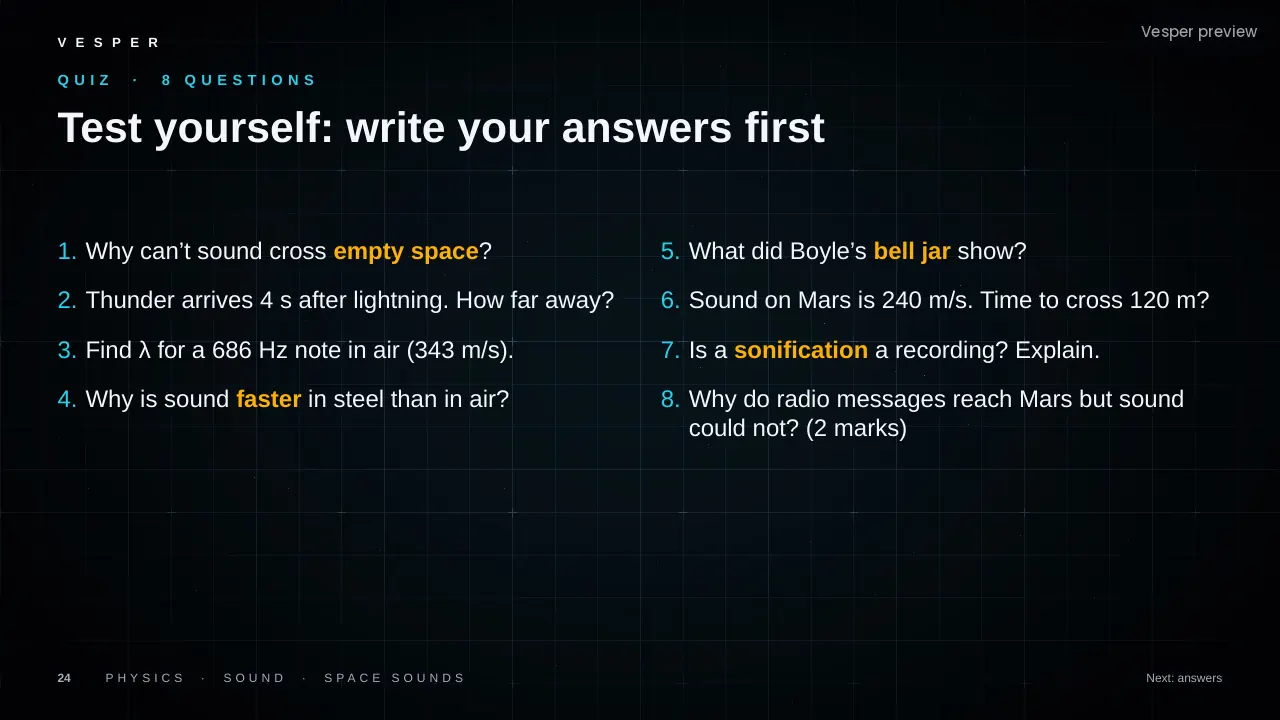
29 slides on the Nova template. Radio delays to the Moon (1.28 s) and Mars, a string telephone, a spot-the-mistake on space-battle booms, an honest frontier slide on Titan (no one has heard it yet), two checkpoints, polls and an 8-question quiz with explained answers.
How to teach it
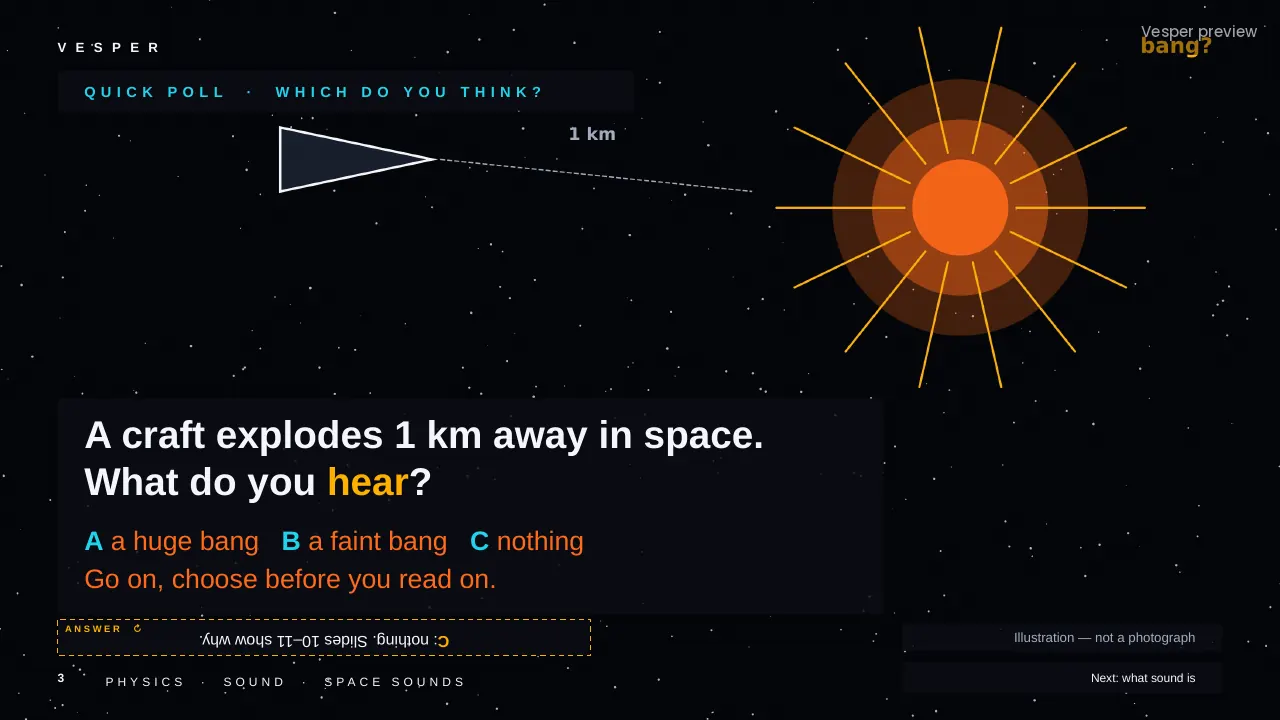
Allow about 55 minutes. Ask the hook (a craft explodes 1 km away in space: what do you hear?) and take a vote. After slide 13, play one real NASA sonification and ask students to sort it into one of the four kinds. The string telephone on slide 20 needs two cups and a few metres of string. Notes on every slide give Say, Ask, Watch for and Time.
Who it’s for
For ages 13–15 studying sound, waves and the wave equation, and for space fans who have heard ‘the sound of a black hole’ online. Editable PowerPoint with named layouts.