Physics Ages 14–15

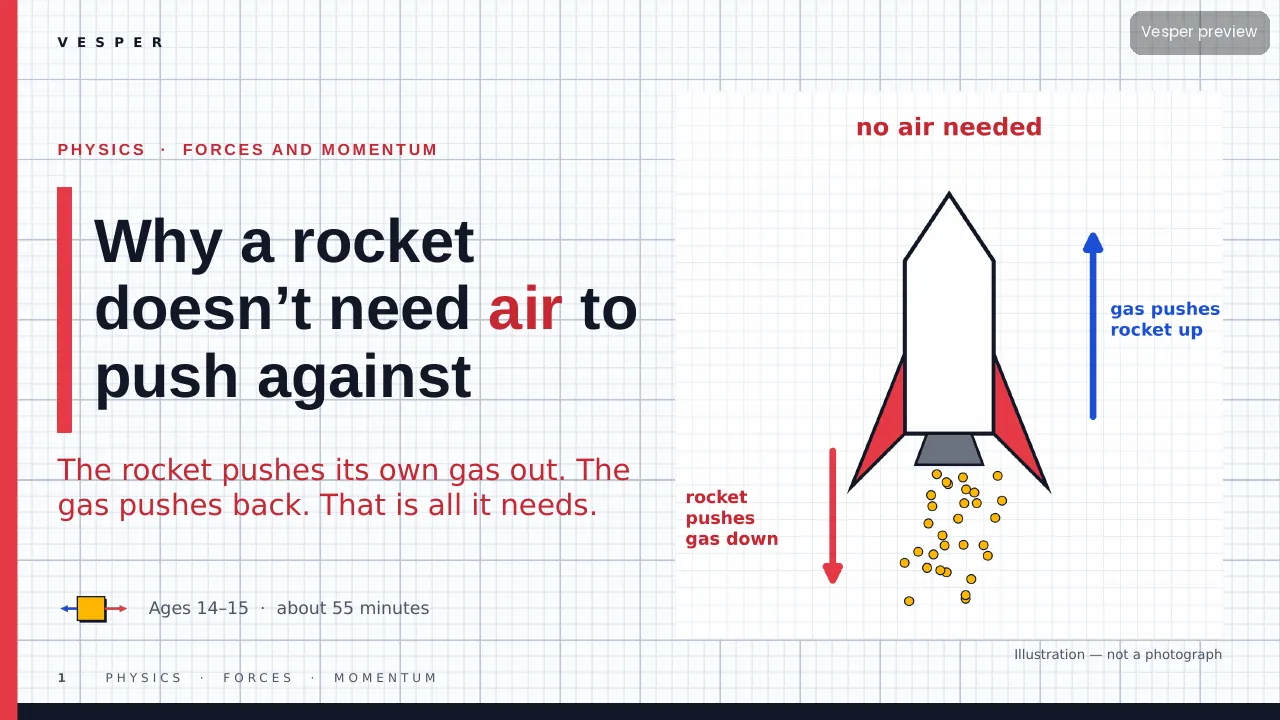
Why a rocket doesn't need air to push against

A rocket pushes its own gas, not the air. Here are the numbers.

A 31-slide lesson on Newton’s third law and momentum: from skateboard recoil to rocket thrust, lift-off and the 1920 newspaper that got it wrong.

The short answer

A rocket does not push on air. It pushes hot gas out of the back at high speed, and by Newton's third law the gas pushes the rocket forwards with an equal force. Momentum is conserved, so this works best in empty space: the same engine performs about 15% better in a vacuum than in air.

Inside the deck

slides
31
quiz questions
8
minutes
55
your-turn tasks
7

Choose a format

  • Lesson Notes (PDF)Every slide with its teacher notes, as a PDF to read or print.
  • Teacher DeckThe editable PowerPoint with speaker notes on every slide, a PDF copy and the matching Vesper slide template, so you can add slides of your own.
Pricing coming soon

Pricing coming soon

We’ll email you pricing and launch offers shortly.

  • Finished and checked: buying opens soon
  • Sources listed at the end
  • Curriculum links under ‘Curriculum & specs’
  • For one classroom. Campus licences for whole schools

Key facts

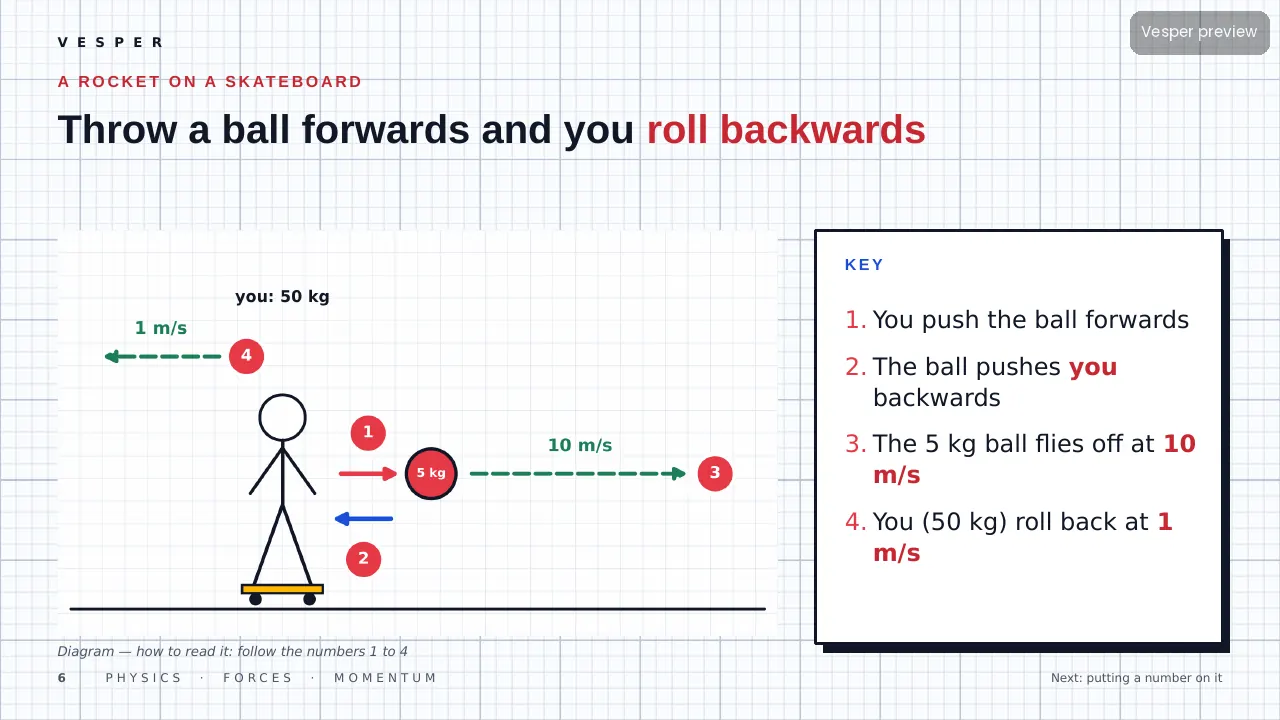
  • Throw a 5 kg ball at 10 m/s and a 50 kg skateboarder rolls back at 1 m/s
  • Thrust = gas per second × exhaust speed: 100 kg/s × 3,000 m/s = 300,000 N
  • The same engine works about 15% better in a vacuum
  • Saturn V produced 34.5 million newtons at lift-off
  • Goddard fired rockets in a vacuum in 1916
  • An ion engine pushes with about 0.09 N

What students will be able to do

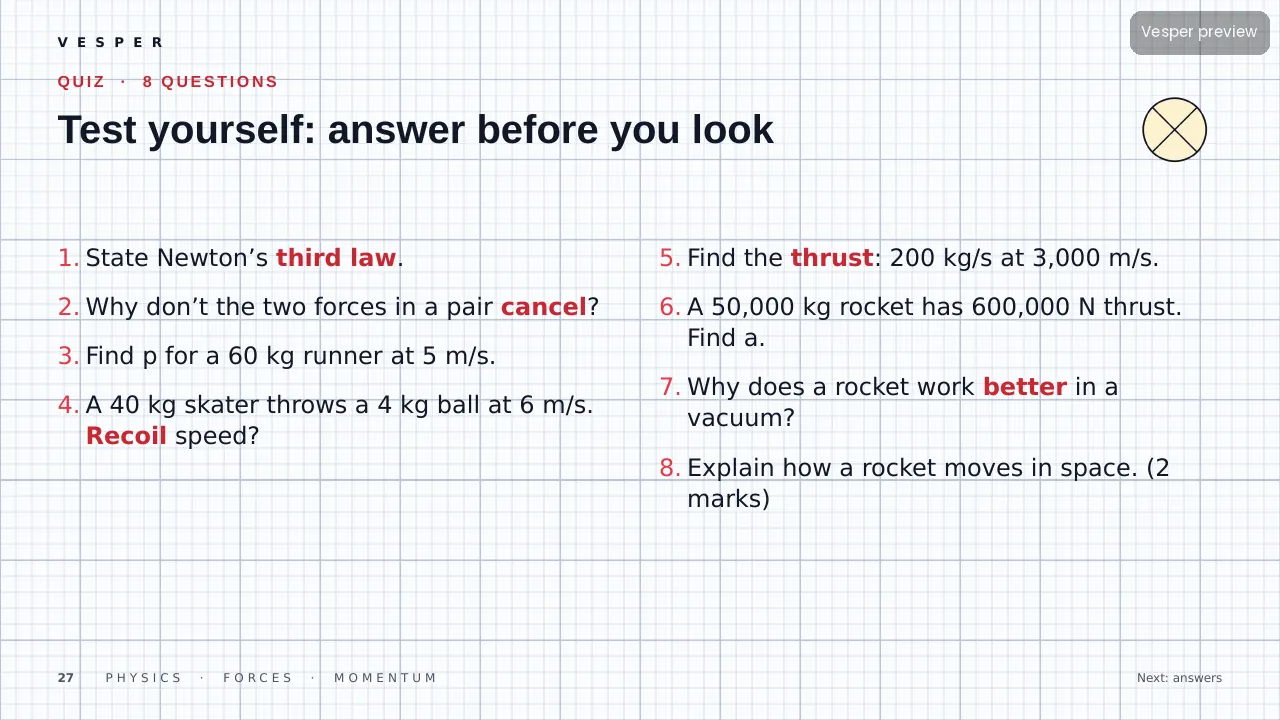
  • Students can state Newton's third law and explain why a force pair does not cancel
  • Students can calculate momentum with p = m × v
  • Students can use conservation of momentum to predict recoil
  • Students can calculate rocket thrust and decide whether it can lift off
  • Students can explain why a rocket works in a vacuum

About this lesson

What students discover

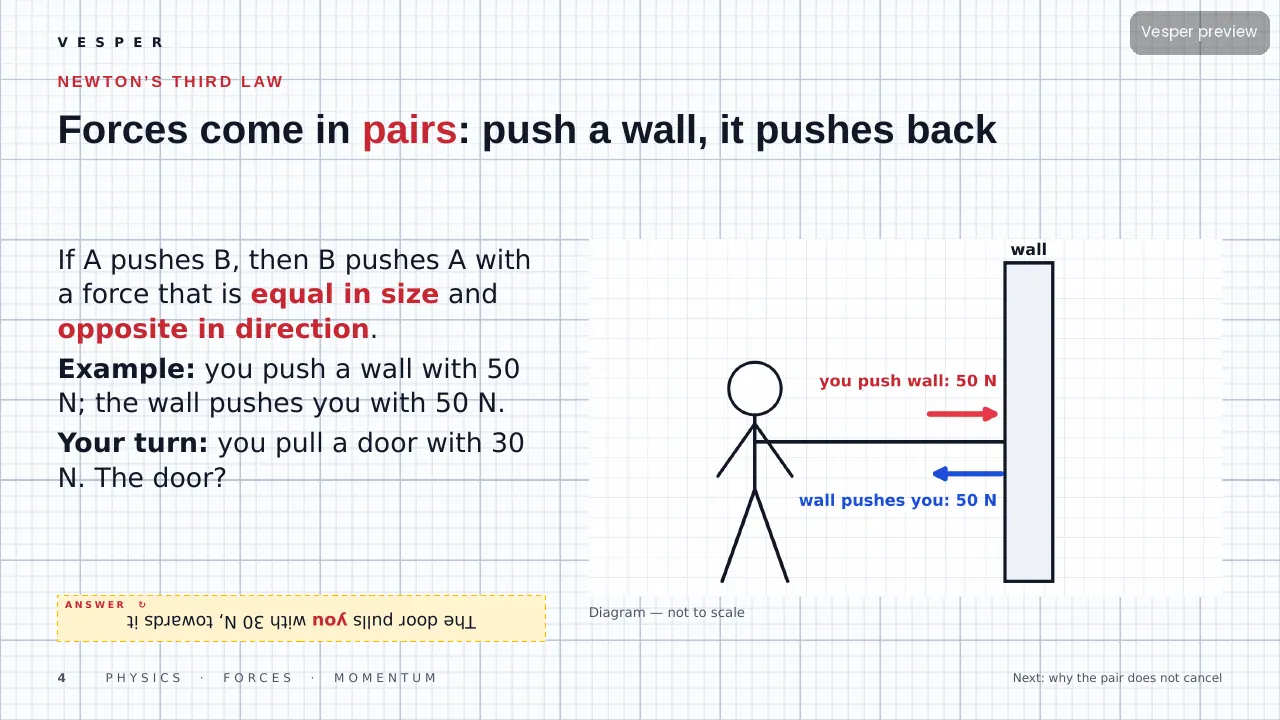
In 1920 a famous newspaper said a rocket could not work in space because it had nothing to push against. Students find out why that was wrong, with numbers. They meet Newton’s third law (push a wall with 50 N, it pushes back with 50 N), learn why a force pair never cancels, and use momentum to predict recoil: throw a 5 kg ball at 10 m/s from a skateboard and a 50 kg rider rolls back at 1 m/s.

A cut-away engine shows the push happening inside the rocket. Students calculate thrust (100 kg/s × 3,000 m/s = 300,000 N), test whether a rocket can lift off, and see why acceleration grows as fuel burns.

Inside the deck

31 slides on the Vector template. Goddard’s 1916 vacuum tests, the newspaper’s correction 49 years later, the Saturn V’s 34.5 MN at lift-off, a spanner-throwing spacewalk rescue, an ion engine that pushes with about 0.09 N and a safe balloon rocket on a string. Two checkpoints, a myth slide, polls, upside-down answers and an 8-question quiz with explained answers.

How to teach it

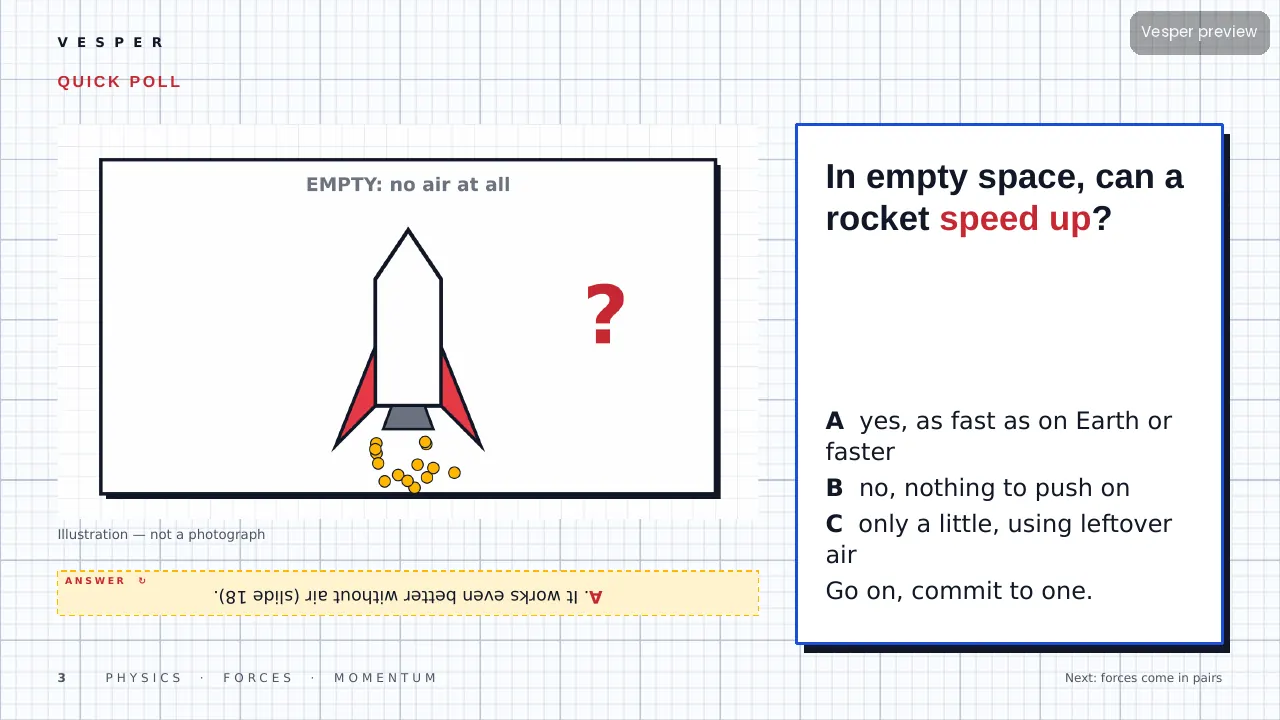
Allow about 55 minutes. Take a vote on the hook (‘In empty space, can a rocket speed up?’) and leave it on the board until slide 17. The balloon rocket on slide 22 needs a balloon, a straw, tape and a long string across the room. Notes on every slide give Say, Ask, Watch for and Time.

Who it’s for

For ages 14–15 studying forces, Newton’s laws and momentum. Space fans will enjoy it, and it suits revision of conservation of momentum. The PowerPoint is editable, with named layouts.
Curriculum & specs

CBSE/NCERT (India)Class 9 · Class 9 Exploration ch 6 How Forces Affect Motion
CambridgeIGCSE 0625 §1.6 Momentum
NGSS (US)MS-PS2-1; HS-PS2-2
IB MYPSciences · KC Relationships · RC Movement, Interaction
Ages14–15
LevelSenior
Slide templateVector
Slides31
Teaching timeAbout 55 minutes
LanguageEnglish (UK)

Questions

Questions, answered

How do rockets work in space with no air?

They push gas out of the back. By Newton's third law the gas pushes back on the rocket with an equal and opposite force, so no air is needed.

Does air help a rocket?

No. Air gets in the way. The lesson shows the same engine working about 15% better in a vacuum.

Why don't action and reaction forces cancel?

They act on different objects. The rocket pushes the gas and the gas pushes the rocket, so each object accelerates.

What is conservation of momentum?

The total momentum before an event equals the total after it. If gas goes backwards with momentum, the rocket gains the same momentum forwards.

How do you calculate rocket thrust?

Multiply the mass of gas leaving per second by its speed. In the lesson, 100 kg/s × 3,000 m/s = 300,000 N.

What newspaper said rockets couldn't work in space?

A famous newspaper editorial in 1920 mocked Robert Goddard for the idea. It printed a correction in 1969, 49 years later.

Main sources

  1. Newton, I. (1687). Principia: Laws of Motion (third law).
  2. Goddard, R. H. (1919). A Method of Reaching Extreme Altitudes. Smithsonian Miscellaneous Collections 71(2); vacuum tests 1915–16.
  3. Smithsonian Air & Space: “The Misunderstood Professor” (1920 editorial; 1969 correction).

The full source list is on the last slides of the deck. Spotted an error? Tell us.