About this lesson
What students discover
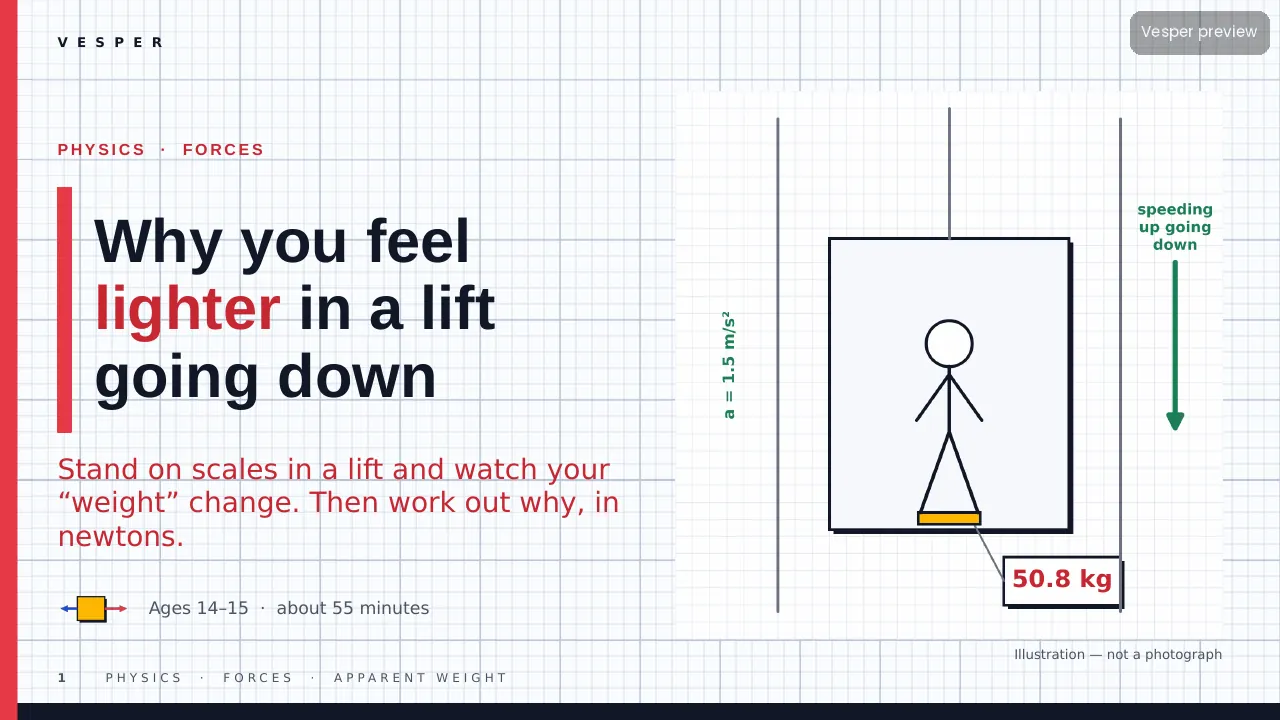
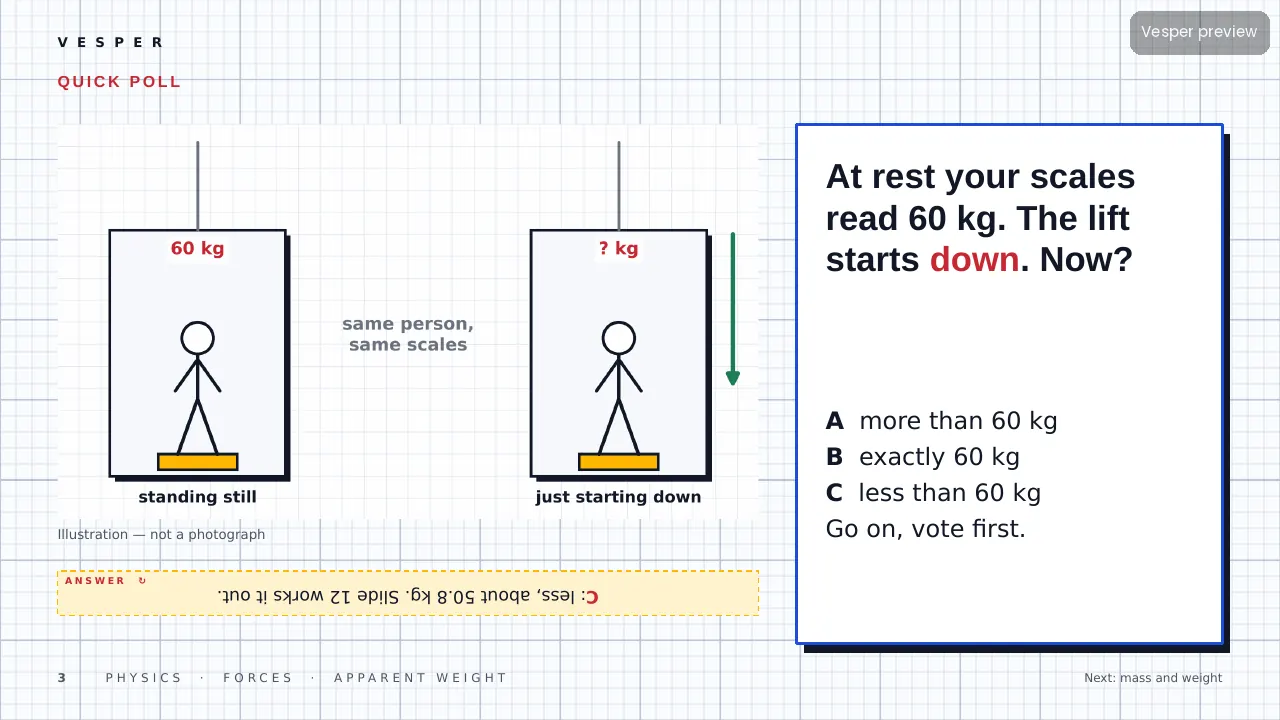
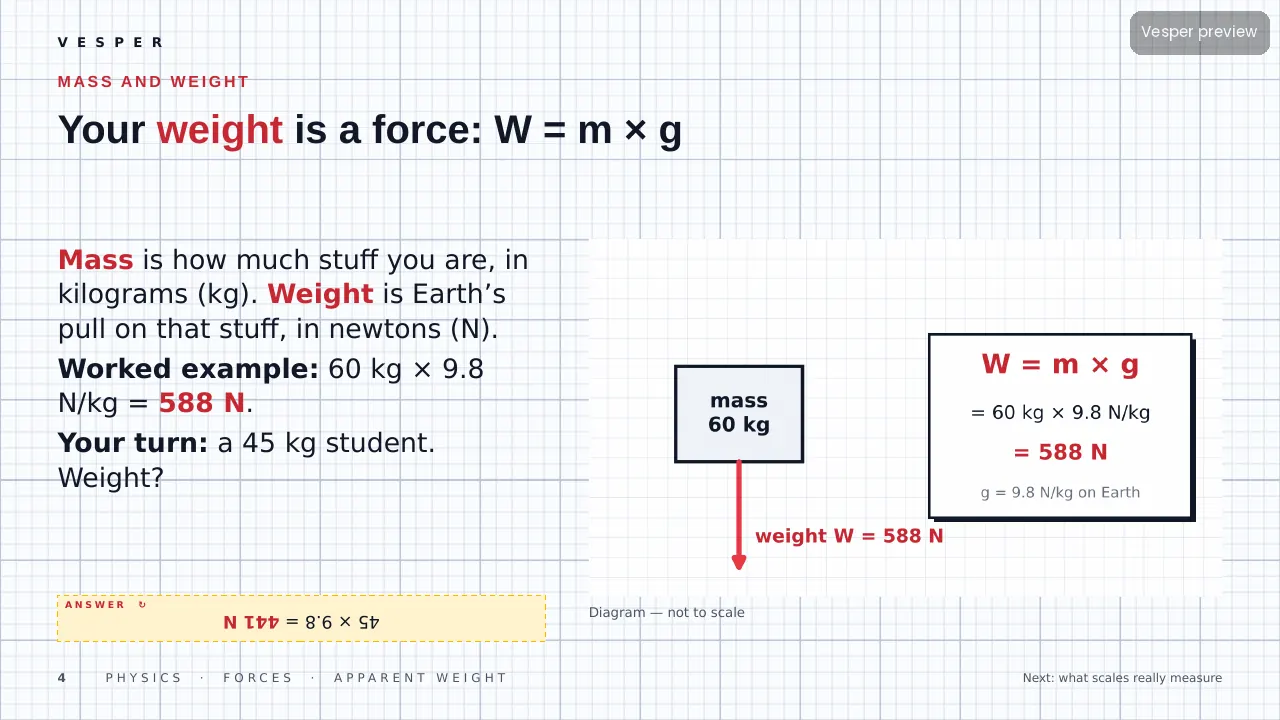
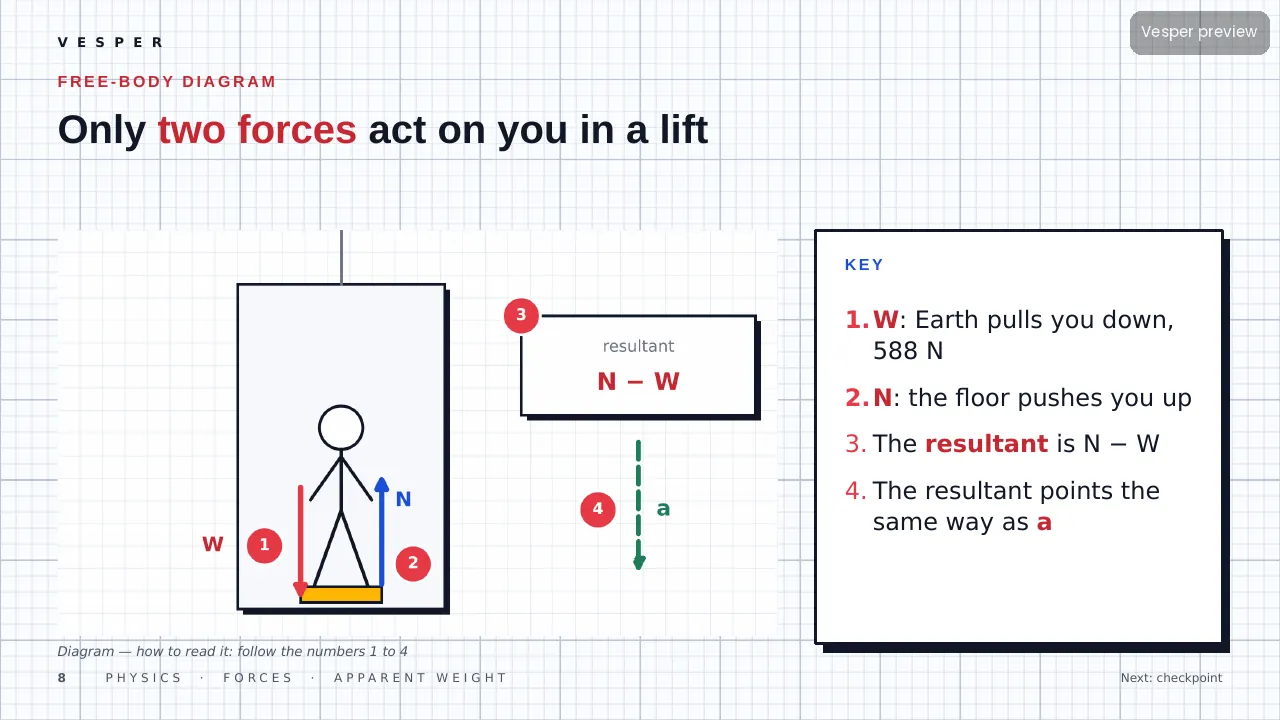
Why does your stomach float when a lift sets off downwards? This lesson puts bathroom scales in a lift and follows the numbers. Students separate mass from weight (60 kg gives 588 N) and discover that scales only measure the floor’s push, the normal force. Gravity pulls on every part of you at once, so on its own you wouldn’t feel it; what you feel is the floor pushing up.
Newton’s second law then predicts every reading. Speeding up downwards at 1.5 m/s², the floor pushes 498 N and the scales read 50.8 kg. Speeding up upwards, they read 69.2 kg. At a steady speed, in either direction, they read 60 kg, which is where the spot-the-mistake ‘going down makes you lighter’ comes unstuck. A free-body diagram turns into one line, N = m(g ± a), and a four-case grid shows that the direction of the acceleration, not the direction of travel, decides. If a = g, the floor pushes nothing: free fall, as on ESA’s Zero-G plane, which gives about 22 seconds at a time. A myth slide works out why jumping in a falling lift won’t save you (about 24.2 m/s from 30 m).
Inside the deck
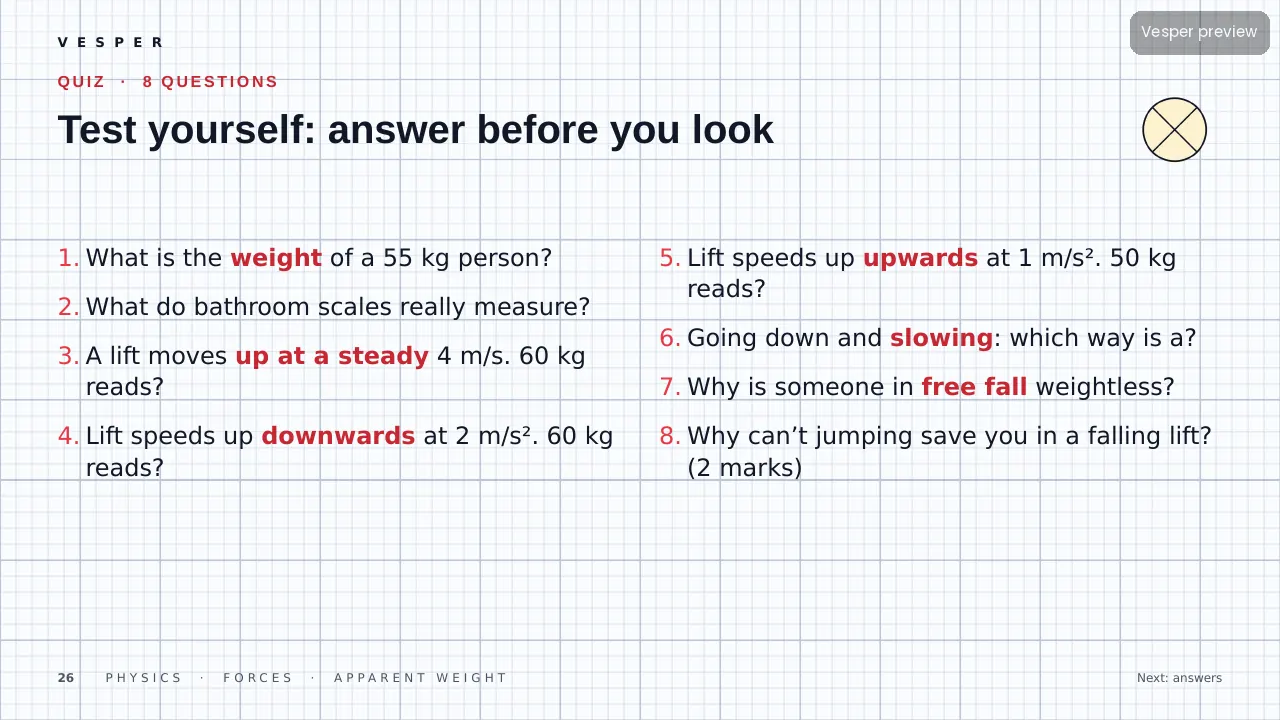
30 slides on the Vector template: a poll hook, a primer, two diagram walks, five your-turn tasks, a pause-and-predict, an evidence slide, two checkpoints and a real-world slide on the 21 m/s record lift. Engineers’ g-readings (0.85 g, 1.15 g, 0 g) close the maths. An eight-question quiz has explained answers.
How to teach it
About 55 minutes. The leaky-bottle activity, done outdoors with an adult, makes free fall visible: drop the bottle and the water stops leaking. Speaker notes sit on every slide.
Who it’s for
Learners aged 14–15 working on mass, weight, Newton’s second law and free-body diagrams, and anyone who has felt a lift drop.