Physics Ages 13–15

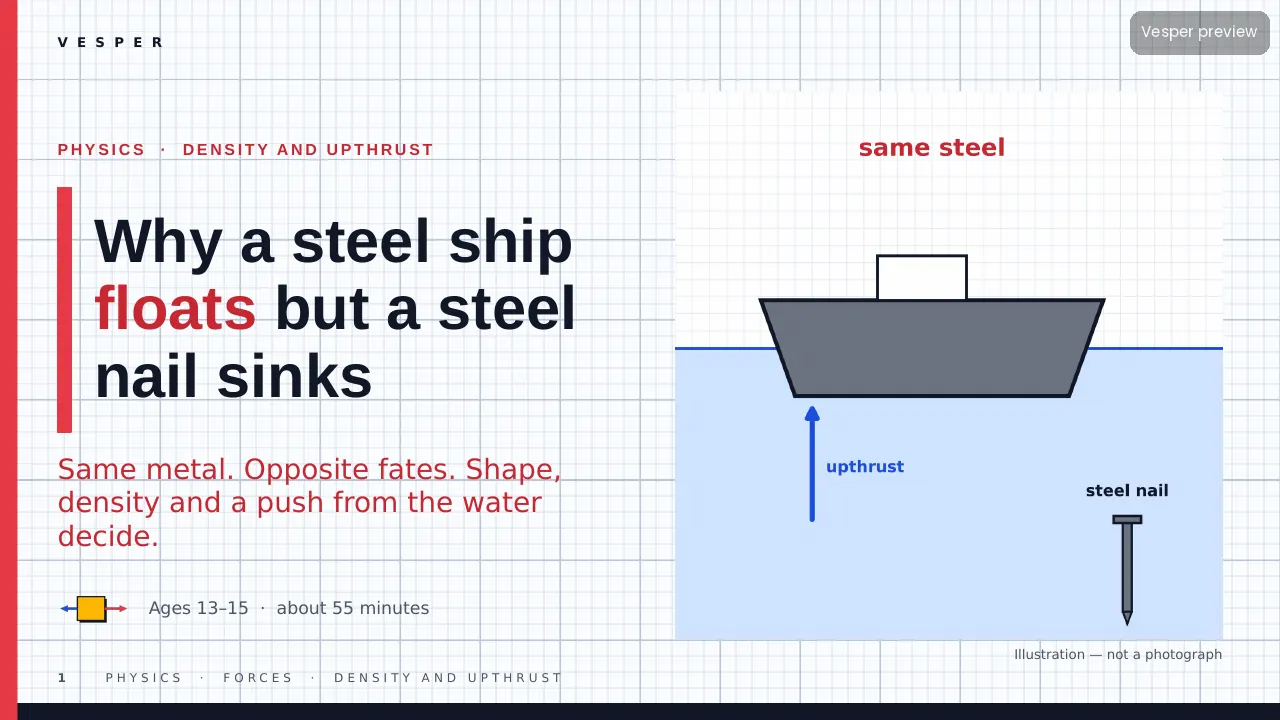
Why a steel ship floats but a steel nail sinks

Same metal, opposite fates: shape decides the average density.

A 29-slide lesson on density, water pressure and upthrust: why shape, not weight, decides whether steel floats, with worked numbers throughout.

The short answer

A steel ship floats because its shape makes its average density less than water's. The hull pushes aside a large volume of water, and the upthrust equals the weight of that water. A nail is solid steel at 8 g/cm³, much denser than water's 1 g/cm³, so its upthrust is too small and it sinks.

Inside the deck

slides
29
quiz questions
8
minutes
55
your-turn tasks
7

Choose a format

  • Lesson Notes (PDF)Every slide with its teacher notes, as a PDF to read or print.
  • Teacher DeckThe editable PowerPoint with speaker notes on every slide, a PDF copy and the matching Vesper slide template, so you can add slides of your own.
Pricing coming soon

Pricing coming soon

We’ll email you pricing and launch offers shortly.

  • Finished and checked: buying opens soon
  • Sources listed at the end
  • Curriculum links under ‘Curriculum & specs’
  • For one classroom. Campus licences for whole schools

Key facts

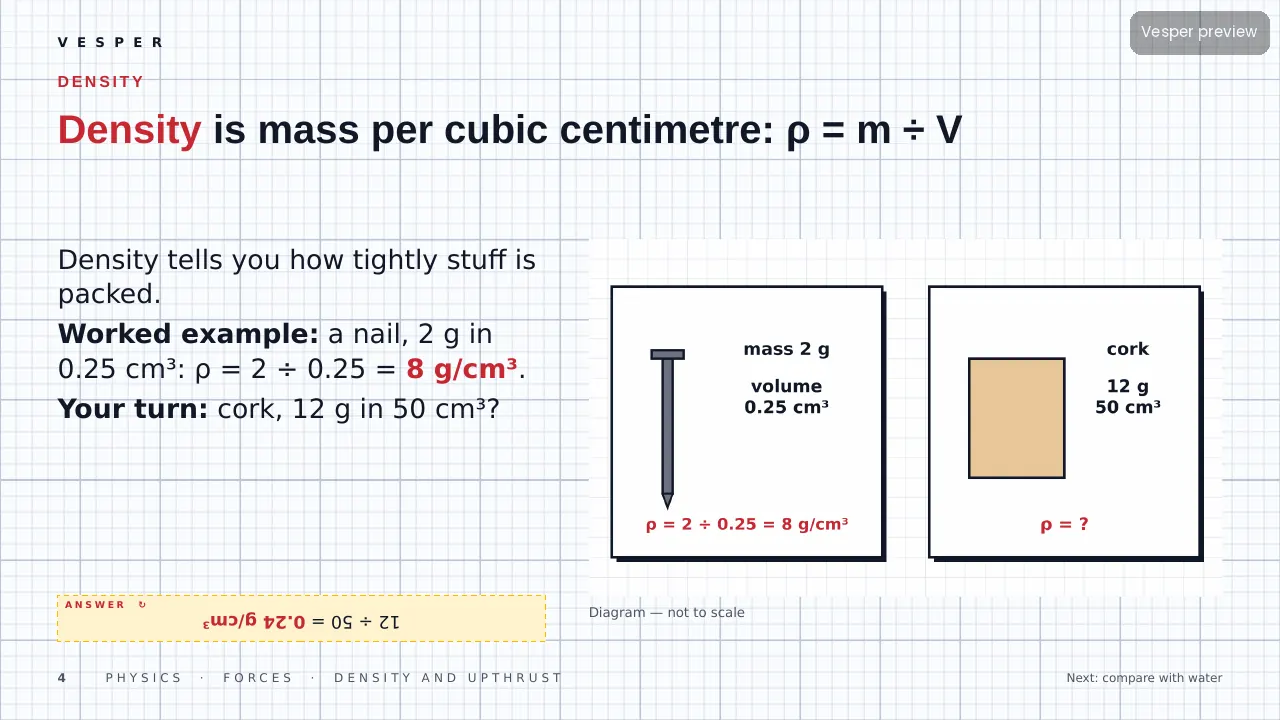
  • The nail: 2 g in 0.25 cm³ is 8 g/cm³; water is 1 g/cm³
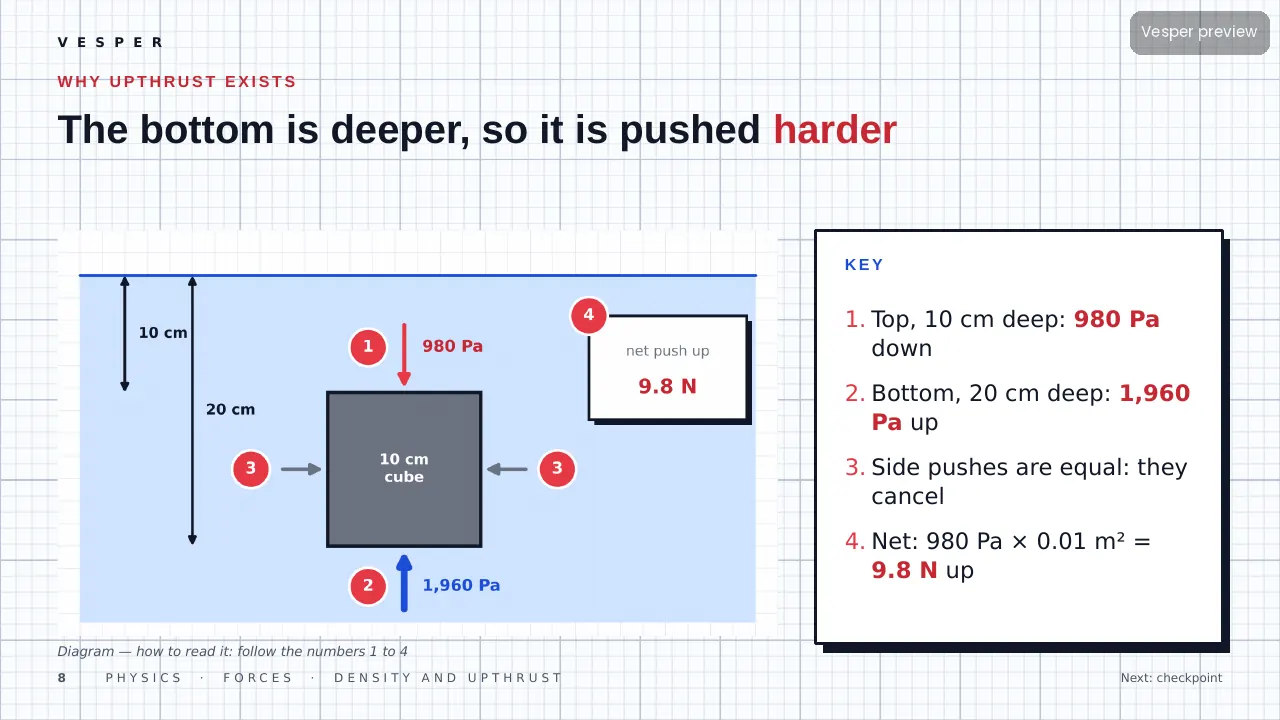
  • A 10 cm cube: 980 Pa on top, 1,960 Pa below, a net 9.8 N
  • Upthrust equals the weight of water pushed aside
  • A 1 kg steel box floats 5 cm deep at an average density of 0.5 g/cm³
  • About 89% of an iceberg is under water

What students will be able to do

  • Students can calculate density with ρ = m ÷ V
  • Students can explain upthrust using water pressure, p = ρgh
  • Students can state and use Archimedes' principle
  • Students can explain why shape changes average density
  • Students can explain the Plimsoll line, icebergs and submarines

About this lesson

What students discover

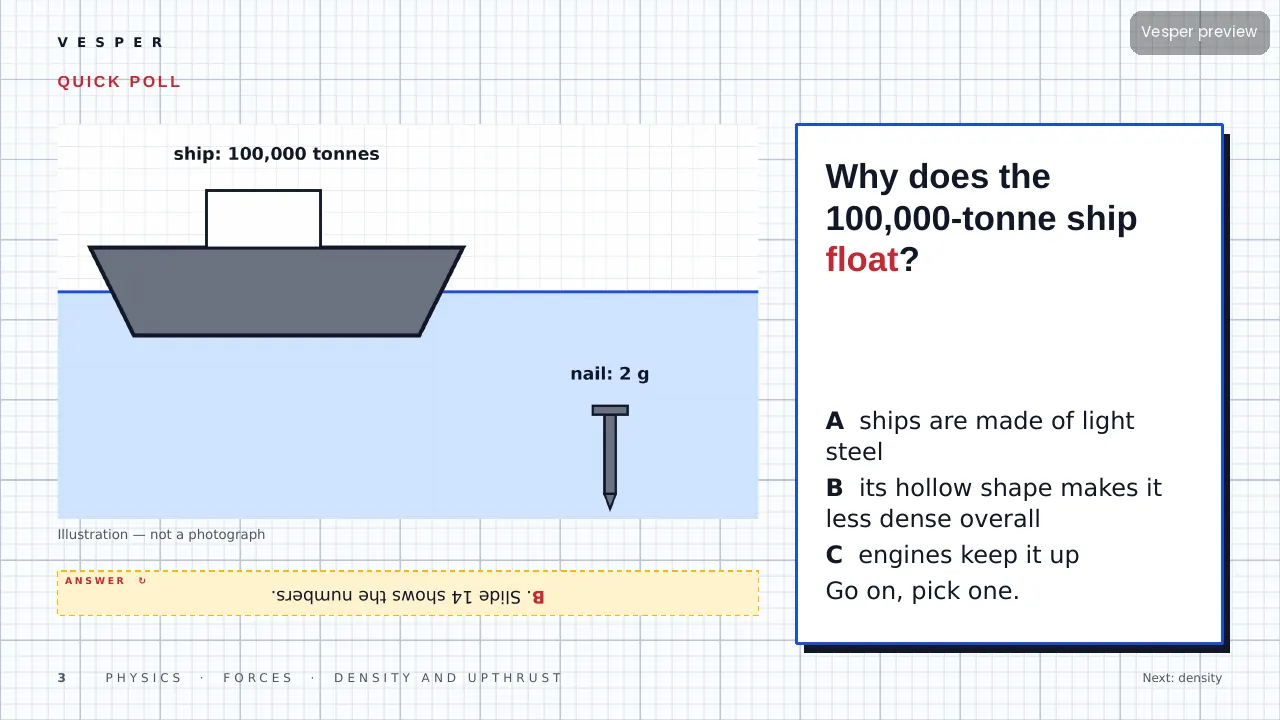
A 100,000-tonne steel ship floats; a 2 g steel nail sinks. Students calculate density (the nail: 2 g in 0.25 cm³ is 8 g/cm³), compare it with water’s 1 g/cm³, and measure upthrust with a spring balance (10 N in air, 6 N in water).

Water pressure, p = ρgh, explains where the push comes from: a 10 cm cube gets 980 Pa on top and 1,960 Pa underneath, a net 9.8 N, exactly the weight of the litre of water it pushes aside. That is Archimedes’ principle, with the crown story clearly labelled as legend. Then the steel gets folded: a 1 kg box floats 5 cm deep because its average density is 0.5 g/cm³.

Inside the deck

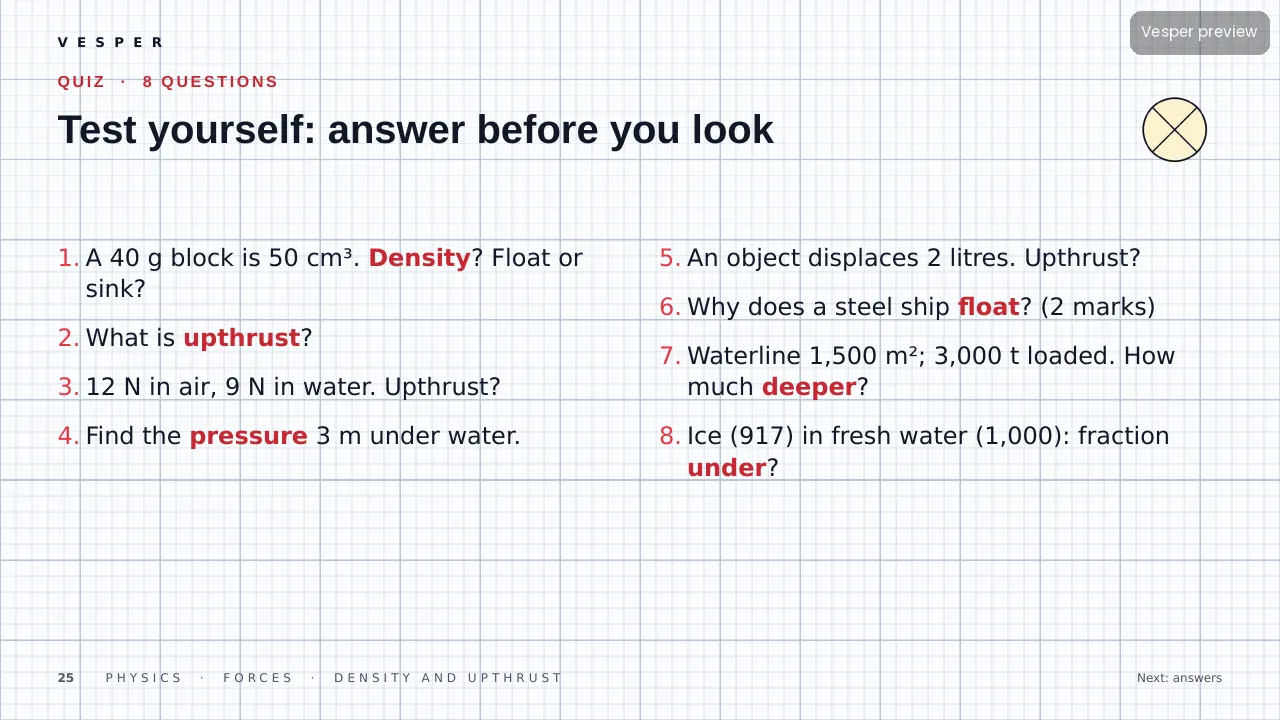
29 slides on the Vector template: cargo loading, the Plimsoll line (ships sit lower in fresh water), icebergs 89% under water, submarines that change their average density, a concrete ship, a myth slide (‘heavy things sink’), a foil-boat versus foil-ball challenge, two checkpoints, polls, upside-down answers and an 8-question quiz with explained answers.

How to teach it

Allow about 55 minutes. Ask the hook and collect the class’s reasons before slide 4. The foil challenge on slide 22 needs two equal squares of kitchen foil and a bowl of water: one scrunched into a ball, one folded into a boat. Notes on every slide give Say, Ask, Watch for and Time.

Who it’s for

For ages 13–15 studying density, pressure, forces and floating and sinking. It works for younger confident groups too. Editable PowerPoint with named layouts.

Curriculum & specs

CBSE/NCERT (India)Class 8-9 · Class 8 Curiosity ch 5 Exploring Forces (upthrust – confirm in PDF)
CambridgeLS Stage 8 Physics (density); IGCSE 0625 §1.4 Density; §1.8 Pressure
NGSS (US)MS-PS2-2 (partial; buoyancy not an NGSS PE)
IB MYPSciences · KC Relationships · RC Form, Interaction
Common Core (US)6.EE.A.2 (formulas: density = mass ÷ volume)
Ages13–15
LevelSenior
Slide templateVector
Slides29
Teaching timeAbout 55 minutes
LanguageEnglish (UK)

Questions

Questions, answered

Why does a steel ship float?

Its hollow shape means its average density, steel plus all the air inside, is less than water's. It pushes aside enough water for the upthrust to equal its weight.

Why does a steel nail sink?

A nail is solid steel at about 8 g/cm³, much denser than water, so the water it pushes aside weighs less than the nail.

What is upthrust?

The upward push of a liquid on an object in it. It comes from water pressure being greater on the bottom of the object than on the top.

What is Archimedes' principle?

The upthrust on an object equals the weight of the fluid it displaces.

What is the Plimsoll line?

A mark on a ship's side showing how deep it can safely sit. Ships sit lower in fresh water because it is less dense than sea water.

Do heavy things always sink?

No. Whether something floats depends on its average density compared with the liquid, not on its weight.

Main sources

  1. Archimedes (c. 250 BC). On Floating Bodies, Book I.
  2. Vitruvius (1st century BC). De Architectura, Book IX (the crown story).
  3. Kaye & Laby / NPL tables: densities of steel (about 7.85 g/cm³), ice (0.917), sea water (about 1.025).

The full source list is on the last slides of the deck. Spotted an error? Tell us.