Physics Ages 11–14

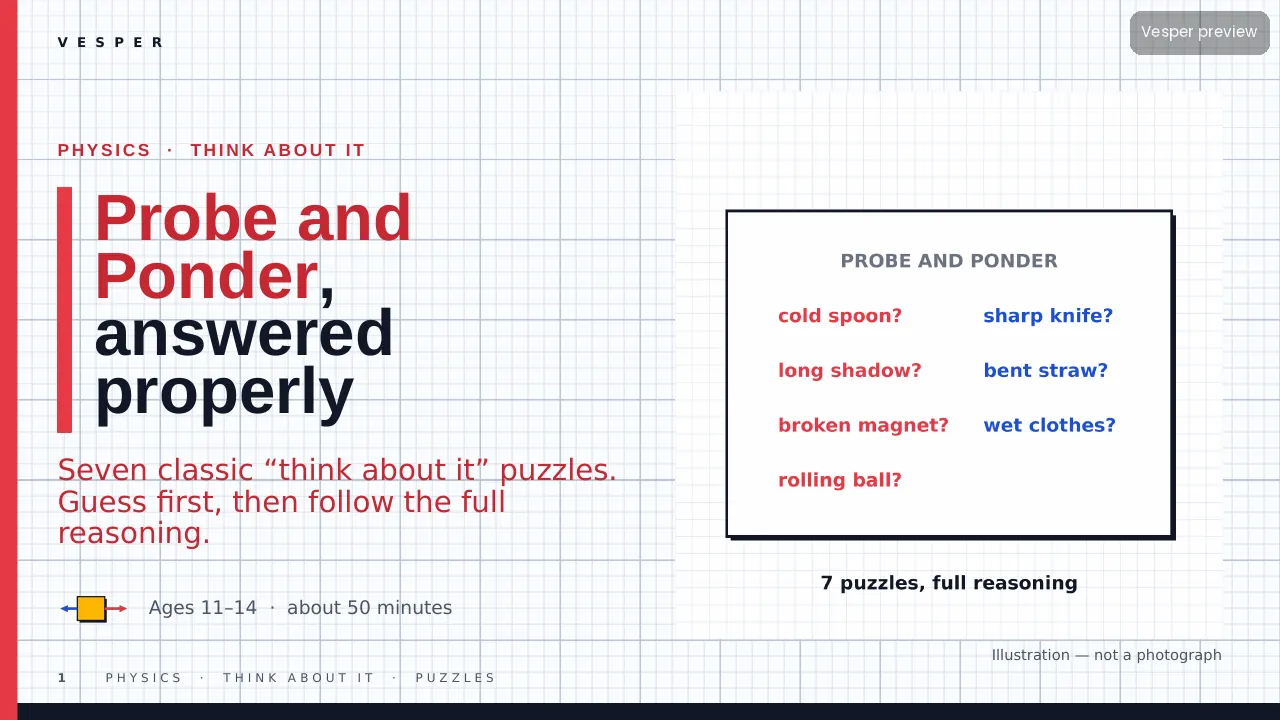
Probe and Ponder, answered properly

Seven classic 'think about it' puzzles, each answered with a claim, evidence and a number.

A 28-slide lesson that answers seven classic ‘think about it’ physics puzzles with claim, evidence, reasoning and numbers. Use it whole or as seven starters.

The short answer

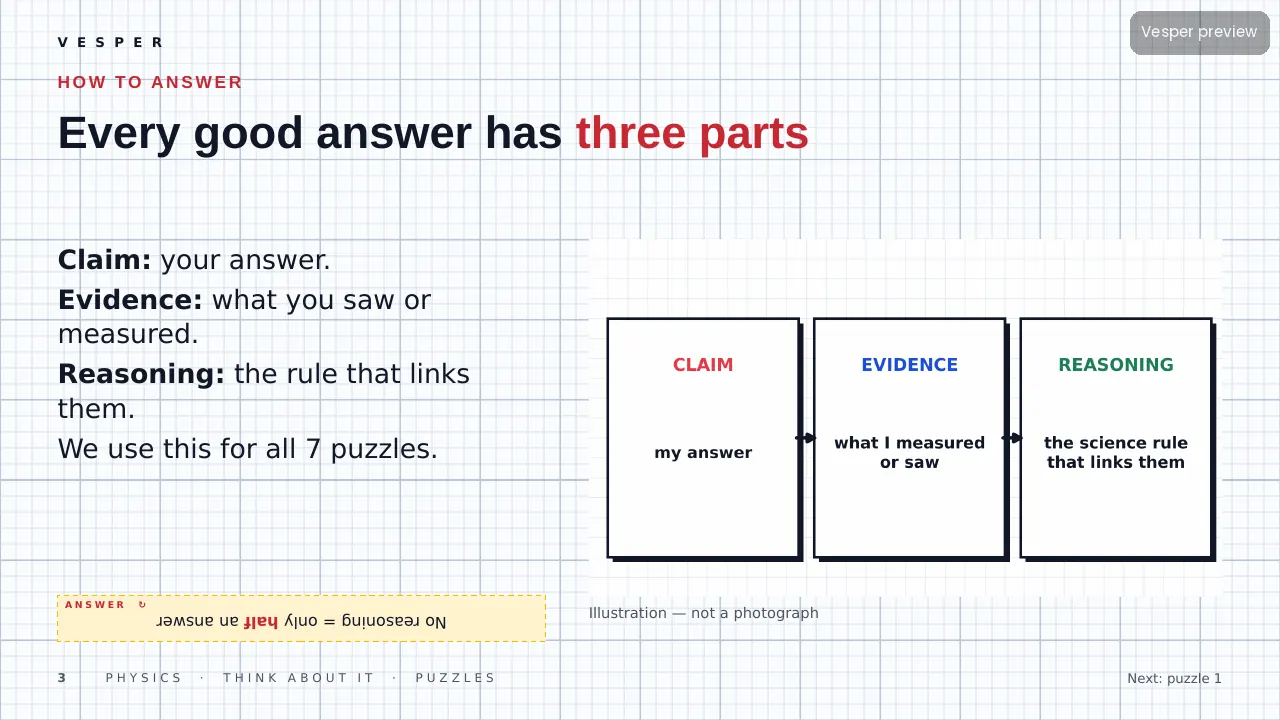
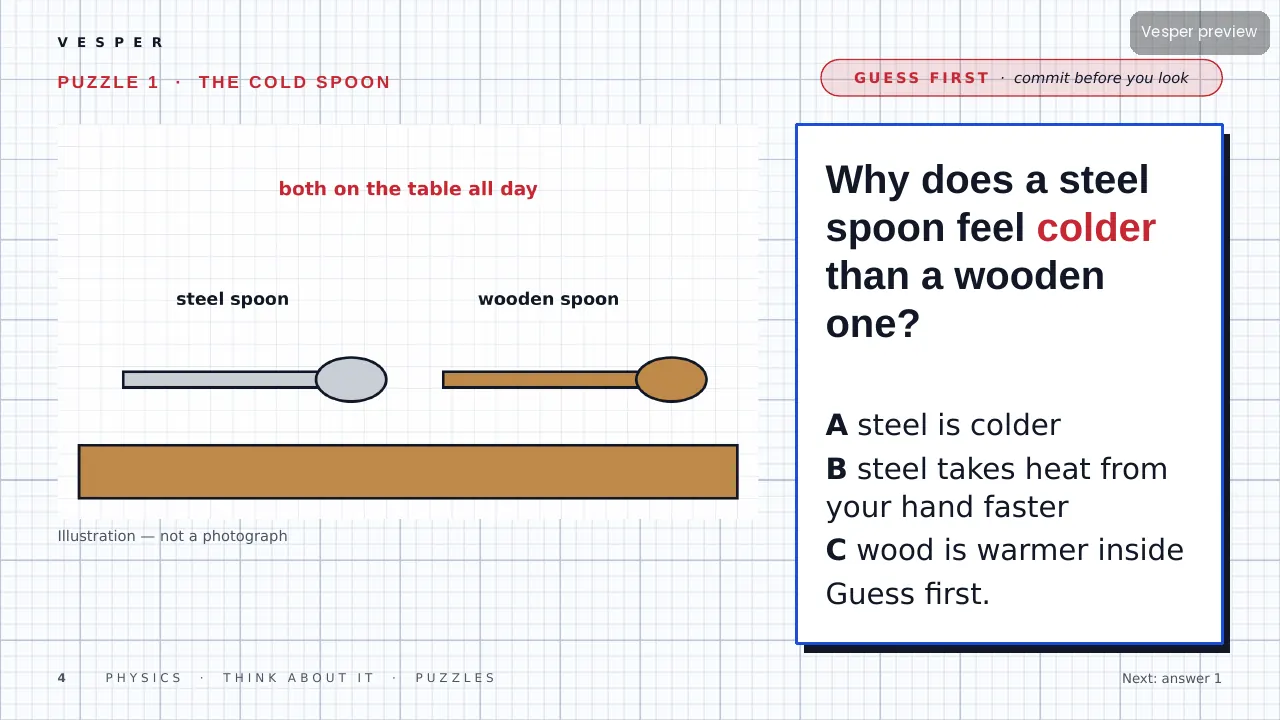
A steel spoon feels colder than a wooden one at the same 20 °C because steel conducts heat away from your hand about 300 times faster. That is one of seven puzzles in this lesson, each answered the same way: a claim, the evidence and the reasoning, backed by a number students can check.

Inside the deck

slides
28
quiz questions
8
minutes
50
your-turn tasks
8

Choose a format

  • Lesson Notes (PDF)Every slide with its teacher notes, as a PDF to read or print.
  • Teacher DeckThe editable PowerPoint with speaker notes on every slide, a PDF copy and the matching Vesper slide template, so you can add slides of your own.
Pricing coming soon

Pricing coming soon

We’ll email you pricing and launch offers shortly.

  • Finished and checked: buying opens soon
  • Sources listed at the end
  • Curriculum links under ‘Curriculum & specs’
  • For one classroom. Campus licences for whole schools

Key facts

  • Steel conducts heat about 300 times better than wood
  • 50 N on 0.5 cm² gives a pressure of 100 N/cm²
  • A low Sun can stretch a 1 m stick's shadow to 3 m
  • A 2 m deep pool looks about 1.5 m deep from above
  • Every piece of a snapped bar magnet has two poles

What students will be able to do

  • Students can structure an answer as claim, evidence and reasoning
  • Students can explain why metal feels colder than wood at the same temperature
  • Students can use pressure = force ÷ area
  • Students can explain shadows and the bent-straw effect using how light travels
  • Students can explain why a rolling ball stops

About this lesson

What students discover

Why does a steel spoon feel colder than a wooden one on the same table? Why does a sharp knife cut with the same push? Students take seven classic puzzles and answer each one properly: guess first, then follow a claim, the evidence and the reasoning, with a number.

Steel conducts heat about 300 times better than wood, though both sit at 20 °C. Fifty newtons on 0.5 cm² gives 100 N/cm². A low Sun stretches a 1 m stick’s shadow to 3 m. Light bends as it leaves water, so a 2 m pool looks 1.5 m deep. Every piece of a snapped magnet has two poles. Wind sweeps damp air away so clothes dry faster. Friction, not ‘running out of push’, stops a rolling ball.

Inside the deck

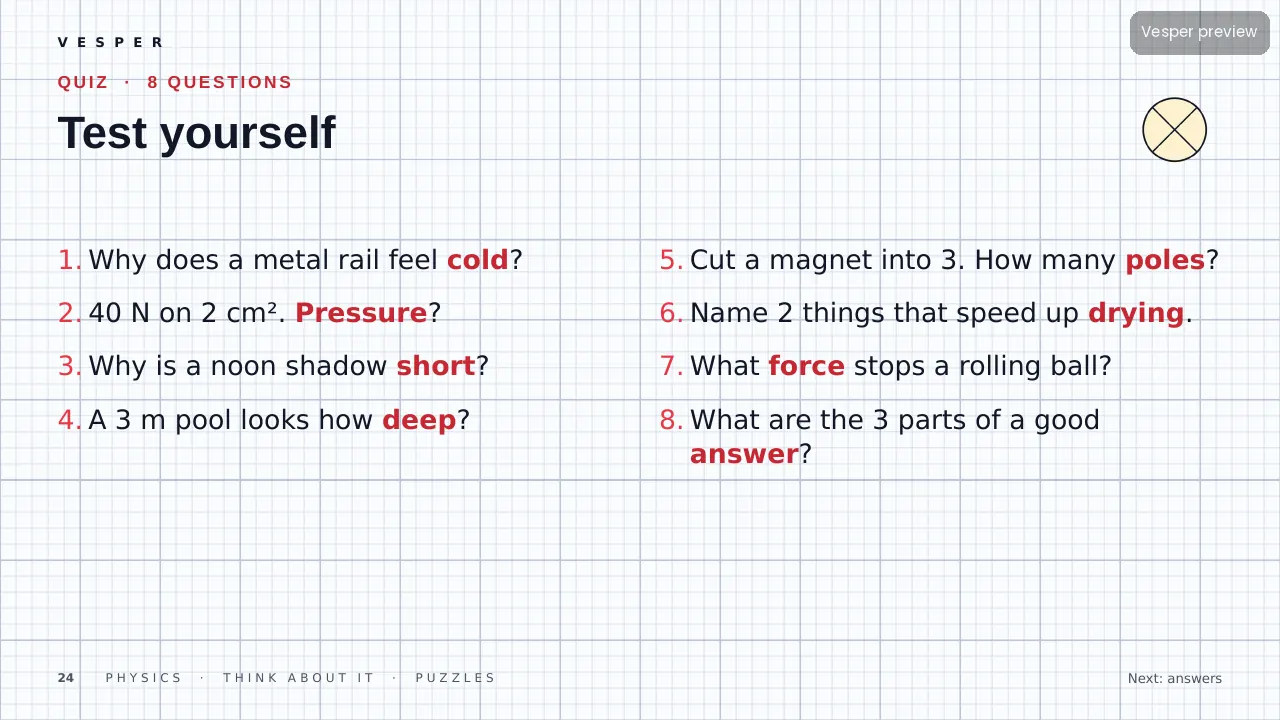
28 slides on the Vector template: a primer on the three parts of a good answer, seven hook-and-answer pairs, a coin-in-a-mug trick, a myth slide (‘metal is colder than wood’), two checkpoints and an 8-question quiz with explained answers. Every diagram is drawn in code.

How to teach it

Allow about 50 minutes as one lesson, or use each hook-and-answer pair as a five-minute starter across seven lessons. Ask students to write their own claim before you show each answer slide, then compare. The coin trick on slide 13 needs a mug, a coin and a jug of water. Notes on every slide give Say, Ask, Watch for and Time.

Who it’s for

For ages 11–14 learning to explain science with evidence. It suits teachers who want students to stop writing one-word answers, and it covers heat, pressure, light, magnetism, evaporation and forces in a single deck.
Curriculum & specs

CBSE/NCERT (India)Class 6-8 · Class 6–8 Curiosity, every chapter (in-chapter Probe and Ponder questions)
CambridgeLS Thinking and Working Scientifically
NGSS (US)SEP 1–8 (varies by chapter)
IB MYPSciences · Crit A, B (varies)
Ages11–14
LevelMiddle
Slide templateVector
Slides28
Teaching timeAbout 50 minutes
LanguageEnglish (UK)

Questions

Questions, answered

Why does metal feel colder than wood?

Both are at room temperature, but metal conducts heat away from your hand much faster, so your skin cools faster. Steel conducts about 300 times better than wood.

Why does a sharp knife cut better?

The same push acts on a much smaller area, so the pressure is much bigger. Pressure = force ÷ area.

Why is your shadow longest in the morning?

Light travels in straight lines, and when the Sun is low its rays hit you at a shallow angle, stretching the shadow.

Why does a straw look bent in water?

Light bends when it leaves water, so the part under water looks higher than it is. Pools look shallower for the same reason.

What happens if you cut a magnet in half?

You get two smaller magnets, each with a north and a south pole.

Why does a rolling ball stop?

Friction acts on it. With no friction or air resistance, it would keep rolling.

Main sources

  1. Thermal conductivity: steel about 50 W/m °C, dry wood about 0.15 (standard tables).
  2. Speed of light in water about 225,000 km/s (refractive index 1.33); apparent depth ≈ real depth ÷ 1.33 for viewing from above.
  3. Newton, I. (1687). Principia: first law of motion.

The full source list is on the last slides of the deck. Spotted an error? Tell us.