Cosmos Ages 14–16

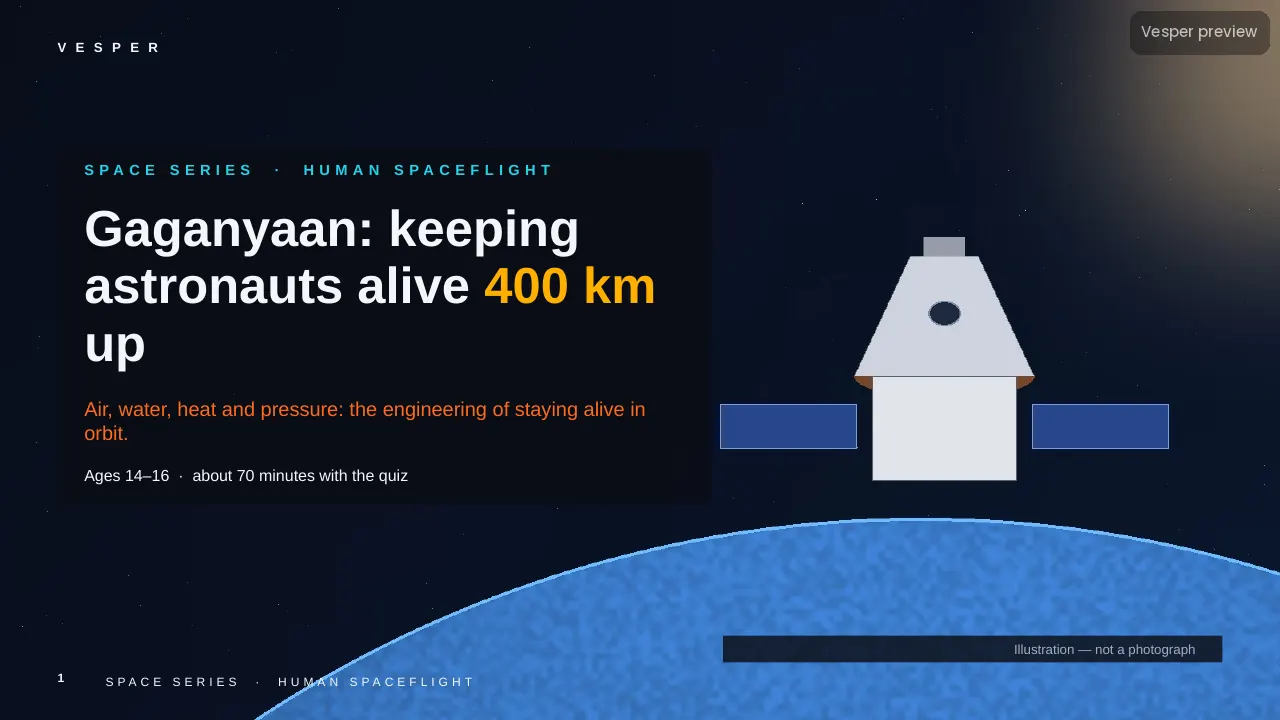
Gaganyaan explained: keeping astronauts alive 400 km up

Pressure, oxygen, scrubber, heat: the engineering of staying alive in orbit.

A 35-slide space-and-biology lesson on how India’s Gaganyaan capsule keeps a crew alive: air pressure, oxygen, carbon dioxide, heat and the trip home. The mission’s status is dated 18 Nov 2026.

The short answer

Gaganyaan keeps astronauts alive by holding Earth-like air at about 101 kPa inside a sealed capsule, topping up the 0.84 kg of oxygen each person uses a day, and scrubbing the 1.00 kg of carbon dioxide they breathe out with lithium hydroxide. It also manages a hull that swings from +121 °C to −157 °C every lap.

Inside the deck

slides
35
quiz questions
8
minutes
70
your-turn tasks
7

Choose a format

  • Lesson Notes (PDF)Every slide with its teacher notes, as a PDF to read or print.
  • Teacher DeckThe editable PowerPoint with speaker notes on every slide, a PDF copy and the matching Vesper slide template, so you can add slides of your own.
Pricing coming soon

Pricing coming soon

We’ll email you pricing and launch offers shortly.

  • Finished and checked: buying opens soon
  • Sources listed at the end
  • Curriculum links under ‘Curriculum & specs’
  • For one classroom. Campus licences for whole schools

Key facts

  • Without air pressure, a person blacks out in about 15 seconds; sea-level pressure is 101 kPa.
  • Gaganyaan aims for up to 3 crew, up to 3 days, about 400 km up.
  • One astronaut uses about 0.84 kg of oxygen and gives out about 1.00 kg of carbon dioxide a day.
  • At 400 km, gravity is still about 89% of its strength at the ground.
  • Cabin air at 101 kPa pushes on each square metre with 101,000 N, about 10 tonnes.

What students will be able to do

  • Students can explain why air pressure is the first danger in space.
  • Students can calculate a crew's oxygen needs from daily per-person figures.
  • Students can use respiration and the lithium hydroxide reaction to explain carbon dioxide removal.
  • Students can calculate the force of cabin air on a hull using force = pressure × area.
  • Students can describe how the escape system and parachutes protect the crew at launch and landing.

About this lesson

What students discover

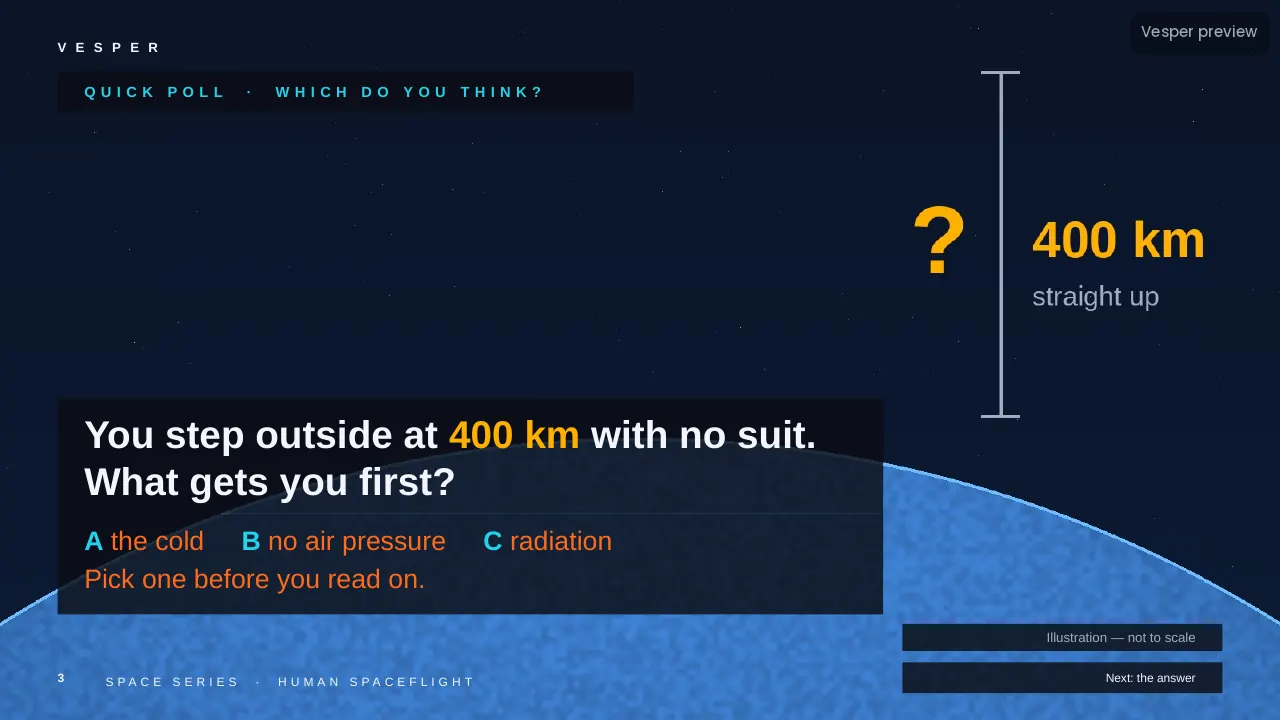
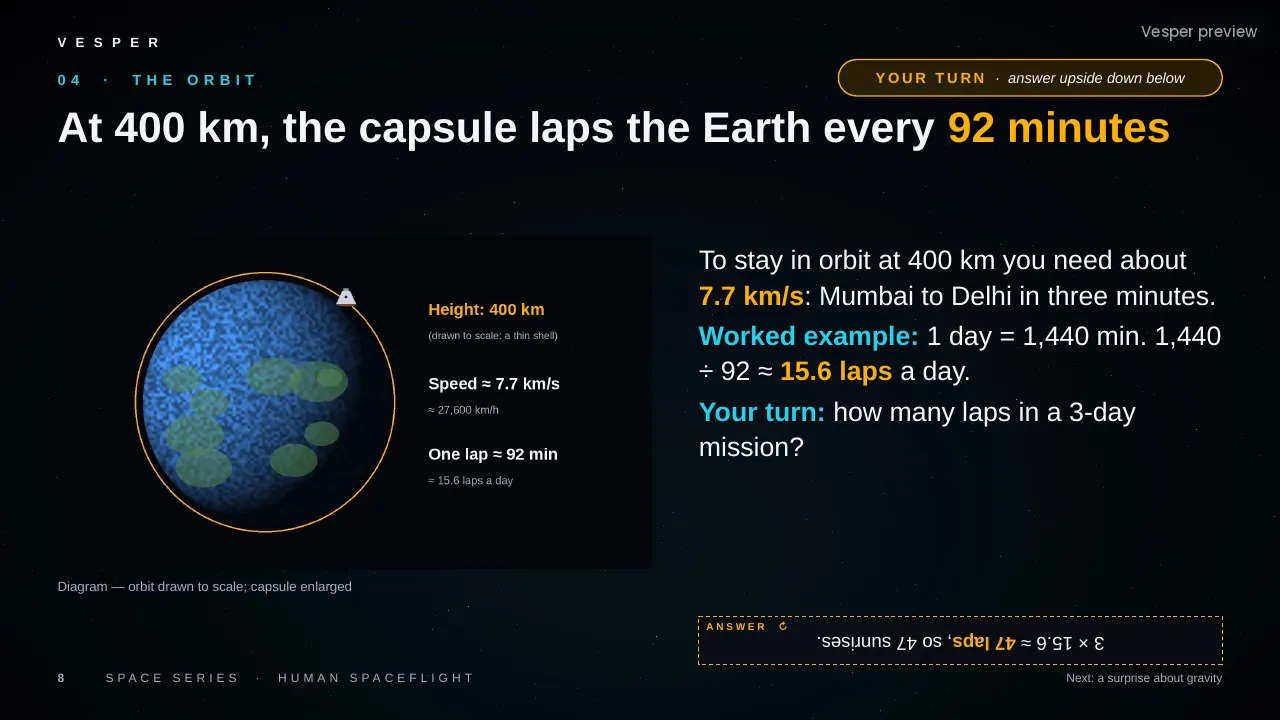
You step outside at 400 km with no suit. What gets you first: the cold, the lack of air pressure or radiation? Pressure. With none, you black out in about 15 seconds, because your lungs cannot load oxygen. Sea-level air presses at 101 kPa, and Gaganyaan’s job is to carry that bubble of air round the Earth every 92 minutes at about 7.7 km/s. Students also find that gravity at 400 km is still 89% as strong as on the ground, which changes how they explain floating.

Then they build an astronaut’s daily shopping list from NASA design figures: 0.84 kg of oxygen in, 1.00 kg of carbon dioxide out. The respiration equation with real masses shows why more mass of CO₂ comes out than oxygen goes in. A sealed-cabin calculation shows carbon dioxide climbing fast, and students balance the lithium hydroxide reaction that locks it into a solid (2LiOH + CO₂ → Li₂CO₃ + H₂O). Pressure × area shows why each square metre of hull carries 101,000 N, about 10 tonnes. A myth slide fixes ‘space is freezing, so keep warm’: a vacuum traps heat.

Inside the deck

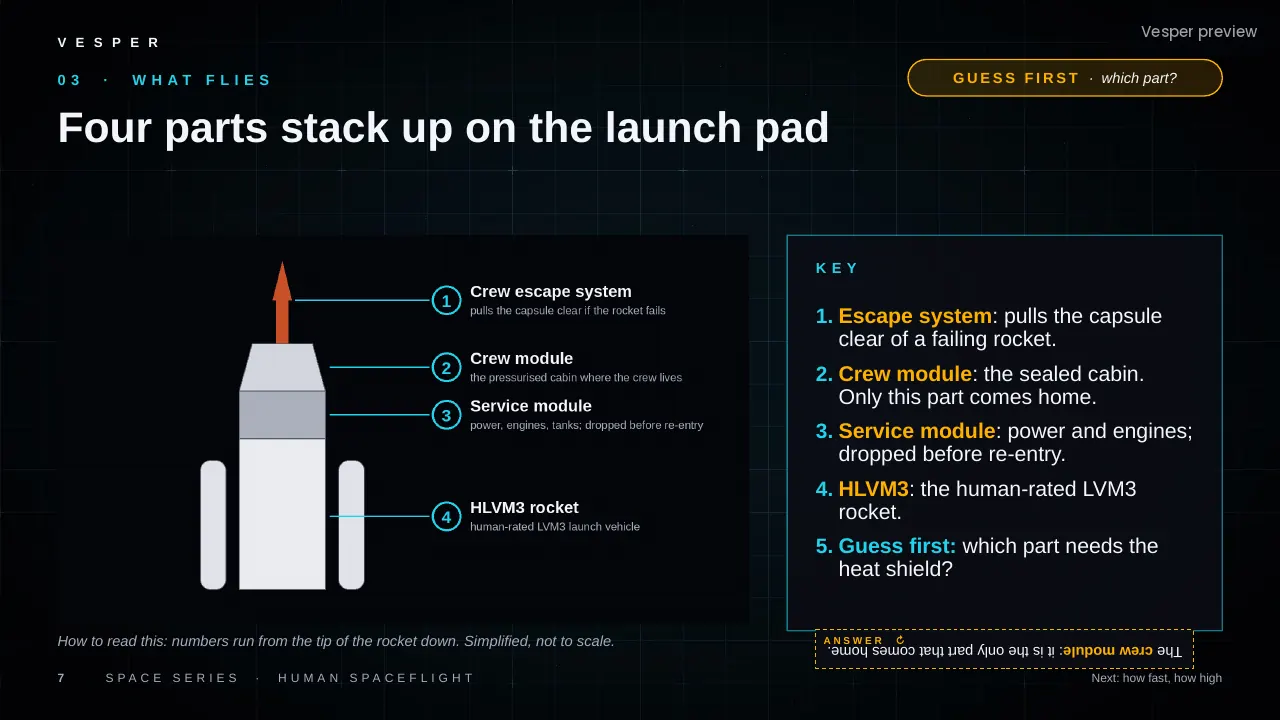
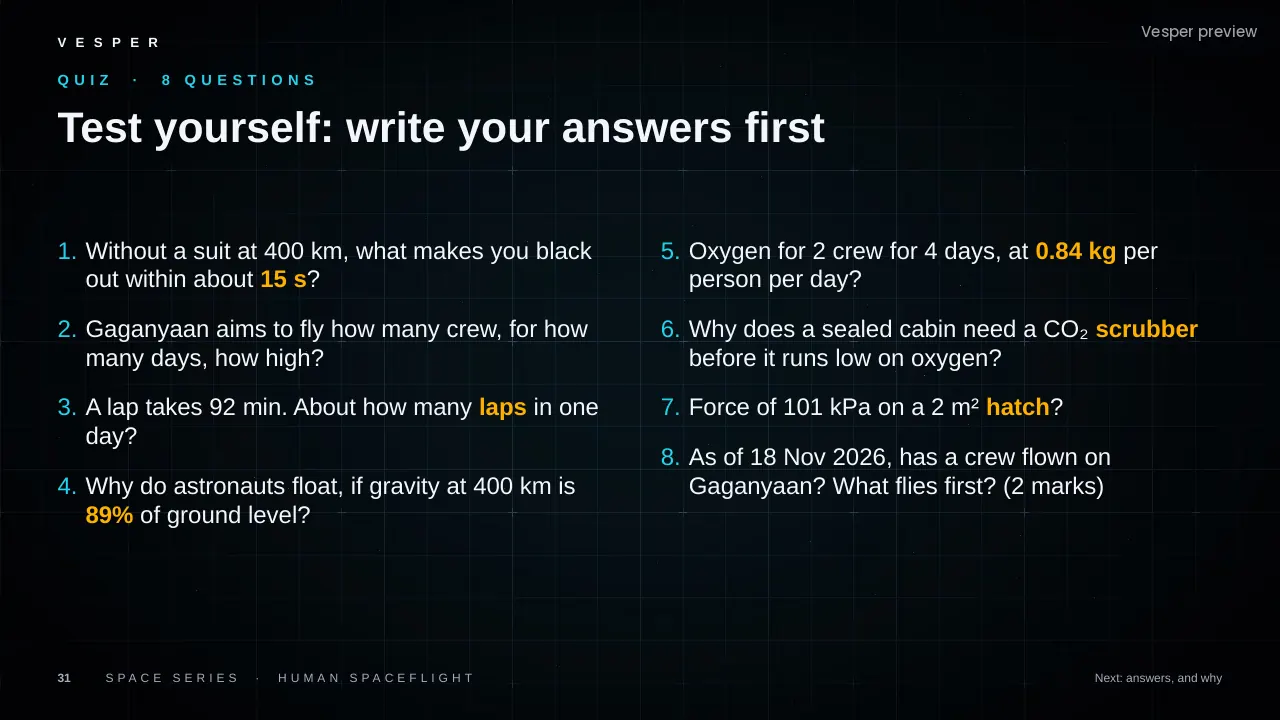
35 slides on the Nova template: a guess-first hook, three diagram walks (the rocket stack, the six air jobs, the ten-parachute landing), seven your-turn calculations, an evidence slide on the 2023 TV-D1 escape test, two checkpoints and a frontier slide on the planned uncrewed G1 flight with Vyommitra. Planned dates are labelled as plans, as of 18 Nov 2026. An eight-question quiz has explained answers.

How to teach it

About 70 minutes. The breathing activity (count breaths for 60 seconds, multiply by 0.5 L) gives students their own number to compare with the design figures. Speaker notes sit on every slide.

Who it’s for

Learners aged 14–16 linking biology, chemistry and physics, and anyone following India’s human spaceflight programme.

Curriculum & specs

CBSE/NCERT (India)Class 8-10 · No direct chapter. Links: Class 8 Curiosity ch 3 Health: The Ultimate Treasure; Class 10 Science ch 5 Life Processes
CambridgeLS Science in Context; IGCSE Biology 0610 §11 Gas exchange
NGSS (US)HS-ETS1-2; HS-LS1-3; MS-ETS1-1
IB MYPDesign / Sciences · KC Systems · RC Balance · Crit D
Ages14–16
LevelSenior
Slide templateNova
Slides35
Teaching timeAbout 70 minutes
LanguageEnglish (UK)

Questions

Questions, answered

What is Gaganyaan?

India's programme to fly its own astronauts: up to 3 crew for up to 3 days in an orbit about 400 km up, ending with a splashdown at sea.

How do astronauts breathe in a spacecraft?

The capsule holds Earth-like air at about 101 kPa, tops up the oxygen the crew use and removes the carbon dioxide they breathe out.

How does a spacecraft remove carbon dioxide?

Gaganyaan uses lithium hydroxide canisters, as Apollo did: 2LiOH + CO₂ → Li₂CO₃ + H₂O locks the gas into a solid.

Why do astronauts float if gravity still acts at 400 km?

Gravity there is about 89% of ground level, but the capsule and crew are in constant free fall around the Earth together.

Is space freezing cold for a spacecraft?

Not in the way people expect. A vacuum traps heat, and the hull swings from about +121 °C in sunlight to −157 °C in shadow.

When will Gaganyaan fly?

As of 18 Nov 2026, the first uncrewed flight, G1 with the robot Vyommitra, is planned for December 2026, before the first crewed flight.

Main sources

  1. Wieland, P. O. (1994). Designing for Human Presence in Space: An Introduction to Environmental Control and Life Support Systems. NASA RP-1324, Marshall Space Flight Center. Daily O₂, CO₂, water, food; metabolic rate.
  2. ISRO. Gaganyaan programme pages and TV-D1 mission brochure (2023). Crew module, escape system, parachutes, TV-D1 timeline.
  3. Indian Defence News (12 Nov 2026). Gaganyaan first test flight set for December 2026, ISRO chief confirms.

The full source list is on the last slides of the deck. Spotted an error? Tell us.