About this lesson
What students discover
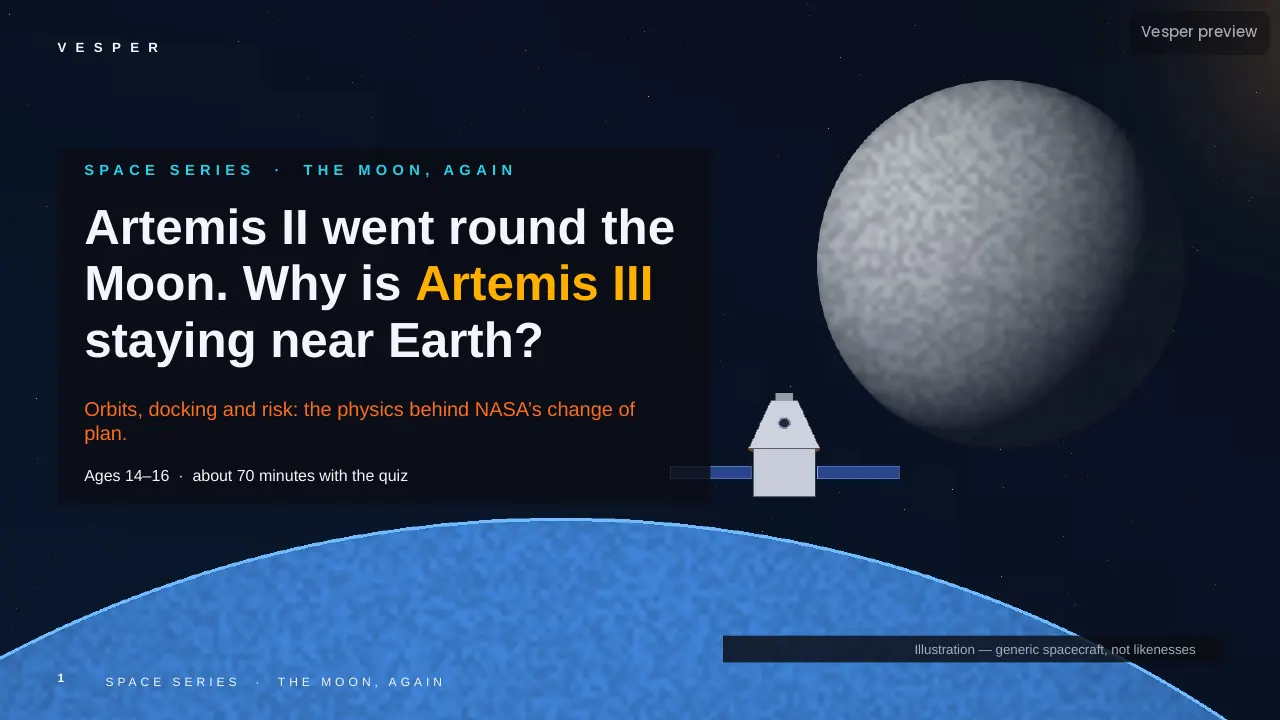
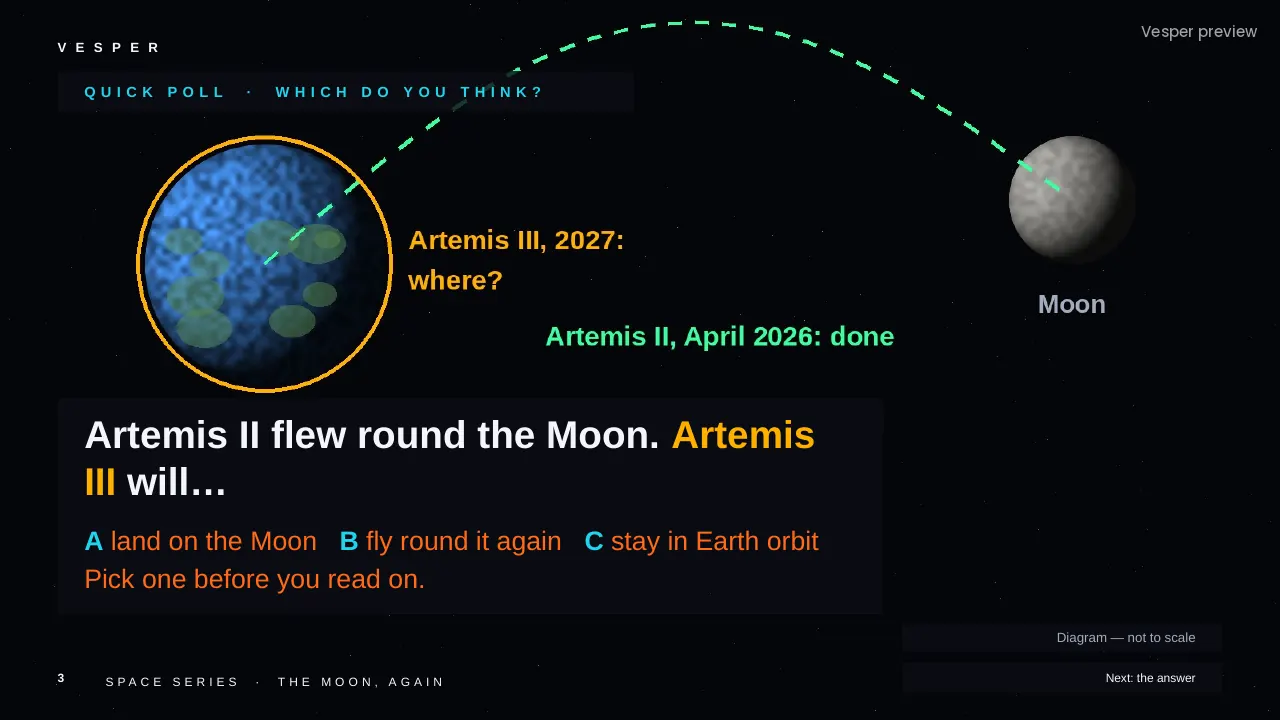
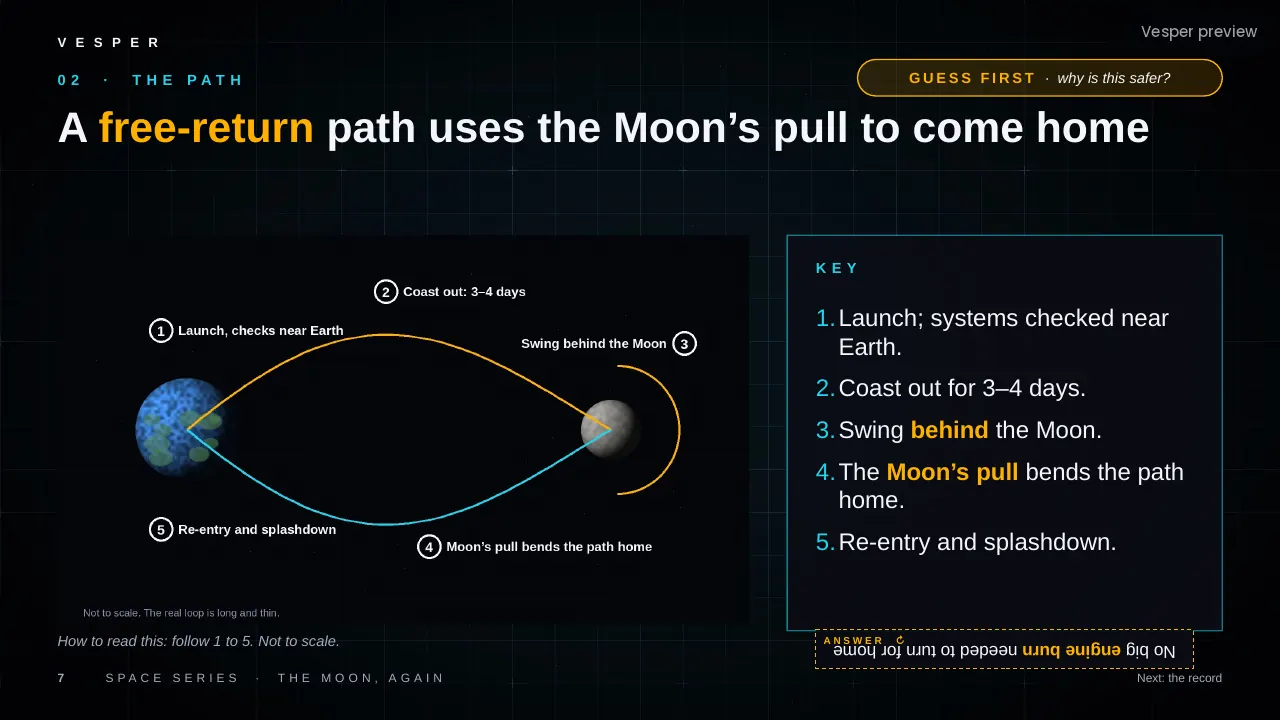
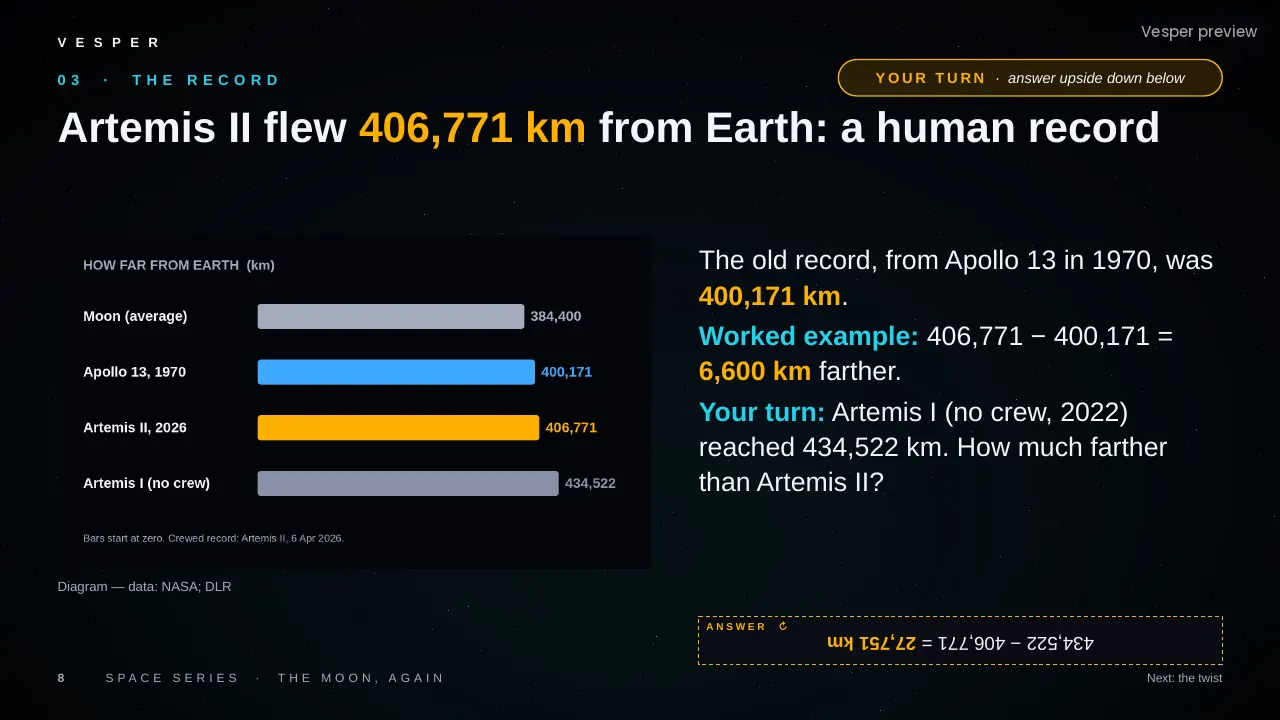
In April 2026 four astronauts flew round the Moon and reached 406,771 km from Earth, beating Apollo 13’s 1970 record of 400,171 km by 6,600 km. So why will the next mission stay close to home? Students follow Artemis II’s free-return path, then find the catch: Orion cannot land. Every landing needs the crew to dock with a lander and move across.
The physics does the persuading. Students calculate that a lap takes 92.0 minutes at 380 km and 92.8 minutes at 420 km, which gives the strange rule that you catch up by going lower. They time a docking approach at 0.1 m/s, compare radio delays near Earth and near the Moon, and use ½mv² to show that coming home at 11.2 km/s from the Moon carries about twice the energy per kilogram of a 7.8 km/s return from orbit. Apollo 9, which tested its lander in Earth orbit in 1969, is the precedent.
Inside the deck
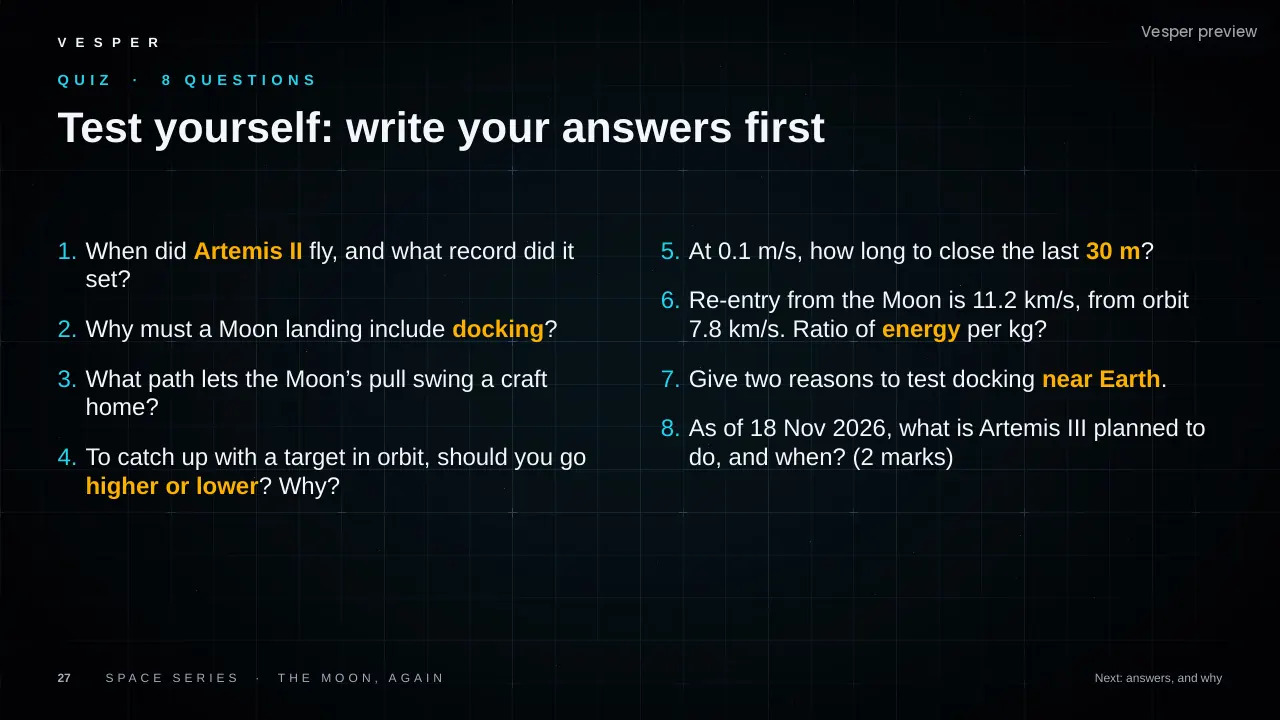
31 slides on the Nova template: a guess-first hook, two diagram walks, your-turn sums with answers, a myth slide (‘NASA has given up on the Moon’), two checkpoints and an eight-question quiz with explained answers. The Artemis III crew named in June 2026 and the state of both landers are covered on evidence slides. Every planned date is labelled as a plan, dated 18 Nov 2026.
How to teach it
Allow about 70 minutes. The playground activity, two people walking chalk circles 4 m and 6 m across, makes the inner-lane idea physical in five minutes. Speaker notes sit on every slide.
Who it’s for
Ages 14–16 studying orbits, energy or forces, space clubs, and anyone who saw the Artemis II headlines and wondered what comes next.