Cosmos Ages 14–16

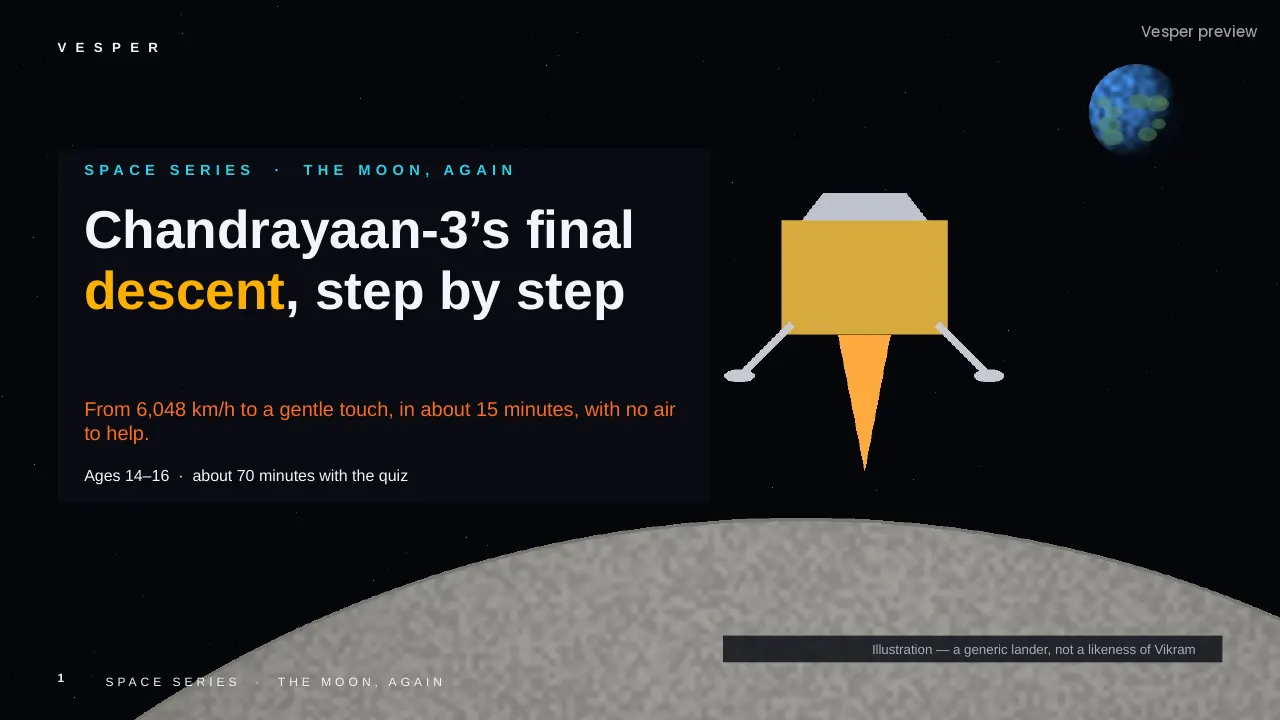
Chandrayaan-3's final descent, step by step

Brake, turn, brake, hover, touch. No parachute, because there's no air.

A 34-slide physics lesson that rides India’s 2023 Moon landing down, phase by phase. ISRO’s published numbers teach deceleration, weight, thrust and speed–time graphs.

The short answer

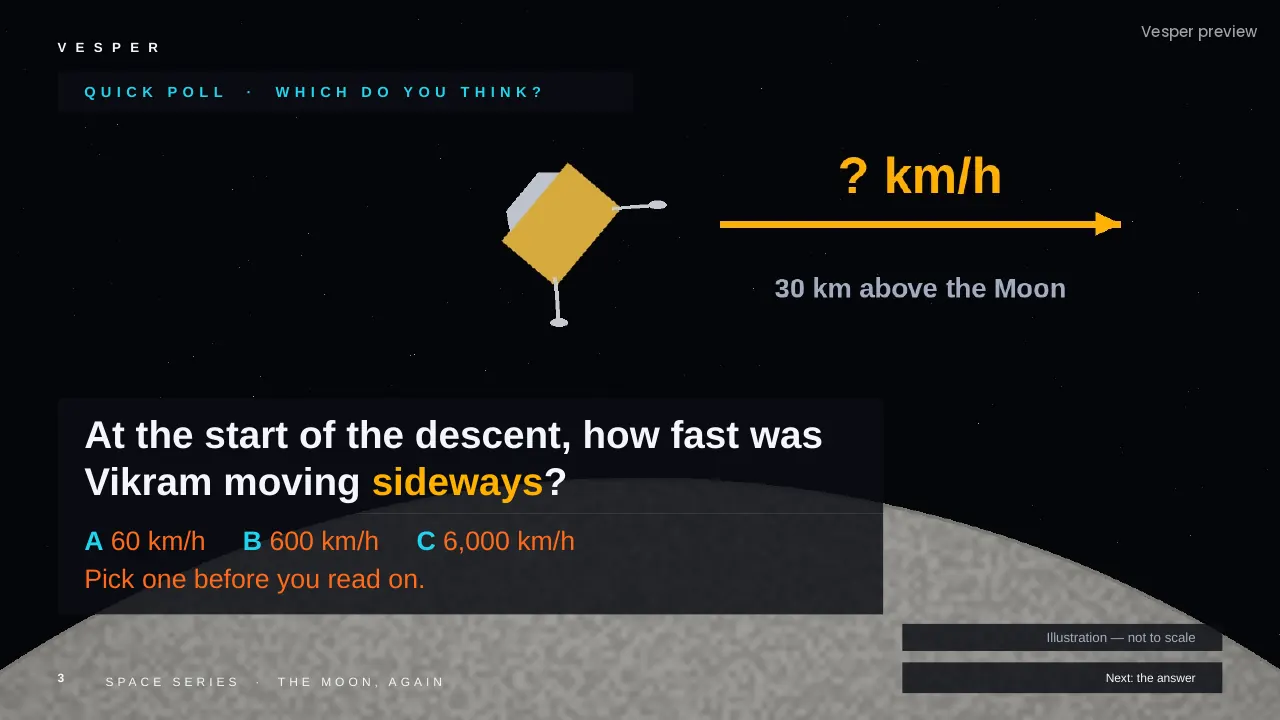
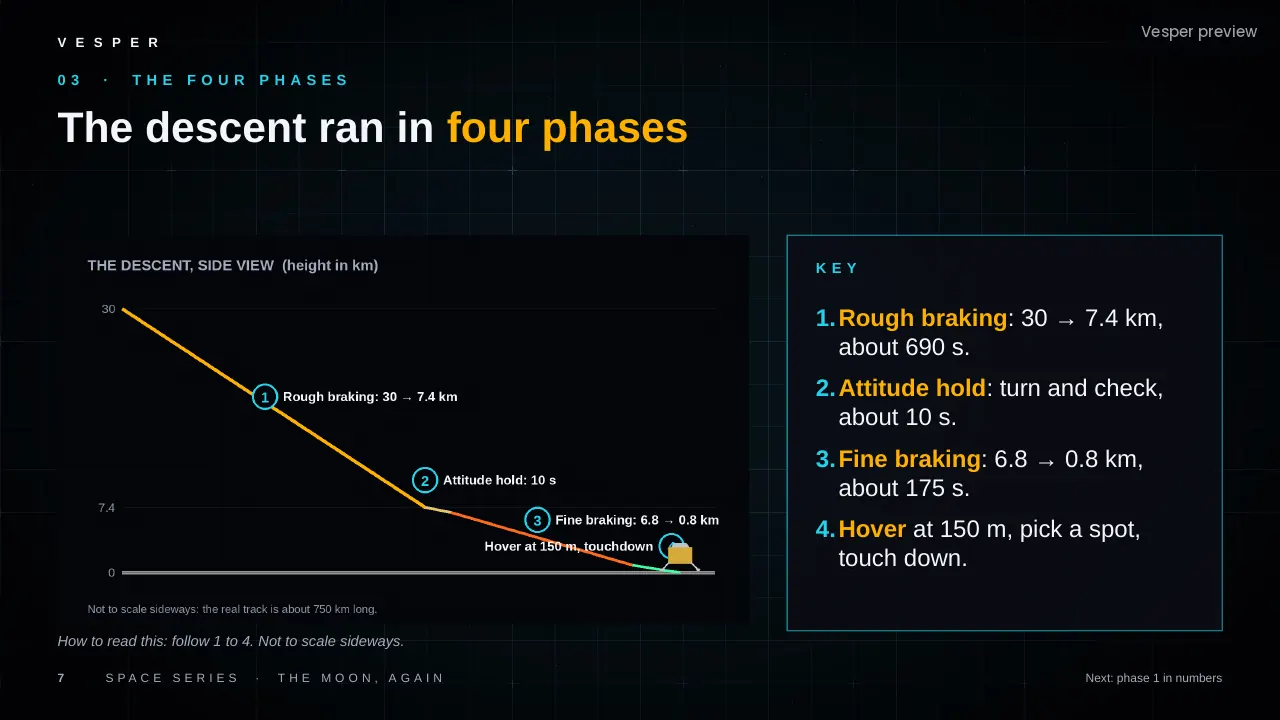
Chandrayaan-3's Vikram lander started 30 km above the Moon moving sideways at 1.68 km/s (6,048 km/h). With no air for a parachute, its engines did all the braking in four phases: rough braking, attitude hold, fine braking and a hover at 150 m to pick a safe spot, touching down on 23 August 2023.

Inside the deck

slides
34
quiz questions
8
minutes
70
your-turn tasks
7

Choose a format

  • Lesson Notes (PDF)Every slide with its teacher notes, as a PDF to read or print.
  • Teacher DeckThe editable PowerPoint with speaker notes on every slide, a PDF copy and the matching Vesper slide template, so you can add slides of your own.
Pricing coming soon

Pricing coming soon

We’ll email you pricing and launch offers shortly.

  • Finished and checked: buying opens soon
  • Sources listed at the end
  • Curriculum links under ‘Curriculum & specs’
  • For one classroom. Campus licences for whole schools

Key facts

  • The descent began 30 km up at 1.68 km/s sideways: about 6,048 km/h.
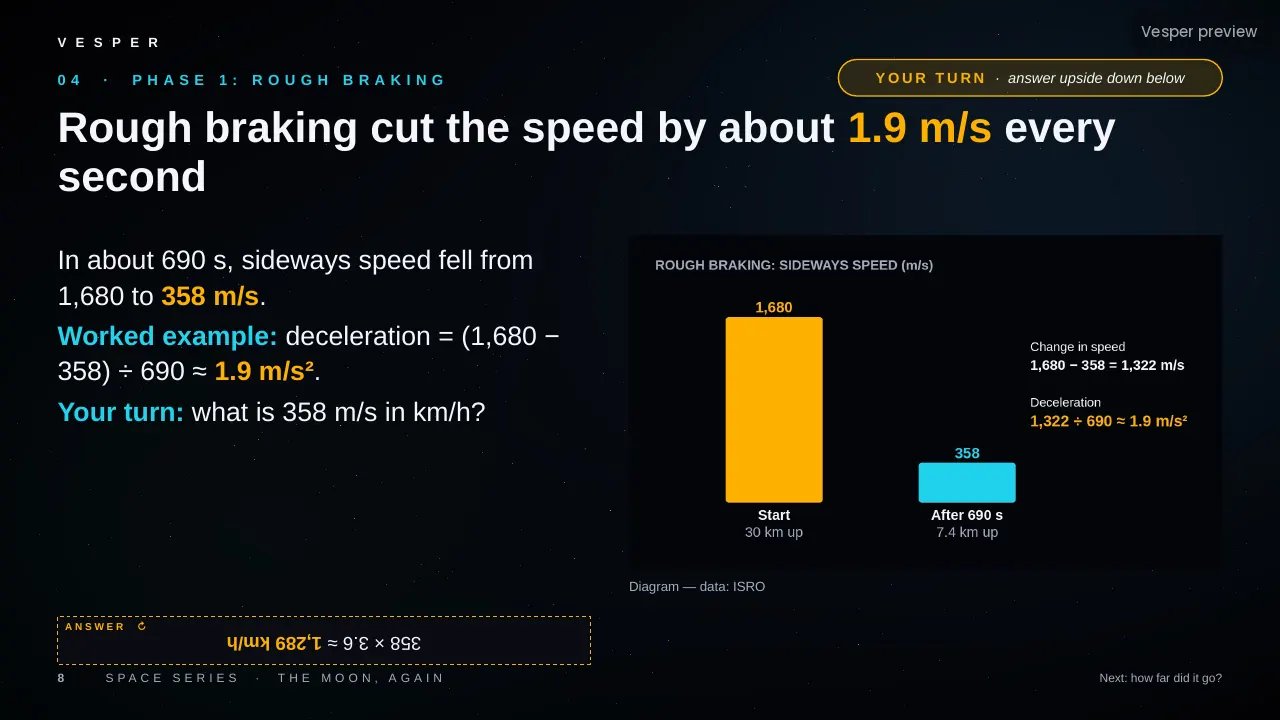
  • Rough braking cut the speed from 1,680 to 358 m/s in about 690 s: about 1.9 m/s².
  • On the Moon the 1,729 kg lander weighed about 2,801 N; its four engines gave up to 3,200 N.
  • The legs were built for a touchdown of up to 3 m/s.
  • After 2019 the landing area grew from 0.5 km × 0.5 km to 4 km × 2.4 km: about 38 times larger.
  • Vikram landed at 18:04 IST on 23 August 2023, at about 69.4° S.

What students will be able to do

  • Students can calculate deceleration from a change in speed over time.
  • Students can find distance from the area under a speed–time graph.
  • Students can compare weight and thrust to find the resultant force on the lander.
  • Students can explain why the engines fired almost to the ground, using v = √(2gh).
  • Students can describe what changed after the 2019 Chandrayaan-2 crash.

About this lesson

What students discover

Thirty kilometres above the Moon, moving sideways faster than a rifle bullet, with no air to help: how do you stop? Students follow the Vikram lander through its four descent phases using ISRO’s published figures. Rough braking took the sideways speed from 1,680 to 358 m/s in about 690 s, a deceleration of about 1.9 m/s². The area under the speed–time graph gives about 700 km, which students check against ISRO’s 713.5 km.

Forces come next. The 1,729 kg lander weighed about 2,800 N on the Moon, and its four engines gave up to 3,200 N: enough on the Moon, never on Earth. Hovering shows balanced forces, and v = √(2gh) shows why a 10 m free fall (5.7 m/s) would beat the 3 m/s the legs could take. The 2019 crash shows engineers learning from failure, with a landing area about 38 times larger. Touchdown came at 18:04 IST near the south pole, and the rover Pragyan drove about 100 m.

Inside the deck

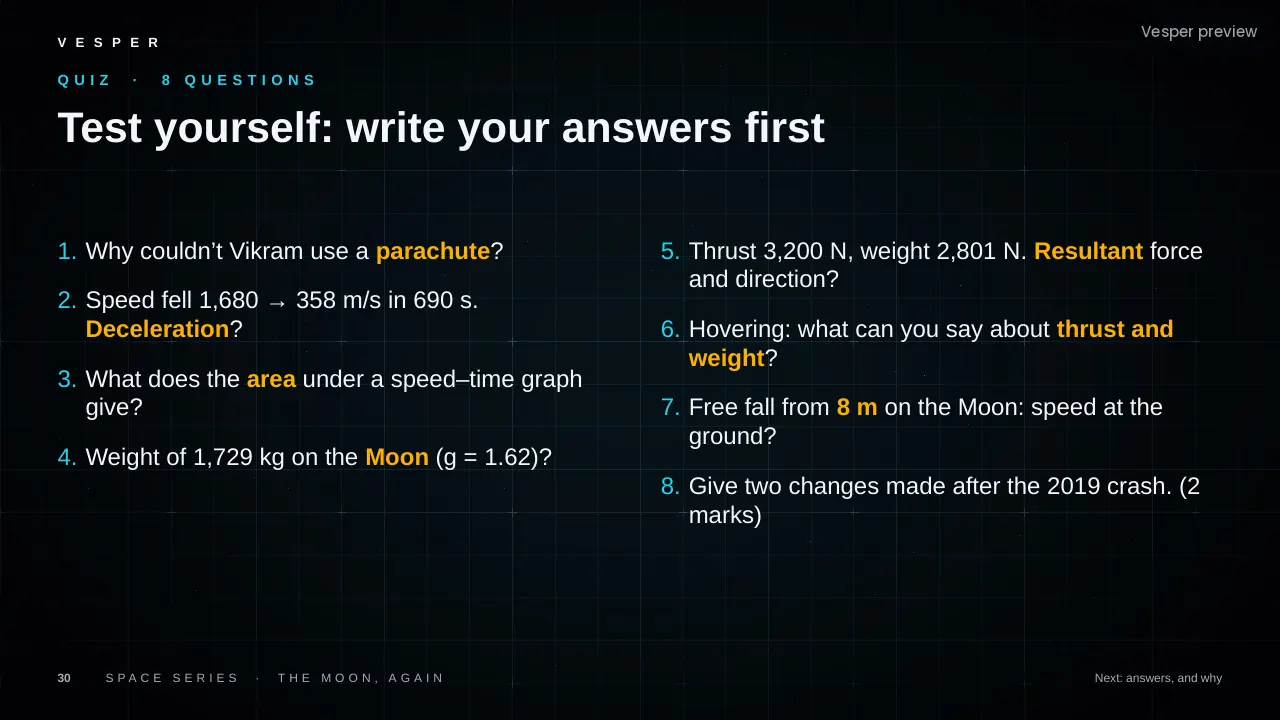
34 slides on the Nova template: a guess-first hook, three diagram walks, seven your-turn calculations, two bridges, two checkpoints, evidence slides on 2019 and 2023, a myth slide (‘low gravity makes landing easy’) and a frontier slide on water ice in dark craters. An eight-question quiz has explained answers.

How to teach it

About 70 minutes. The toy-car activity (film it beside a tape measure, mark each second) lets students draw their own speed–time graph and compare it with Vikram’s. Speaker notes sit on every slide.

Who it’s for

Learners aged 14–16 studying motion and forces, and any class that watched the landing and wants the physics behind it.
Curriculum & specs

CBSE/NCERT (India)Class 7-10 · Class 9 Exploration ch 4 Describing Motion Around Us; ch 6 How Forces Affect Motion
CambridgeLS Stage 8–9 Physics (forces); IGCSE 0625 §1.2 Motion, §1.5 Forces
NGSS (US)MS-PS2-2; HS-PS2-1
IB MYPSciences · KC Relationships · RC Movement, Energy
Ages14–16
LevelSenior
Slide templateNova
Slides34
Teaching timeAbout 70 minutes
LanguageEnglish (UK)

Questions

Questions, answered

How did Chandrayaan-3 land on the Moon?

Its Vikram lander braked with rocket engines in four phases: rough braking, attitude hold, fine braking and a hover at 150 m to choose a safe spot, then a slow final descent.

Why couldn't Chandrayaan-3 use a parachute?

The Moon has no air, so a parachute cannot slow anything. The engines had to do all the braking.

How fast was Vikram going at the start of the descent?

About 1.68 km/s sideways, roughly 6,048 km/h, which was its speed in orbit.

What changed after Chandrayaan-2 crashed in 2019?

Among other design changes, the allowed landing area grew about 38 times: 4 km × 2.4 km instead of 0.5 km × 0.5 km.

When did Chandrayaan-3 land?

At 18:04 IST on 23 August 2023, near the Moon's south pole.

What physics does this lesson teach?

Speed, deceleration, speed–time graphs, weight, thrust, resultant force and free fall, all with the mission's real numbers.

Main sources

  1. Swarajya (23 Aug 2023). Explained: how Chandrayaan-3 lander will navigate through its final descent (ISRO phase figures: 30 → 7.42 km in 690 s; 1.68 km/s → 358 m/s; 713.5 km; 10 s hold; 175 s fine braking; 150 m hazard check; 3 m/s limit).
  2. Powered descent trajectory optimisation of Chandrayaan-3 (2025). arXiv 2511.03594 (mass 1,729 kg; four 800 N engines; 50° thrust angle; hover up to 22 s; 1 m/s final descent; site 69.37° S, 32.32° E).
  3. ISRO. Chandrayaan-3 mission updates (landing 23 Aug 2023; rover traverse; sulphur detection; hop experiment 3 Sep 2023).

The full source list is on the last slides of the deck. Spotted an error? Tell us.