Cosmos Ages 13–16

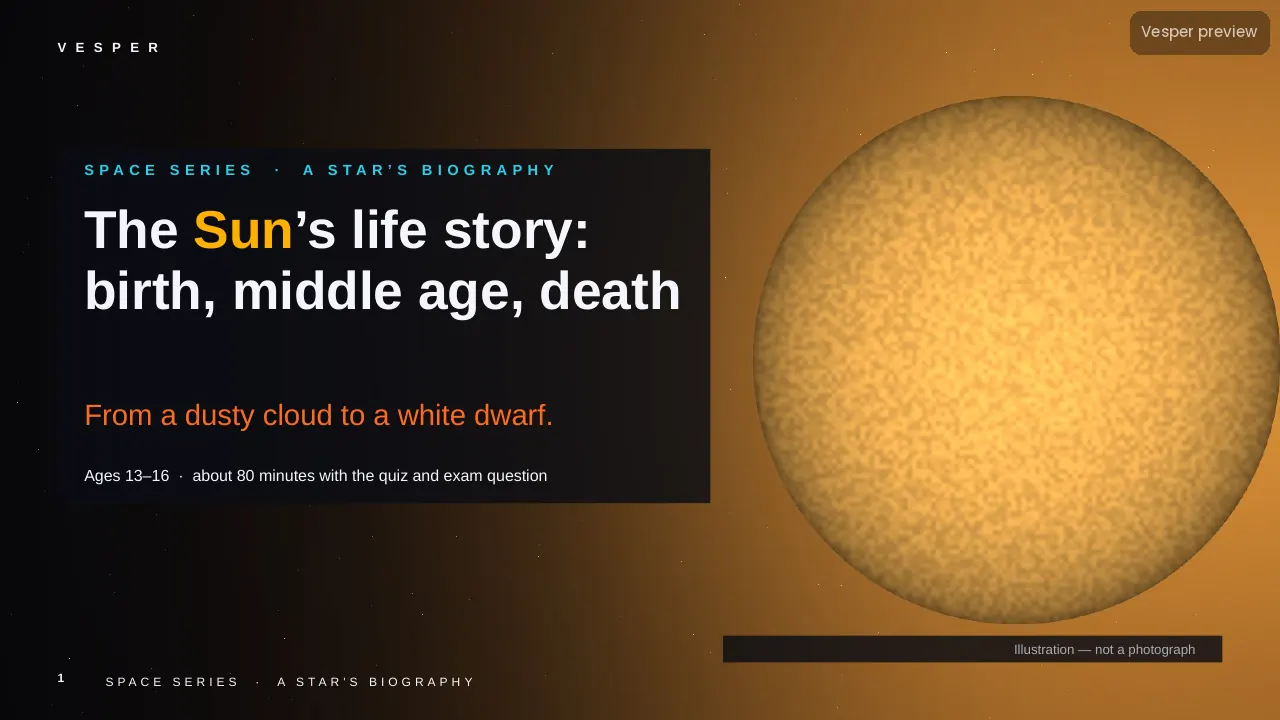
The Sun's life story: birth, middle age, death

Cloud, shine, swell, shed, shrink: our star's biography in five chapters.

A 38-slide space lesson for ages 13–16 that tells the Sun’s life story as a biography, in chapters: birth, middle age, the red giant and death, with real numbers throughout.

The short answer

The Sun formed 4.567 billion years ago from a collapsing cloud of gas and dust. Its 15-million-degree core turns about 4 million tonnes of mass into light each second. In billions of years it will swell into a red giant, shed its outer layers and end as a white dwarf, too light to become a black hole.

Inside the deck

slides
38
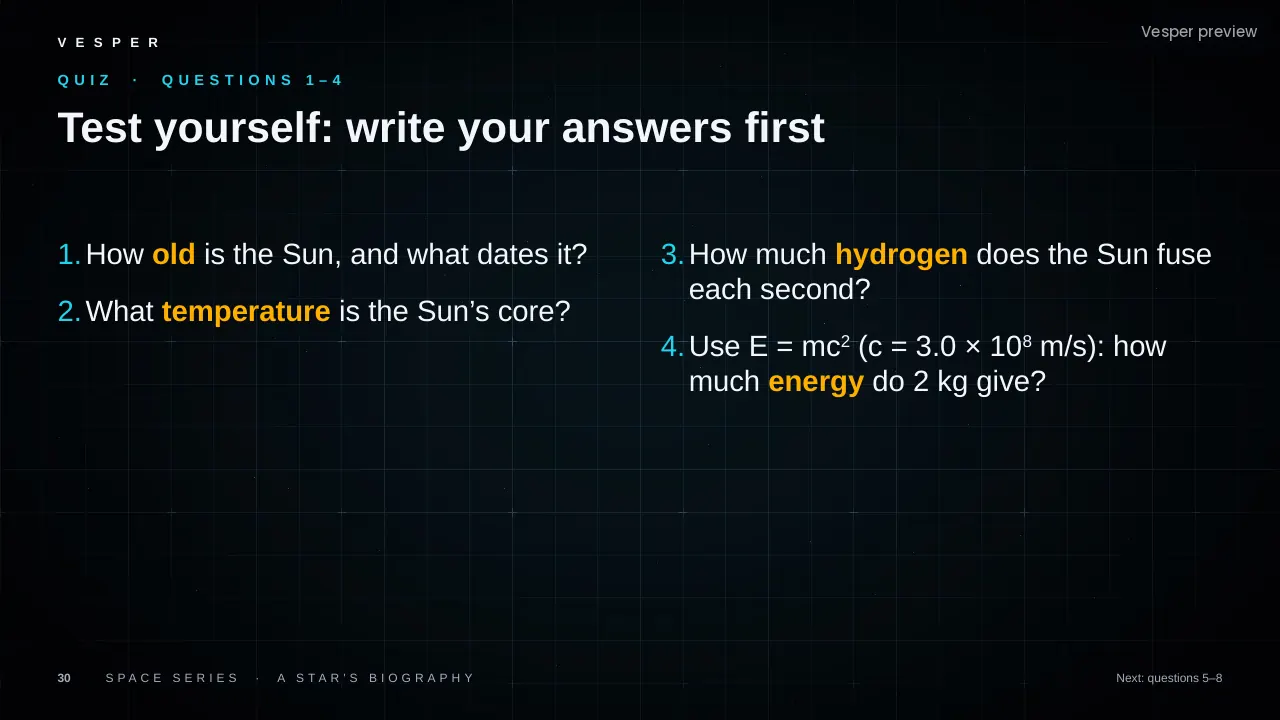
quiz questions
8
minutes
80
your-turn tasks
6

Choose a format

  • Lesson Notes (PDF)Every slide with its teacher notes, as a PDF to read or print.
  • Teacher DeckThe editable PowerPoint with speaker notes on every slide, a PDF copy and the matching Vesper slide template, so you can add slides of your own.
Pricing coming soon

Pricing coming soon

We’ll email you pricing and launch offers shortly.

  • Finished and checked: buying opens soon
  • Sources listed at the end
  • Curriculum links under ‘Curriculum & specs’
  • For one classroom. Campus licences for whole schools

Key facts

  • The Sun formed 4.567 billion years ago
  • Its core is about 15 million °C
  • About 4 million tonnes of mass become light every second
  • Sunlight takes about 8 min 20 s to reach Earth
  • A teaspoon of white dwarf weighs about 5 tonnes
  • A supernova needs about 8 Sun masses; the Sun has 1

What students will be able to do

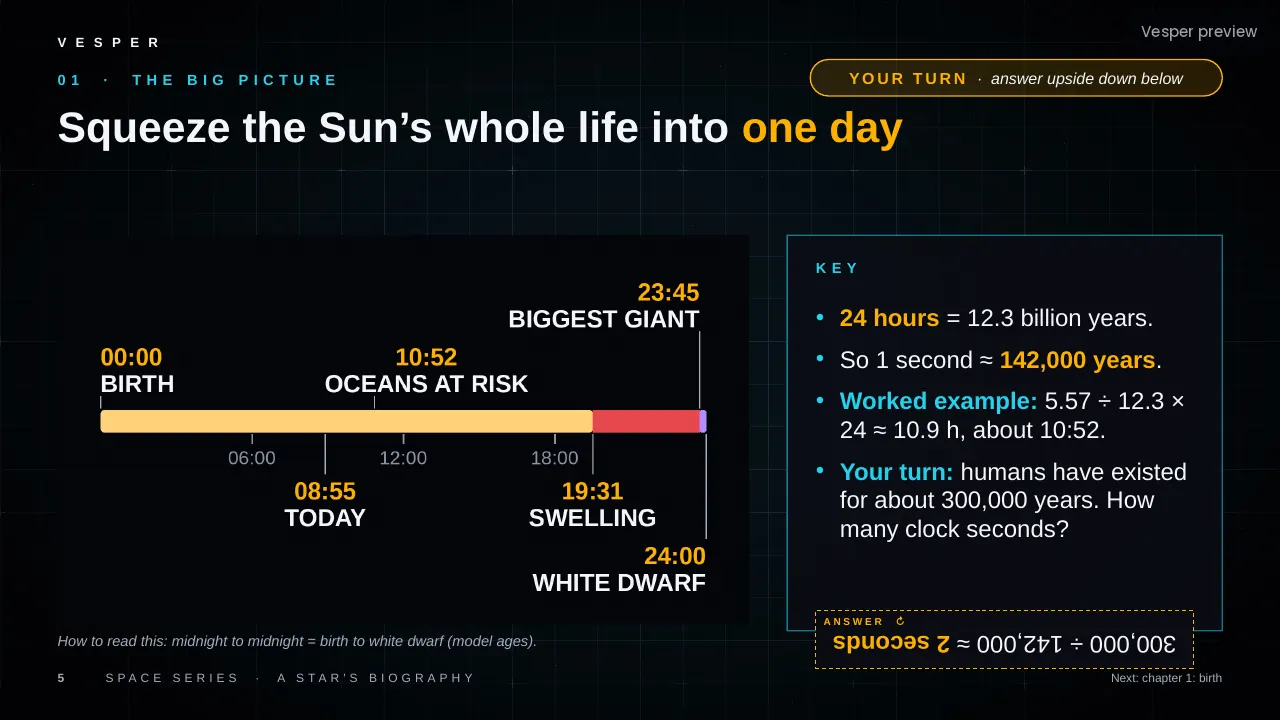
  • Students can describe the stages of the Sun's life in order
  • Students can explain how meteorites date the Sun's birth
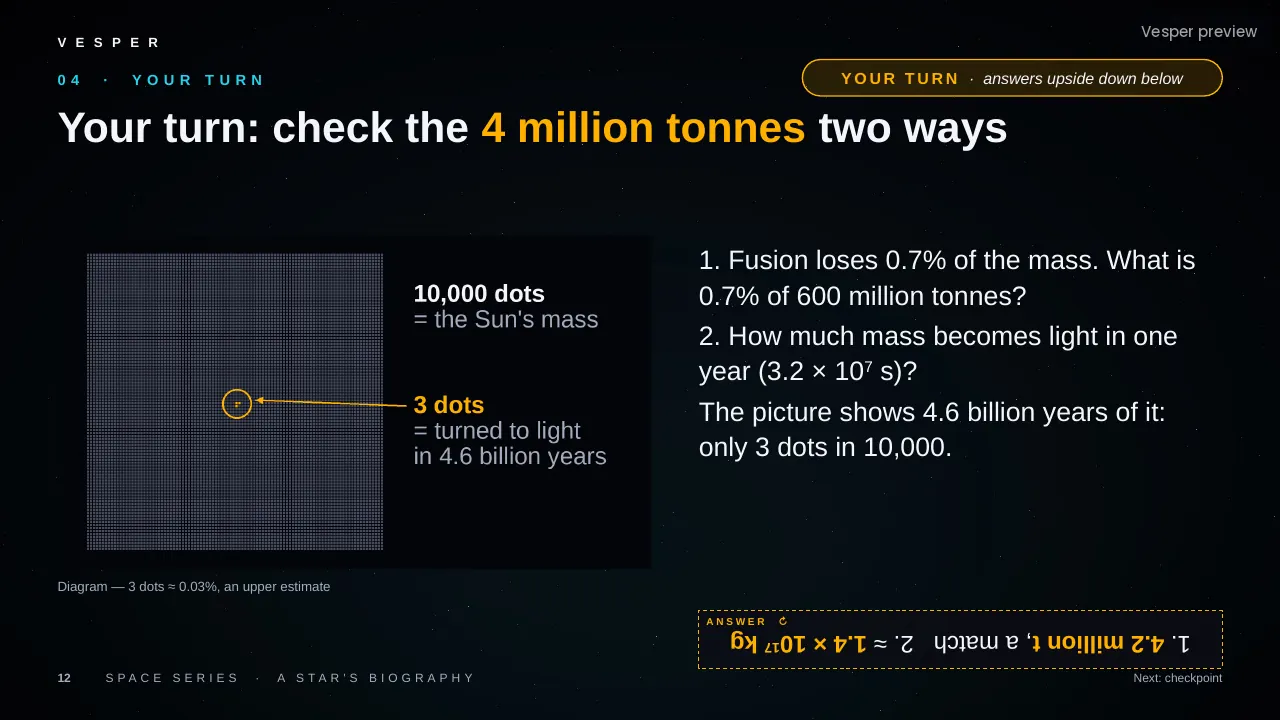
  • Students can use E = mc² to estimate the mass the Sun turns into light
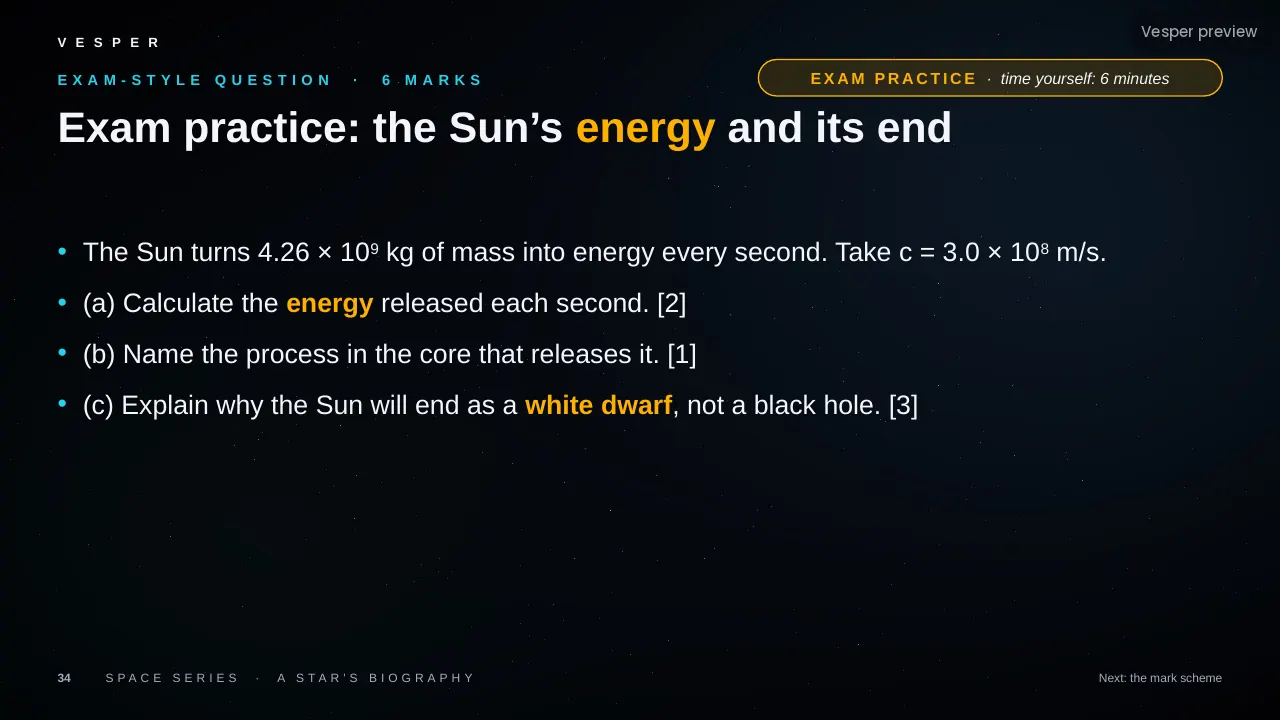
  • Students can explain why the Sun will become a white dwarf, not a black hole
  • Students can tell established facts from model estimates

About this lesson

What students discover

How old is the Sun, and how will it die? Students follow our star’s life as a biography in five chapters. They date its birth from meteorites (4.567 billion years), step inside the 15-million-degree core, and use E = mc² to show that about 4 million tonnes of mass become light every second, checked two ways. They time sunlight’s 8 min 20 s trip to Earth and its far slower escape from the core.

Model estimates are clearly marked: the Sun brightening by about 10% per billion years, oceans at risk in about a billion years, and a red giant reaching about 1.2 AU. Earth’s own fate is shown as an open question. The story ends with a white dwarf where a teaspoon weighs about 5 tonnes, and explains why the Sun is far too light for a supernova.

Inside the deck

38 slides on the Nova template, with a ‘whole life in one day’ diagram, guess-first prompts, your-turn calculations including the real white dwarf Sirius B, a spot-the-two-mistakes homework answer, two checkpoints, an 8-question quiz with explained answers, and a 6-mark exam question with its mark scheme.

How to teach it

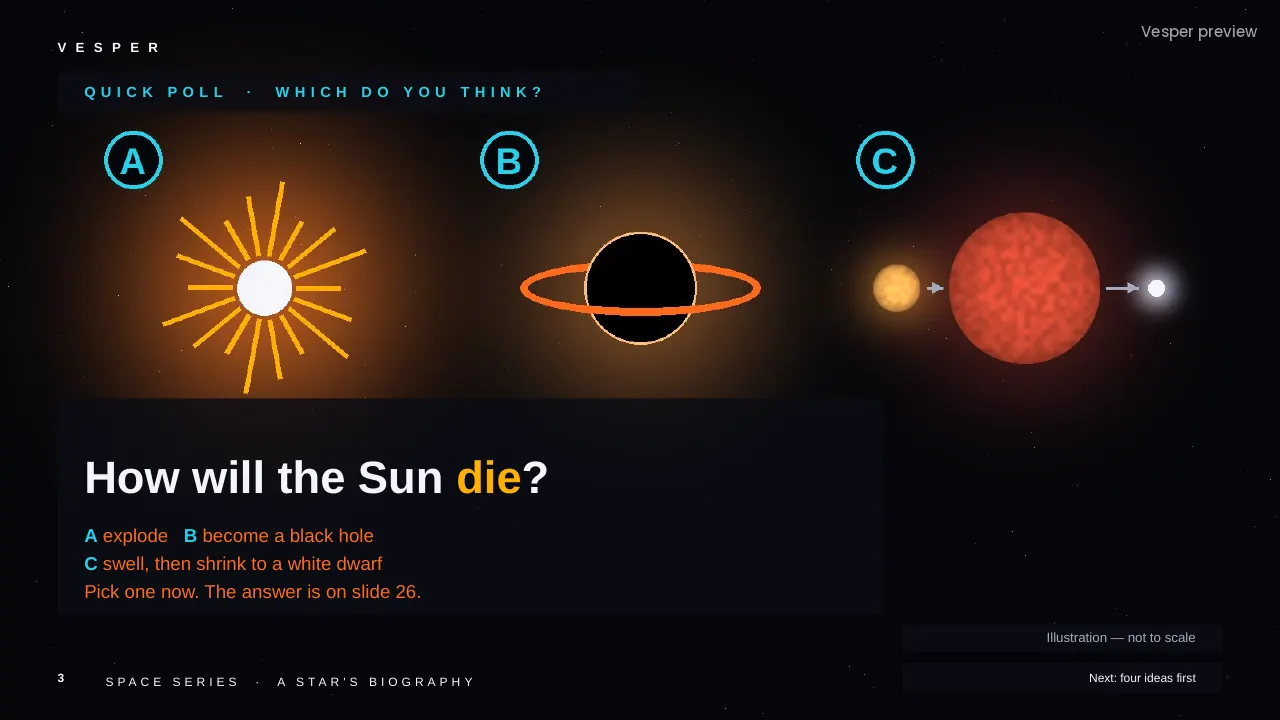
Allow about 80 minutes, or two lessons split at the second checkpoint (slide 24). Run the poll on slide 3 (how will the Sun die?) and return to it on slide 26. The E = mc² slides suit students who have met powers of ten. Notes on every slide give Say, Ask, Watch for and Time.

Who it’s for

For ages 13–16 studying stars, the life cycle of stars, and energy. The calm framing of the Sun’s far future suits younger students. Editable PowerPoint with named layouts.
Curriculum & specs

CBSE/NCERT (India)Class 8-10 · No direct chapter (enrichment). Link: Class 6 Curiosity ch 12 Beyond Earth
CambridgeIGCSE 0625 §6.2.1 The Sun as a star; §6.2.2 Stars
NGSS (US)HS-ESS1-1; HS-ESS1-3
IB MYPSciences · KC Change · RC Energy, Transformation
Ages13–16
LevelSenior
Slide templateNova
Slides38
Teaching timeAbout 80 minutes
Exam-style questionYes, with a model answer
LanguageEnglish (UK)

Questions

Questions, answered

How old is the Sun?

About 4.567 billion years, dated from the oldest material in meteorites.

How will the Sun die?

It will swell into a red giant, puff off its outer layers as a planetary nebula, and shrink to a white dwarf.

Will the Sun become a black hole?

No. A star needs about 8 times the Sun's mass to explode as a supernova, and far more to leave a black hole. The Sun has 1.

How much mass does the Sun lose each second?

About 4 million tonnes of mass is turned into light every second, which the lesson checks with E = mc².

Will the Sun swallow Earth?

Nobody knows yet. The red giant may reach about 1.2 AU; the lesson labels Earth's fate as a hypothesis.

Does this lesson include an exam question?

Yes. It ends with a 6-mark exam question on the Sun's energy and its end, with a mark scheme.

Main sources

  1. NASA NSSDCA: Sun Fact Sheet
  2. NASA Science: Sun facts
  3. Connelly et al., Science, 2012

The full source list is on the last slides of the deck. Spotted an error? Tell us.