Cosmos Ages 11–14

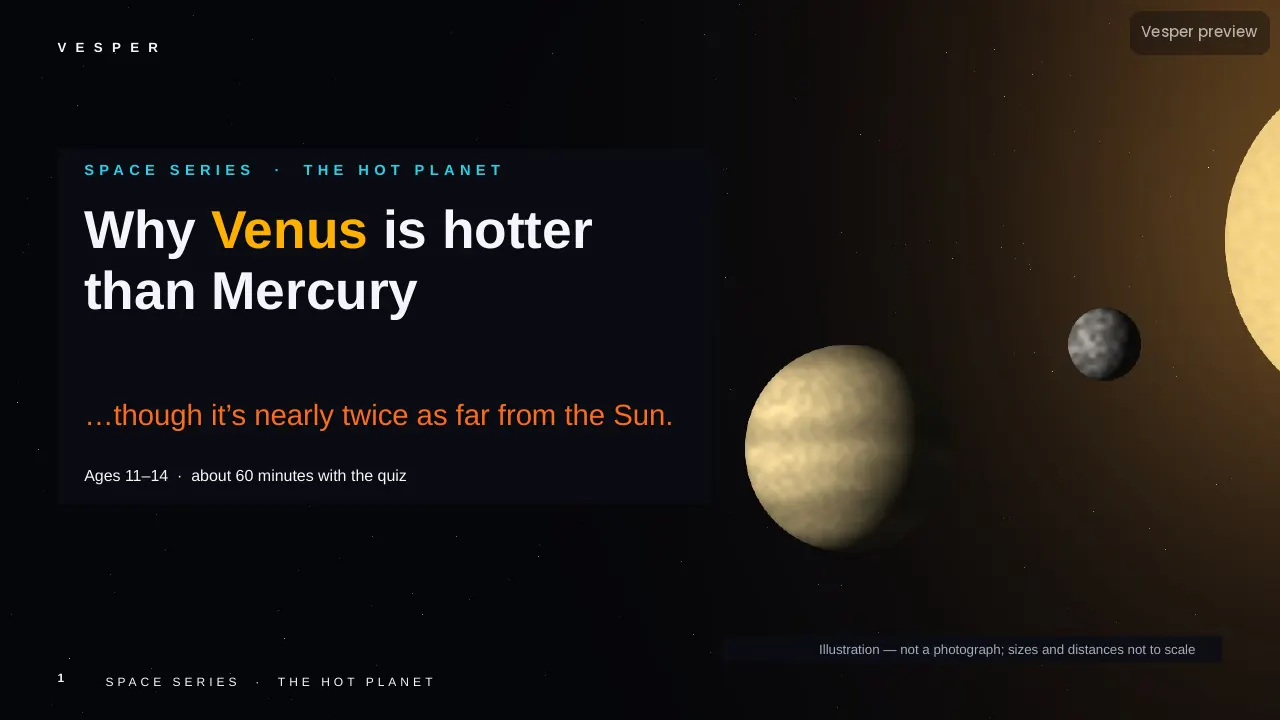
Why Venus is hotter than Mercury

Distance sets the light. The blanket keeps the heat.

A 31-slide space lesson for ages 11–14 that solves a real puzzle with NASA numbers: why the second planet beats the first. Distance, reflection and a carbon-dioxide blanket, step by step.

The short answer

Venus is hotter than Mercury because of its thick carbon-dioxide atmosphere. Mercury gets 3.5 times more sunlight, and Venus's clouds reflect 77% of what arrives, so with no air Venus would be about −47 °C. But its air, 96.5% carbon dioxide, traps heat in a greenhouse effect that adds about 511 °C, giving 464 °C day and night.

Inside the deck

slides
31
quiz questions
7
minutes
60
your-turn tasks
5

Choose a format

  • Lesson Notes (PDF)Every slide with its teacher notes, as a PDF to read or print.
  • Teacher DeckThe editable PowerPoint with speaker notes on every slide, a PDF copy and the matching Vesper slide template, so you can add slides of your own.
Pricing coming soon

Pricing coming soon

We’ll email you pricing and launch offers shortly.

  • Finished and checked: buying opens soon
  • Sources listed at the end
  • Curriculum links under ‘Curriculum & specs’
  • For one classroom. Campus licences for whole schools

Key facts

  • Venus is 464 °C, day and night
  • Mercury gets 3.5 times as much sunlight as Venus
  • Venus's clouds reflect 77% of sunlight; Mercury reflects 7%
  • Venus's air is 96.5% carbon dioxide and presses 92 times harder than Earth's
  • Without its atmosphere Venus would be about −47 °C
  • Venera 13 was built to last 32 minutes and lasted 127

What students will be able to do

  • Students can use the inverse-square rule to compare sunlight on two planets
  • Students can explain how reflection reduces the sunlight a planet keeps
  • Students can explain the greenhouse effect on Venus
  • Students can explain why Mercury has huge temperature swings and Venus does not
  • Students can correct the idea that closer always means hotter

About this lesson

What students discover

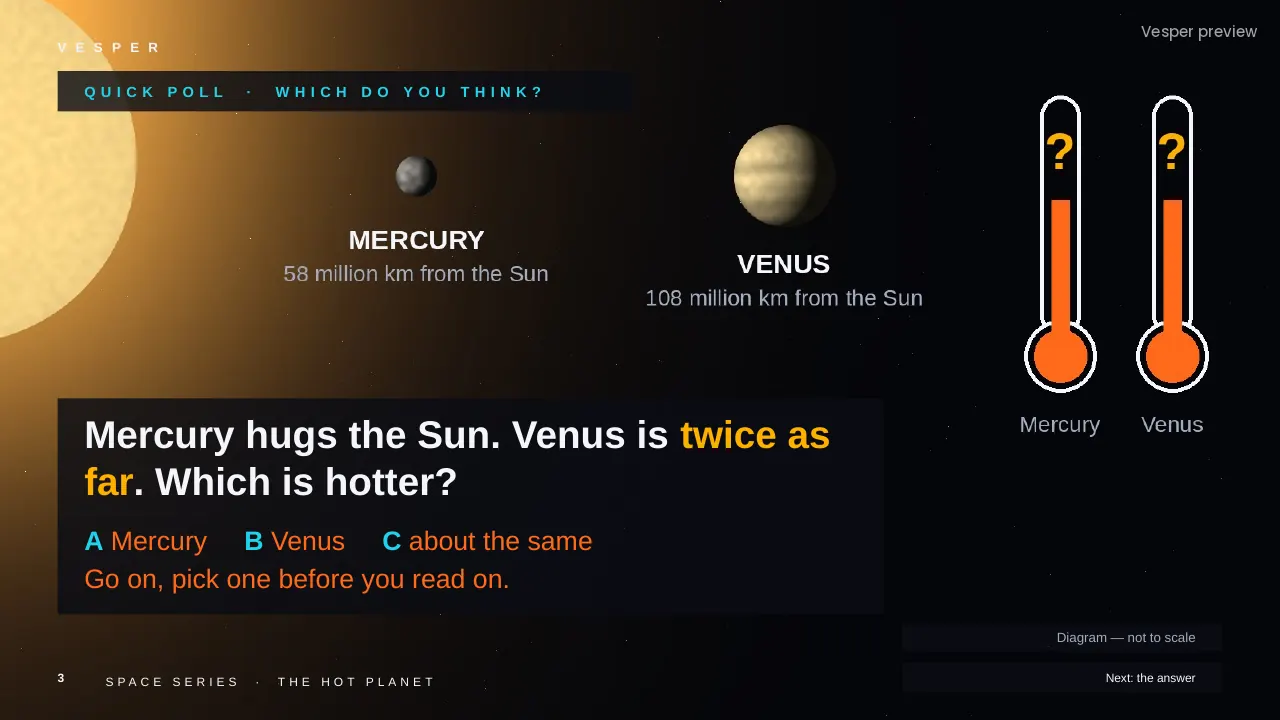
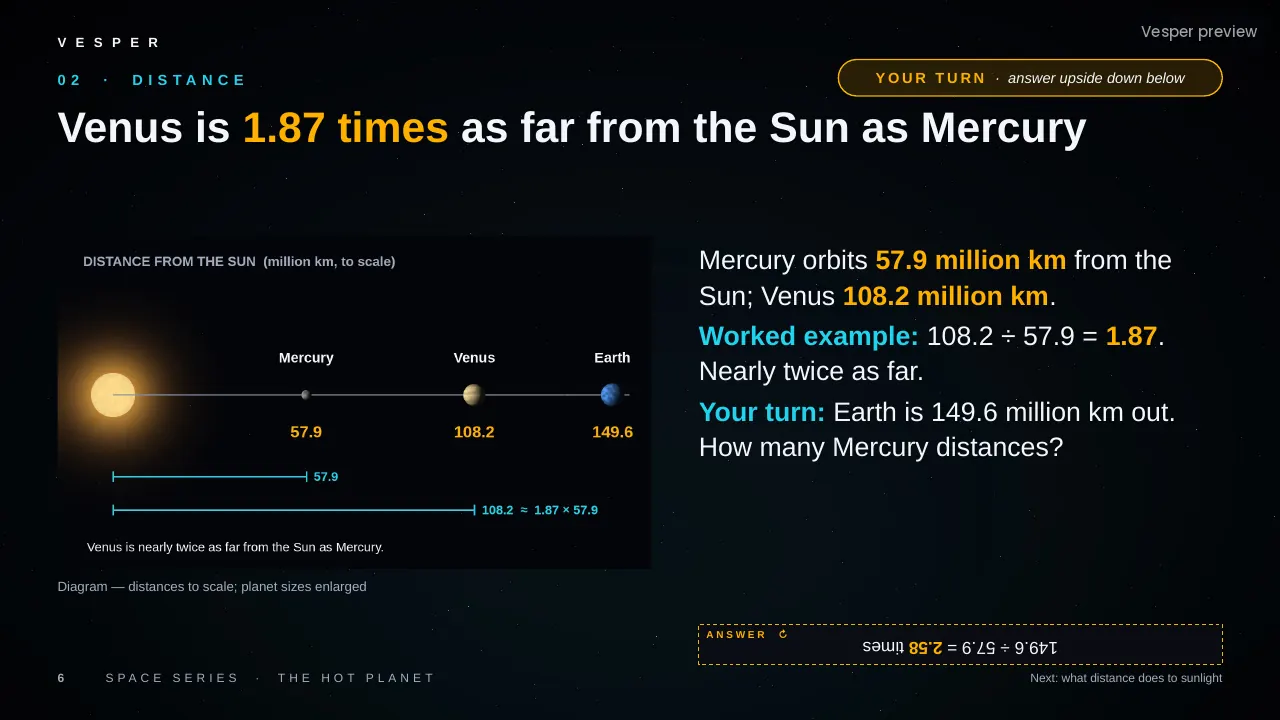
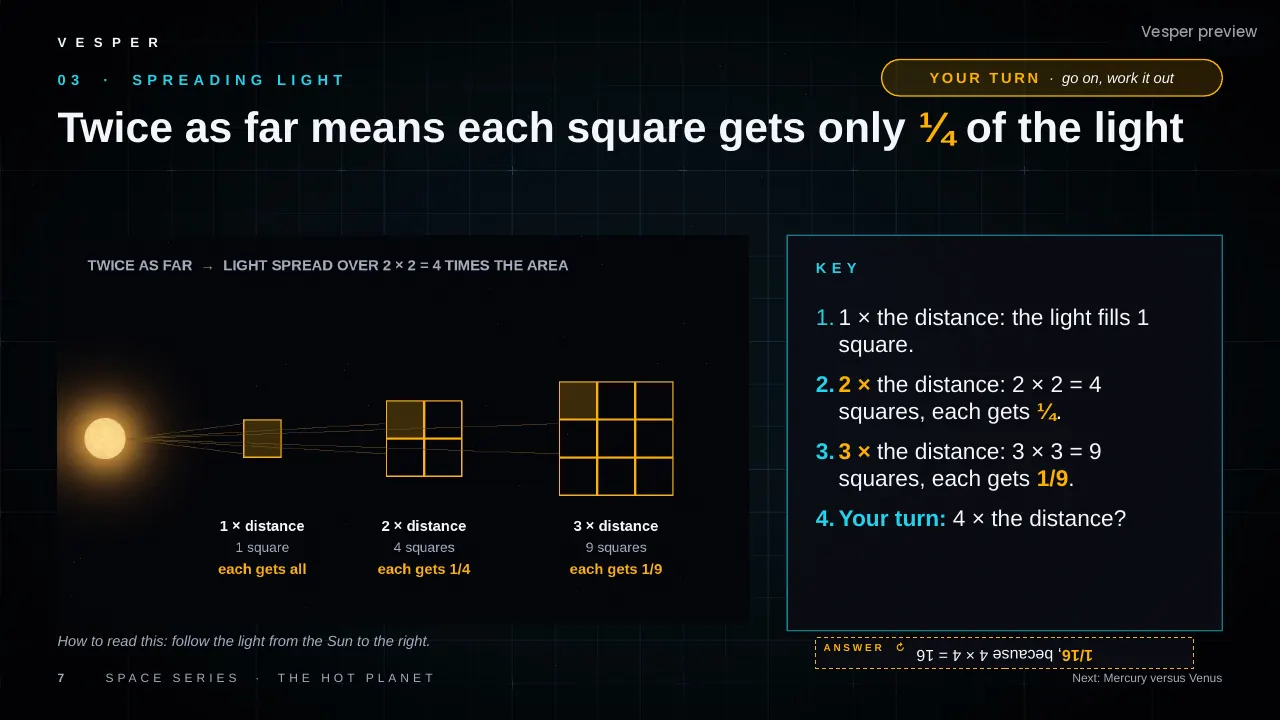
Mercury sits closest to the Sun, so why is Venus the hottest planet, at 464 °C day and night? Students solve the puzzle themselves. They compare real distances (Venus is 1.87 times as far out), use the inverse-square rule to show that Mercury gets 3.5 times more sunlight, then find that Venus’s clouds reflect 77% of it while Mercury reflects only 7%.

With no air, Venus would be −47 °C. The answer is its blanket: air that is 96.5% carbon dioxide and presses 92 times harder than Earth’s, trapping heat in a greenhouse effect that adds about 511 °C. Mercury, with no blanket, swings 610 °C between day and night.

Inside the deck

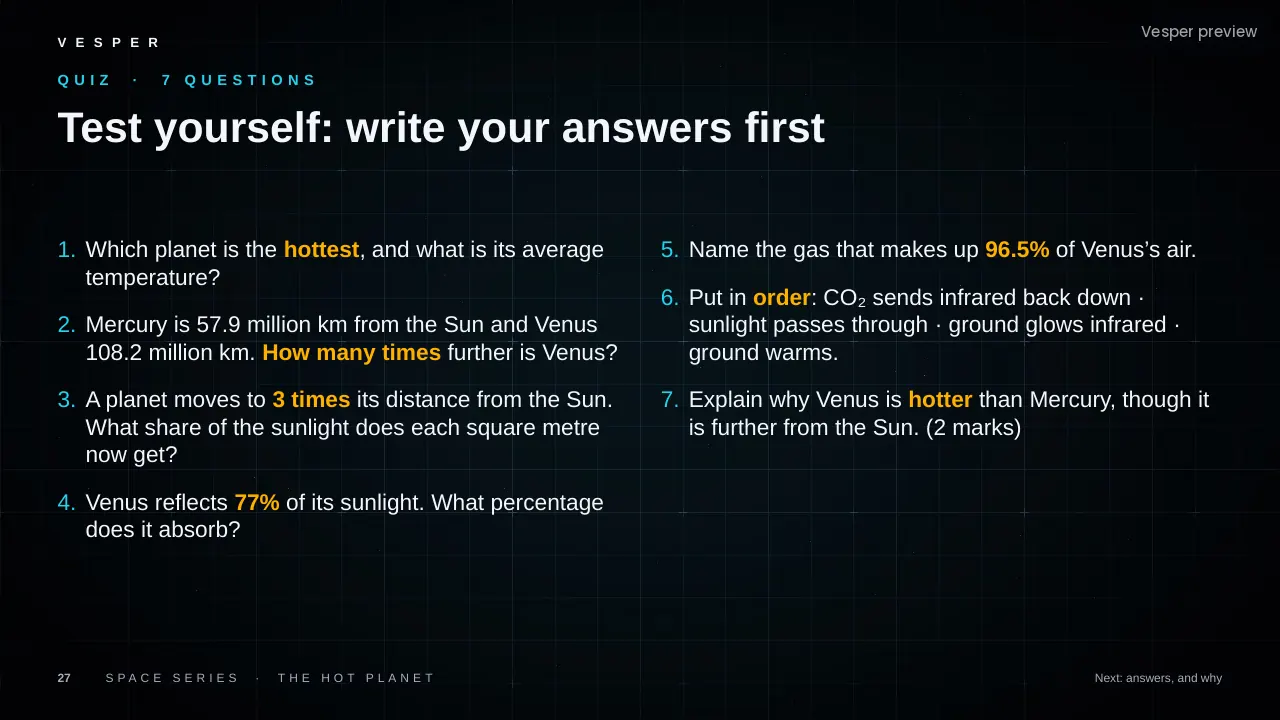
31 slides on the Nova template with every diagram drawn from NASA and NOAA data. Polls, guess-first prompts, your-turn questions with upside-down answers, a safe two-jar greenhouse experiment, a spot-the-mistake (‘closer always means hotter’), the Venera 7 and Venera 13 landers, Earth’s own CO₂ record, an open question on ancient Venus oceans, two checkpoints and a 7-question quiz with explained answers.

How to teach it

Allow about 60 minutes. Take a vote on the hook (which is hotter?) and leave it on the board. The two-jar experiment on slide 17 needs two jars, soil, two thermometers and cling film, and 20 minutes in the sun; the slide notes that the film mostly traps warm air, which is not quite how Venus works. Notes on every slide give Say, Ask, Watch for and Time.

Who it’s for

For ages 11–14 studying the Solar System, heat and the greenhouse effect. It links space to climate calmly, with labelled data. Editable PowerPoint with named layouts.
Curriculum & specs

CBSE/NCERT (India)Class 6-8 · Class 6 Curiosity ch 12 Beyond Earth
CambridgeLS Stage 8–9 Earth & Space; IGCSE 0625 §6.1.2 Solar System
NGSS (US)MS-ESS1-3; HS-ESS2-4
IB MYPSciences · KC Relationships · RC Energy, Evidence
Ages11–14
LevelMiddle
Slide templateNova
Slides31
Teaching timeAbout 60 minutes
LanguageEnglish (UK)

Questions

Questions, answered

Why is Venus hotter than Mercury?

Venus has a thick carbon-dioxide atmosphere that traps heat by the greenhouse effect. Mercury has almost no atmosphere, so its heat escapes.

What is the hottest planet in the Solar System?

Venus, at about 464 °C, day and night.

How much more sunlight does Mercury get than Venus?

About 3.5 times as much, because Venus is 1.87 times as far from the Sun and light spreads out with the square of distance.

Why doesn't Venus cool down at night?

Its thick atmosphere holds the heat, so the temperature hardly changes. Mercury swings 610 °C between day and night.

What is Venus's atmosphere made of?

About 96.5% carbon dioxide, and it presses 92 times harder than Earth's air.

Did Venus once have oceans?

Nobody knows. The lesson's frontier slide shows this as an open question, labelled as a hypothesis.

Main sources

  1. Williams, D. R. Mercury, Venus and Earth Fact Sheets. NASA Space Science Data Coordinated Archive (Planetary Fact Sheets, regularly updated). Distances, sunlight, reflectivity, predicted and mean temperatures, pressure, CO₂ share.
  2. NASA Science. Mercury: Facts (day 430 °C, night −180 °C). science.nasa.gov.
  3. NASA NSSDCA. Venera 7 (1970-060A) and Venera 13 (1981-106D) mission records.

The full source list is on the last slides of the deck. Spotted an error? Tell us.