About this lesson
What students discover
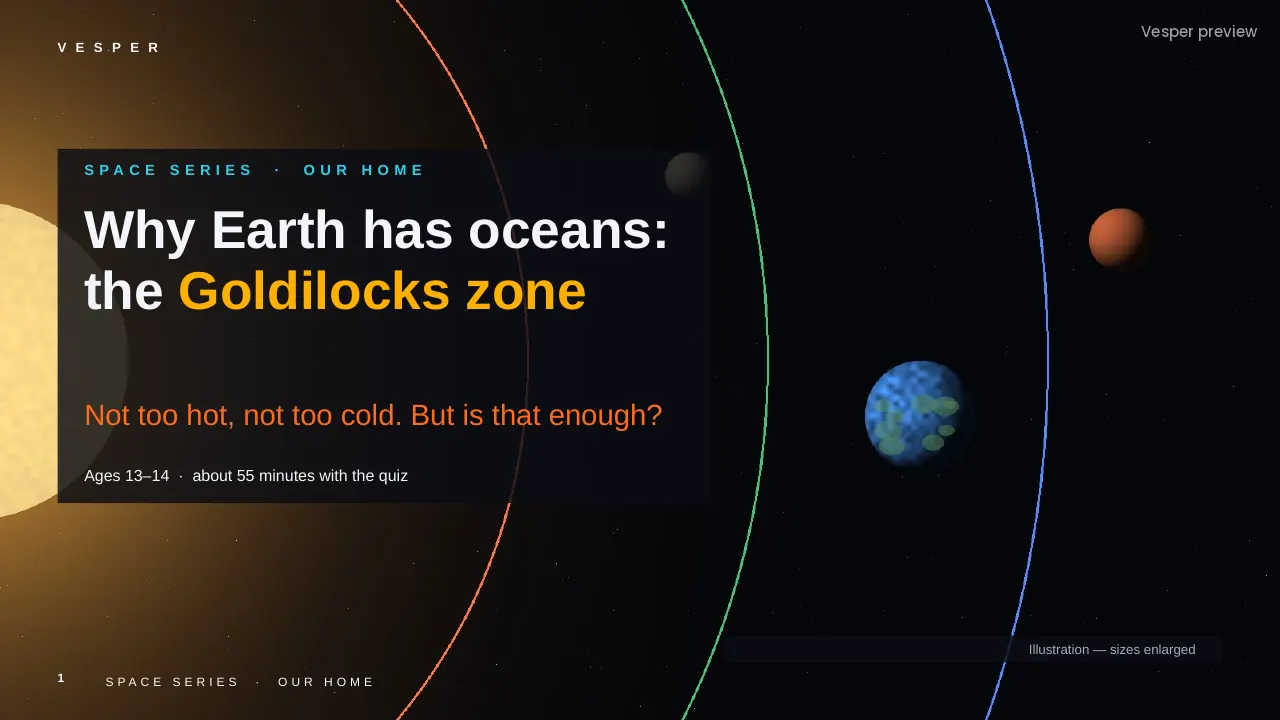
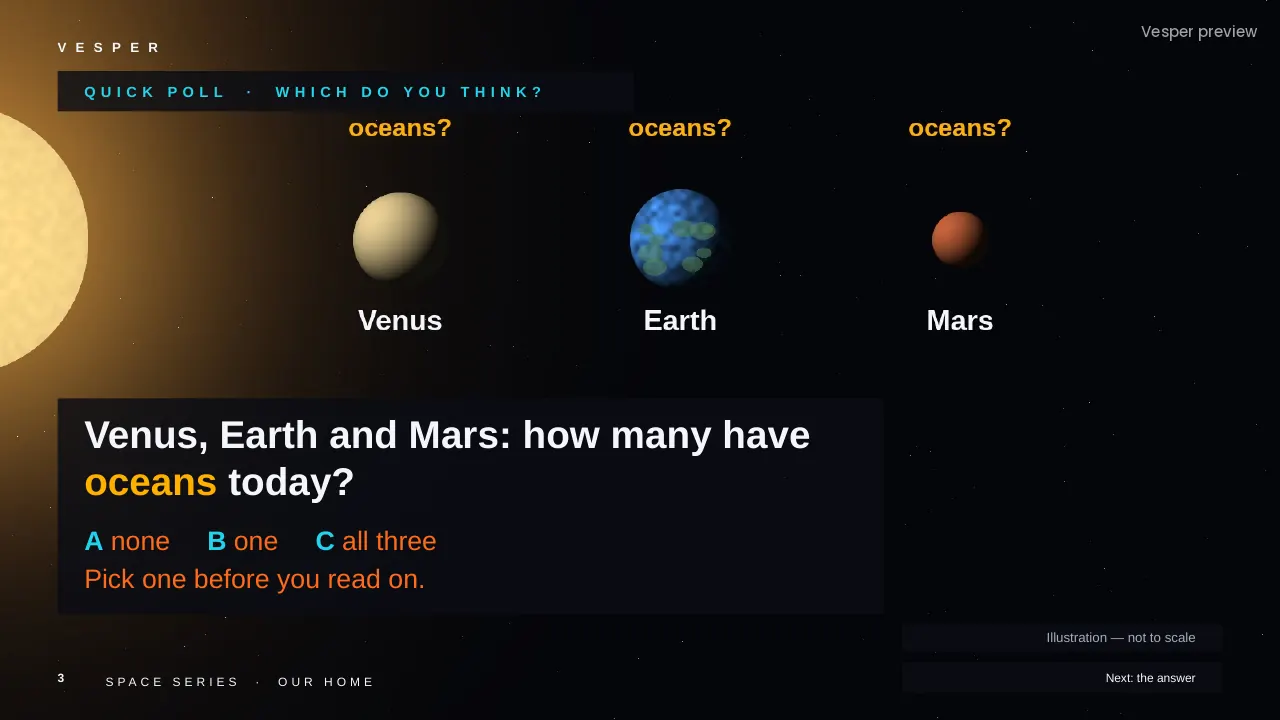
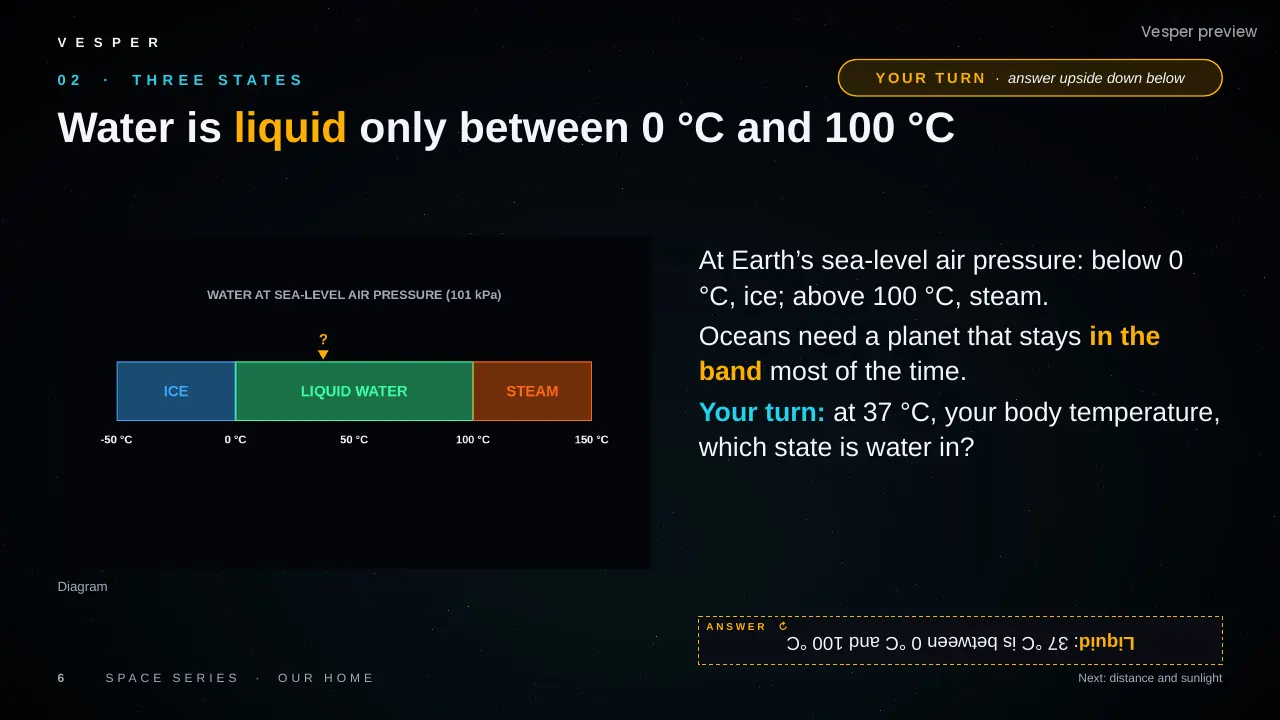
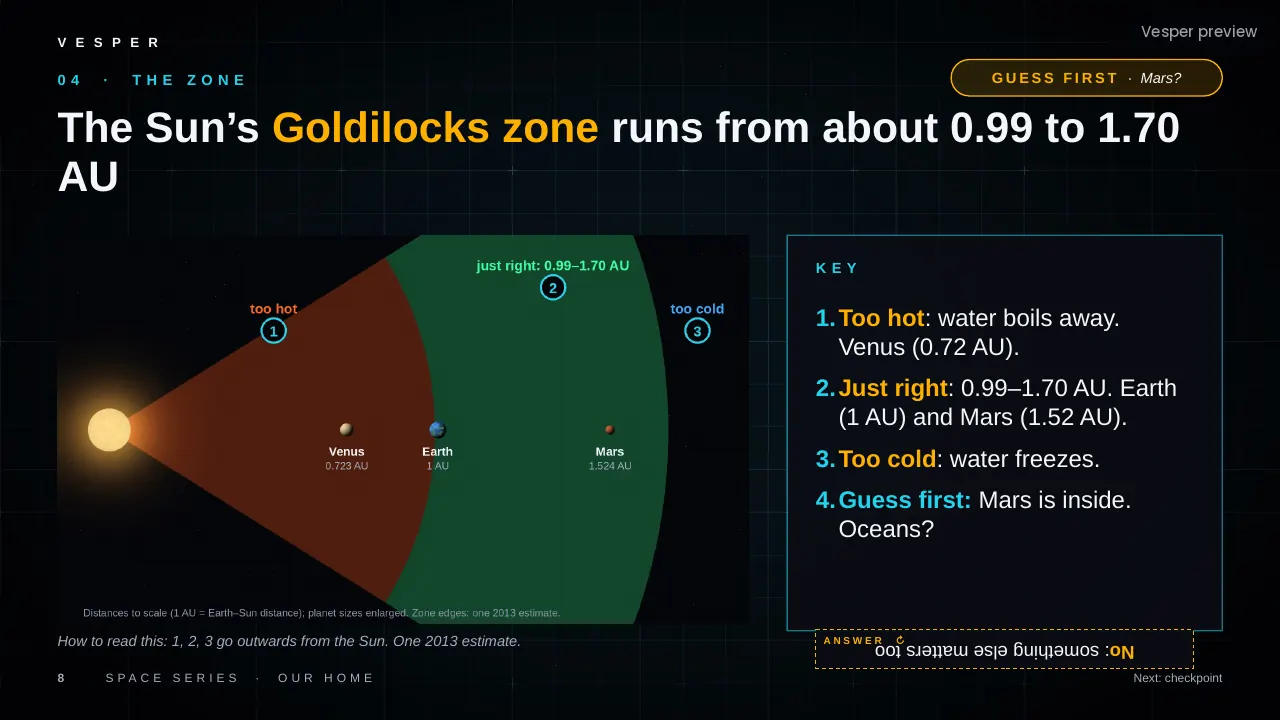
Venus, Earth and Mars are rocky neighbours, yet only Earth has oceans. The lesson starts with water’s liquid band (0–100 °C at sea-level pressure) and real NASA temperatures: Venus averages 464 °C, Earth 15 °C, Mars −65 °C. Students use the 1 ÷ distance² rule to compare sunlight (Venus gets 1.9 times Earth’s, Mars 0.43 times) and place the planets on a to-scale map of the Sun’s Goldilocks zone, about 0.99 to 1.70 AU.
Then the twist: Mars sits inside the zone and has no oceans. Three more conditions explain why. Air pressure: Mars’s air presses at about 0.6 kPa, 0.6% of ours, so water boils or freezes (on Everest, at 34 kPa, water already boils at about 70 °C). A greenhouse blanket: with no air, Earth would average about −19 °C, so the blanket adds about 34 °C. Size: Mars is about half as wide as Earth and lost most of its air. A myth slide uses the Moon, at Earth’s own distance and bone dry, to bust ‘in the zone means oceans’. Perseverance’s ancient river delta shows that Mars once had water.
Inside the deck
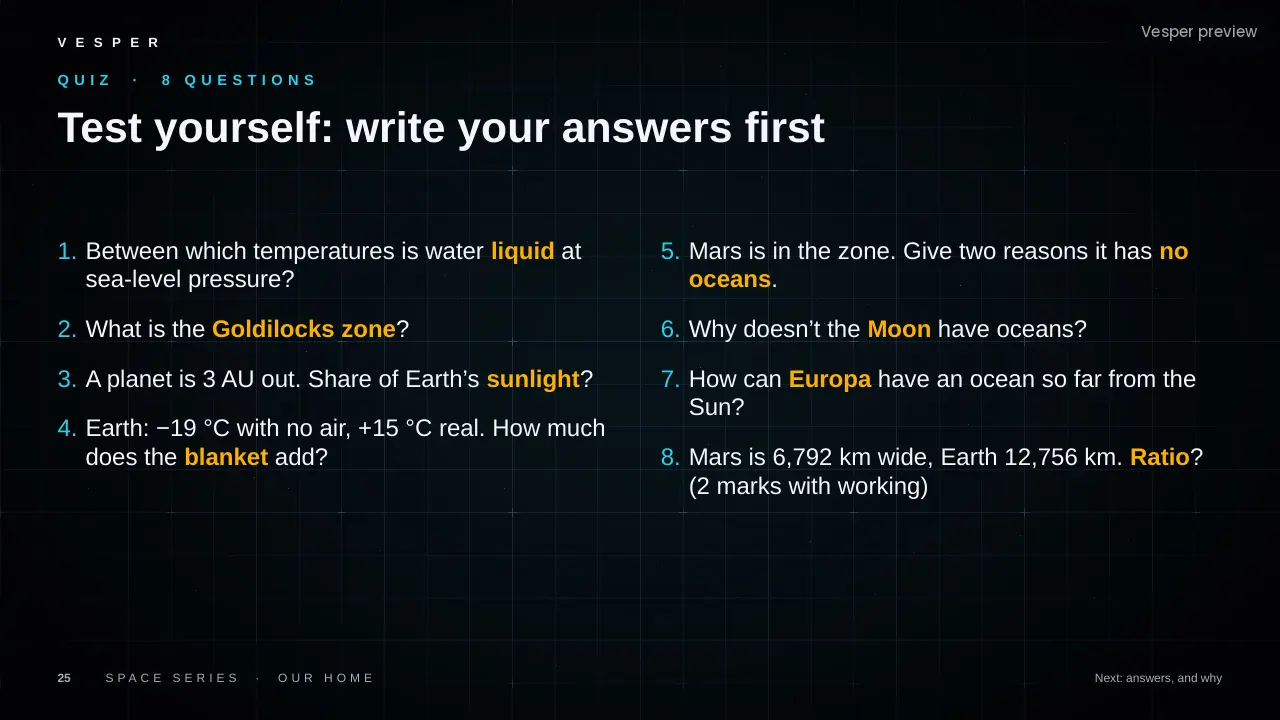
29 slides on the Nova template: a guess-first hook, a primer, a diagram walk, four your-turn tasks, two bridges, two checkpoints, an evidence slide and a frontier slide on whether any of the 6,000-plus known exoplanets has oceans. Europa, Enceladus and TRAPPIST-1 show oceans and zones beyond the textbook picture. An eight-question quiz has explained answers.
How to teach it
About 55 minutes with the quiz. The torch-and-squared-paper activity (10 cm, then 20 cm) shows the 1 ÷ distance² rule in two minutes. Speaker notes sit on every slide.
Who it’s for
Learners aged 13–14 studying what makes Earth able to support life, and anyone curious about the search for other ocean worlds.