Chemistry Ages 13–16

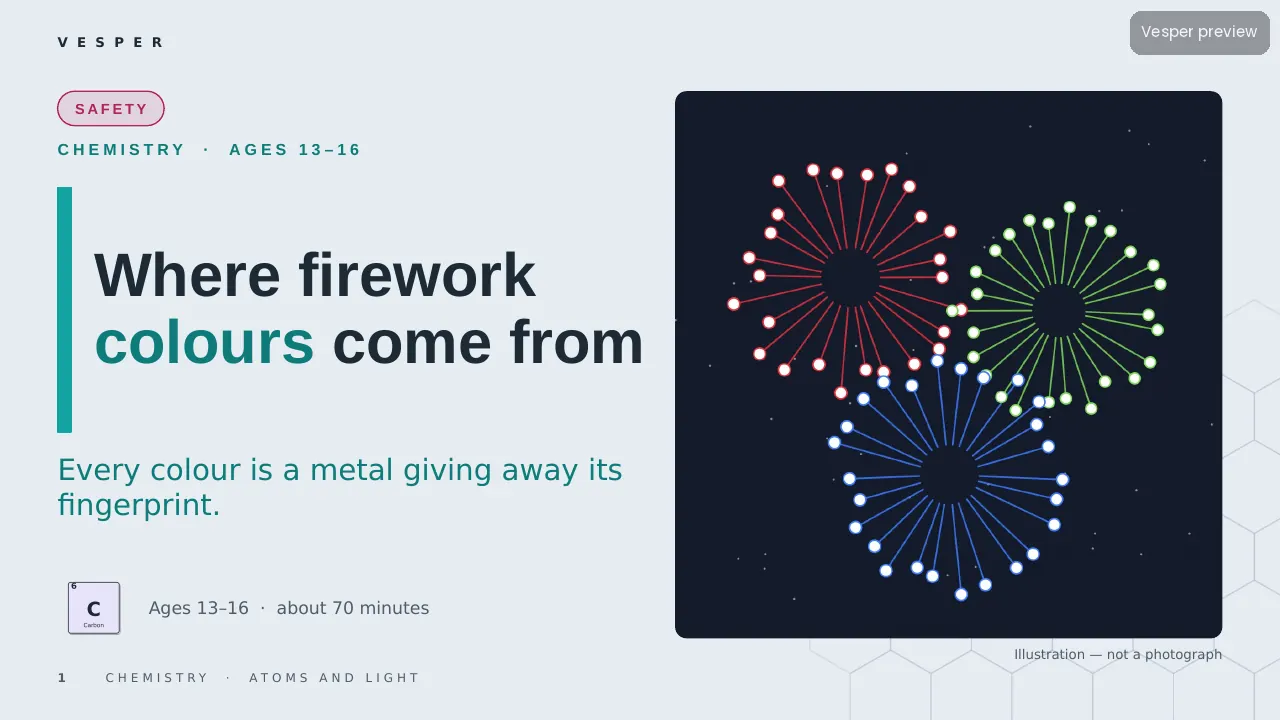
Where firework colours come from

Every colour is a metal giving away its fingerprint.

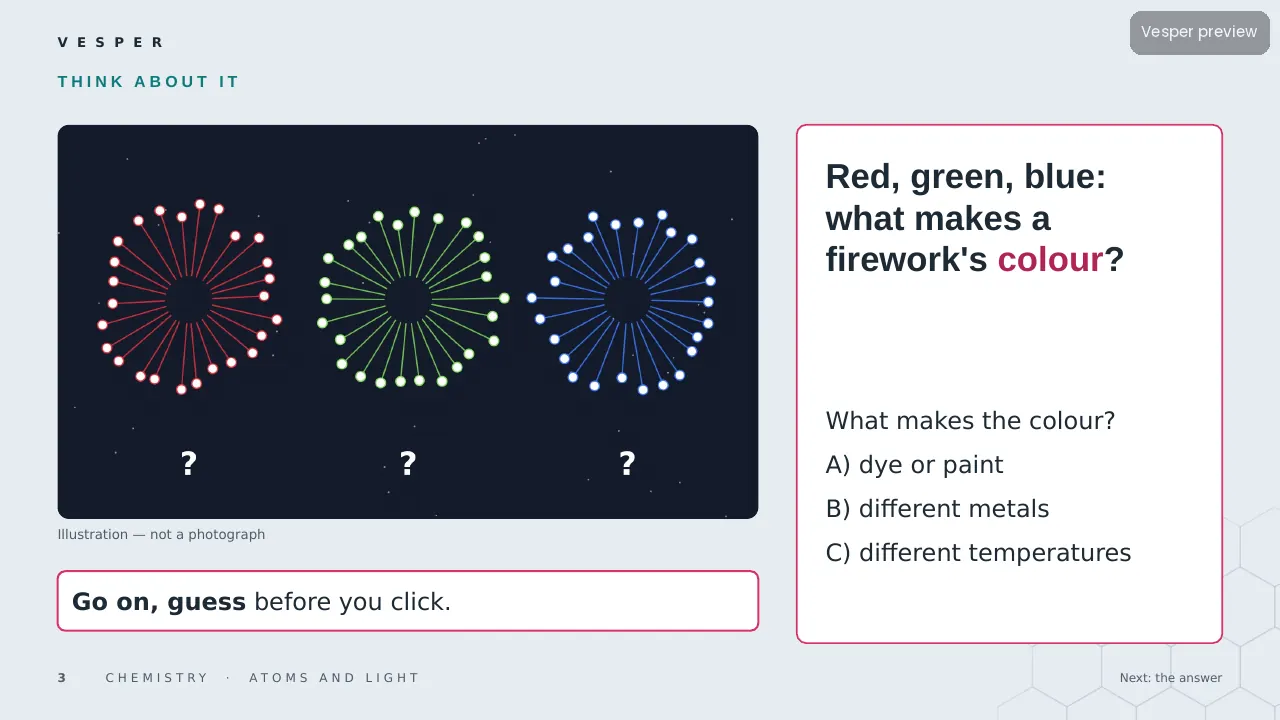
Red is strontium, green is barium and blue is copper. This 32-slide lesson covers electron jumps, photon energy, balanced firework chemistry and the real costs of fireworks.

The short answer

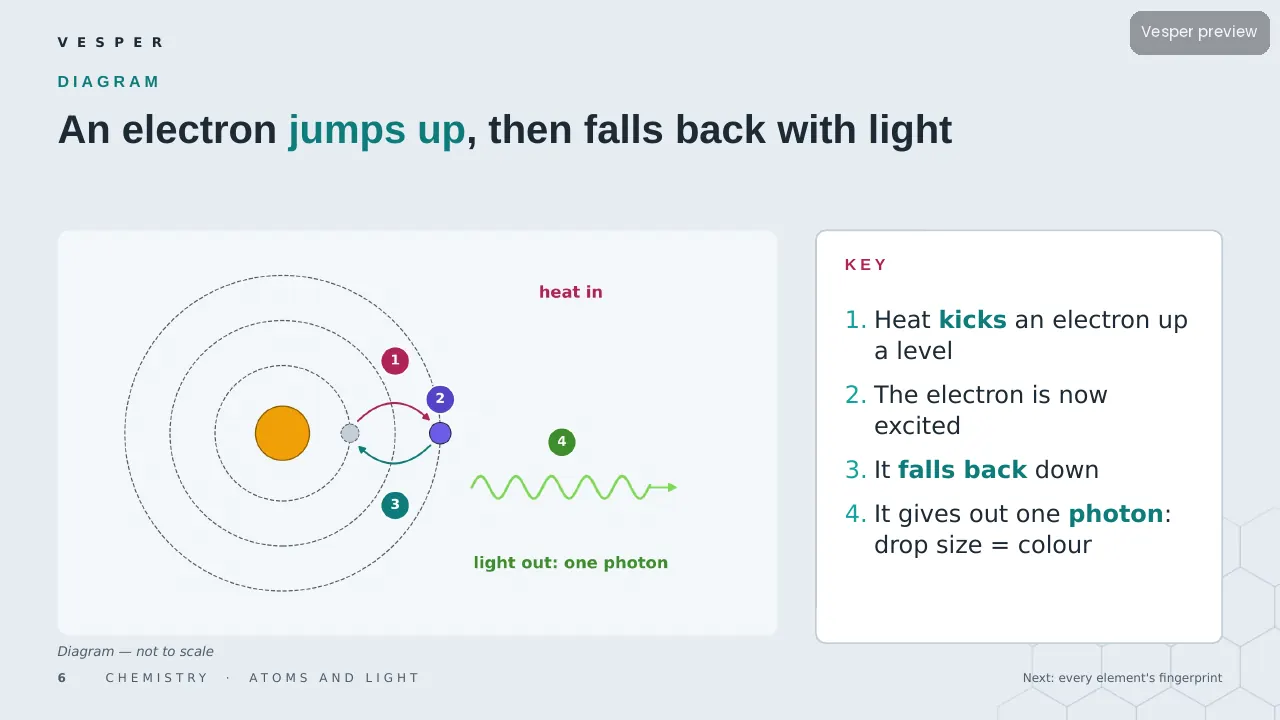
Firework colours come from metals, not dyes. Heat kicks an electron in a metal atom up an energy level; when it falls back it gives out light of one exact colour. Strontium gives red, barium green, copper blue and sodium yellow. Gold and white sparks are different: hot solids glowing by temperature.

Inside the deck

slides
32
quiz questions
8
minutes
70
your-turn tasks
2

Choose a format

  • Lesson Notes (PDF)Every slide with its teacher notes, as a PDF to read or print.
  • Teacher DeckThe editable PowerPoint with speaker notes on every slide, a PDF copy and the matching Vesper slide template, so you can add slides of your own.
Pricing coming soon

Pricing coming soon

We’ll email you pricing and launch offers shortly.

  • Finished and checked: buying opens soon
  • Sources listed at the end
  • Curriculum links under ‘Curriculum & specs’
  • For one classroom. Campus licences for whole schools

Key facts

  • Strontium gives red, calcium orange, sodium yellow, barium green and copper blue.
  • Visible light runs from about 400 nm (violet) to 700 nm (red).
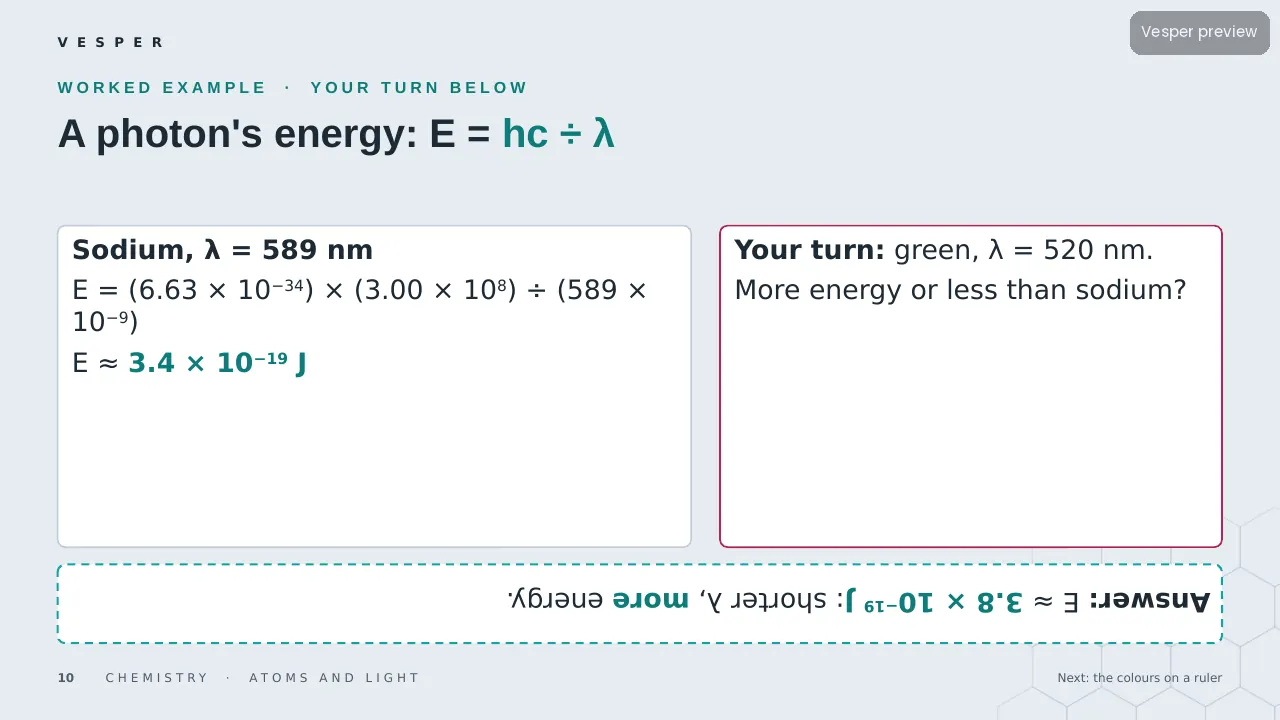
  • A sodium photon at 589 nm carries about 3.4 × 10⁻¹⁹ J.
  • Bunsen and Kirchhoff found caesium (1860) and rubidium (1861) from their spectral colours.
  • Black powder: 2KNO₃ + S + 3C → K₂S + N₂ + 3CO₂.

What students will be able to do

  • Students can explain how electron transitions give each metal its colour.
  • Students can tell incandescence from emission.
  • Students can calculate a photon's energy from its wavelength using E = hc ÷ λ.
  • Students can identify metals from flame-test colours.
  • Students can balance the black powder and potassium perchlorate equations.

About this lesson

What students discover

Why is one firework red and another green? Not dye: metals. Students learn how heat kicks an electron up an energy level and how it falls back with one exact colour, giving every element a fingerprint. They separate incandescence (gold and white sparks, coloured by temperature) from emission (coloured stars, coloured by element), and read flame-test colours from a teacher demo: lithium crimson, sodium yellow, potassium lilac, barium pale green.

Then the numbers. Students calculate a photon’s energy with E = hc ÷ λ (sodium at 589 nm gives about 3.4 × 10⁻¹⁹ J) and place firework colours on the wavelength ruler. They meet Bunsen and Kirchhoff, who found caesium and rubidium by colour alone, look inside an aerial shell, balance black powder (2KNO₃ + S + 3C → K₂S + N₂ + 3CO₂) and the oxygen supplier KClO₄, and find out why deep blue is the hardest colour to make. Kabir’s ‘red stars burn hotter’ is the spot-the-mistake. The real-world slide is honest about the cost: smoke, fine particles, toxic barium and India’s Supreme Court rulings on barium nitrate.

Inside the deck

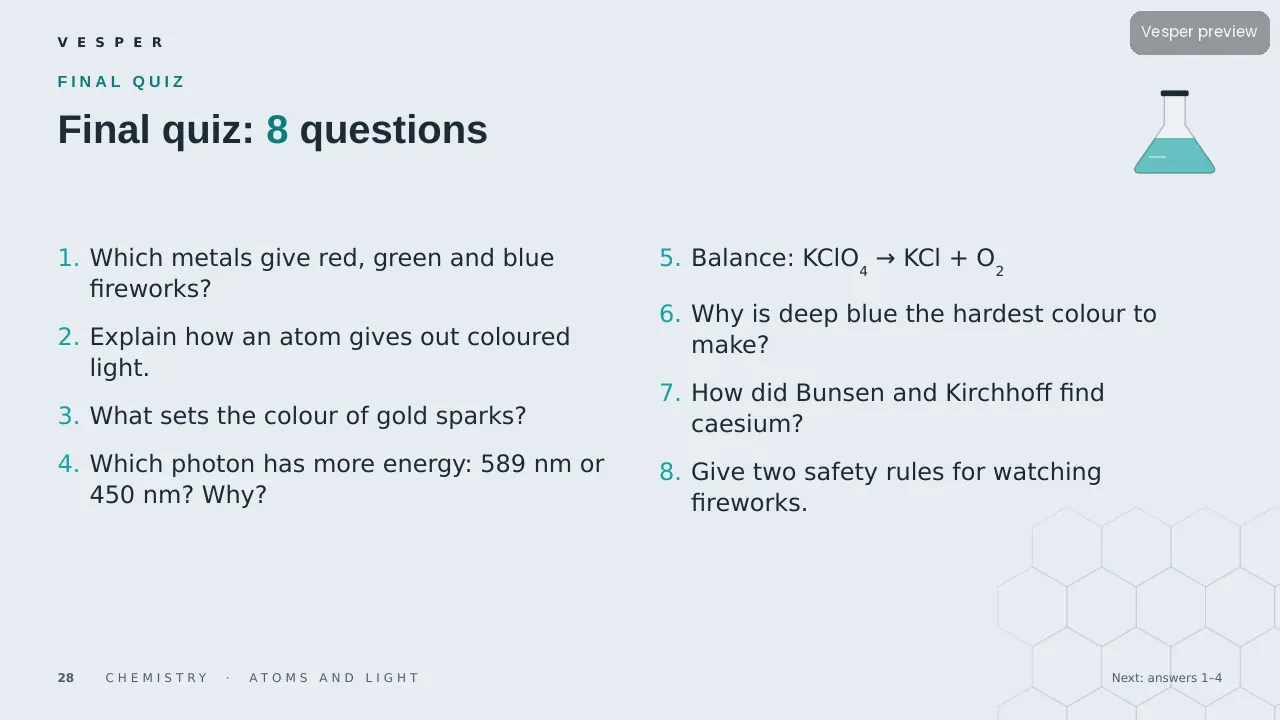
32 slides on the Flask template: a guess-first hook, two diagrams, two worked examples, a your-turn, two pause-and-predicts, a quick poll on mixing purple, a safety slide and two checkpoints. An eight-question quiz has explained answers.

How to teach it

About 70 minutes. Flame tests are a teacher demo only, with goggles. The safe home activity uses an old CD as a spectroscope to compare a filament bulb, an LED and a tube light. The safety rule is plain: watch fireworks, never make or test them.

Who it’s for

Learners aged 13–16 meeting atomic structure, flame tests or spectra, and a natural lesson for the weeks around Diwali or any fireworks season.
Curriculum & specs

CBSE/NCERT (India)Class 8-10 · No direct chapter (enrichment). Link: Class 9 Exploration ch 8 Journey Inside the Atom
CambridgeIGCSE 0620 §12 Experimental techniques (flame tests)
NGSS (US)HS-PS1-1; HS-PS4-3
IB MYPSciences · KC Change · RC Energy, Evidence
Ages13–16
LevelSenior
Slide templateFlask
Slides32
Teaching timeAbout 70 minutes
LanguageEnglish (UK)

Questions

Questions, answered

What makes firework colours?

Metal compounds. Heat excites electrons in the metal atoms, and as they fall back they give out light of a colour set by the element.

Which metals make which firework colours?

Strontium makes red, calcium orange, sodium yellow, barium green and copper blue. Strontium and copper together make purple.

Why is blue the hardest firework colour?

Blue comes from copper chloride molecules in the flame. Too cool and they glow dimly; too hot and they break apart.

What is the difference between incandescence and emission?

Incandescence is light from a hot solid, coloured by temperature. Emission is light from excited atoms, coloured by the element.

How do flame tests work?

Each metal gives a characteristic flame colour, such as sodium yellow and potassium lilac, so chemists can identify it. In this lesson it is a teacher demo only.

Is there a safe activity for students?

Yes. An old CD acts as a spectroscope to compare the light from different bulbs. Students should never make or test fireworks.

Main sources

  1. Cambridge IGCSE Chemistry 0620 syllabus: flame-test colours.
  2. LiveLaw, 23 Sep 2023: Supreme Court on barium nitrate in firecrackers (bans 2019, 2021).
  3. Bunsen and Kirchhoff: caesium 1860, rubidium 1861 (standard histories).

The full source list is on the last slides of the deck. Spotted an error? Tell us.