Chemistry Ages 13–14

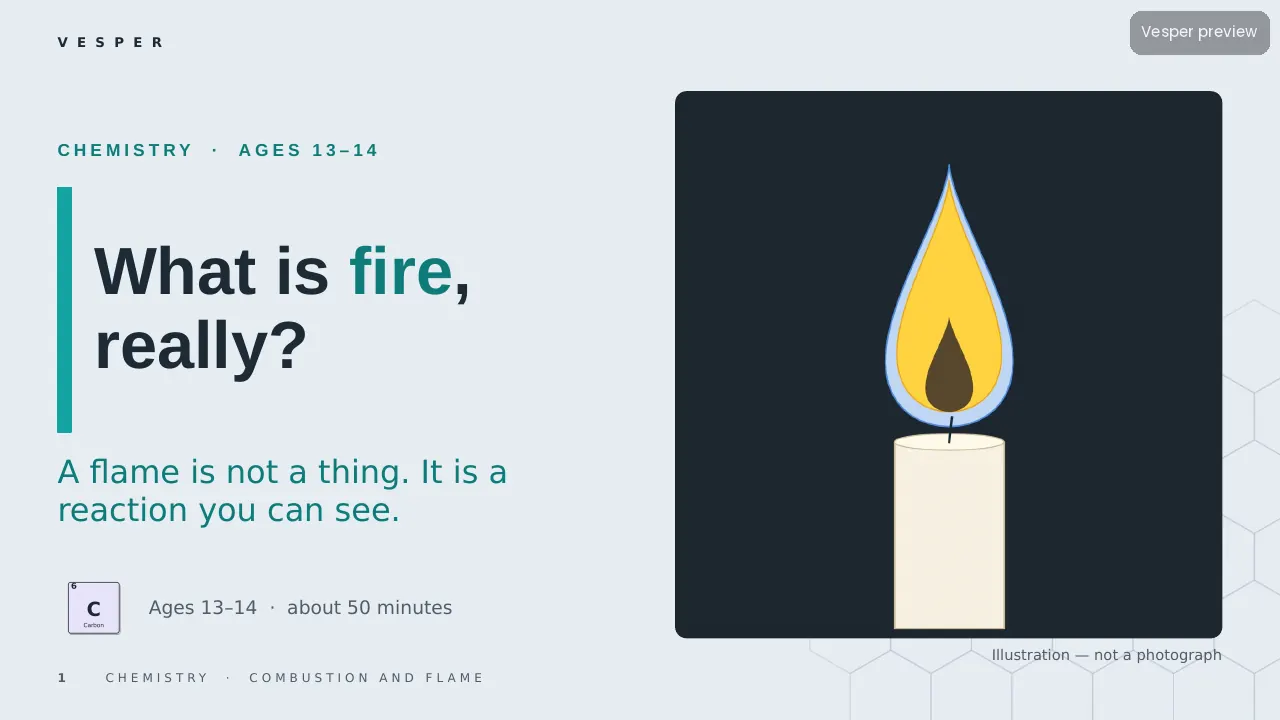
What is fire, really?

A flame is not a thing. It is a reaction you can see.

A flame is a reaction you can see. Fire triangle, balanced combustion equations, flame zones and safe ways to put fires out, in 30 slides for ages 13–14.

The short answer

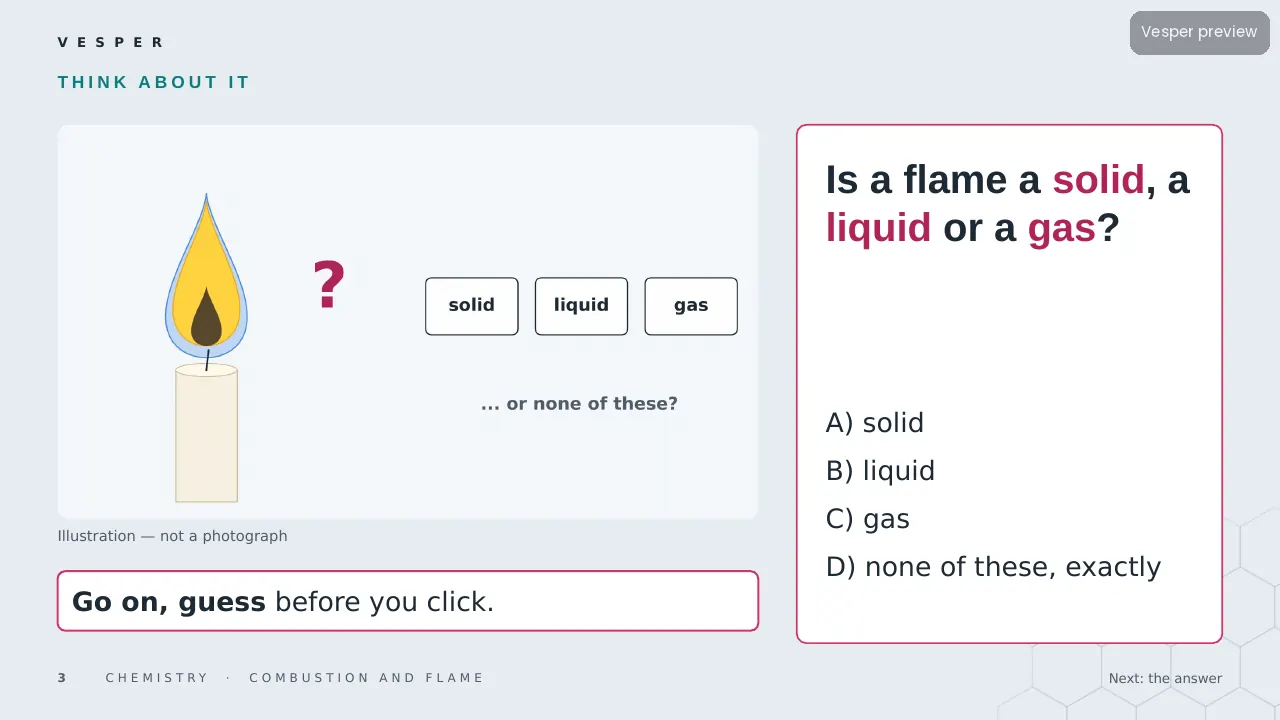
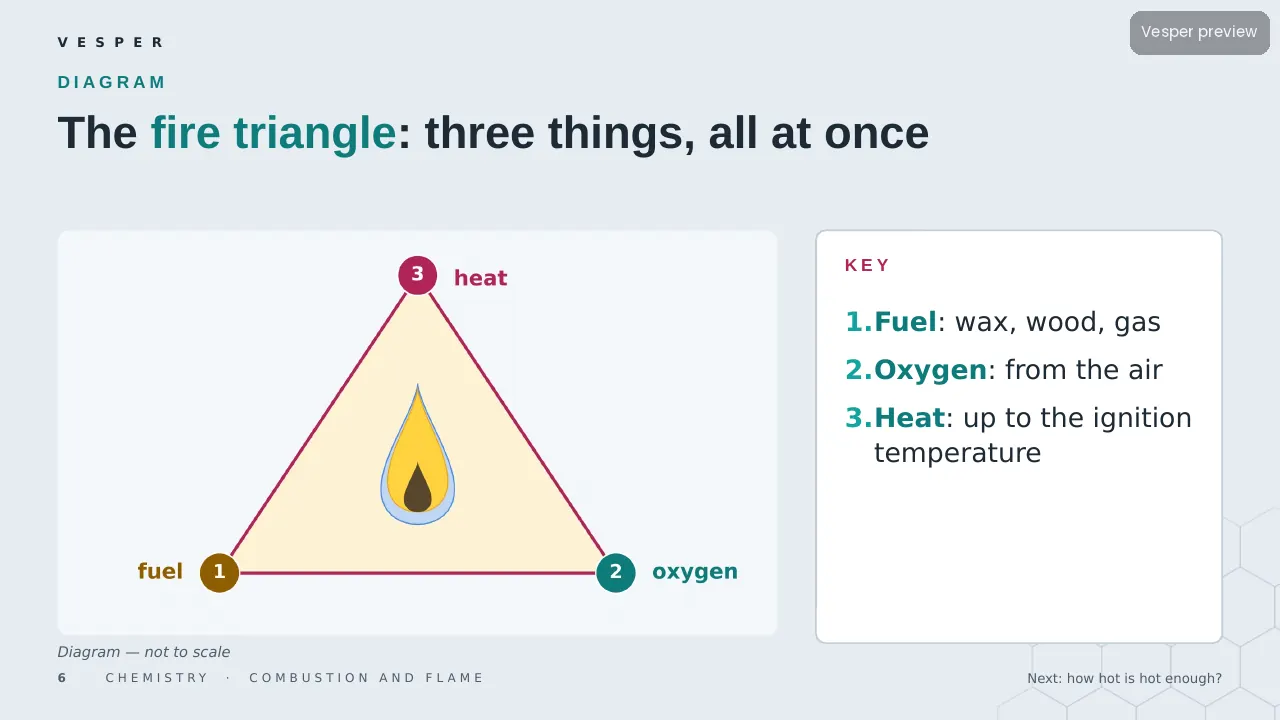
Fire is fast combustion: a fuel reacting with oxygen and giving out heat and light. A flame is not a solid, liquid or gas but a reaction you can see, made of hot gas and glowing soot. It needs fuel, oxygen and heat together, the fire triangle, so taking away any one of them puts the fire out.

Inside the deck

slides
30
quiz questions
7
minutes
50
your-turn tasks
3

Choose a format

  • Lesson Notes (PDF)Every slide with its teacher notes, as a PDF to read or print.
  • Teacher DeckThe editable PowerPoint with speaker notes on every slide, a PDF copy and the matching Vesper slide template, so you can add slides of your own.
Pricing coming soon

Pricing coming soon

We’ll email you pricing and launch offers shortly.

  • Finished and checked: buying opens soon
  • Sources listed at the end
  • Curriculum links under ‘Curriculum & specs’
  • For one classroom. Campus licences for whole schools

Key facts

  • Paper catches fire at about 230 °C
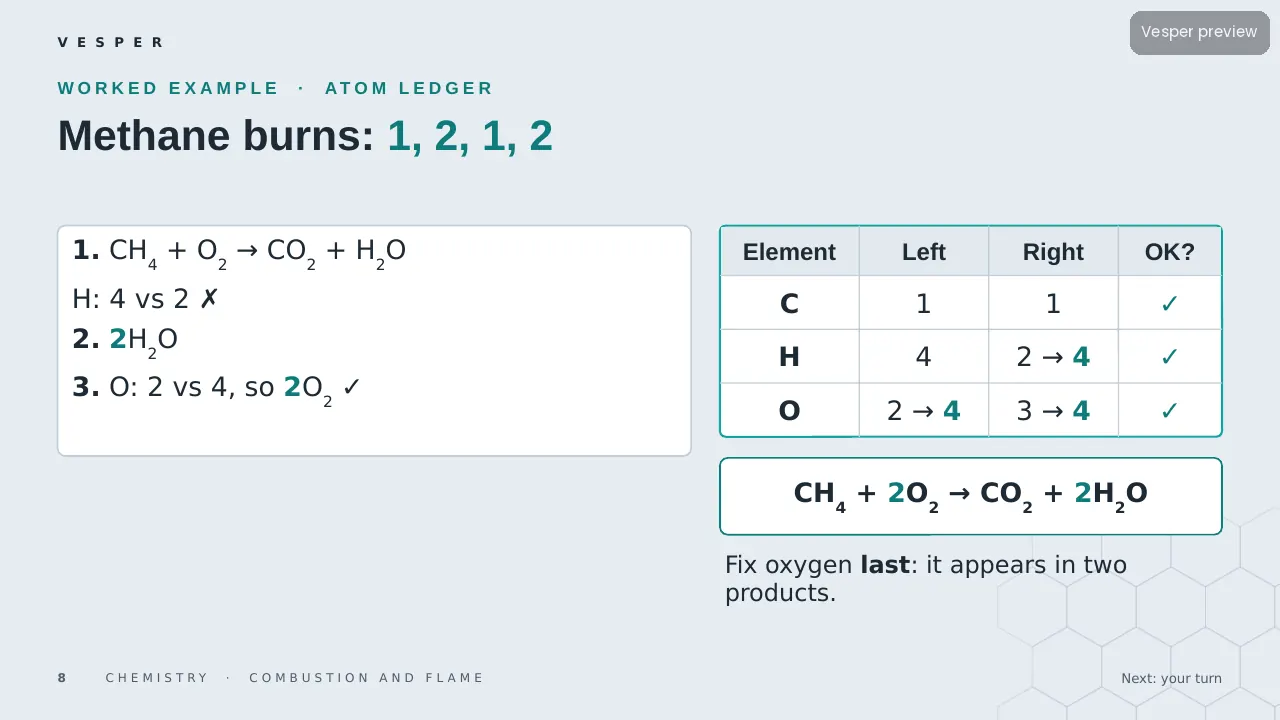
  • Methane burns 1 : 2 → 1 : 2 (CH4 + 2O2 → CO2 + 2H2O)
  • A candle flame has three zones
  • A candle burns wax vapour, not solid wax
  • In space, a candle flame is round and blue
  • Faraday turned one candle into six lectures in 1848

What students will be able to do

  • Students can explain that a flame is a chemical reaction
  • Students can use the fire triangle to explain how fires start and stop
  • Students can balance combustion equations for methane and LPG
  • Students can describe the zones of a candle flame
  • Students can explain why incomplete combustion makes carbon monoxide

About this lesson

What students discover

Is a flame a solid, a liquid or a gas? Most adults cannot answer. Students find that a flame is not a thing but a reaction you can see: hot gas and glowing soot giving out heat and light. They meet the fire triangle and ignition temperature (paper at about 230 °C), and balance combustion equations with an atom ledger: methane, kitchen LPG and a candle-wax molecule.

They read the three zones of a candle flame, learn why yellow means soot and blue means hottest, and why too little oxygen makes carbon monoxide. Faraday’s 1848 candle lectures and NASA’s round blue flames in space add wonder.

Inside the deck

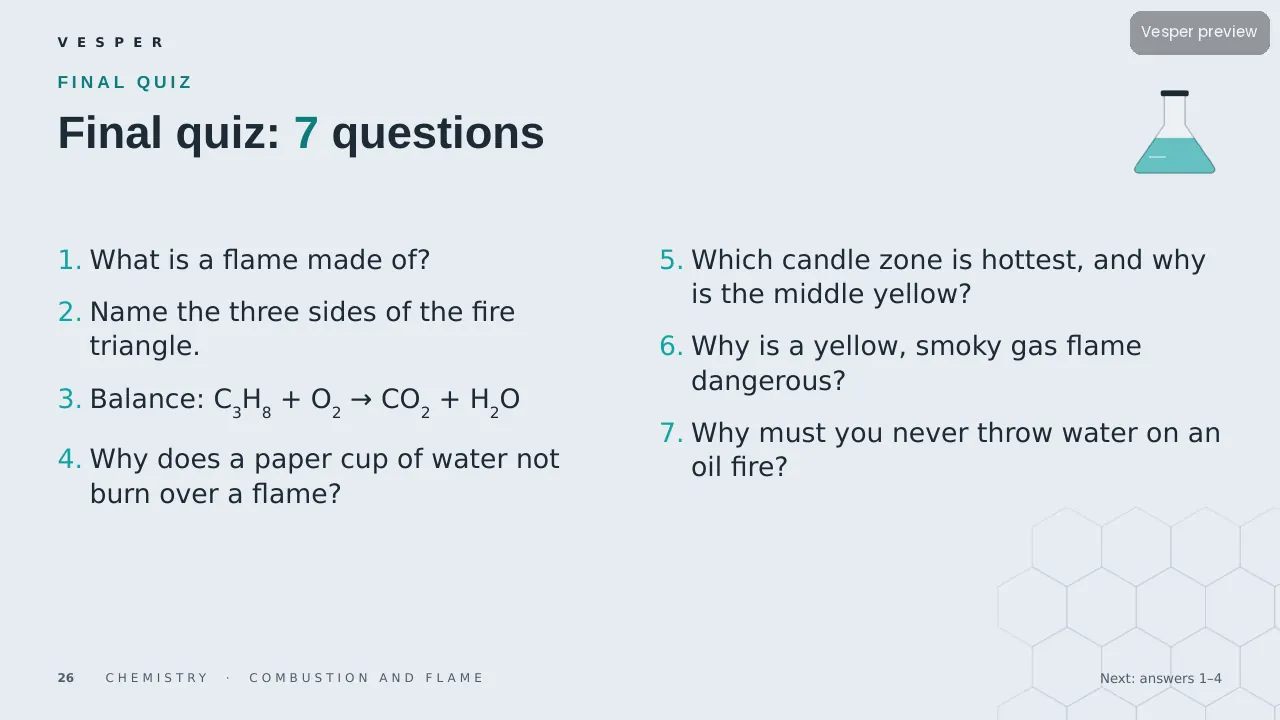
30 slides on the Flask template with worked equations, your-turn slides on LPG and fuels compared by energy per kilogram, pause-and-predict slides, a myth (‘a flame is plasma’), a spot-the-mistake on throwing water on a burning oil pan, two checkpoints and a 7-question quiz with explained answers. Fire safety is built in: break the triangle, and never use water on an oil fire.

How to teach it

Allow about 50 minutes. Take a vote on the hook before revealing answer D. The home activity on slide 22 uses no flame at all: warm steel wool in a jar with a thermometer, which rises a few degrees as the iron reacts with oxygen. Equations were checked by script. Notes on every slide give Say, Ask, Watch for and Time.

Who it’s for

For ages 13–14 studying combustion, oxidation and chemical reactions, and for any class that needs fire safety taught with the science behind it. Editable PowerPoint with named layouts.
Curriculum & specs

CBSE/NCERT (India)Class 8 · No current chapter (Combustion and Flame was in the old Class 8 book). Links: Class 8 Curiosity ch 8 Nature of Matter; Class 10 ch 1
CambridgeLS Stage 7–8 Chemistry (combustion); IGCSE 0620 §5 Chemical energetics
NGSS (US)MS-PS1-2; MS-PS1-6; HS-PS1-4
IB MYPSciences · KC Change · RC Energy, Transformation
Ages13–14
LevelMiddle
Slide templateFlask
Slides30
Teaching timeAbout 50 minutes
LanguageEnglish (UK)

Questions

Questions, answered

What is fire made of?

A flame is hot, reacting gas with glowing particles of soot. It is a chemical reaction you can see, not a solid, liquid or gas.

What is the fire triangle?

Fuel, oxygen and heat. A fire needs all three at once; remove one and it goes out.

Why is a candle flame yellow?

Glowing soot particles give out yellow light. The blue part at the base is where burning is most complete and hottest.

Why should you never put water on an oil fire?

Water sinks under the hot oil, flashes to steam and throws burning oil out of the pan. Turn off the heat and slide a lid over the pan instead.

What is incomplete combustion?

Burning with too little oxygen, which makes carbon monoxide and soot instead of only carbon dioxide and water.

Is a flame plasma?

Not an ordinary candle flame. Only a tiny fraction of it is ionised, so it is mostly hot gas and glowing soot. Lightning and the Sun are plasma.

Main sources

  1. NASA, "Candle Flame – 1g vs Microgravity" (2020).
  2. M. Faraday, The Chemical History of a Candle (lectures 1848, book 1861).
  3. Flame temperature about 1,400 °C: hypertextbook.com summary (approximate).

The full source list is on the last slides of the deck. Spotted an error? Tell us.