Chemistry Ages 15–16

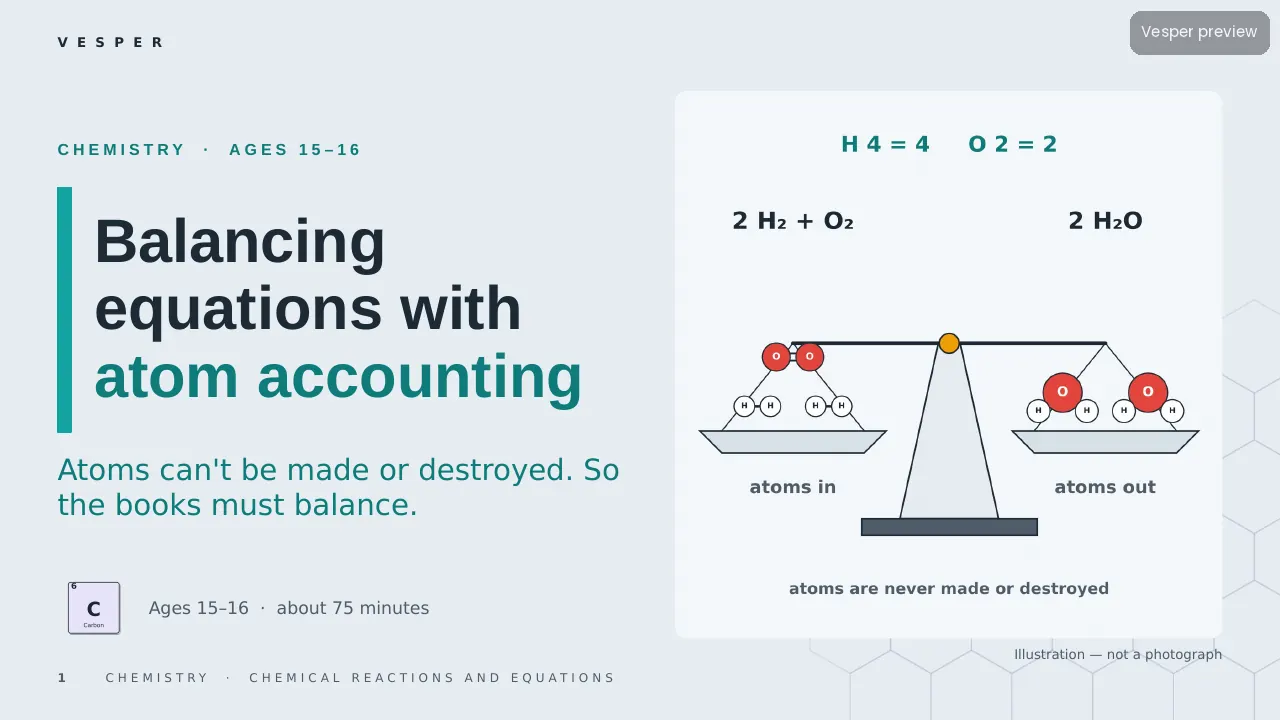
Balancing equations with atom accounting

Atoms can't be made or destroyed. So the books must balance.

Students balance any chemical equation with an atom ledger: change the big numbers, never the small ones, and prove it by mass. The 39 slides include six worked examples, each followed by a your-turn.

The short answer

To balance a chemical equation, count the atoms of each element on both sides in a ledger, then change only the coefficients (the big numbers in front), never the subscripts. Work on carbon and metals first and hydrogen and oxygen last. When every row matches, check that the mass in equals the mass out.

Inside the deck

slides
39
quiz questions
8
minutes
75
your-turn tasks
9

Choose a format

  • Lesson Notes (PDF)Every slide with its teacher notes, as a PDF to read or print.
  • Teacher DeckThe editable PowerPoint with speaker notes on every slide, a PDF copy and the matching Vesper slide template, so you can add slides of your own.
Pricing coming soon

Pricing coming soon

We’ll email you pricing and launch offers shortly.

  • Finished and checked: buying opens soon
  • Sources listed at the end
  • Curriculum links under ‘Curriculum & specs’
  • For one classroom. Campus licences for whole schools

Key facts

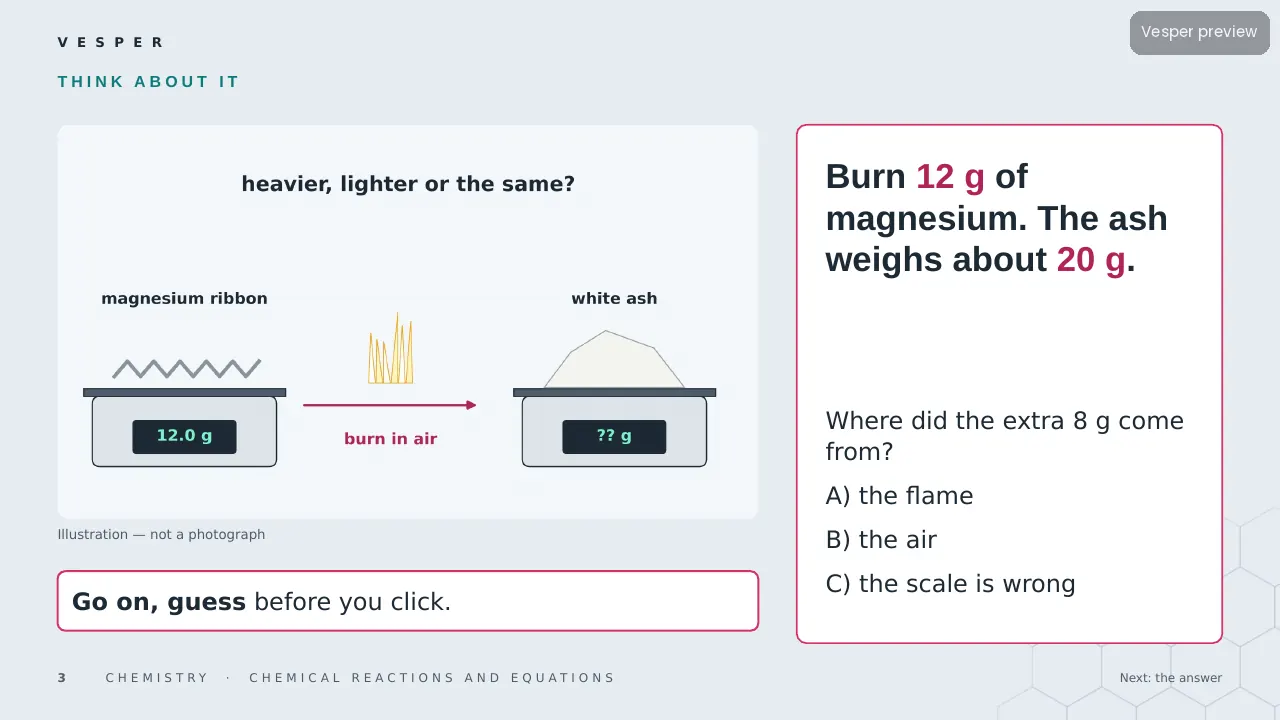
  • 12 g of magnesium burns to about 20 g of magnesium oxide: the extra 8 g is oxygen from the air.
  • Change coefficients, never subscripts: H₂O₂ is a different substance, not balanced water.
  • 2H₂ + O₂ → 2H₂O: 36 g in, 36 g out.
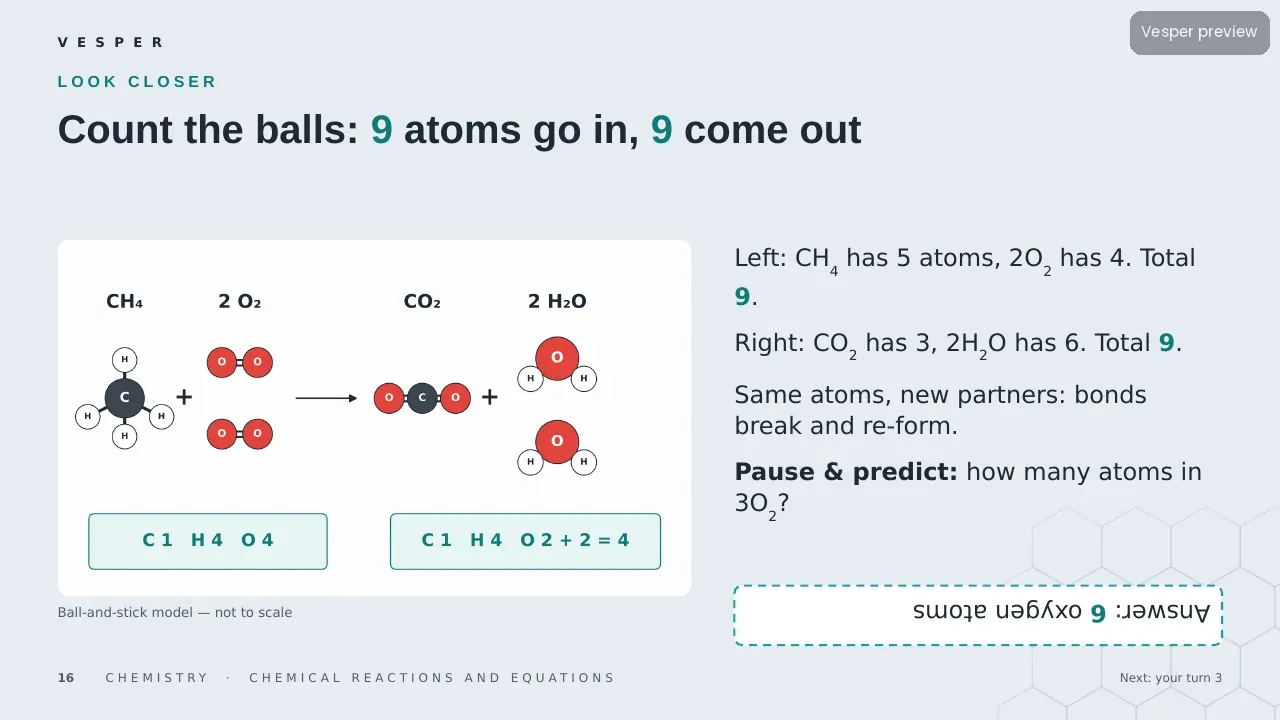
  • Burning methane, CH₄ + 2O₂ → CO₂ + 2H₂O, starts with 9 atoms and ends with 9.
  • In a car engine, 514 g of octane and oxygen in gives 514 g of products out.

What students will be able to do

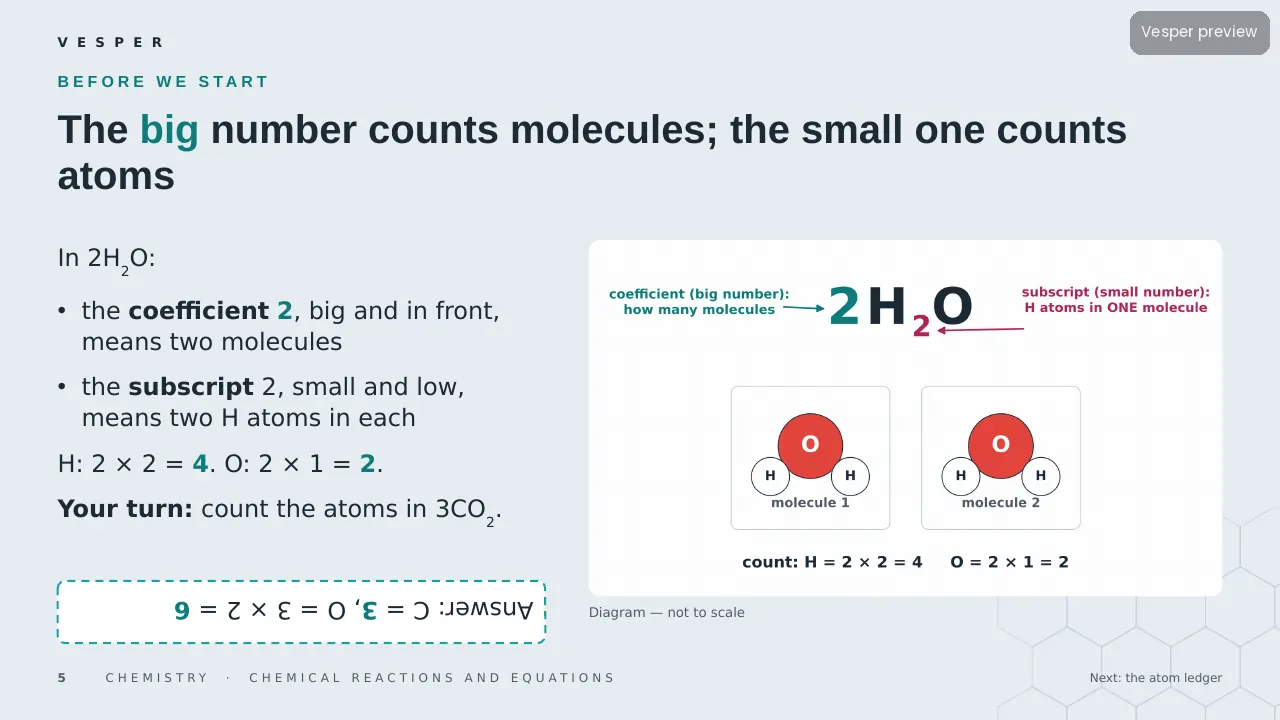
  • Students can tell a coefficient from a subscript and count the atoms in a formula such as 2Fe₂O₃.
  • Students can balance equations with an atom ledger, changing coefficients only.
  • Students can use the order of attack, the odd-even trick and polyatomic blocks on harder equations.
  • Students can show conservation of mass by checking an equation with relative masses.
  • Students can add state symbols to a balanced equation.

About this lesson

What students discover

Burn 12 g of magnesium and the ash weighs about 20 g. Where did the extra 8 g come from? The air. That puzzle opens a lesson that treats every equation as a bank ledger for atoms: element, left, right, balanced? Students learn the golden rule (change coefficients, never subscripts) and watch Kwame break it by turning water into H₂O₂.

Six worked examples rise in difficulty: water, magnesium oxide, methane, iron oxide, propane, and aluminium with copper sulfate. Three tricks make the hard ones quick: the order of attack (carbon and metals first, hydrogen and oxygen last), the odd-even doubling trick, and treating SO₄ or NO₃ as a single block. Checking by mass closes the loop: 2H₂ + O₂ gives 36 g in and 36 g out, and a car engine keeps the same books at 514 g in, 514 g out.

Inside the deck

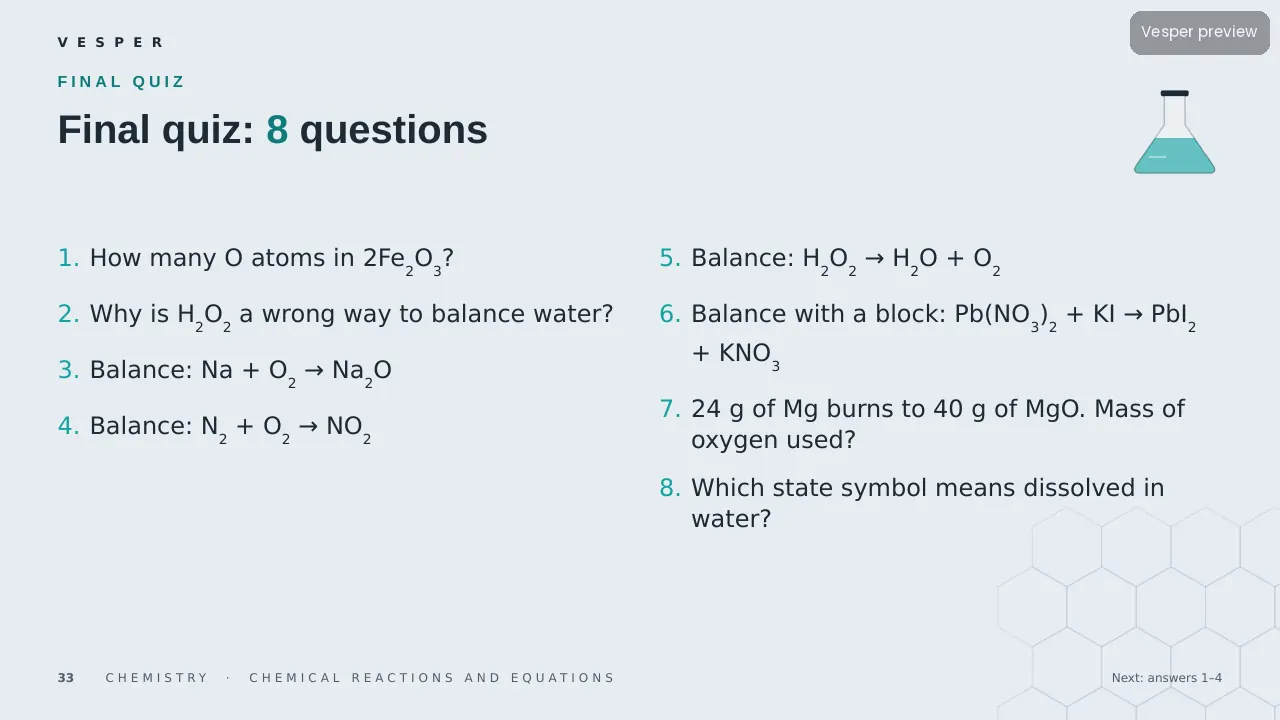
39 slides on the Flask template, with nine your-turn moments, each answer printed upside down. There are two checkpoints, a pause-and-predict with ball-and-stick atoms (9 in, 9 out), state symbols, a myth slide on burning logs and an eight-question quiz with explained answers. A 6-mark thermite exam question comes with a mark scheme. Every equation in the deck was checked by script.

How to teach it

Allow about 75 minutes, or split it at checkpoint 1 across two lessons. Insist on the ledger for every example; the deck models it each time. Speaker notes give timing for every slide.

Who it’s for

Learners aged 15–16 meeting chemical equations and conservation of mass before exams, and teachers who want a method rather than trial and error.
Curriculum & specs

CBSE/NCERT (India)Class 10 · Class 10 Science ch 1 Chemical Reactions and Equations
CambridgeLS Stage 9 Chemistry; IGCSE 0620 §3 Stoichiometry
NGSS (US)MS-PS1-5; HS-PS1-7
IB MYPSciences · KC Change · RC Models, Balance
Ages15–16
LevelSenior
Slide templateFlask
Slides39
Teaching timeAbout 75 minutes
Exam-style questionYes, with a model answer
LanguageEnglish (UK)

Questions

Questions, answered

What is the easiest way to balance chemical equations?

Draw an atom ledger with each element's count on the left and right, then fix one mismatch at a time by changing a coefficient. Do carbon and metals first and hydrogen and oxygen last.

Why can't you change the subscripts when balancing an equation?

Changing a subscript changes the substance. H₂O₂ is hydrogen peroxide, not water.

What is the odd-even trick in balancing equations?

If one side has an odd number of oxygen atoms and the other an even number, double the odd side first. Fe + O₂ → Fe₂O₃ becomes 4Fe + 3O₂ → 2Fe₂O₃.

How do you balance equations with polyatomic ions?

Treat a group such as SO₄ or NO₃ as one block if it travels unchanged from one side to the other.

Does burning destroy matter?

No. Mass is conserved; the missing mass of a burning log leaves as gases such as carbon dioxide and water vapour.

Is there an exam question in this lesson?

Yes, a 6-mark question on the thermite reaction with a mark scheme, plus an eight-question quiz with answers.

Main sources

  1. Conservation of mass: A. Lavoisier, Traité élémentaire de chimie, 1789.
  2. Relative atomic masses (rounded): H 1, C 12, N 14, O 16, Mg 24, Al 27, S 32, Fe 56, Cu 63.5, Zn 65, Ag 108.
  3. Octane density about 0.70 g/ml.

The full source list is on the last slides of the deck. Spotted an error? Tell us.