Chemistry Ages 15–16

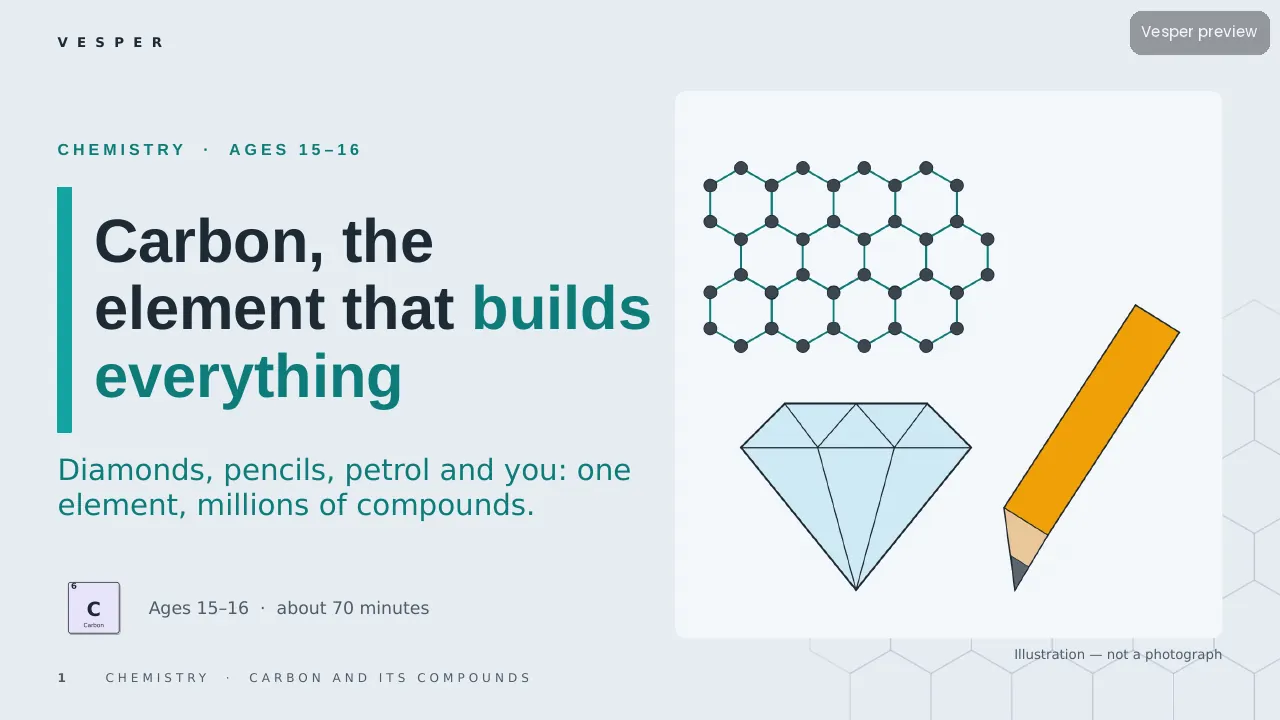
Carbon, the element that builds everything

Diamonds, pencils, petrol and you: one element, millions of compounds.

A 32-slide chemistry lesson on why one element makes diamonds, pencils, fuels and you. It covers covalent bonds, chains, families and balanced carbon reactions.

The short answer

Carbon builds so many compounds because each atom has four outer electrons and shares them, making four covalent bonds (tetravalency). Carbon also bonds to itself in chains, branches and rings (catenation). Joined differently, the same atoms give diamond, graphite and graphene; joined with hydrogen and oxygen, they give fuels, alcohols and living things.

Inside the deck

slides
32
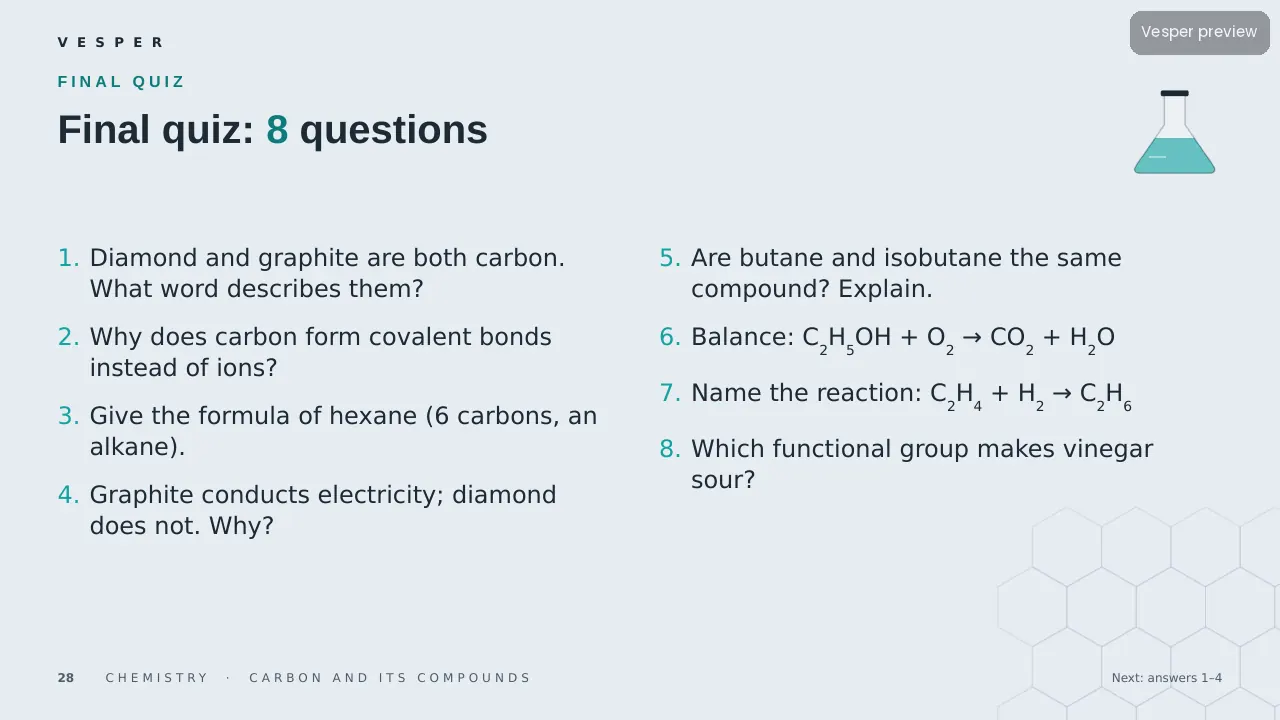
quiz questions
8
minutes
70
your-turn tasks
3

Choose a format

  • Lesson Notes (PDF)Every slide with its teacher notes, as a PDF to read or print.
  • Teacher DeckThe editable PowerPoint with speaker notes on every slide, a PDF copy and the matching Vesper slide template, so you can add slides of your own.
Pricing coming soon

Pricing coming soon

We’ll email you pricing and launch offers shortly.

  • Finished and checked: buying opens soon
  • Sources listed at the end
  • Curriculum links under ‘Curriculum & specs’
  • For one classroom. Campus licences for whole schools

Key facts

  • Carbon has 6 electrons arranged 2, 4, so it shares 4 to make 4 covalent bonds.
  • C₆₀ (1985) has 60 carbons: 12 pentagons and 20 hexagons; it won the 1996 Nobel Prize in Chemistry.
  • Butane and isobutane are both C₄H₁₀ but boil at −1 °C and −12 °C.
  • Ethanol burns as C₂H₅OH + 3O₂ → 2CO₂ + 3H₂O.
  • About 18% of the human body is carbon: about 9 kg in a 50 kg person.

What students will be able to do

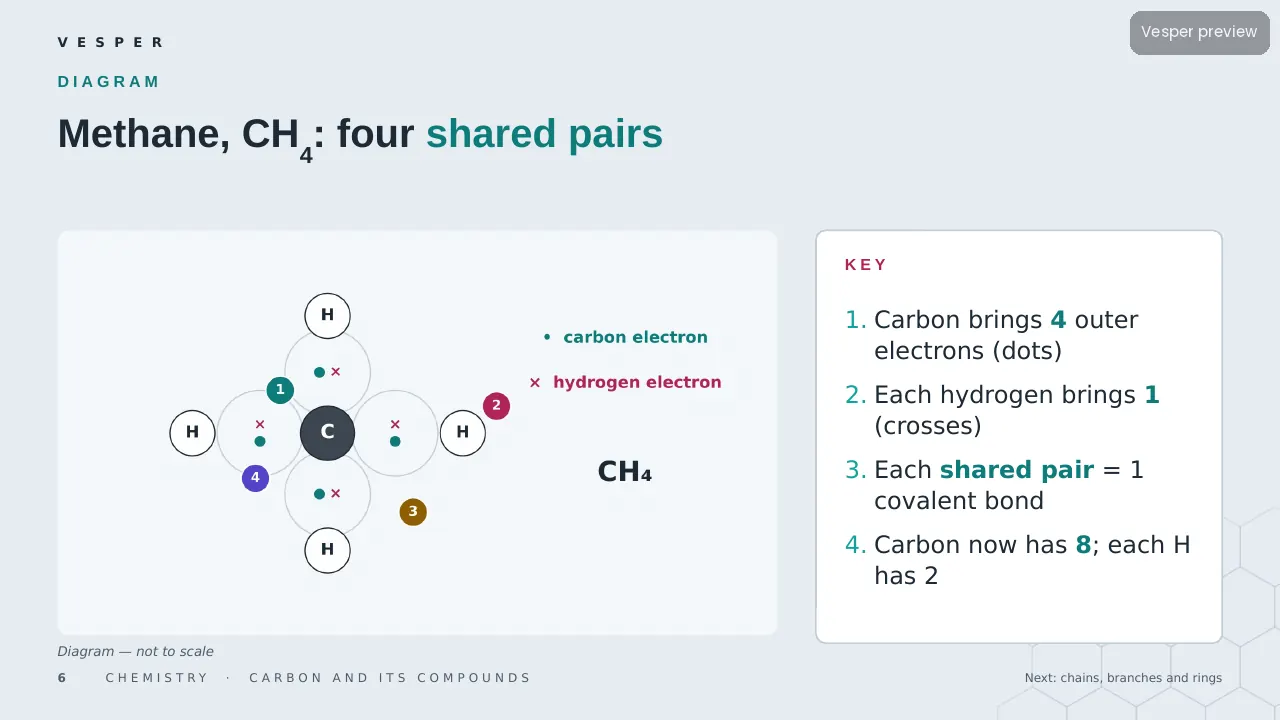
  • Students can explain why carbon forms covalent bonds and draw the bonds in methane.
  • Students can explain the different properties of diamond and graphite from their structures.
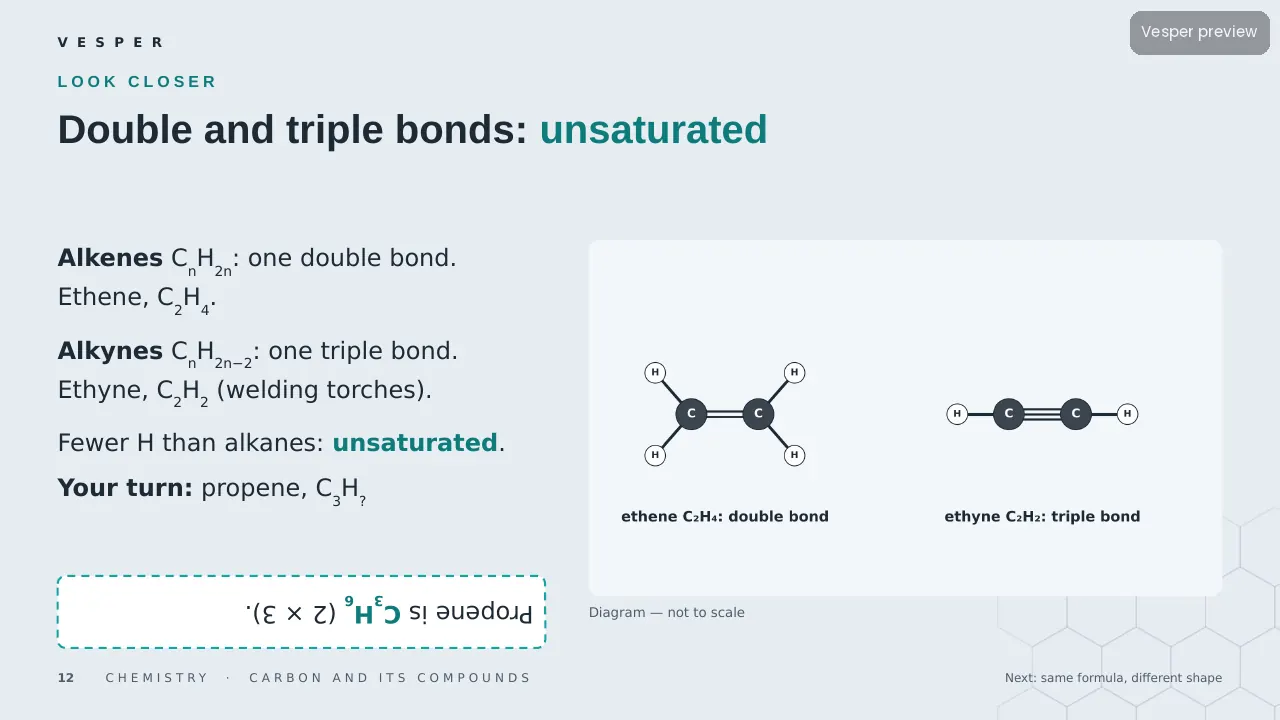
  • Students can name and give formulas for alkanes, alkenes and alkynes in a homologous series.
  • Students can identify isomers and common functional groups.
  • Students can balance combustion, addition and substitution reactions of carbon compounds.

About this lesson

What students discover

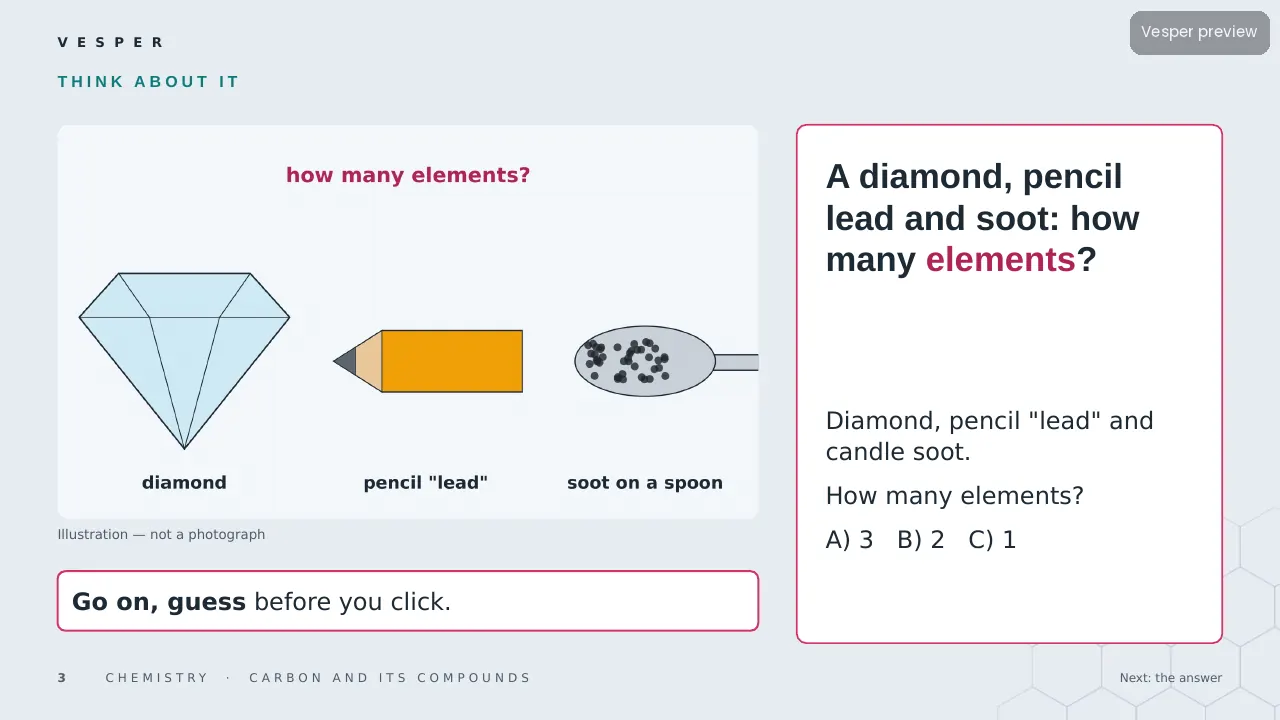
Diamond, pencil lead and candle soot: how many elements? One. Students see why carbon (2, 4) shares electrons rather than gaining or losing four, draw methane dot by dot, and meet tetravalency and catenation. Diamond and graphite are compared bond by bond, which settles the quick poll on which one conducts. Two Nobel-winning newcomers follow: C₆₀, 60 carbons in a football shape, and graphene.

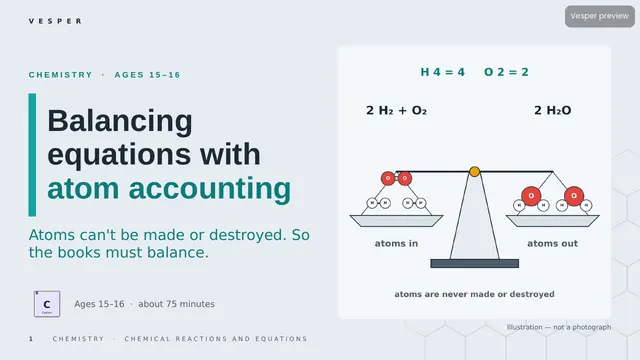
Then the families. Alkanes (CₙH₂ₙ₊₂), alkenes and alkynes line up in a homologous-series table that students use to predict the next member. Butane and isobutane show isomers (same C₄H₁₀, boiling at −1 °C and −12 °C), rings appear, and functional groups explain why ethanol and vinegar behave so differently. Each reaction is balanced with an atom ledger: combustion of methane and ethanol, adding hydrogen to ethene, and swapping a hydrogen for chlorine.

Inside the deck

32 slides on the Flask template: a guess-first hook, a dot-and-cross diagram, a bet-you-didn’t-know, two worked examples with matching your-turns, a carbon-cycle diagram, Meera’s spot-the-mistake (‘C₃H₆ is propane’) and two checkpoints. Real-world links include the 18% of you that is carbon, about 9 kg in a 50 kg person. An eight-question quiz has explained answers.

How to teach it

About 70 minutes, or two shorter lessons split at checkpoint 1. The toothpick-and-pea model activity is safe at home or in class: every carbon gets four toothpicks, and students count bonds on the pause-and-predict slide that follows. Speaker notes cover every slide.

Who it’s for

Learners aged 15–16 starting organic chemistry, and teachers who want bonding, families and equations in one connected lesson.
Curriculum & specs

CBSE/NCERT (India)Class 10 · Class 10 Science ch 4 Carbon and its Compounds
CambridgeIGCSE 0620 §11 Organic chemistry
NGSS (US)HS-PS1-1; HS-LS1-6
IB MYPSciences · KC Systems · RC Form, Patterns
Ages15–16
LevelSenior
Slide templateFlask
Slides32
Teaching timeAbout 70 minutes
LanguageEnglish (UK)

Questions

Questions, answered

Why does carbon form so many compounds?

Each carbon makes four covalent bonds and can bond to other carbons in long chains, branches and rings, so the number of possible structures is enormous.

Why does graphite conduct electricity but diamond does not?

In graphite each carbon bonds to three others, leaving a free electron that can move. In diamond all four outer electrons are locked in bonds.

What is a homologous series?

A family of compounds with the same general formula, each member one CH₂ longer than the last, such as methane, ethane and propane.

What is the difference between alkanes, alkenes and alkynes?

Alkanes have only single bonds (CₙH₂ₙ₊₂), alkenes have one double bond (CₙH₂ₙ) and alkynes one triple bond (CₙH₂ₙ₋₂).

What are isomers?

Compounds with the same formula but a different structure, such as butane and isobutane.

Is there a hands-on activity?

Yes. Students build methane, ethane and ethene from toothpicks and peas, giving every carbon four toothpicks.

Main sources

  1. Nobel Prize website: Chemistry 1996 (fullerenes); Physics 2010 (graphene).
  2. Boiling points: CRC Handbook, rounded.
  3. Body composition: standard rounded values.

The full source list is on the last slides of the deck. Spotted an error? Tell us.