Chemistry Ages 12–16

Baking soda vs baking powder: kitchen chemistry

Soda seeks sour. Powder packs its partner.

A 33-slide chemistry lesson on why baking soda needs an acid and baking powder brings its own. It has balanced equations with atom counts, gas calculations, a safe fizz test and an exam question with a mark scheme.

The short answer

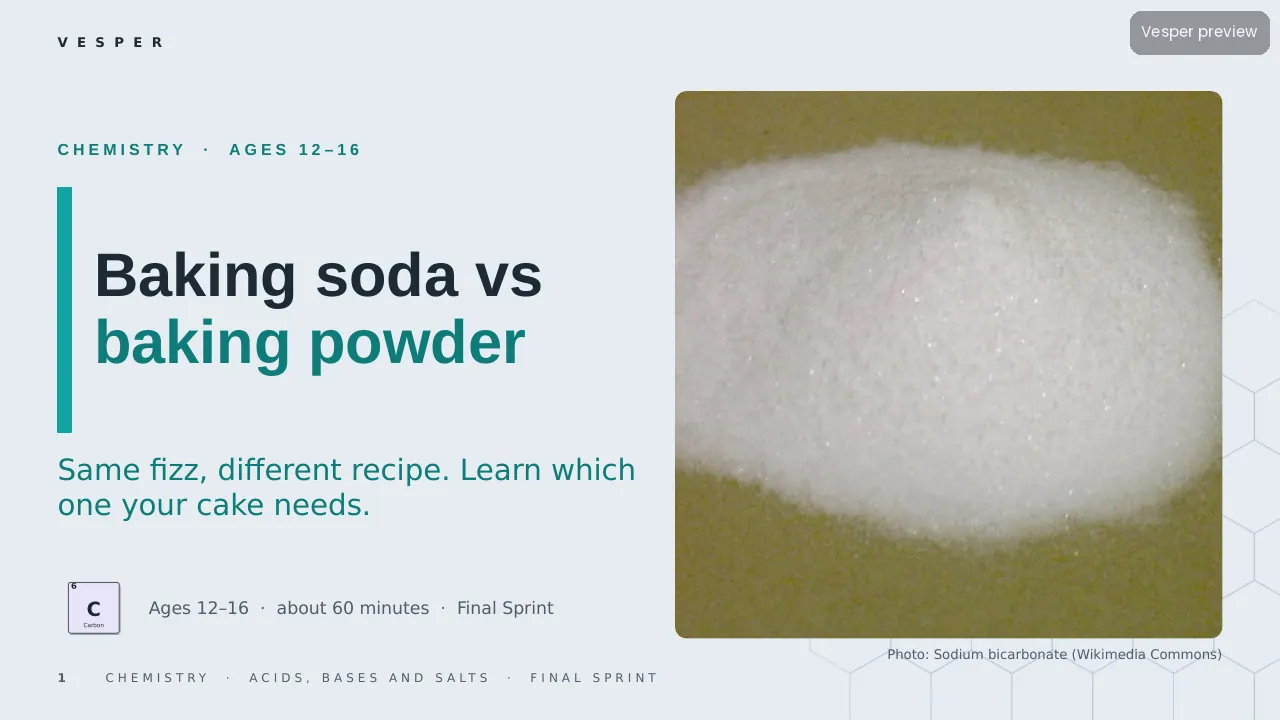
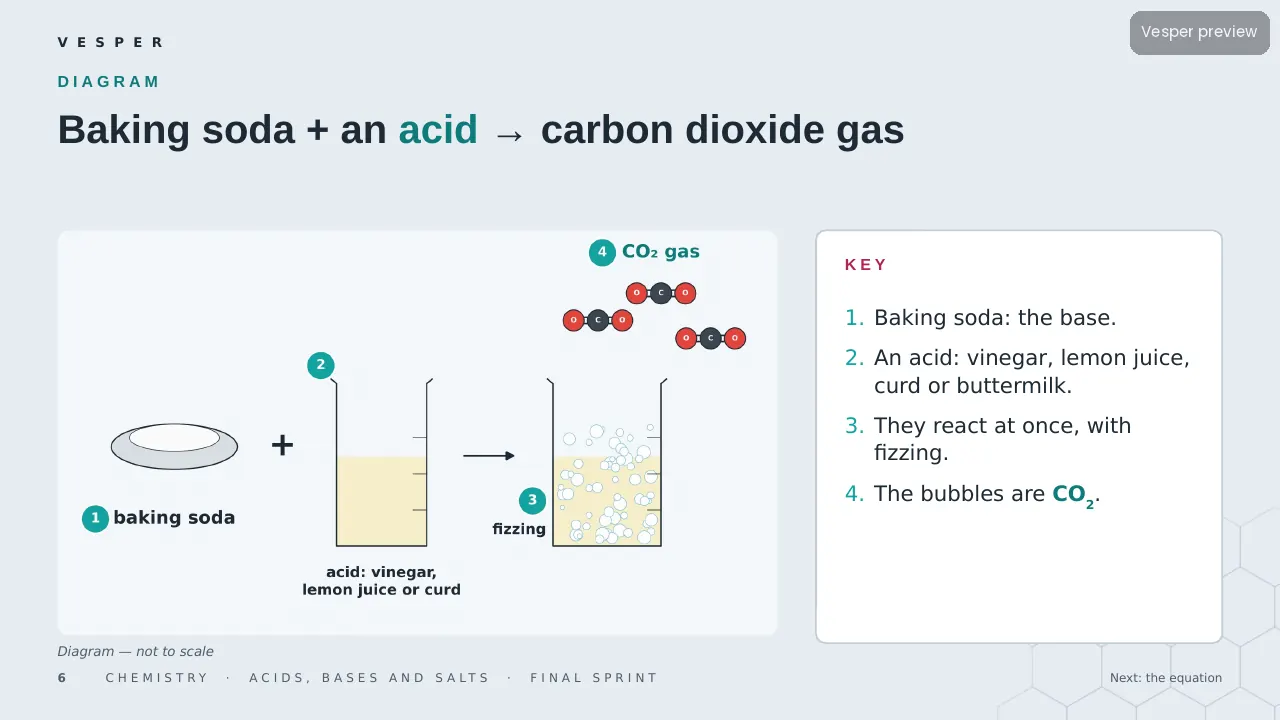
Baking soda is sodium hydrogencarbonate, a weak base that needs an acid such as curd or lemon to release plenty of carbon dioxide. Baking powder is baking soda already mixed with a dry acid and starch, so it fizzes with just water. Heated alone, soda leaves bitter washing soda and half the gas.

Inside the deck

slides
33
quiz questions
8
minutes
60
your-turn tasks
5

Choose a format

  • Lesson Notes (PDF)Every slide with its teacher notes, as a PDF to read or print.
  • Teacher DeckThe editable PowerPoint with speaker notes on every slide, a PDF copy and the matching Vesper slide template, so you can add slides of your own.
Pricing coming soon

Pricing coming soon

We’ll email you pricing and launch offers shortly.

  • Finished and checked: buying opens soon
  • Sources listed at the end
  • Curriculum links under ‘Curriculum & specs’
  • For one classroom. Campus licences for whole schools

Key facts

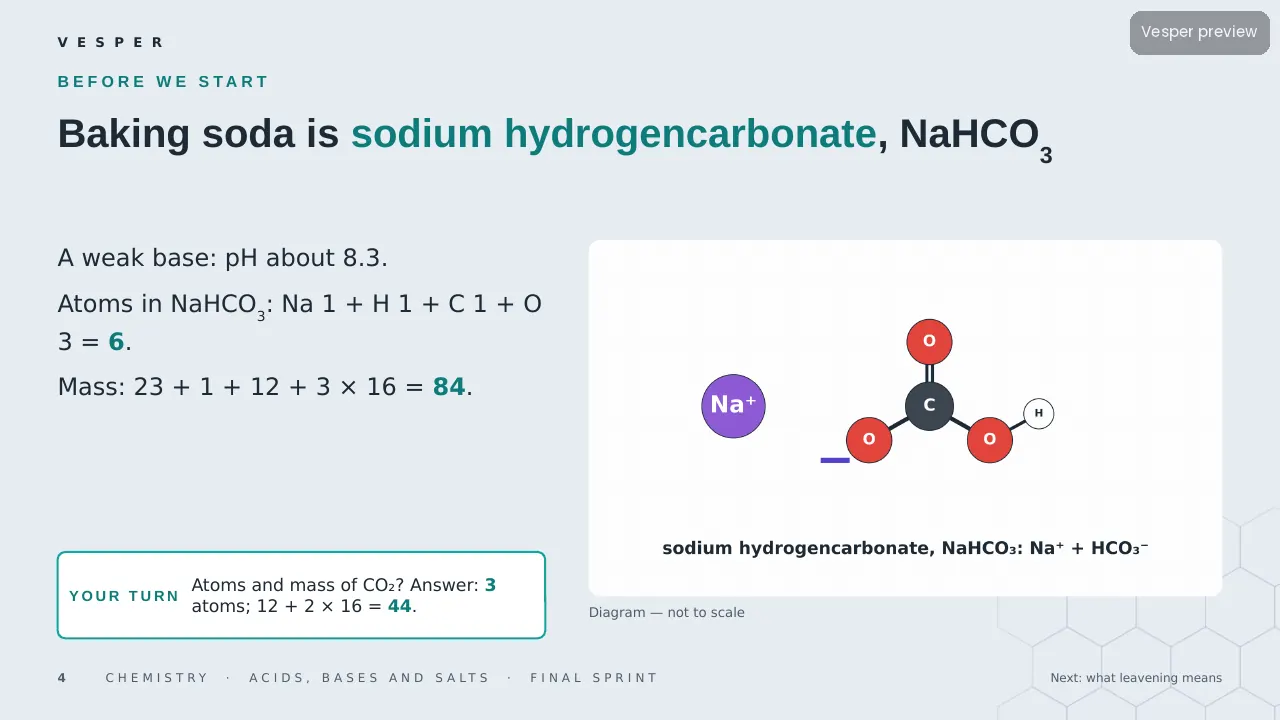
  • Baking soda is sodium hydrogencarbonate, NaHCO₃, relative formula mass 84.
  • 84 g of baking soda with acid makes 44 g of CO₂; a 5 g teaspoon gives about 1.4 litres of gas.
  • Heated alone, 2NaHCO₃ → Na₂CO₃ + H₂O + CO₂: bitter washing soda and half the gas.
  • Homemade baking powder is 1 part soda to 2 parts cream of tartar.
  • Cakes use about 3–5% baking powder on the weight of flour.

What students will be able to do

  • Students can name and give the formula of baking soda (NaHCO₃) and describe what is in baking powder.
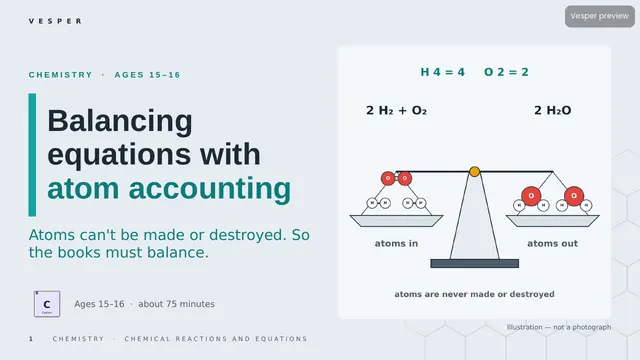
  • Students can write balanced equations for soda with an acid and for soda heated alone.
  • Students can calculate the mass and volume of carbon dioxide made from a given mass of soda.
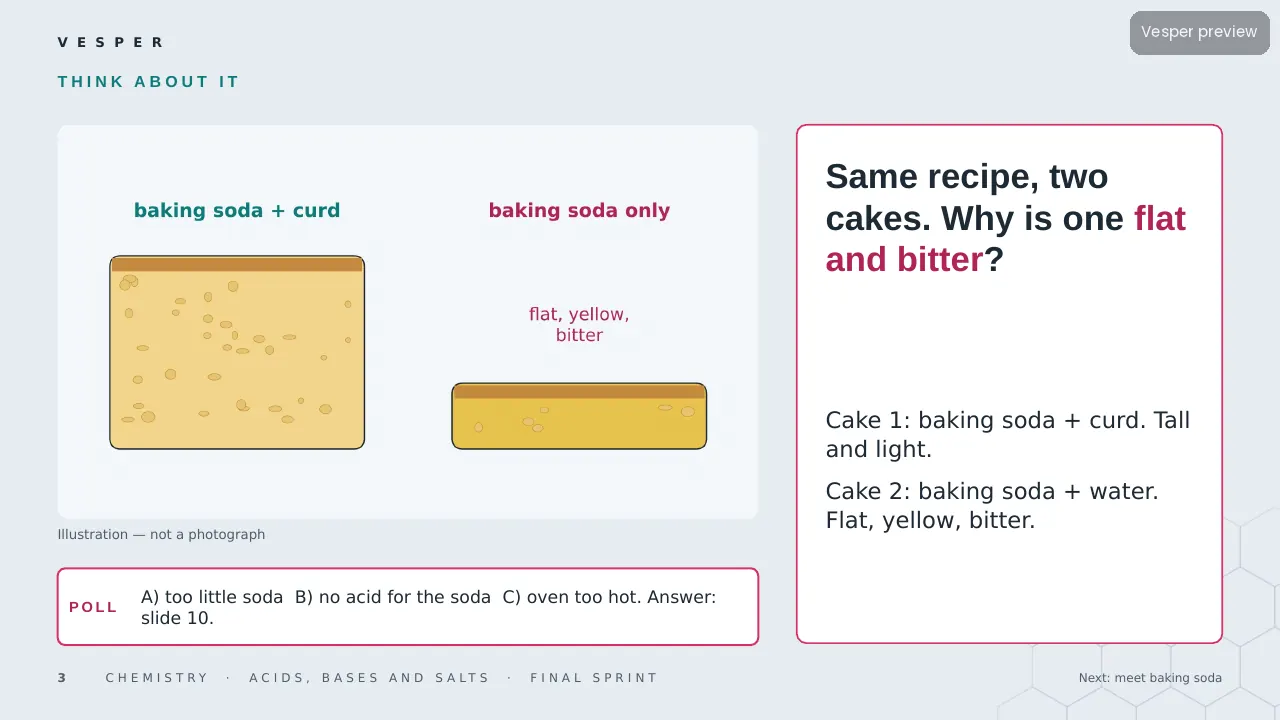
  • Students can explain why a soda-only cake tastes bitter and rises less.
  • Students can explain what double-acting baking powder does.

About this lesson

What students discover

Two cakes from one recipe: one tall and light, one flat, yellow and bitter. The difference is a partner acid. Students meet baking soda as NaHCO₃ (relative mass 84) and balance its reaction with vinegar atom by atom. Then the numbers: 84 g of soda gives 44 g of carbon dioxide, so a 5 g teaspoon makes about 1.4 litres of gas.

With no acid, the oven still splits the soda: 2NaHCO₃ → Na₂CO₃ + H₂O + CO₂. That leaves washing soda behind, which tastes bitter, and only half the gas. Baking powder solves it by carrying soda, a dry acid and starch in one tin; double-acting powder fizzes once in the bowl and again in the oven. Students work out a 1 : 2 homemade powder and a 3–5% dose on flour, and finish with the same reaction in instant dhokla and antacids.

Inside the deck

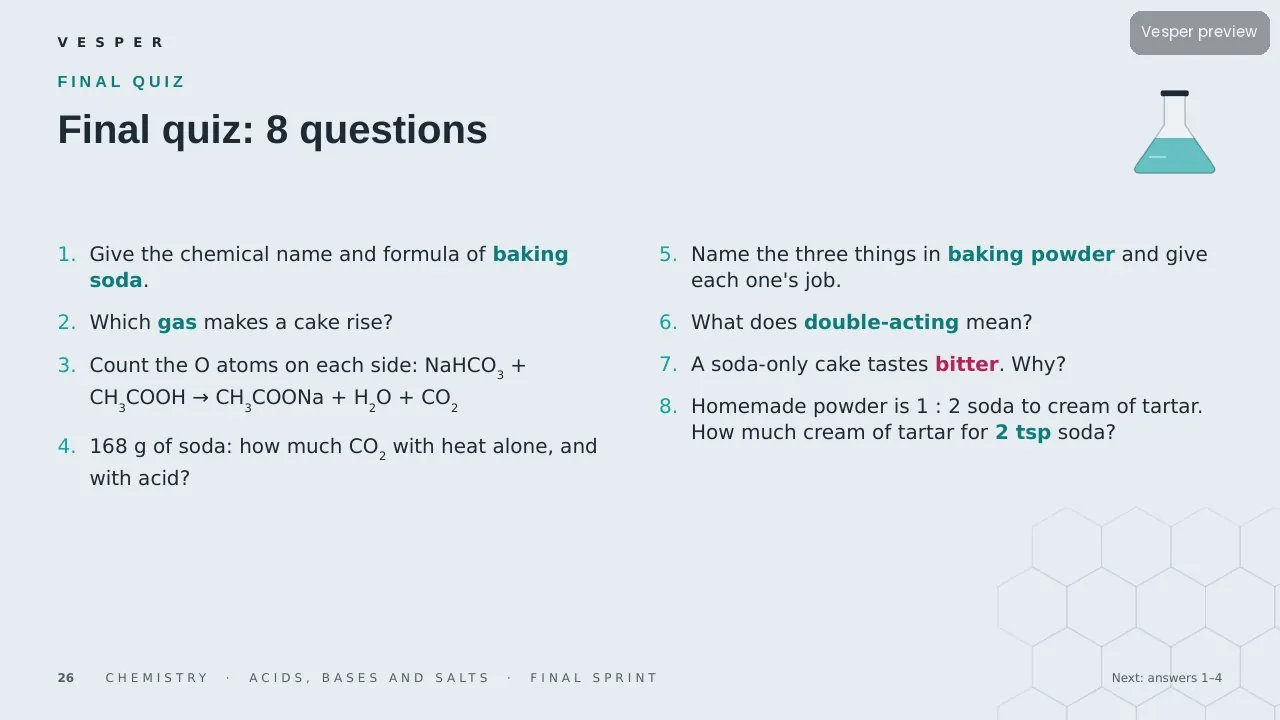
33 slides on the Flask template: a quick-poll hook, two diagram walks, five your-turn tasks, a pause-and-predict (curd or water?), Priya’s spot-the-mistake (‘powder is just weak soda’), a myth slide on bigger fizz, two checkpoints and an eight-question quiz with explained answers. A 7-mark exam question, ‘the bitter cake’, comes with a full mark scheme.

How to teach it

About 60 minutes. Run the fizz test with three glasses of 100 ml water and a teaspoon each of soda, powder and soda plus vinegar, then use the results slide to explain what happened. Speaker notes cover every slide. It is part of the Final Sprint collection of exam lessons.

Who it’s for

Learners aged 12–16 studying acids, bases and salts or thermal decomposition, and anyone revising for an exam that likes everyday chemistry questions.
Curriculum & specs

CBSE/NCERT (India)Class 7, 10 · Class 7 Curiosity ch 2 Exploring Substances: Acidic, Basic, and Neutral; Class 10 Science ch 2 Acids, Bases and Salts
CambridgeLS Stage 8–9 Chemistry; IGCSE 0620 §7.3 Preparation of salts
NGSS (US)MS-PS1-2; MS-PS1-5
IB MYPSciences · KC Change · RC Transformation, Evidence
Ages12–16
LevelSenior
Slide templateFlask
Slides33
Teaching timeAbout 60 minutes
Exam-style questionYes, with a model answer
LanguageEnglish (UK)

Questions

Questions, answered

What is the difference between baking soda and baking powder?

Baking soda is a base that needs an acid to fizz. Baking powder is soda already mixed with a dry acid and starch, so it only needs water.

Can I use baking soda instead of baking powder?

Only if the recipe has an acid such as curd, buttermilk or lemon juice. Without one, the cake rises less and tastes bitter.

Why does a cake with too much baking soda taste bitter?

Heat turns leftover soda into sodium carbonate (washing soda), a stronger base with a bitter taste.

What is the equation for heating baking soda?

2NaHCO₃ → Na₂CO₃ + H₂O + CO₂. It is a thermal decomposition.

What does double-acting baking powder mean?

It contains two acids: one reacts when the powder gets wet, the other when it gets hot, so the batter gets two bursts of gas.

Does this lesson include an exam question?

Yes, a 7-mark exam-style question on the bitter cake with a full mark scheme, plus an eight-question quiz.

Main sources

  1. BAKERpedia, 'Baking powder' (accessed 17 Nov 2026): bicarbonate + leavening acid + filler such as cornstarch; double-acting releases gas during mixing and again during baking; cakes use 3–5% baking powder on flour weight; homemade mix 1 tbsp bicarbonate of soda with 2 tbsp cream of tartar.
  2. Relative formula masses from atomic masses Na 23, H 1, C 12, O 16: NaHCO₃ 84, CO₂ 44, Na₂CO₃ 106. One mole of gas occupies about 24 litres at room temperature.
  3. Typical values: baking soda solution pH about 8.3; sodium carbonate solution pH about 11; one level teaspoon of baking soda about 5 g (varies with packing).

The full source list is on the last slides of the deck. Spotted an error? Tell us.