Chemistry Ages 15–16

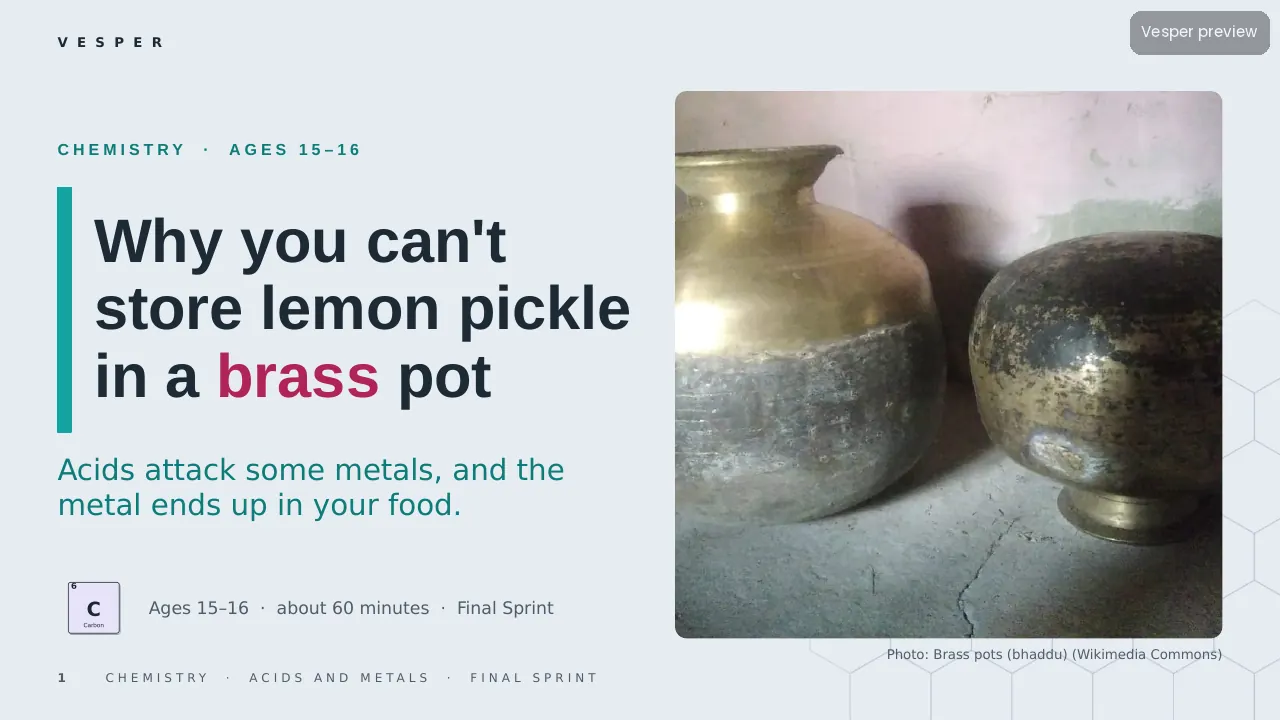
Why you can't store lemon pickle in a brass pot

Sour stays in glass. Brass stays dry.

A 32-slide chemistry lesson on acids and metals: why zinc and copper leave brass and enter sour food. It has balanced equations, a food-safety rule and an exam question with a mark scheme.

The short answer

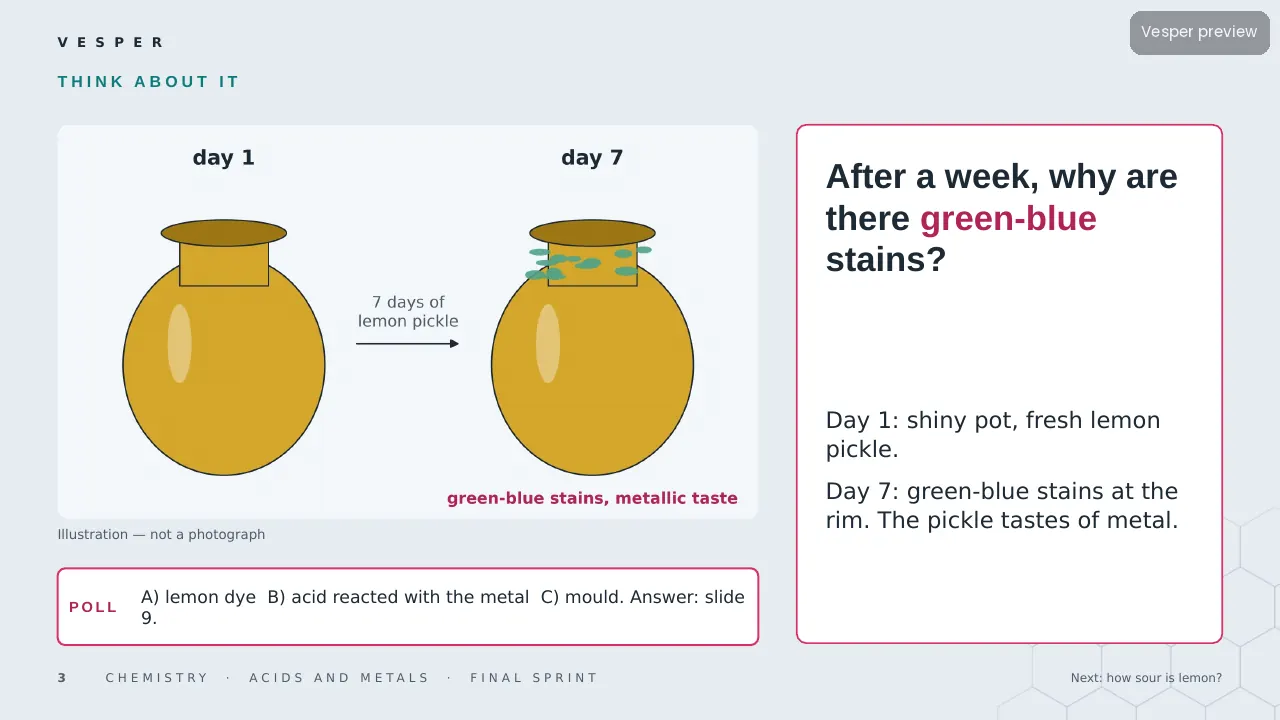
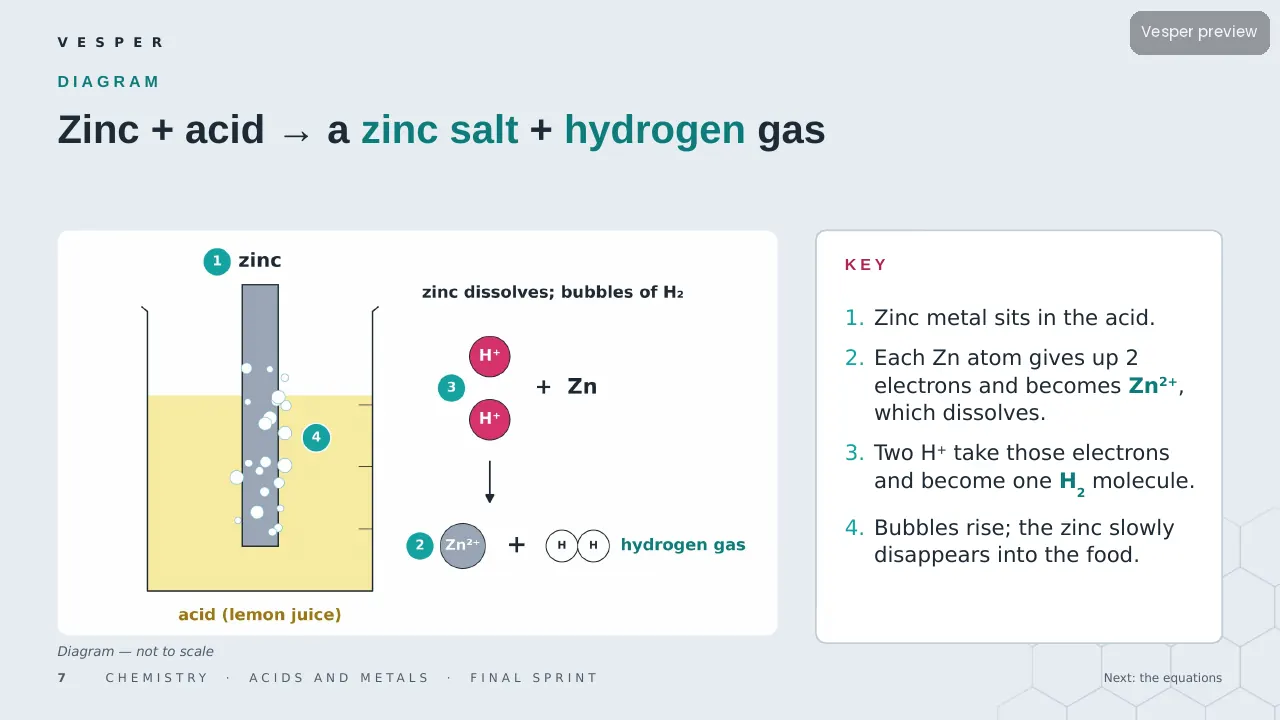
Lemon pickle is acidic, about pH 2. Brass is an alloy of roughly 70% copper and 30% zinc. Zinc sits above hydrogen in the reactivity series, so the acid dissolves it and releases hydrogen. Copper dissolves slowly too when oxygen is present, leaving green-blue stains. The dissolved metals end up in the food.

Inside the deck

slides
32
quiz questions
8
minutes
60
your-turn tasks
3

Choose a format

  • Lesson Notes (PDF)Every slide with its teacher notes, as a PDF to read or print.
  • Teacher DeckThe editable PowerPoint with speaker notes on every slide, a PDF copy and the matching Vesper slide template, so you can add slides of your own.
Pricing coming soon

Pricing coming soon

We’ll email you pricing and launch offers shortly.

  • Finished and checked: buying opens soon
  • Sources listed at the end
  • Curriculum links under ‘Curriculum & specs’
  • For one classroom. Campus licences for whole schools

Key facts

  • Lemon juice is about pH 2, with roughly 5 g of citric acid per 100 ml.
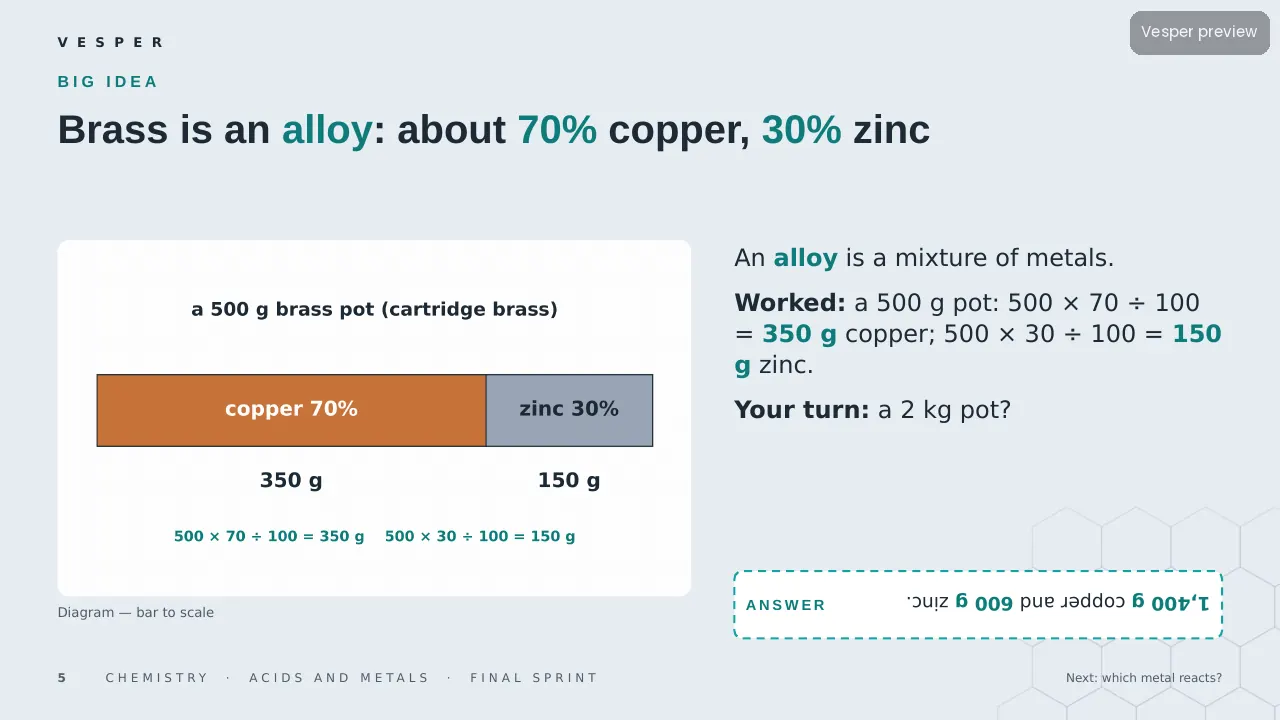
  • A 500 g brass pot at 70 : 30 holds 350 g of copper and 150 g of zinc.
  • 3Zn + 2C₆H₈O₇ → Zn₃(C₆H₅O₇)₂ + 3H₂: 16 hydrogen atoms on each side.
  • The US FDA Food Code bans copper and brass from contact with food below pH 6.
  • Kalai is a thin tin lining used inside brass and copper cooking pots.

What students will be able to do

  • Students can explain what brass is and which of its metals react with acid.
  • Students can write balanced equations for zinc with citric and hydrochloric acid.
  • Students can use the reactivity series to explain why copper needs oxygen to dissolve in acid.
  • Students can explain why acidic food should not be stored in copper or brass.
  • Students can choose safe containers for acidic food and explain why.

About this lesson

What students discover

Day 1: a shiny brass pot of fresh lemon pickle. Day 7: green-blue stains at the rim, and the pickle tastes of metal. This lesson explains why, one step at a time. Students meet lemon juice as an acid (about pH 2, roughly 5 g of citric acid in every 100 ml) and brass as an alloy: a 500 g pot at 70 : 30 holds 350 g of copper and 150 g of zinc.

The reactivity series shows the split. Zinc sits above hydrogen, so it reacts with acid on its own: 3Zn + 2C₆H₈O₇ → Zn₃(C₆H₅O₇)₂ + 3H₂, balanced with a full atom count. Copper sits below hydrogen, so it needs oxygen as well (2Cu + O₂ + 4H⁺ → 2Cu²⁺ + 2H₂O), and copper ions are the blue-green of the stains. Old copper’s green coat, basic copper carbonate, dissolves in acid too. Then the ‘so what’: the metal ends up in the food. The US FDA Food Code bans copper and brass from touching foods below pH 6, and kalai, a thin tin lining, is the traditional fix. Arjun’s ‘copper is unreactive, so a copper pot is fine’ is the spot-the-mistake, and a myth slide sets the record straight: brass is fine for water, while sour, salty food is the problem.

Inside the deck

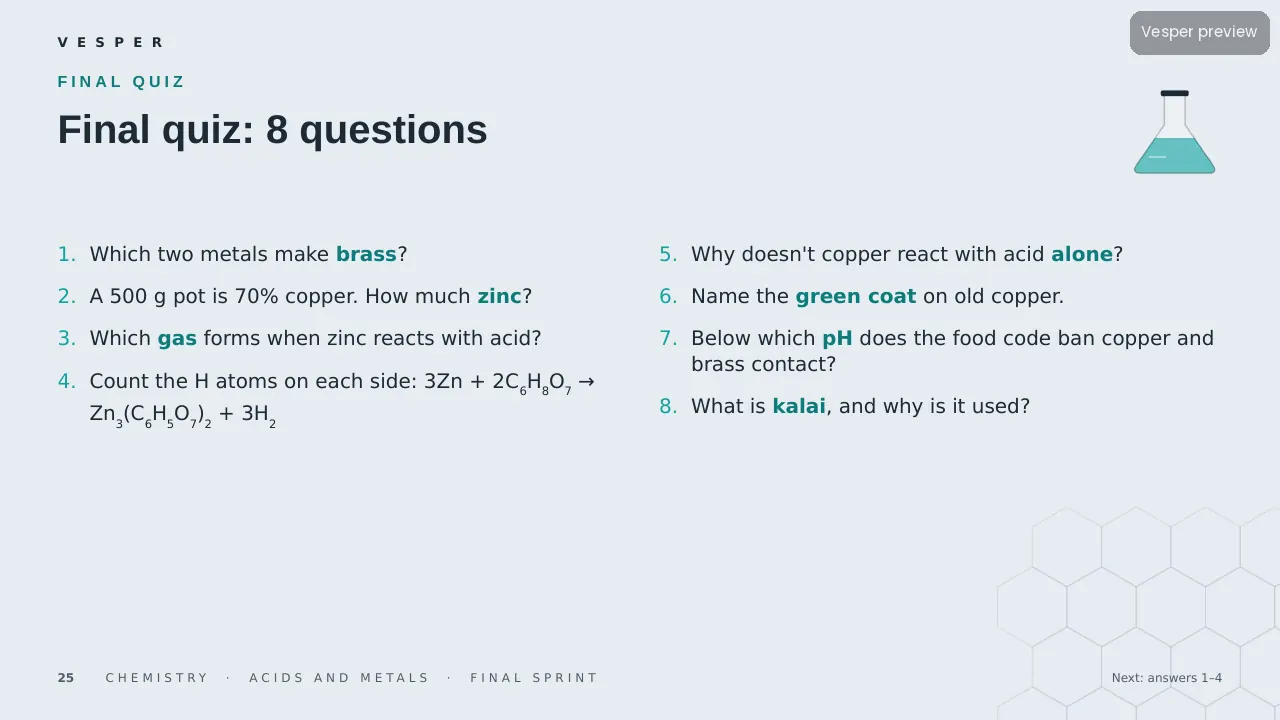
32 slides on the Flask template: a quick-poll hook, a primer, a diagram walk, three your-turn tasks, two bridges, a pause-and-predict on which containers are safe, two checkpoints and an eight-question quiz with explained answers. A 7-mark exam question on the pickle pot comes with a mark scheme.

How to teach it

About 60 minutes. The home activity, lemon and salt rubbed on a tarnished brass or copper object (an adult chooses which), shows the tarnish dissolving, and the next slide explains the equation. Part of the Final Sprint collection; speaker notes sit on every slide.

Who it’s for

Learners aged 15–16 revising acids, metals and the reactivity series, and any family that still owns a brass pot.
Curriculum & specs

CBSE/NCERT (India)Class 10 · Class 10 Science ch 2 Acids, Bases and Salts; ch 3 Metals and Non-metals
CambridgeIGCSE 0620 §7.1 Acids and bases; §9.5
NGSS (US)MS-PS1-2; HS-PS1-2
IB MYPSciences · KC Change · RC Consequences, Interaction
Ages15–16
LevelSenior
Slide templateFlask
Slides32
Teaching timeAbout 60 minutes
Exam-style questionYes, with a model answer
LanguageEnglish (UK)

Questions

Questions, answered

Why can't you store pickle in a brass pot?

Pickle is acidic. The acid dissolves zinc from the brass and, with oxygen, copper too, so metal ends up in the food.

What is brass made of?

Brass is an alloy, a mixture of metals, of about 70% copper and 30% zinc.

Why does zinc react with acid but copper doesn't?

Zinc is above hydrogen in the reactivity series, so it pushes hydrogen out of acids. Copper is below hydrogen, so it only dissolves slowly when oxygen is present as well.

What causes green-blue stains on brass and copper?

Copper ions, which are blue-green, and on old copper a green coat of basic copper carbonate.

What is kalai on brass utensils?

A thin layer of tin lining the inside of brass and copper cooking pots, which keeps food away from the copper and zinc.

Is there an exam question in this lesson?

Yes, a 7-mark exam-style question on the pickle pot with a mark scheme, plus an eight-question quiz.

Main sources

  1. US FDA Food Code, section 4-101.14 (as adopted in Washington State WAC 246-215-04115, accessed 17 Nov 2026): 'copper and copper alloys such as brass may not be used in contact with a food that has a pH below six'.
  2. Canadian Conservation Institute, 'Preventing and treating the dezincification of brass', CCI Notes 9/13 (accessed 17 Nov 2026): brass is mainly copper and zinc; cartridge brass 70 wt% Cu, 30 wt% Zn; acidic and chloride solutions, including citric acid, remove zinc.
  3. Penniston, K. L., Nakada, S. Y., Holmes, R. P. and Assimos, D. G. (2008). Quantitative assessment of citric acid in lemon juice, lime juice, and commercially-available fruit juice products. Journal of Endourology, 22(3), 567–570.

The full source list is on the last slides of the deck. Spotted an error? Tell us.