Chemistry Ages 15–16

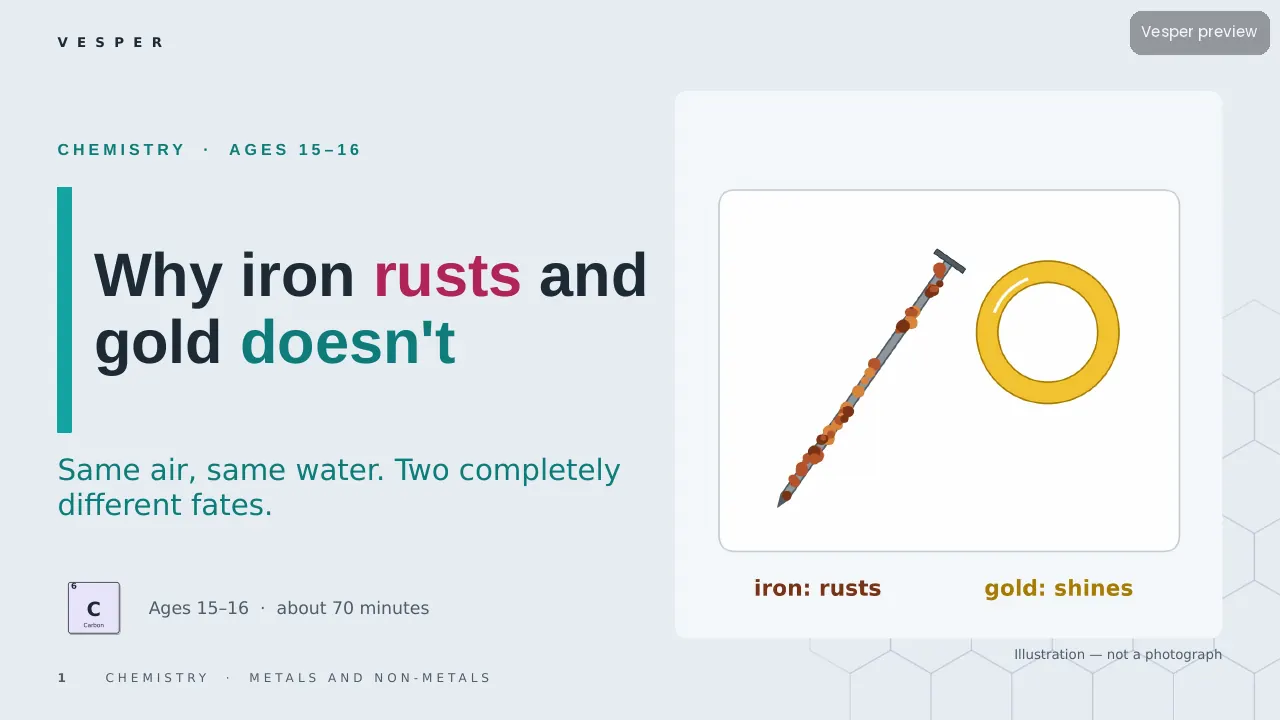
Why iron rusts and gold doesn't

Reactivity, not hardness: why rust needs oxygen and water, and gold barely reacts.

Rust needs oxygen and water; gold barely reacts at all. Students balance the rusting equation, climb the reactivity series and learn to stop rust, in 34 slides for ages 15–16.

The short answer

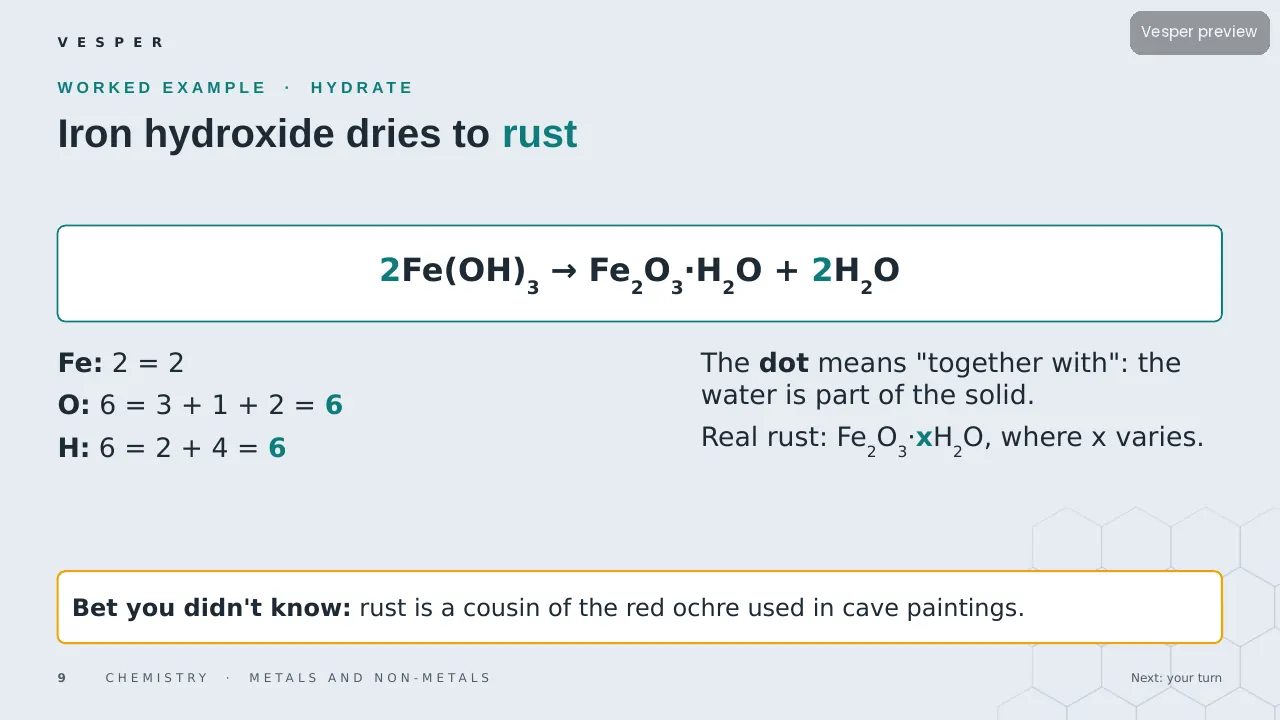
Iron rusts because it is reactive: with oxygen and water together it forms hydrated iron(III) oxide, and salt speeds this up. Gold sits at the bottom of the reactivity series and holds its electrons tightly (+1.50 V), so it barely reacts at all. Hardness has nothing to do with it; reactivity decides.

Inside the deck

slides
34
quiz questions
8
minutes
70
your-turn tasks
4

Choose a format

  • Lesson Notes (PDF)Every slide with its teacher notes, as a PDF to read or print.
  • Teacher DeckThe editable PowerPoint with speaker notes on every slide, a PDF copy and the matching Vesper slide template, so you can add slides of your own.
Pricing coming soon

Pricing coming soon

We’ll email you pricing and launch offers shortly.

  • Finished and checked: buying opens soon
  • Sources listed at the end
  • Curriculum links under ‘Curriculum & specs’
  • For one classroom. Campus licences for whole schools

Key facts

  • Rust needs oxygen and water together; salt speeds it up
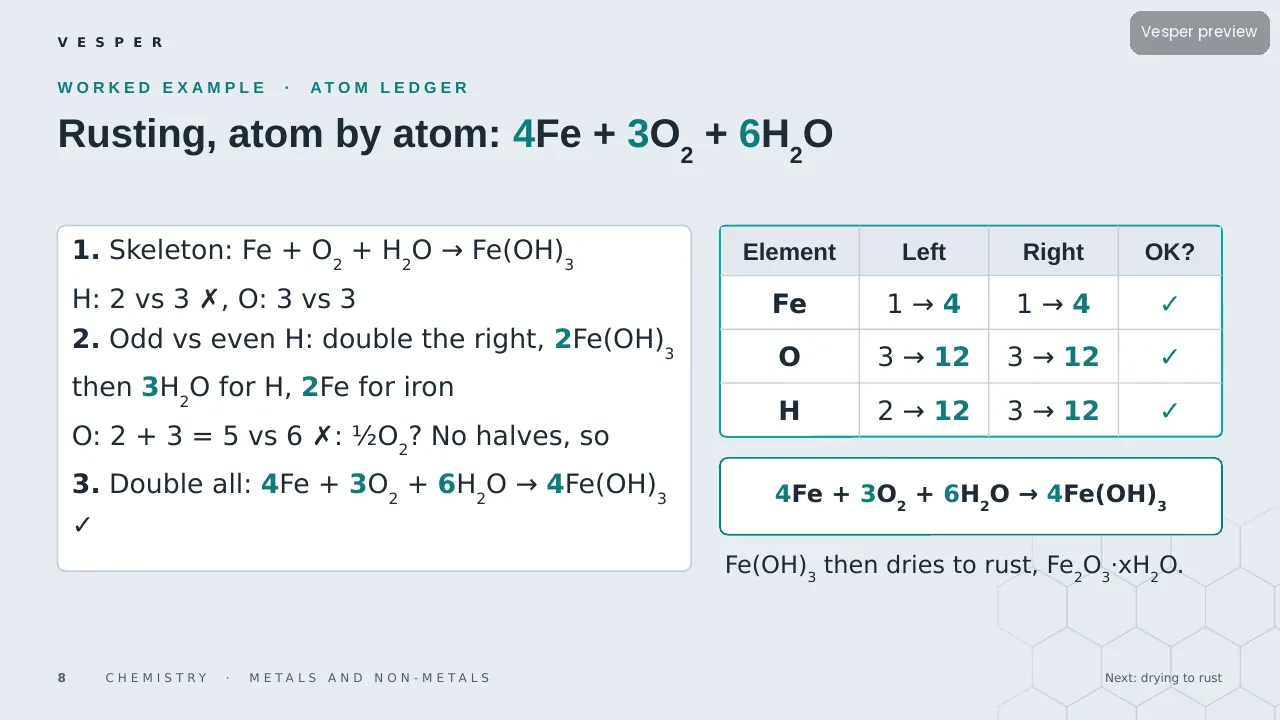
  • Rusting: 4Fe + 3O2 + 6H2O → 4Fe(OH)3
  • Gold's electrode potential is +1.50 V, the tightest hold on electrons
  • Delhi's Iron Pillar has stood about 1,600 years with almost no rust
  • Corrosion costs the world about US$2.5 trillion a year

What students will be able to do

  • Students can state the conditions needed for iron to rust
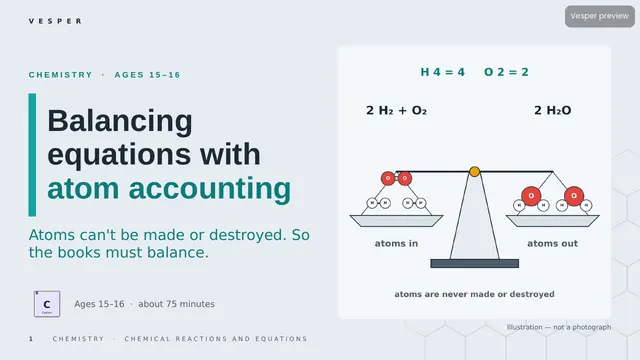
  • Students can balance the rusting equation with an atom count
  • Students can use the reactivity series to explain why gold does not corrode
  • Students can predict displacement reactions from the reactivity series
  • Students can explain how galvanising and sacrificial protection prevent rust

About this lesson

What students discover

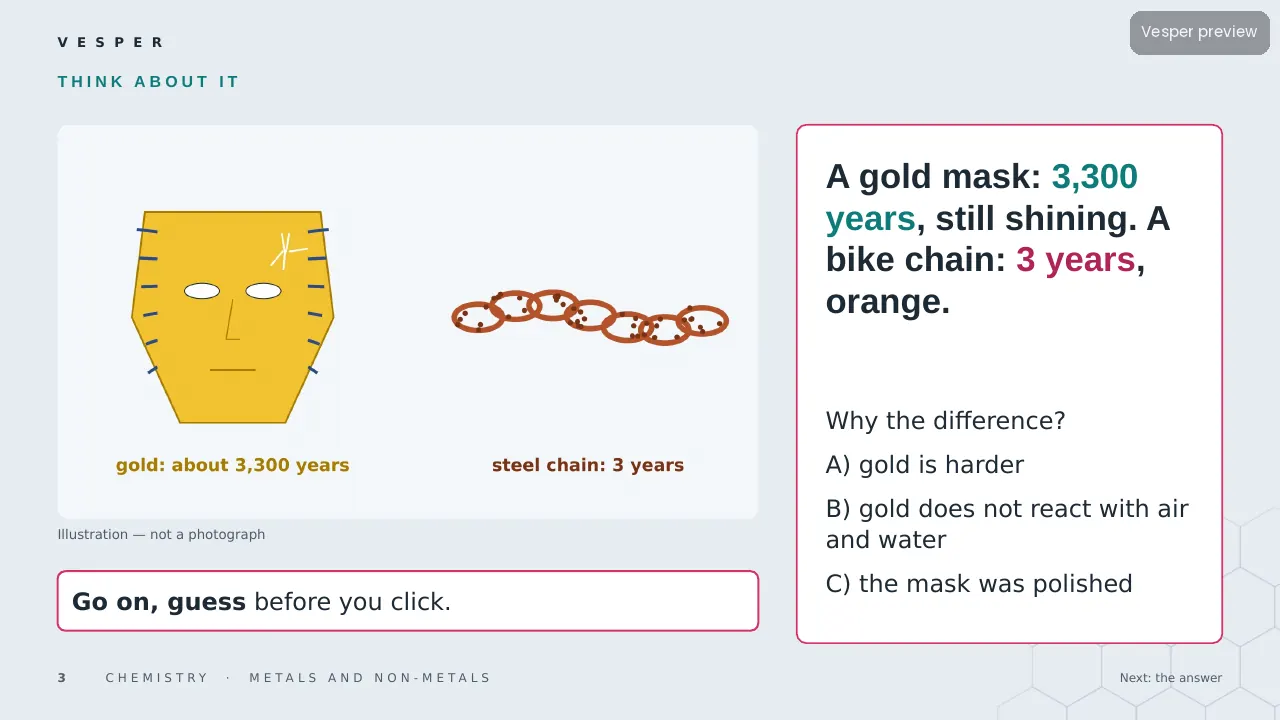
A gold mask comes out of a 3,300-year-old tomb still shining; a bike chain left out for three winters turns orange. The answer is reactivity, not hardness. Students predict the classic four-nail experiment, find that rust needs oxygen and water together (and that salt speeds it up), and balance 4Fe + 3O2 + 6H2O → 4Fe(OH)3 with an atom ledger.

They see rusting as a tiny battery under a water drop, climb the reactivity series, prove it by displacement in copper sulfate and compare electrode potentials. Real stories bring it to life: Delhi’s Iron Pillar, two Nobel medals dissolved in 1940, and a corrosion bill of about US$2.5 trillion a year.

Inside the deck

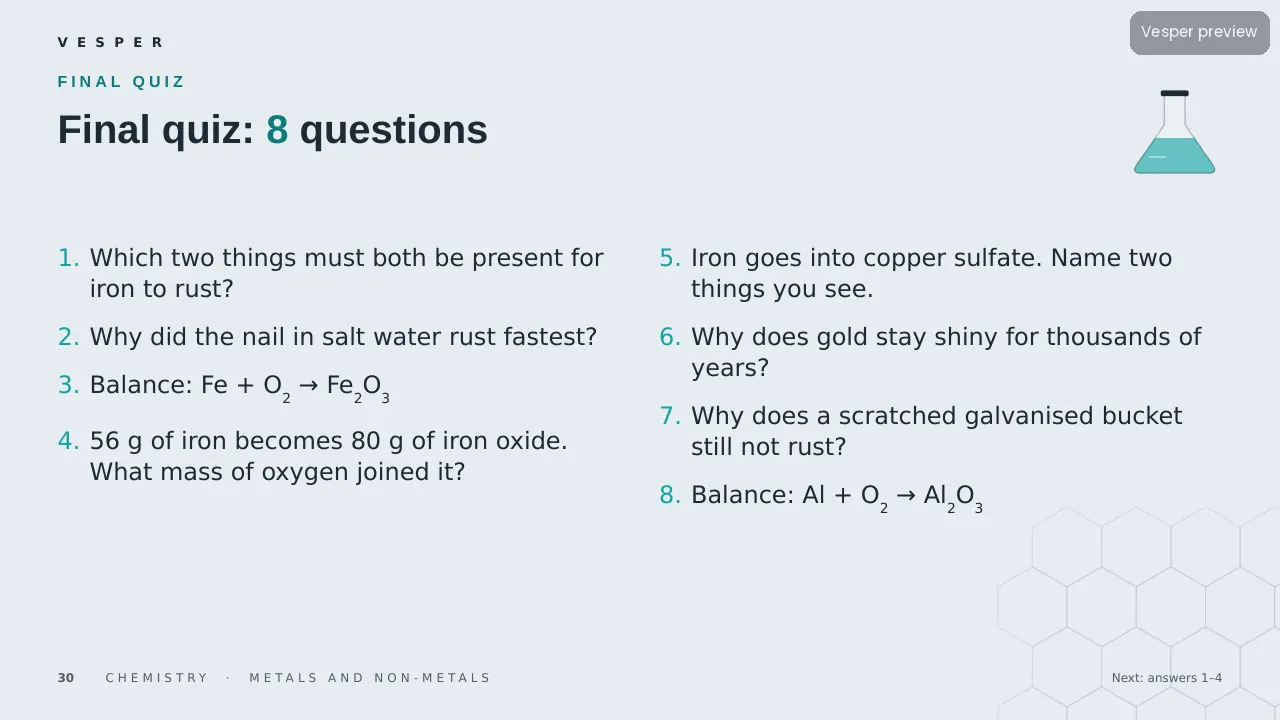
34 slides on the Flask template with worked equations, two your-turn slides, a quick poll (gold ring in copper sulfate), a spot-the-mistake on ‘gold is too hard to rust’, two checkpoints and an 8-question quiz with explained answers. Prevention covers barriers, galvanising and alloys, with a scratch test that zinc passes and tin fails.

How to teach it

Allow about 70 minutes. Set up the safe four-jar rust test from slide 26 a week before the lesson, or show the typical results on slide 27. Ask students to predict the four nails on slide 6 before you reveal anything. Equations were checked by script. Notes on every slide give Say, Ask, Watch for and Time.

Who it’s for

For ages 15–16 studying metals, the reactivity series, displacement and corrosion. The deck is editable, with named layouts for your own slides.
Curriculum & specs

CBSE/NCERT (India)Class 10 · Class 10 Science ch 3 Metals and Non-metals; Class 7 Curiosity ch 4 The World of Metals and Non-metals
CambridgeLS Stage 9 Chemistry (reactivity series); IGCSE 0620 §9.5 Reactivity series; §9.6 Corrosion
NGSS (US)MS-PS1-2; HS-PS1-2
IB MYPSciences · KC Relationships · RC Patterns, Consequences
Ages15–16
LevelSenior
Slide templateFlask
Slides34
Teaching timeAbout 70 minutes
LanguageEnglish (UK)

Questions

Questions, answered

Why does iron rust but gold doesn't?

Iron is reactive and combines with oxygen and water to form rust. Gold is very unreactive, at the bottom of the reactivity series, so it stays shiny for thousands of years.

What does iron need to rust?

Both oxygen and water. The four-nail experiment shows that a nail with only one of them does not rust.

Does salt water make iron rust faster?

Yes. Salt speeds up rusting, which is why cars and ships near the sea rust faster.

Is rust heavier than iron?

Yes. Rust includes oxygen and water from the air, so it weighs more than the iron it came from, and it flakes off.

How does galvanising stop rust?

Zinc coats the iron. Even if it is scratched, the zinc is more reactive and corrodes first, protecting the iron.

Does stainless steel never rust?

It resists rust very well, but 'never' is wrong. The lesson's spot-the-mistake slide deals with this.

Main sources

  1. Wikipedia, "Iron pillar of Delhi" (7.21 m, 41 cm, over 6 t, P about 0.25%, misawite; R. Balasubramaniam, Corrosion Science 2000).
  2. NACE IMPACT study, 2016 (US$2.5 trillion, 3.4% of GDP).
  3. Standard electrode potentials: CRC Handbook values.

The full source list is on the last slides of the deck. Spotted an error? Tell us.