About this lesson
What students discover
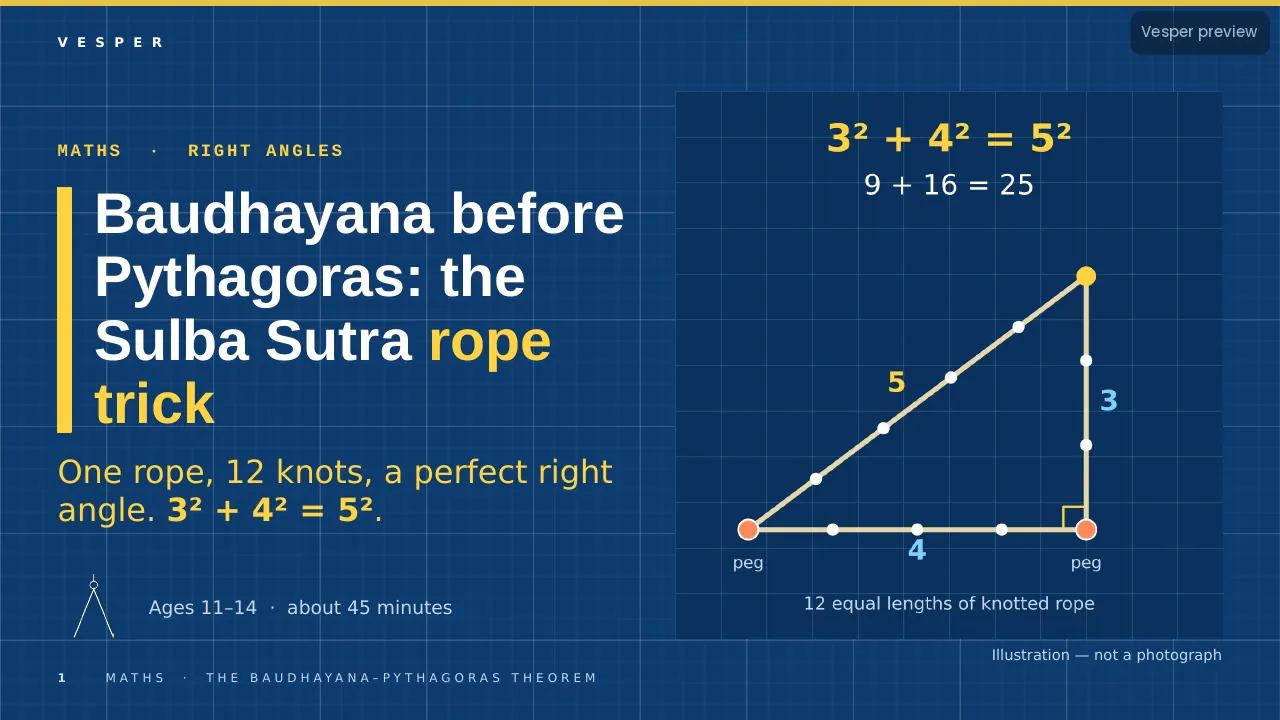
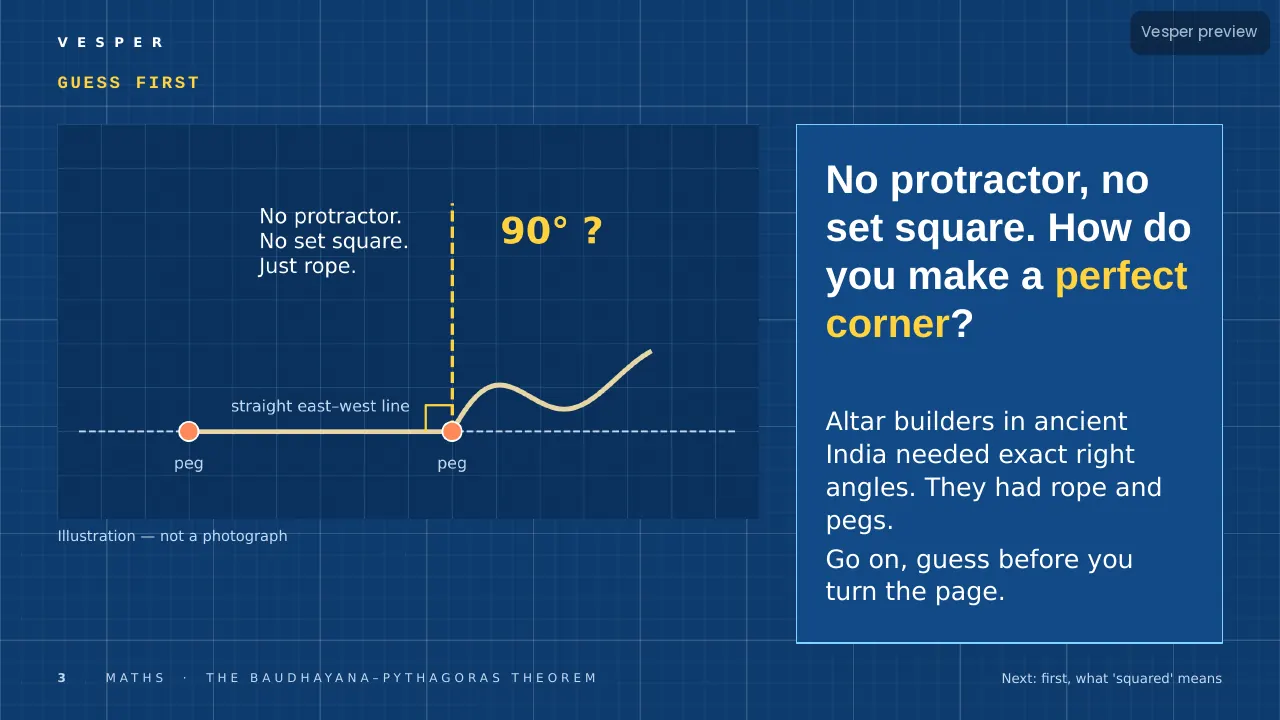
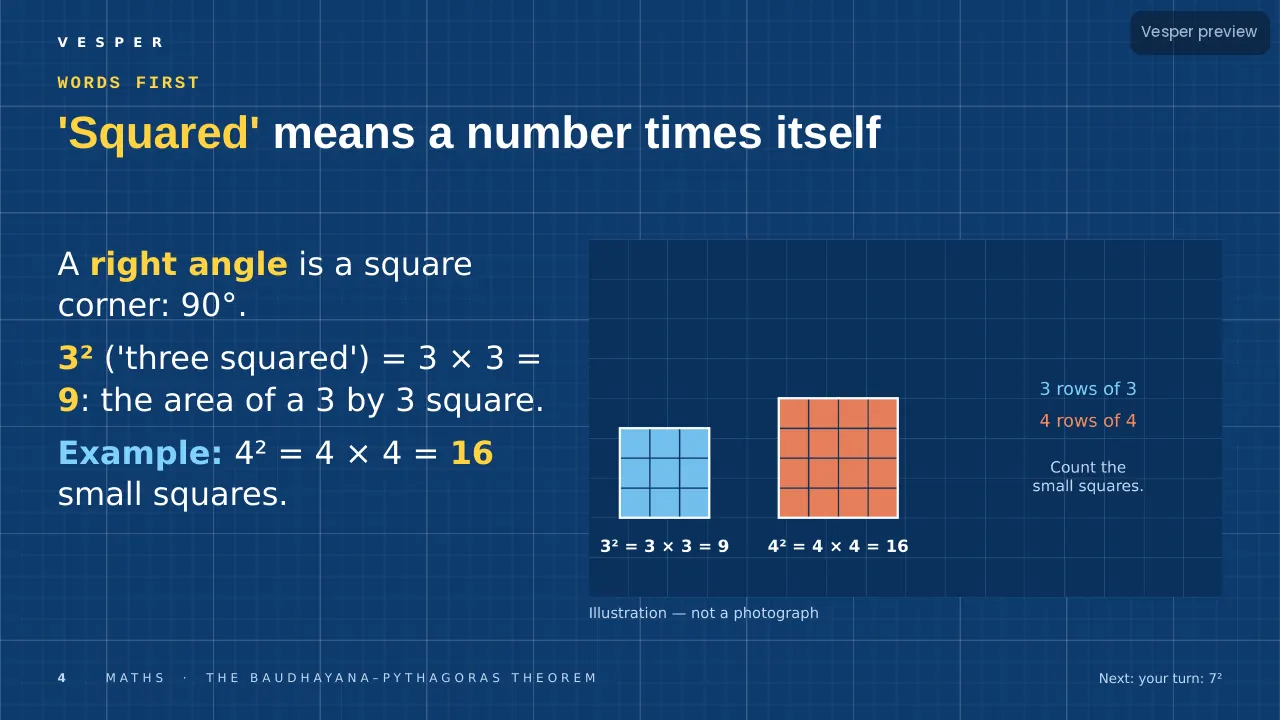
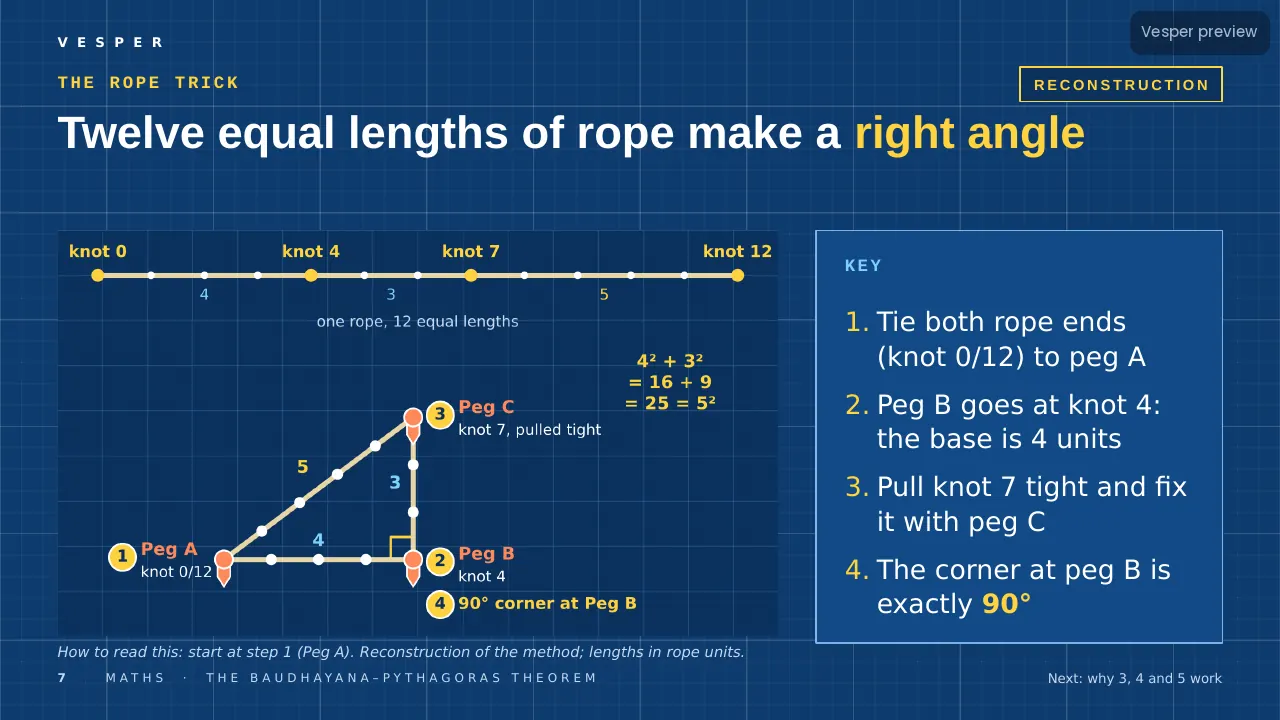
Altar builders in ancient India needed exact right angles and had only rope and pegs. Give a class a rope with 12 equal lengths and they can do the same: pull it into 3, 4 and 5 and the corner is 90°. Then the why. Students draw a square on each side of the triangle and count: 9 + 16 = 25. Longer ropes follow, with 30 lengths for 5-12-13 and 40 for 8-15-17.
Students scale triples (6-8-10, 9-12-15), find a diagonal of a 15 by 36 rectangle straight from Baudhayana’s own list, and find missing sides with square roots. Kwame adds the sides before squaring and gets 7; students find his wrong line. A builder’s check of 0.9 m and 1.2 m along two walls, with a 1.5 m diagonal, brings it into the present day. The Sulba Sutras’ value of √2, correct to five decimal places, is the bet-you-didn’t-know.
Inside the deck
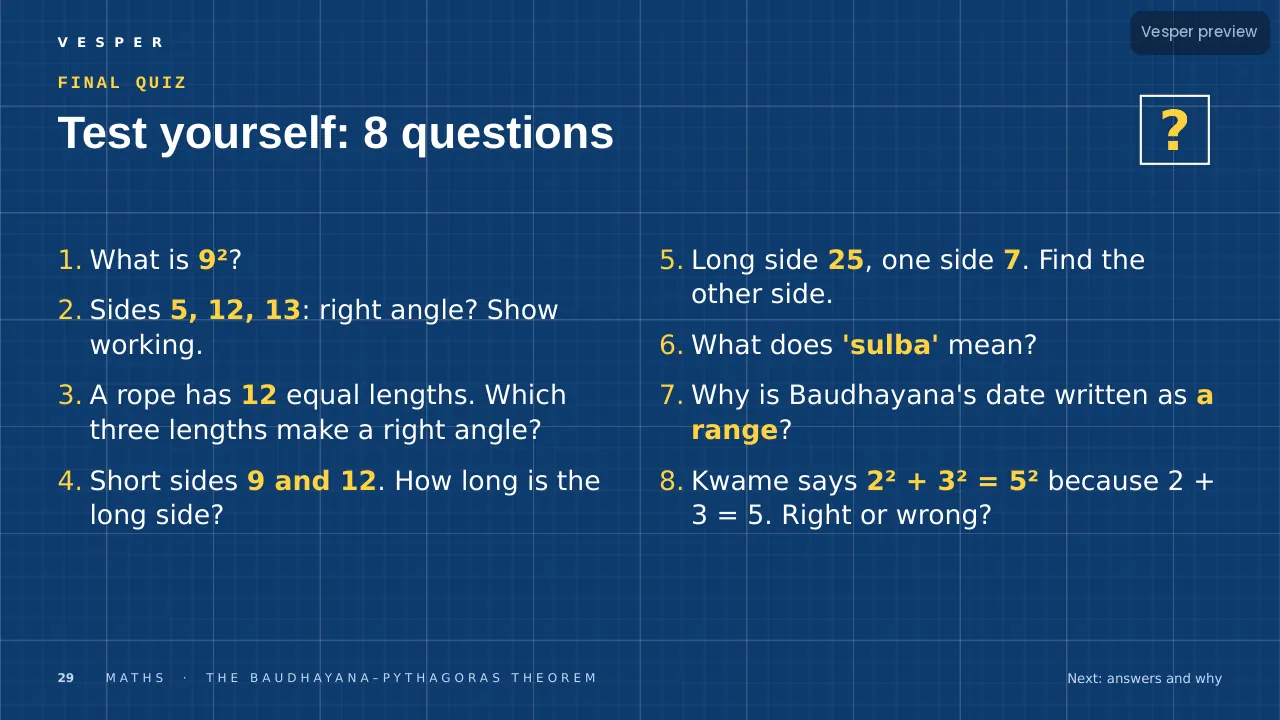
34 slides on the Blueprint template: three diagram walks of the rope method, six your-turn tasks with answers printed upside down, two polls, two checkpoints, an evidence slide on Sutra 1.13’s six rectangles and a myth slide on Pythagoras. The history is careful: a Babylonian tablet (c. 1800 BCE), Baudhayana, Pythagoras and Euclid, with every estimate marked as an estimate. An eight-question quiz has explained answers.
How to teach it
About 45 minutes. Bring string: the home activity uses 120 cm marked every 10 cm, and it works just as well on a classroom table. Speaker notes sit on every slide.
Who it’s for
Learners aged 11–14 meeting the theorem for the first time, and teachers who want the history told accurately, without national point-scoring.