Language Ages 13–16

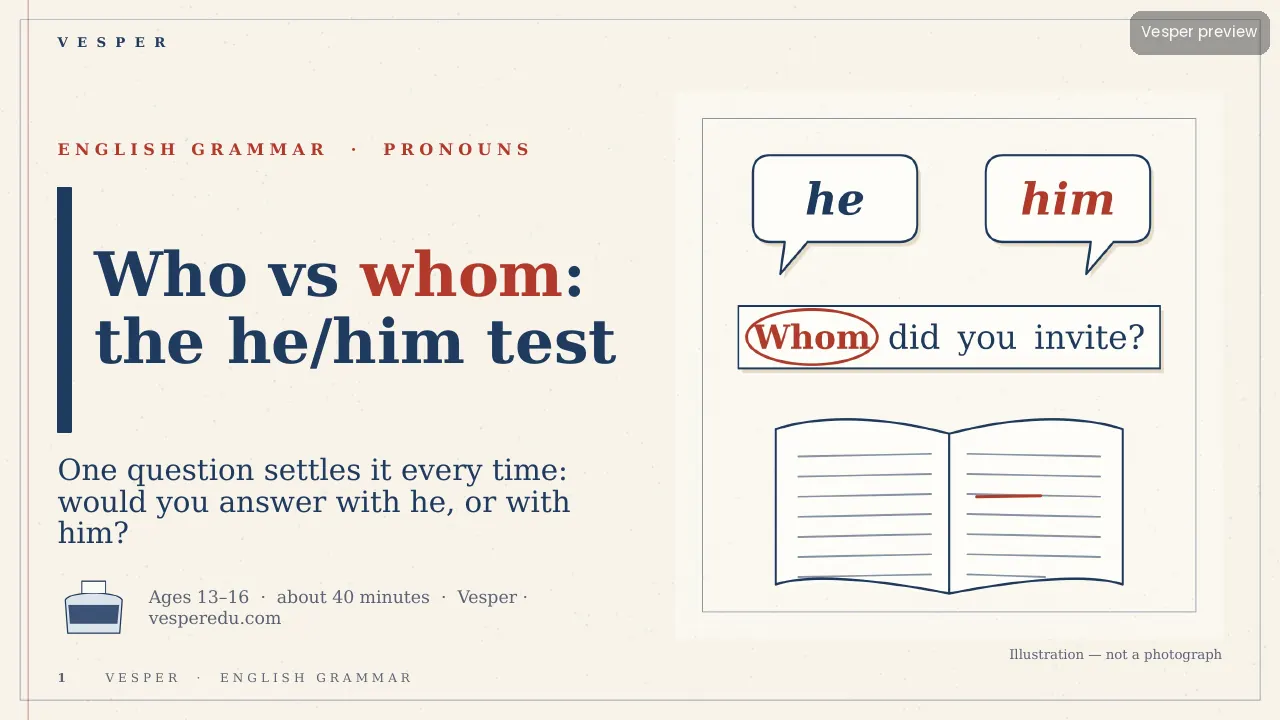
Who vs whom: the he/him test

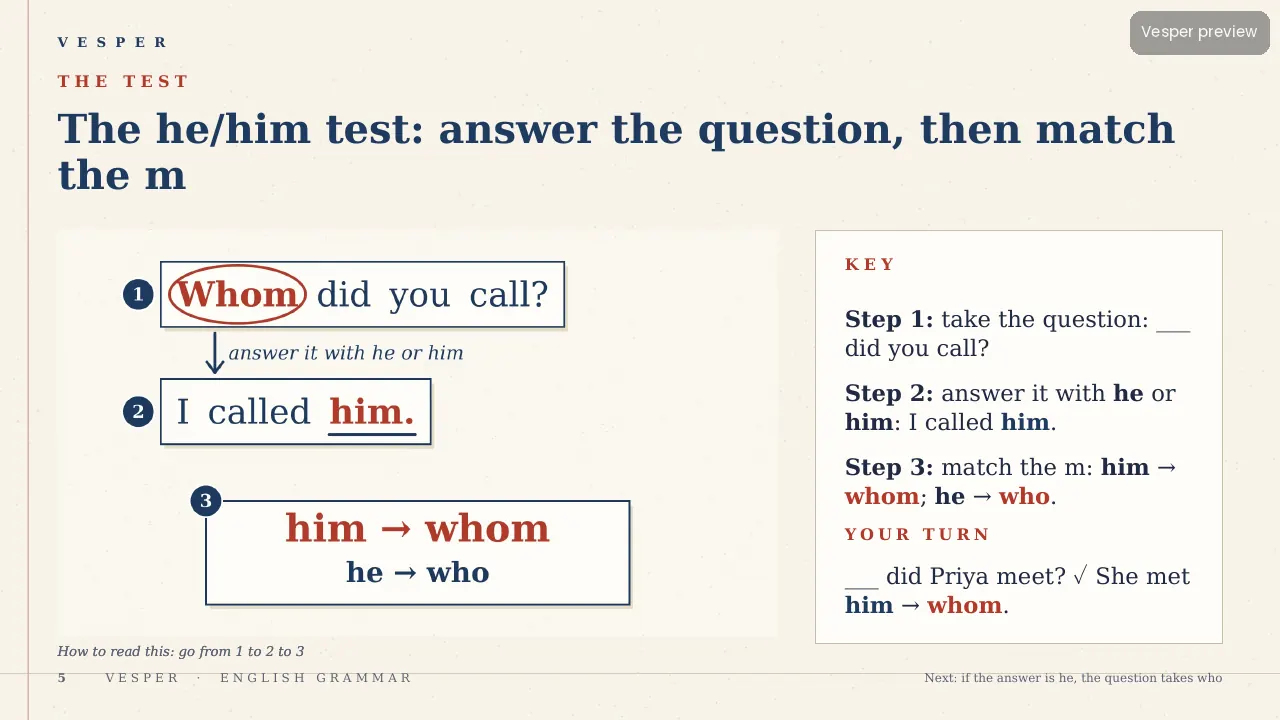
Him and whom both end in m.

A 28-slide lesson that settles who vs whom with one test: answer with he or him, and match the m. Questions, prepositions, relative clauses and the traps that catch adults.

The short answer

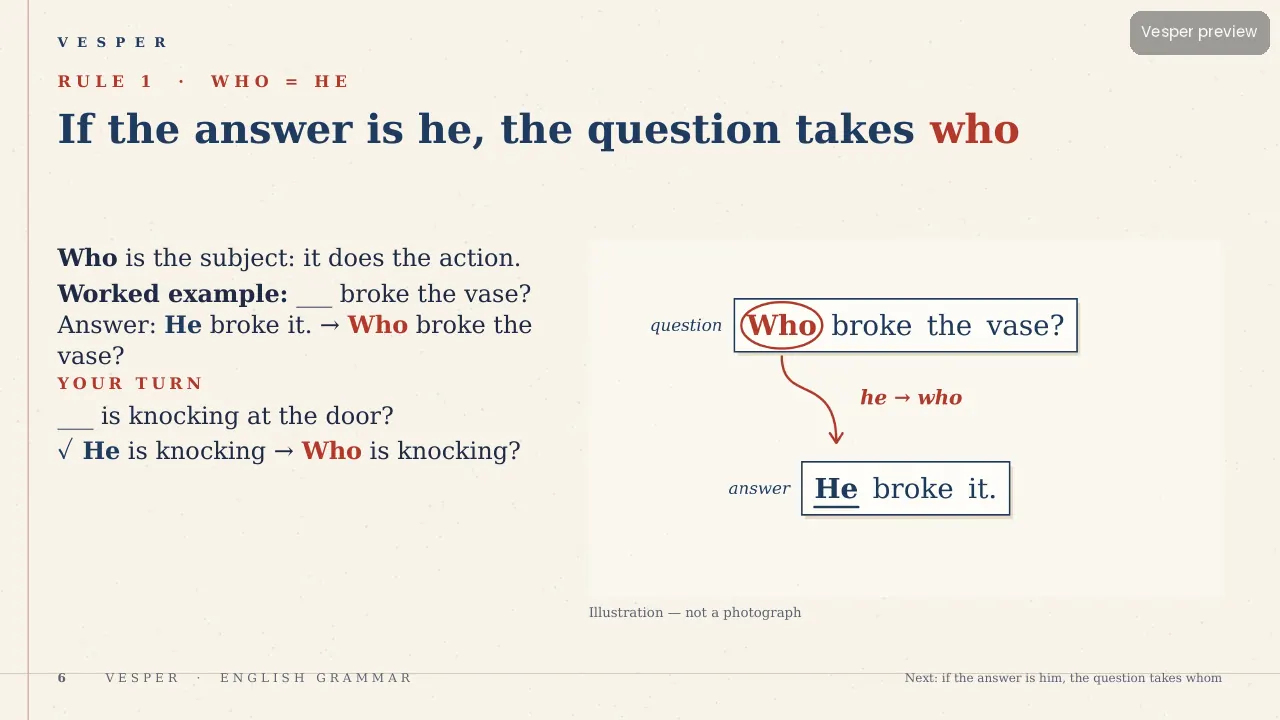
To choose between who and whom, answer the question with he or him. If the answer is he, use who: 'Who broke it? He did.' If it is him, use whom: 'Whom did you invite? I invited him.' Him ends in m, and so does whom. After a preposition, use whom: 'to whom'.

Inside the deck

slides
28
quiz questions
8
minutes
40
your-turn tasks
7

Plenty to extend into a second lesson (about 56 minutes of activities in the notes).

Choose a format

  • Lesson Notes (PDF)Every slide with its teacher notes, as a PDF to read or print.
  • Teacher DeckThe editable PowerPoint with speaker notes on every slide, a PDF copy and the matching Vesper slide template, so you can add slides of your own.
Pricing coming soon

Pricing coming soon

We’ll email you pricing and launch offers shortly.

  • Finished and checked: buying opens soon
  • Sources listed at the end
  • Curriculum links under ‘Curriculum & specs’
  • For one classroom. Campus licences for whole schools

Key facts

  • The test: answer with he → who; answer with him → whom
  • Straight after a preposition, use whom
  • Whom never does the action
  • Cover 'I think' before you test: 'the man who I think is the owner'
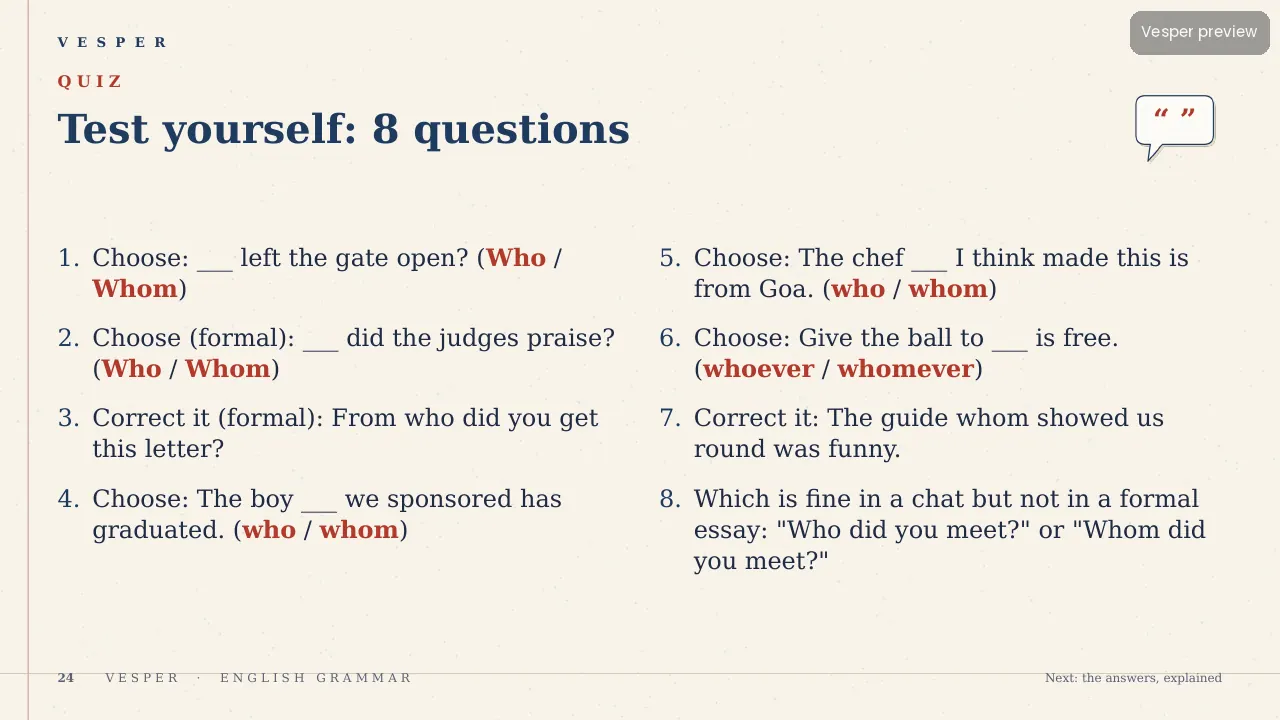
  • 8-question quiz with explained answers

What students will be able to do

  • Students can use the he/him test to choose who or whom
  • Students can use whom after a preposition
  • Students can choose who or whom inside a relative clause
  • Students can handle phrases like 'I think' and 'they say' before testing
  • Students can choose whoever or whomever by testing their own clause

About this lesson

What students discover

Who or whom? One quick test settles it: answer the question with he or him. Him ends in m, and so does whom. Students build that test step by step: in direct questions (who broke it? he did), after prepositions (to whom), and inside relative clauses (the girl whom we met: we met her).

Then come the traps that catch adults, such as ‘the man who I think is the owner’ (cover ‘I think’ before you test) and ‘give it to whoever wins’. Students also learn where whom belongs: formal letters, essays and exams, while who is normal in everyday speech.

Inside the deck

28 slides on the Inkwell template. Every rule has a worked example, a your-turn question with its answer, a red-ink wrong/right pair and a spot-the-mistake task. Two checkpoints, a register poll, a formal email with three who/whom mistakes to correct, an 8-question quiz with explained answers and a summary card. Every example sentence is original.

How to teach it

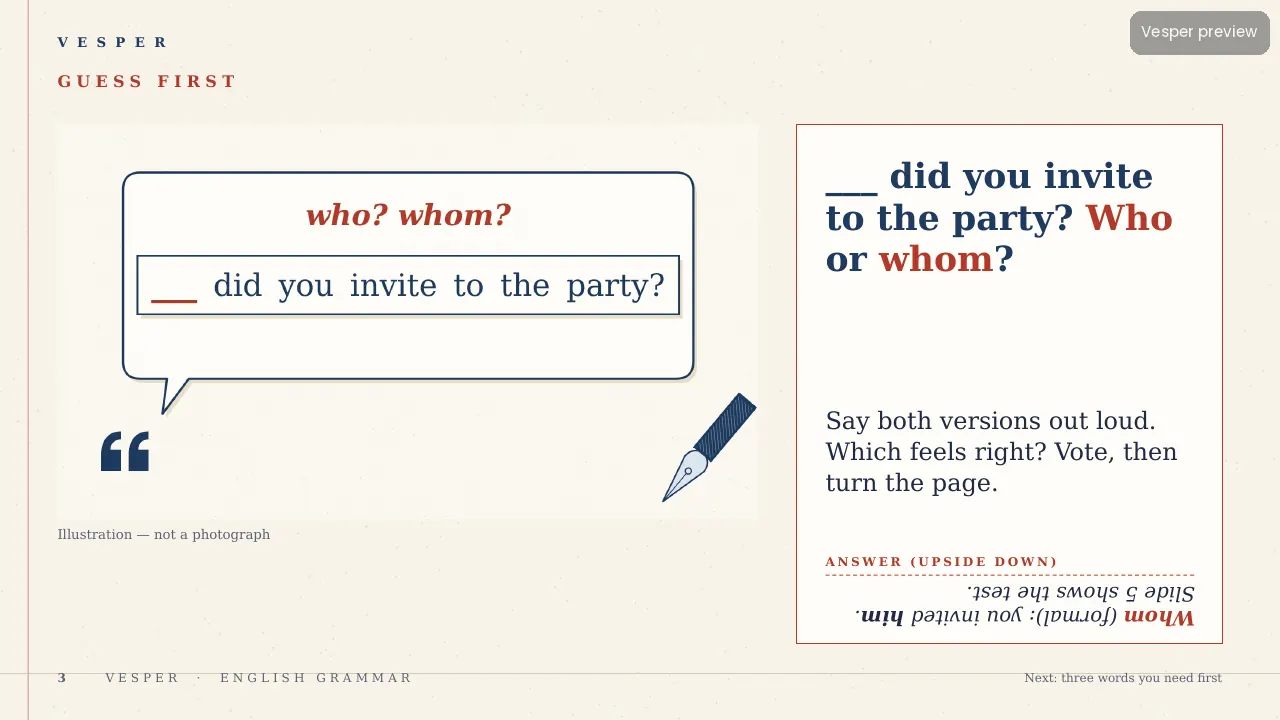
Allow about 40 minutes. Use the party question on slide 3 as a vote, and come back to it after slide 7. Practise the he/him test aloud: students answer each question before choosing. The formal email on slide 21 works well in pairs. Notes on every slide give Say, Ask, Watch for and Time.

Who it’s for

For ages 13–16 working on pronouns, relative clauses and formal writing, and for adults who have never been quite sure. The PowerPoint is editable, with named layouts, so you can add your own formal letter to correct.
Curriculum & specs

CBSE/NCERT (India)Class 8-10 · CBSE English grammar (pronouns; enrichment)
CambridgeLS English Wg
IB MYPLanguage & Literature · KC Communication · Crit D
Common Core (US)L.4.1a; L.6.1a
Ages13–16
LevelSenior
Slide templateInkwell
Slides28
Teaching timeAbout 40 minutes
LanguageEnglish (UK)

Questions

Questions, answered

When should I use whom instead of who?

Use whom when the answer would be him or her: 'Whom did you call? I called him.' Use who when the answer would be he or she.

Is it 'to who' or 'to whom'?

To whom. Straight after a preposition, whom is correct in formal English.

Is it 'whoever' or 'whomever' after 'to'?

Test the clause on its own. In 'Give it to whoever wins', whoever is the subject of wins, so it stays whoever.

Is it 'who I think is' or 'whom I think is'?

Who. Cover 'I think' and test: 'who is the owner? He is.'

Is whom still used?

Yes, in formal writing, letters, essays and exams. In everyday speech who is normal.

What age is this grammar lesson for?

Ages 13–16. It takes about 40 minutes and ends with an 8-question quiz.

Main sources

  1. Wren, P. C. and Martin, H. High School English Grammar and Composition. S. Chand (revised edition by N. D. V. Prasada Rao). Chapters on pronouns (case) and relative pronouns. Used for the order of topics only.
  2. Swan, M. (2016). Practical English Usage, 4th edition. Oxford University Press. Entries on who and whom, relative pronouns and whoever. Used for the rules and for whom as a formal form.
  3. Cambridge Dictionary (2026). English Grammar Today: "Who, whom". dictionary.cambridge.org/grammar/british-grammar. Cited by title.

The full source list is on the last slides of the deck. Spotted an error? Tell us.