About this lesson
What students discover
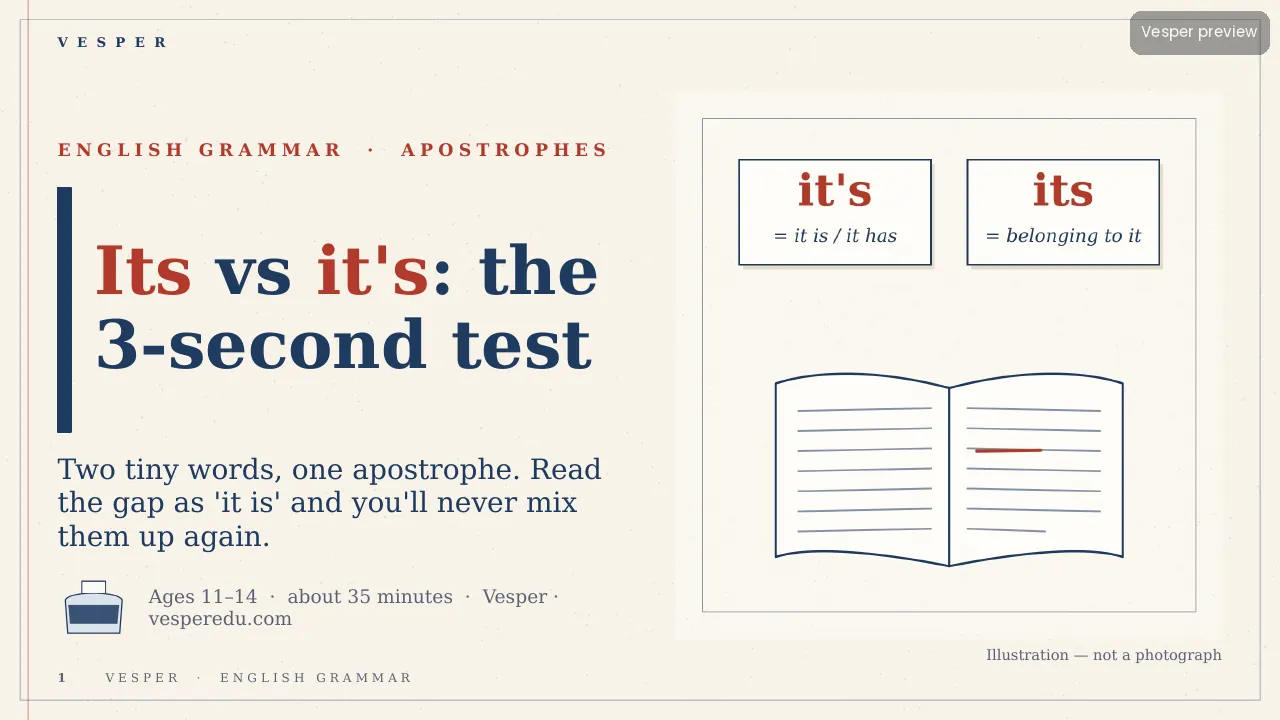
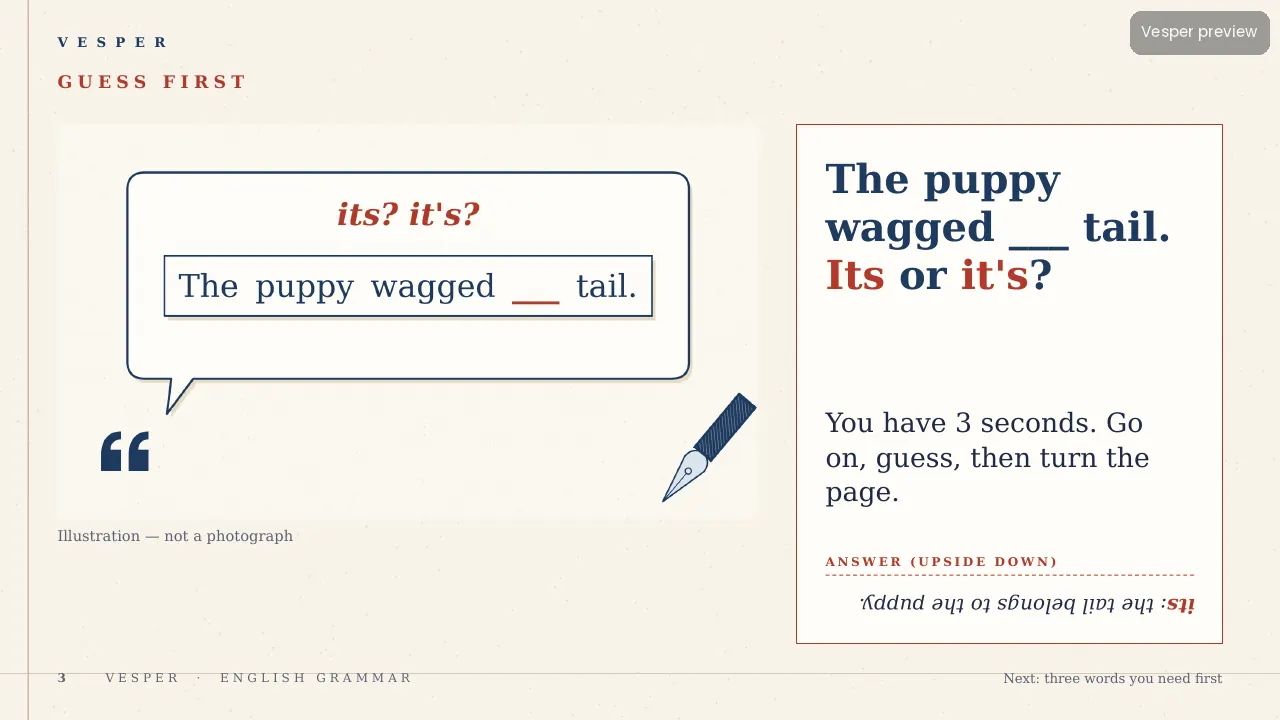
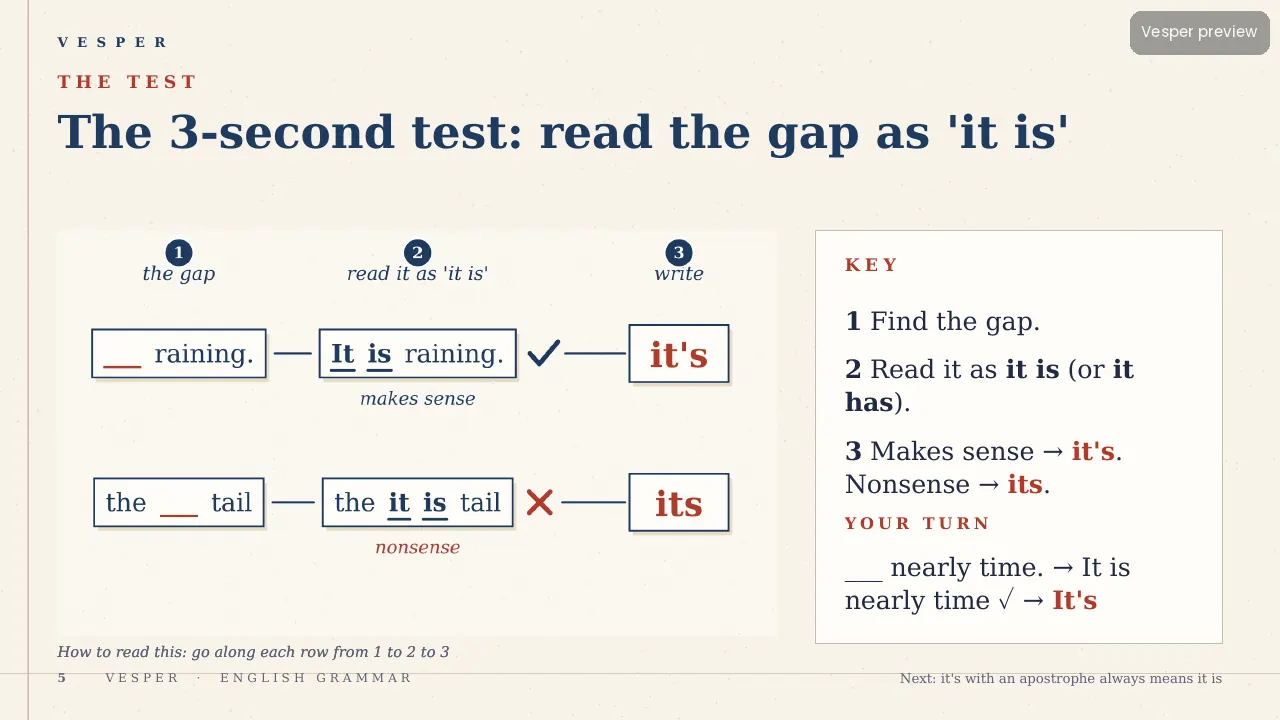
The puppy wagged ___ tail: its or it’s? One test settles it in three seconds. Read the gap as ‘it is’ (or ‘it has’). If the sentence still makes sense, write it’s. If it turns into nonsense (‘the puppy wagged it is tail’), write its. The lesson builds that test step by step, including the ‘it has’ meaning before been or got (‘It’s been raining all week’).
Then it explains why its has no apostrophe: it belongs with his, her and their, the belonging words that never take one. Students kill the non-word its’ for good, and a myth slide fixes ‘an apostrophe always shows belonging’. A bet-you-didn’t-know slide shows that writers around 1600 did spell the belonging form it’s, and why the rule changed. Some sentences need both (‘It’s a pity the shop lost its sign’), so students learn to test each gap separately.
Inside the deck
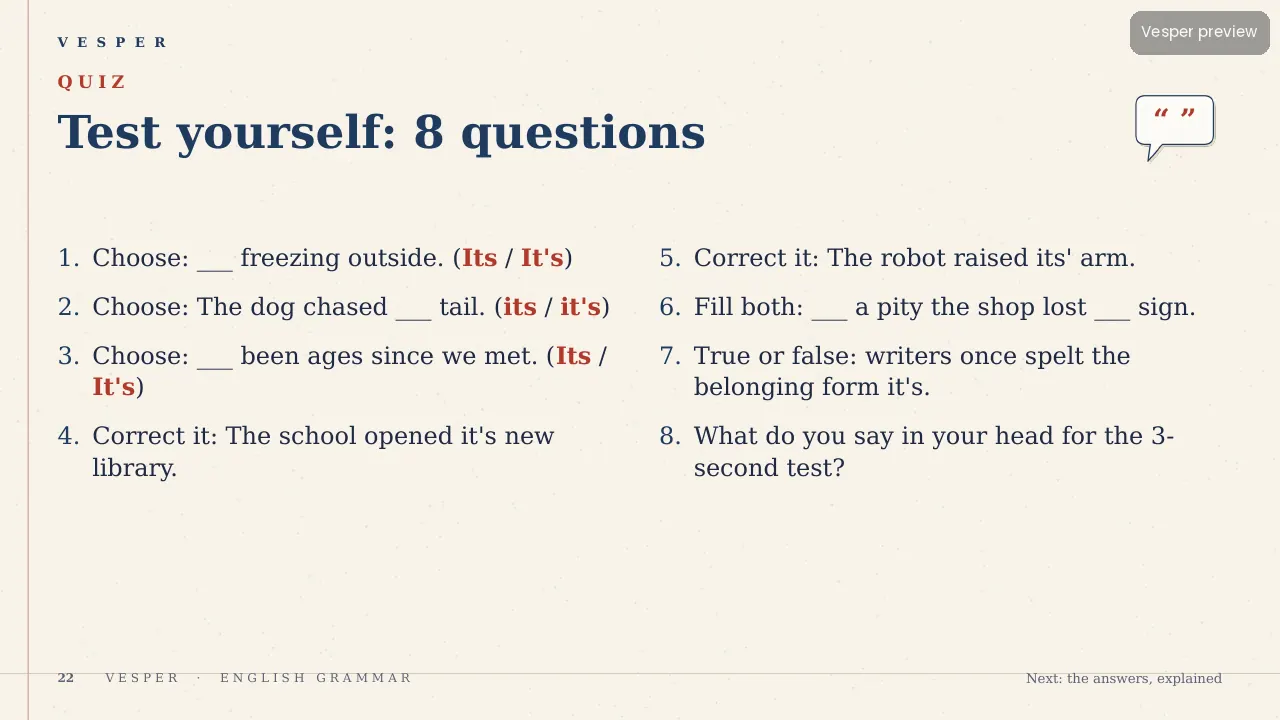
26 slides on the Inkwell template: a guess-first poll, a three-word primer, a diagram walk of the test, four your-turn tasks with answers, red-ink wrong/right pairs, two checkpoints and a quick poll. Students correct a made-up café sign and find three mistakes in a note. An eight-question quiz has explained answers, and every example sentence is original.
How to teach it
About 35 minutes. Have students say the test aloud on every example; the habit is the point. The one-card summary works as a bookmark or desk card. Speaker notes sit on every slide.
Who it’s for
Learners aged 11–14, and anyone who has ever paused over a shop sign. It works as a quick lesson on its own or as a starter before a longer piece of writing.