Language Ages 12–15

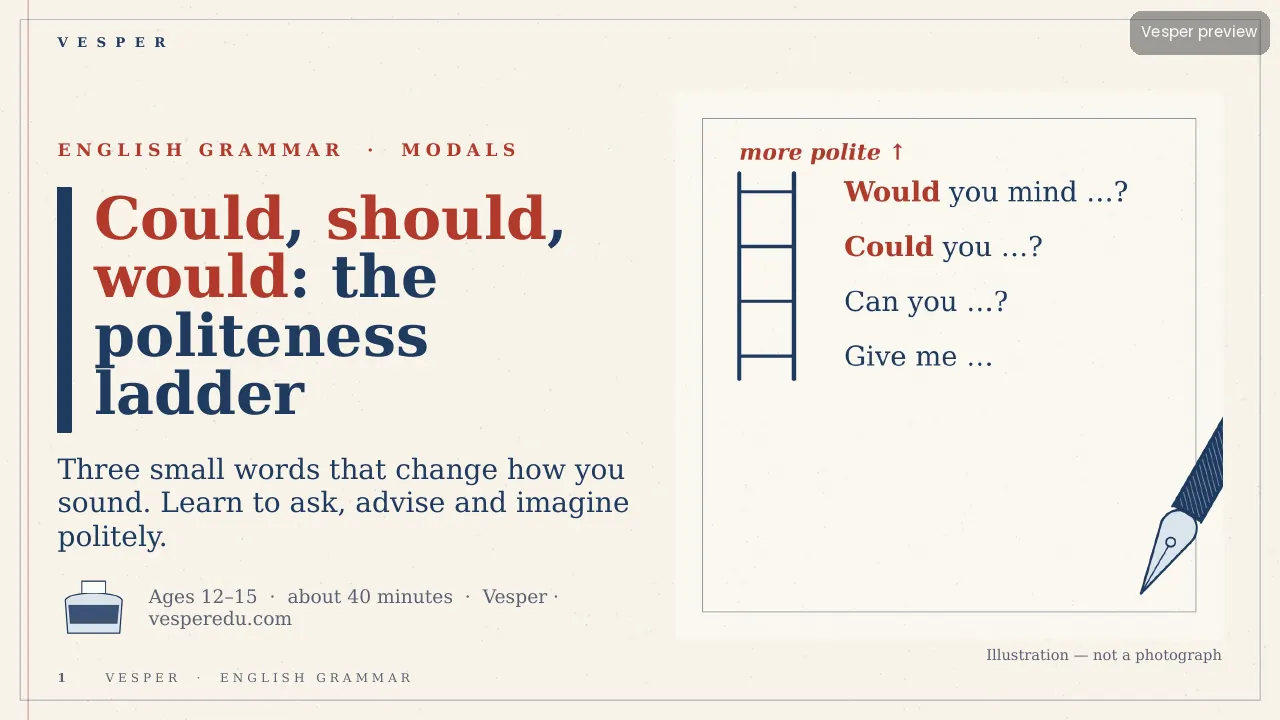
Could, should, would: the politeness ladder

Three small words that change how you sound to a head teacher.

A 27-slide lesson on could, should and would: polite requests, advice and imagined situations. Students fix ‘could you to help’ and ‘would you mind to wait’ along the way.

The short answer

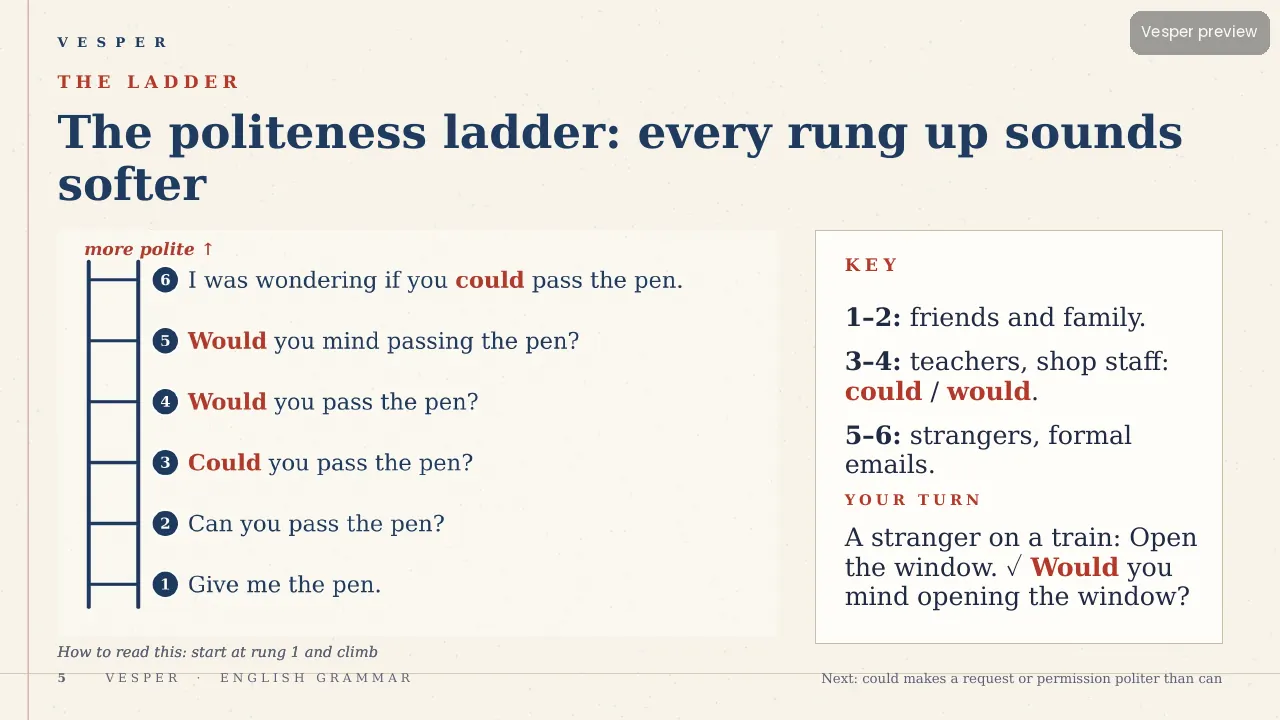
Use could and would to make requests politer: 'Could you help?' is softer than 'Can you help?', and 'Would you mind waiting?' is softer still. Use should for advice, weaker than must and stronger than could. Use would for imagined situations: 'If I had wings, I would fly.' Each modal takes the base verb, with no 'to'.

Inside the deck

slides
27
quiz questions
8
minutes
40
your-turn tasks
6

Choose a format

  • Lesson Notes (PDF)Every slide with its teacher notes, as a PDF to read or print.
  • Teacher DeckThe editable PowerPoint with speaker notes on every slide, a PDF copy and the matching Vesper slide template, so you can add slides of your own.
Pricing coming soon

Pricing coming soon

We’ll email you pricing and launch offers shortly.

  • Finished and checked: buying opens soon
  • Sources listed at the end
  • Curriculum links under ‘Curriculum & specs’
  • For one classroom. Campus licences for whole schools

Key facts

  • The ladder: give me → can you → could you → would you → would you mind …-ing?
  • After a modal, use the base verb: 'Could you lend', not 'Could you to lend'.
  • After 'mind', use -ing: 'Would you mind repeating that?'
  • Must is a rule, should is advice, could is an option.
  • No would in the if-part: 'If I were taller, I would play basketball.'

What students will be able to do

  • Students can order requests on the politeness ladder from 'give me' to 'would you mind …-ing?'.
  • Students can use the base verb after could, should and would, and -ing after 'would you mind'.
  • Students can give advice with should and compare it with must and could.
  • Students can use would for offers and imagined situations, keeping it out of the if-part.
  • Students can rewrite a blunt message for a formal reader.

About this lesson

What students discover

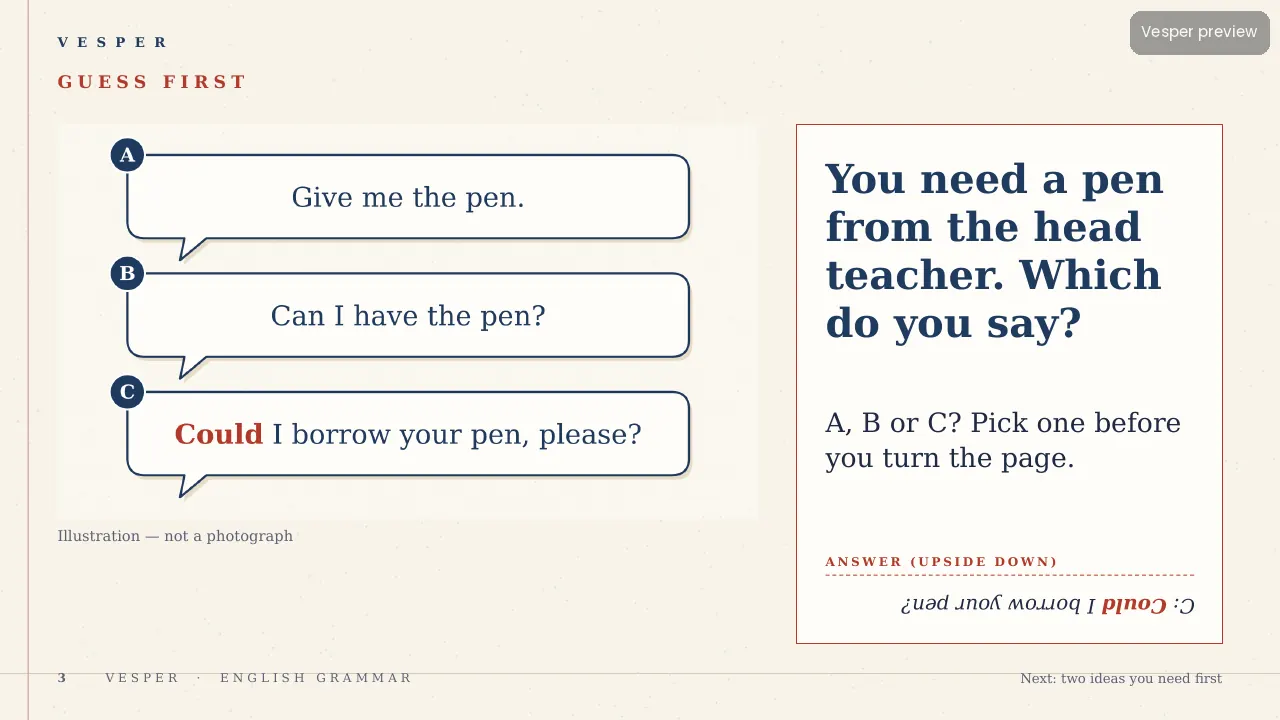
You need a pen from the head teacher. ‘Give me a pen’, ‘Can you give me a pen?’ or ‘Could I borrow a pen, please?’ Every step up the politeness ladder makes a request softer. Students climb a numbered six-rung ladder, from ‘give me’ to ‘would you mind …-ing?’, and learn when to climb: a stranger, a head teacher, a formal email.

Then the lesson separates three modals that learners mix up. Could and would make polite requests and offers. Should gives advice, and sits on a strength scale between must (a rule) and could (an option). Would also imagines: ‘If I had wings, I would fly.’ The classic errors get fixed in red ink: ‘could you to help’, ‘would you mind to wait’, ‘he shoulds practise’ and ‘if I would know’. A bet-you-didn’t-know explains why could and would sound polite: they look like the past, which puts a little distance into the request.

Inside the deck

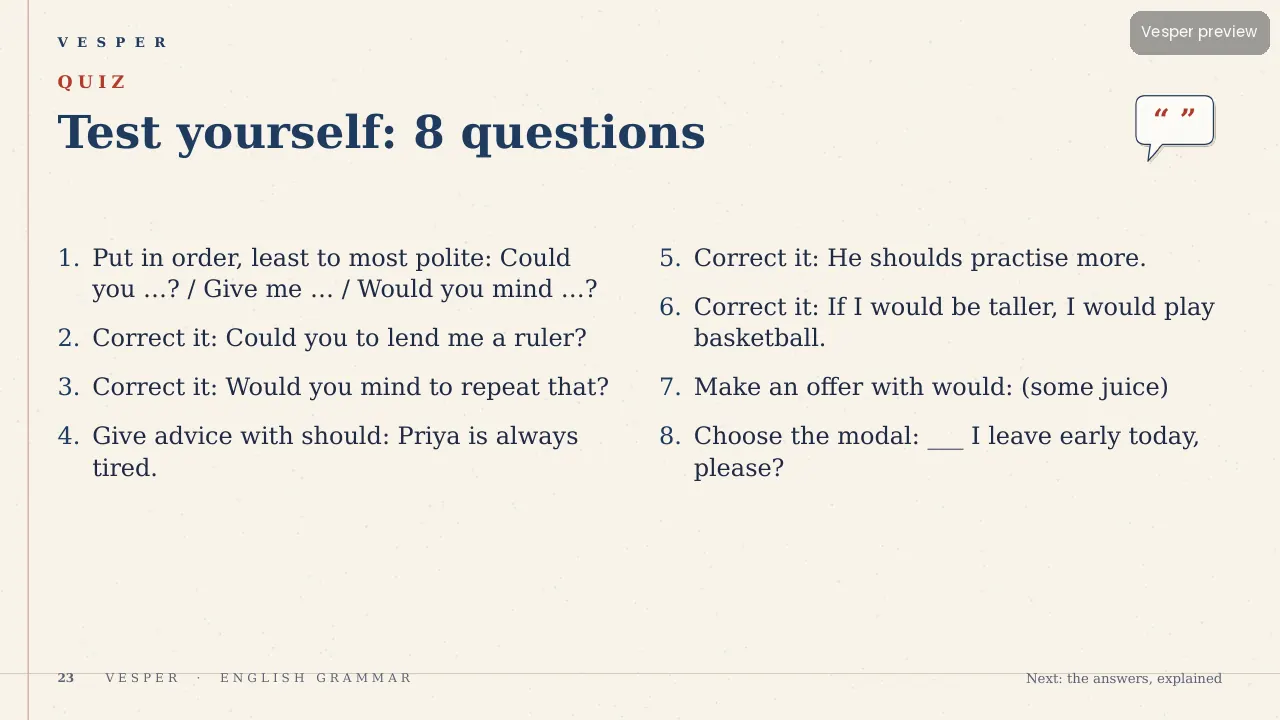
27 slides on the Inkwell template: a guess-first poll, a two-idea primer, a diagram walk of the ladder, six your-turn tasks with answers, wrong/right pairs, two checkpoints and a quick poll matching each modal to its job. Students rewrite a blunt email to a school office and find three modal mistakes in a message. An eight-question quiz has explained answers.

How to teach it

About 40 minutes. Role-play works well: give pairs a situation card and a rung number, and let the class guess who they were talking to. Speaker notes sit on every slide.

Who it’s for

Learners aged 12–15, including those learning English as an additional language, and teachers who want modals taught through how they sound, not a list of rules.
Curriculum & specs

CBSE/NCERT (India)Class 7-9 · CBSE English grammar (modals)
CambridgeLS English Wg; Speaking and listening (register)
IB MYPLanguage & Literature · KC Communication · RC Audience imperatives
Ages12–15
LevelMiddle
Slide templateInkwell
Slides27
Teaching timeAbout 40 minutes
LanguageEnglish (UK)

Questions

Questions, answered

What is the difference between can and could in requests?

Both ask for something, but 'Could you …?' is politer. Use it with teachers, strangers and in formal emails.

Is it 'would you mind to' or 'would you mind -ing'?

Always -ing: 'Would you mind closing the door?' 'Would you mind to close' is wrong.

When do you use should?

For advice: 'You should get more sleep.' It is weaker than must, which states a rule.

Can you use would in an if-clause?

Not in the if-part of an imagined situation. Say 'If I knew, I would tell you', not 'If I would know'.

Why do could and would sound more polite?

They look like past forms, and that small distance from the present makes a request feel softer.

What age is this modals lesson for?

Ages 12–15. It takes about 40 minutes and ends with an eight-question quiz.

Main sources

  1. Wren, P. C. and Martin, H. High School English Grammar and Composition. S. Chand (revised edition by N. D. V. Prasada Rao). Chapters on auxiliaries and modals. Used for the order of topics only.
  2. Swan, M. (2016). Practical English Usage, 4th edition. Oxford University Press. Entries on modal verbs, requests, should, would, if-sentences and distancing (slide 18).

The full source list is on the last slides of the deck. Spotted an error? Tell us.