Language Ages 13–16

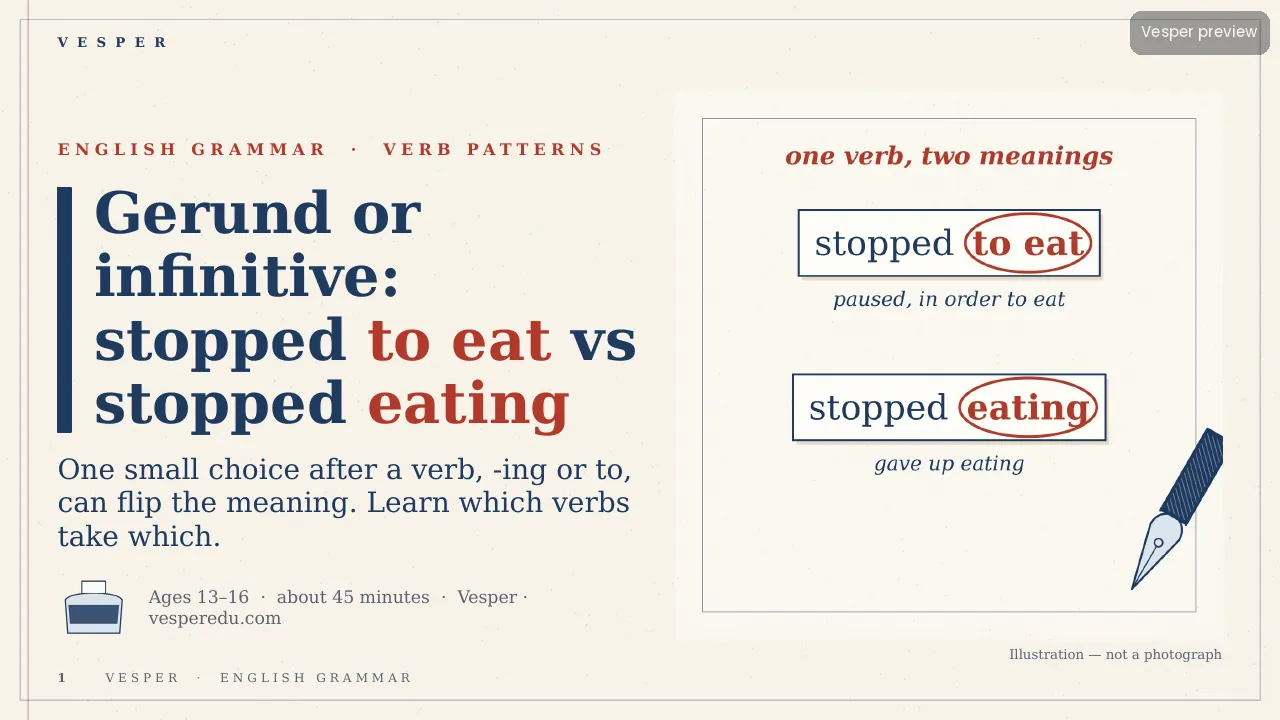
Gerund or infinitive: stopped to eat vs stopped eating

To points forward. -ing looks back.

A 29-slide lesson on -ing or to + verb: which verbs take which, and the five verbs whose meaning flips. Students sort three verb groups and fix ‘I look forward to see you’.

The short answer

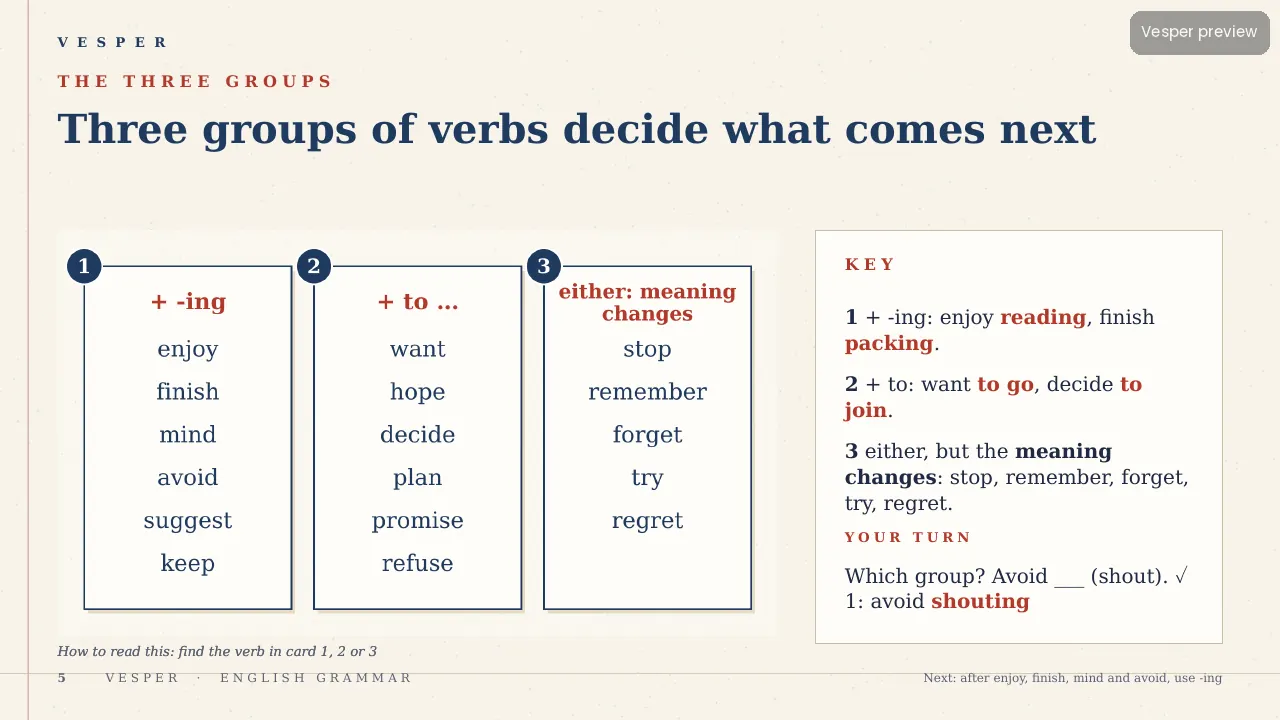
Some verbs take the -ing form (enjoy, finish, mind, avoid), some take to + verb (want, hope, decide, plan), and after a preposition it is always -ing, even in 'look forward to seeing'. Five verbs take both and change meaning: stop, remember, forget, try and regret. 'Stopped to eat' means paused to eat; 'stopped eating' means quit.

Inside the deck

slides
29
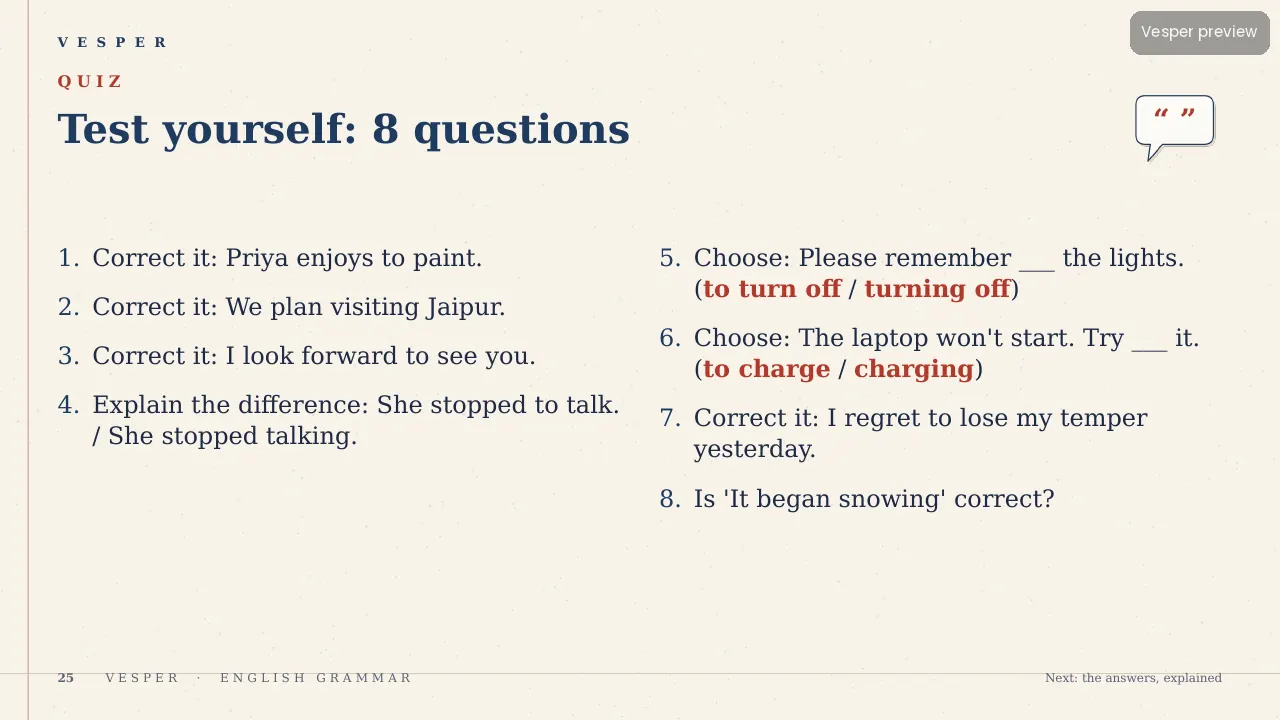
quiz questions
8
minutes
45
your-turn tasks
8

Choose a format

  • Lesson Notes (PDF)Every slide with its teacher notes, as a PDF to read or print.
  • Teacher DeckThe editable PowerPoint with speaker notes on every slide, a PDF copy and the matching Vesper slide template, so you can add slides of your own.
Pricing coming soon

Pricing coming soon

We’ll email you pricing and launch offers shortly.

  • Finished and checked: buying opens soon
  • Sources listed at the end
  • Curriculum links under ‘Curriculum & specs’
  • For one classroom. Campus licences for whole schools

Key facts

  • Enjoy, finish, mind and avoid take -ing: 'I enjoy reading comics.'
  • Want, hope, decide and plan take to + verb: 'She decided to go by train.'
  • After a preposition, always -ing: 'I look forward to seeing you.'
  • Stop to do = pause in order to do; stop doing = no longer do.
  • Remember to = a job to do; remember -ing = a memory.

What students will be able to do

  • Students can choose -ing after verbs such as enjoy, finish, mind and avoid.
  • Students can choose to + verb after verbs such as want, hope, decide and plan.
  • Students can use -ing after prepositions, including 'look forward to'.
  • Students can explain how stop, remember, forget, try and regret change meaning with -ing or to.

About this lesson

What students discover

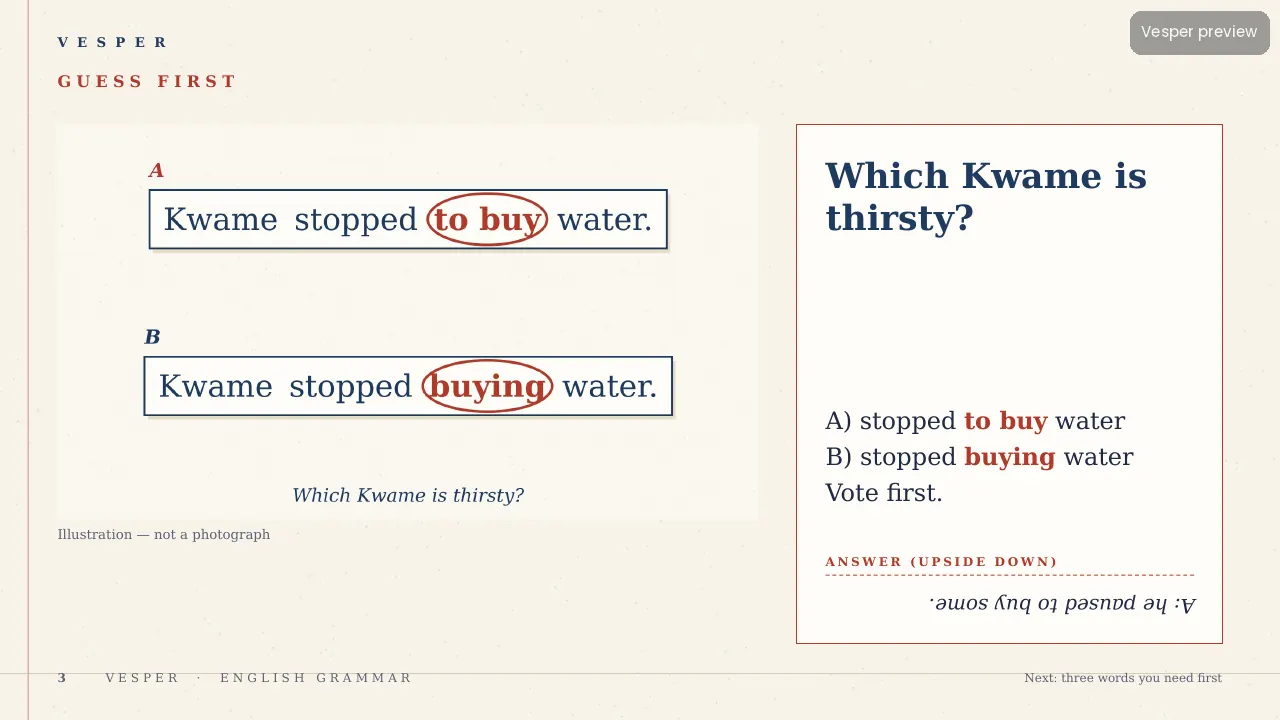
Kwame stopped to buy water. Kwame stopped buying water. One is thirsty; one has given something up. This lesson sorts the -ing form (the gerund) and to + verb (the infinitive) into three groups. Verbs such as enjoy, finish, mind and avoid take -ing. Verbs such as want, hope, decide and plan take to. Then there are verbs that take both with a change of meaning.

Students learn the preposition rule (always -ing, even after ‘look forward to’) and fix ‘I look forward to see you’. The five meaning-flippers get one slide each, pictured on a timeline: stop to (pause in order to) against stop -ing (quit); remember and forget to (a job still to do) against -ing (a memory); try to (make an effort) against try -ing (test and see); and regret, where ‘I regret to lose my temper yesterday’ gets corrected. A bet-you-didn’t-know shows that like, love, hate, prefer and begin take both with almost no change, and signs such as ‘NO SWIMMING’ show a gerund working as a noun.

Inside the deck

29 slides on the Inkwell template: a guess-first poll (‘which Kwame is thirsty?’), a three-word primer, a diagram walk of the three verb groups, eight your-turn tasks with answers, red-ink wrong/right pairs, two checkpoints and a club email with three mistakes to find. An eight-question quiz has explained answers. The verb lists are a teaching selection, and every example sentence is original.

How to teach it

About 45 minutes. Draw the stop timeline on the board early; students return to it for remember, forget and try. Speaker notes sit on every slide.

Who it’s for

Learners aged 13–16, including advanced learners of English, and teachers who want a memorable rule for a pattern most grammar books leave as a list.
Curriculum & specs

CBSE/NCERT (India)Class 8-10 · CBSE English grammar (non-finites; enrichment)
CambridgeLS English Wg
IB MYPLanguage & Literature · KC Communication · Crit D
Ages13–16
LevelSenior
Slide templateInkwell
Slides29
Teaching timeAbout 45 minutes
LanguageEnglish (UK)

Questions

Questions, answered

What is the difference between a gerund and an infinitive?

A gerund is a verb + -ing used like a noun ('Swimming is fun'). An infinitive is to + the base verb ('to swim').

What is the difference between 'stop to do' and 'stop doing'?

'Stopped to eat' means paused in order to eat. 'Stopped eating' means no longer ate.

Is it 'look forward to see' or 'look forward to seeing'?

'Look forward to seeing'. Here 'to' is a preposition, and prepositions are followed by -ing.

Which verbs are followed by -ing?

Common ones include enjoy, finish, mind and avoid: 'Would you mind waiting?'

What is the difference between 'remember to' and 'remember -ing'?

'Remember to lock the door' is a job still to do. 'I remember visiting Goa' is a memory.

What age is this grammar lesson for?

Ages 13–16. It takes about 45 minutes and ends with an eight-question quiz.

Main sources

  1. Wren, P. C. and Martin, H. High School English Grammar and Composition. S. Chand (revised edition by N. D. V. Prasada Rao). The infinitive; the gerund. Used for the order of topics only.
  2. Swan, M. (2016). Practical English Usage, 4th edition. Oxford University Press. Entries on -ing form or infinitive; stop, remember, forget, try, regret; look forward to; like / love / begin.
  3. Verb lists on slide 5 are a teaching selection of common verbs, not complete lists.

The full source list is on the last slides of the deck. Spotted an error? Tell us.