Language Ages 11–14

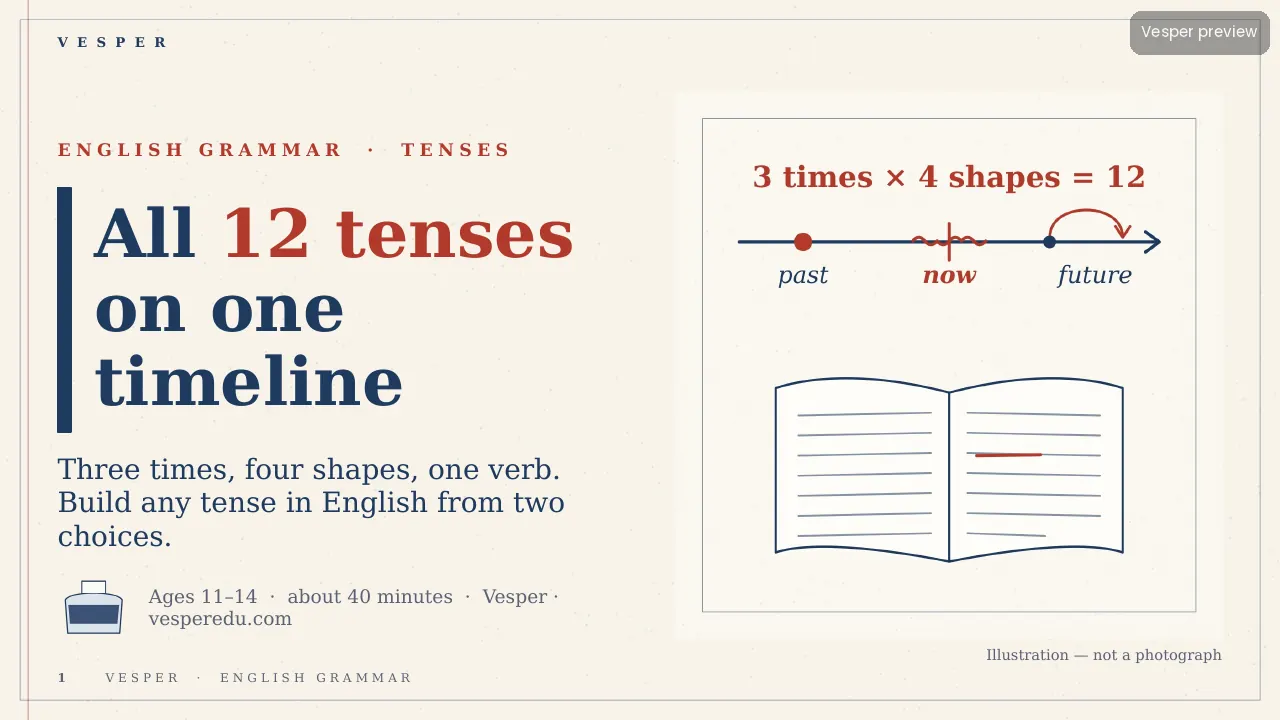
All 12 tenses on one timeline

Time picks the column. Shape picks the row.

A 28-slide lesson that builds all 12 English tenses from two choices, time and shape, on one timeline, with clue words and the classic mistakes fixed in red ink.

The short answer

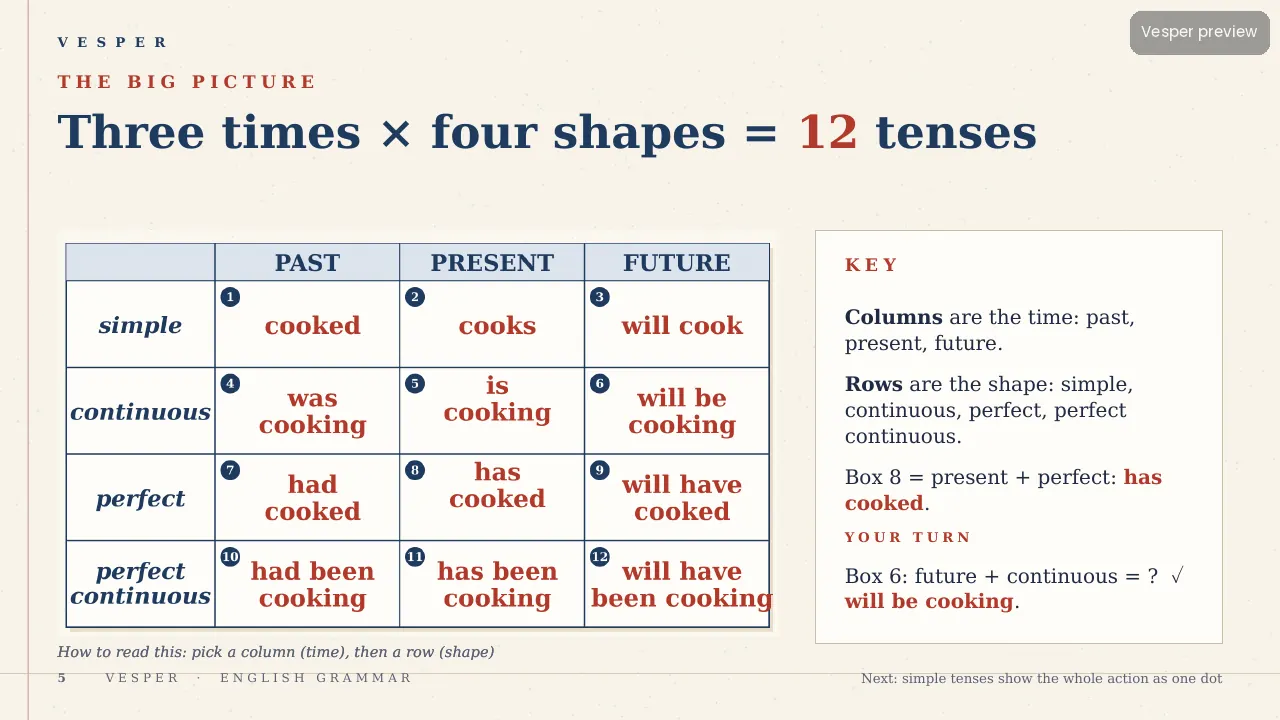
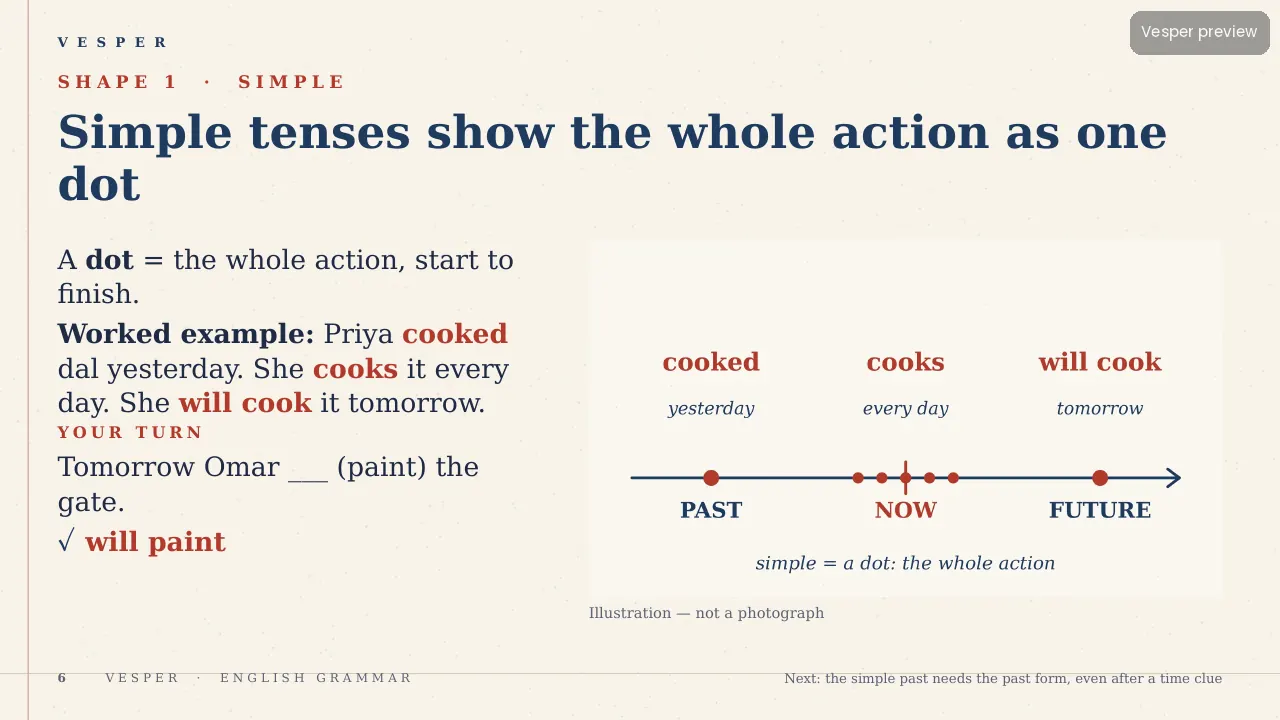
English has 12 tense forms because you make two choices: the time (past, present or future) and the shape of the action. Simple is a dot, continuous a wavy line, perfect an arrow back from a later point, and perfect continuous a wavy line up to a point. Three times × four shapes = 12.

Inside the deck

slides
28
quiz questions
8
minutes
40
your-turn tasks
6

Plenty to extend into a second lesson (about 56 minutes of activities in the notes).

Choose a format

  • Lesson Notes (PDF)Every slide with its teacher notes, as a PDF to read or print.
  • Teacher DeckThe editable PowerPoint with speaker notes on every slide, a PDF copy and the matching Vesper slide template, so you can add slides of your own.
Pricing coming soon

Pricing coming soon

We’ll email you pricing and launch offers shortly.

  • Finished and checked: buying opens soon
  • Sources listed at the end
  • Curriculum links under ‘Curriculum & specs’
  • For one classroom. Campus licences for whole schools

Key facts

  • Three times × four shapes = 12 tense forms
  • Simple = a dot; continuous = a wavy line; perfect = an arrow back from a later point
  • The continuous always needs a form of be
  • Never use the present perfect with a finished time like yesterday
  • State verbs such as know and own usually stay simple

What students will be able to do

  • Students can build all 12 tense forms from time and shape
  • Students can draw each tense on a timeline
  • Students can use clue words to choose the right tense
  • Students can choose between the present perfect and the past simple
  • Students can use for and since with a perfect tense

About this lesson

What students discover

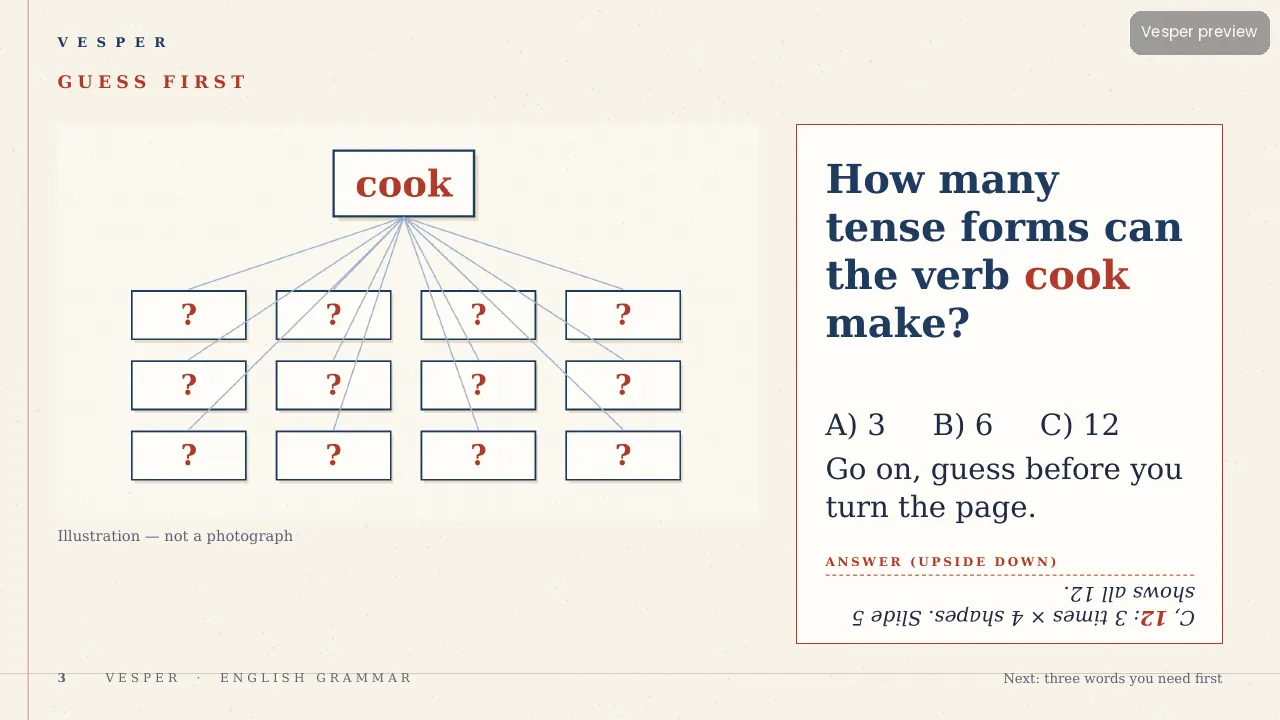
Twelve tenses look like twelve things to memorise. They are really two choices: when (past, present or future) and what shape the action has. Students see every tense drawn on one timeline: a dot for the simple tenses, a wavy line for the continuous, an arrow back from a later point for the perfect, and a wavy line up to a point for the perfect continuous. A 3 × 4 grid then holds all twelve forms of one verb, cook.

They learn the clue words that pick the shape (yesterday, since, by Friday), why the present perfect never goes with yesterday, why for and since need a perfect tense, and that state verbs such as know and own usually stay simple. A slide on the timetable present busts the myth that the present tense always means now.

Inside the deck

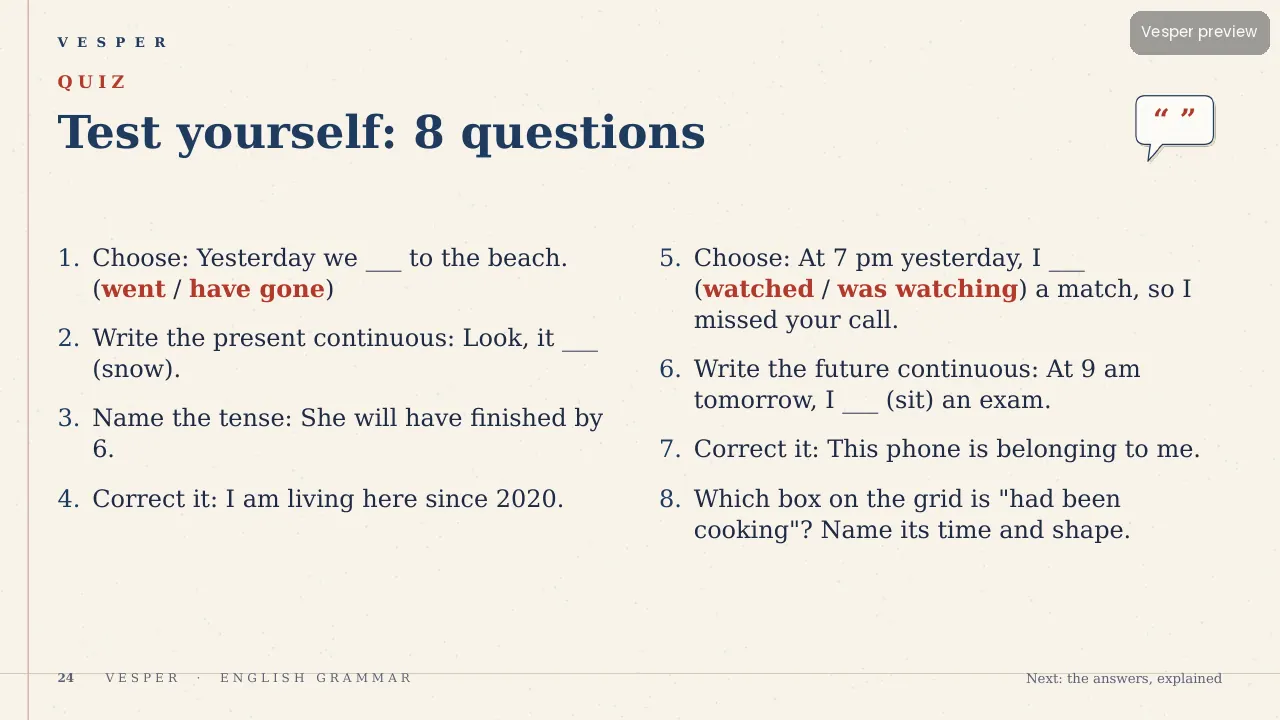
28 slides on the Inkwell template. Every rule has a worked example, a your-turn with its answer and a spot-the-mistake task, with classic errors fixed in red ink. Two checkpoints, a poll, a myth buster, a diary with three tense mistakes to correct, a note on why grammarians strictly count only two tenses, and an 8-question quiz with explained answers.

How to teach it

Allow about 40 minutes. Ask the hook (how many tense forms can cook make?) and collect guesses. Keep the 3 × 4 grid from slide 5 on the board throughout; students can copy it as a reference card. The diary activity on slide 21 works well in pairs. Notes on every slide give Say, Ask, Watch for and Time.

Who it’s for

For ages 11–14 learning or revising English tenses, and for learners of English who mix up the present perfect and past simple. Every example sentence is original. Editable PowerPoint with named layouts.
Curriculum & specs

CBSE/NCERT (India)Class 6-8 · CBSE English grammar (tenses)
CambridgeLS English Wg (verb forms and tense)
IB MYPLanguage & Literature · KC Communication · RC Structure
Common Core (US)L.5.1b; L.5.1c; L.5.1d
Ages11–14
LevelMiddle
Slide templateInkwell
Slides28
Teaching timeAbout 40 minutes
LanguageEnglish (UK)

Questions

Questions, answered

How many tenses are there in English?

Twelve tense forms in school grammar: three times (past, present, future) × four shapes (simple, continuous, perfect, perfect continuous). Strictly, grammarians count only two tenses, which the lesson explains.

What is the difference between the present perfect and the past simple?

The past simple is for a finished time (I cooked yesterday). The present perfect links the past to now and is not used with a finished time (I have cooked).

When do you use for and since?

With a perfect tense: 'I have lived here for two years' or 'since 2024', not 'I live here since 2024'.

Does the present tense always mean now?

No. The present can talk about timetables in the future, such as 'The train leaves at 6.'

Why can't you say 'I am knowing'?

Know is a state verb, and state verbs usually stay in the simple form.

Is there a tense chart in the lesson?

Yes. A 3 × 4 grid shows all twelve forms of one verb, with the timeline drawing for each.

Main sources

  1. Wren, P. C. and Martin, H. High School English Grammar and Composition. S. Chand (revised edition by N. D. V. Prasada Rao). Chapters on the tenses. Used for the order of topics only.
  2. Swan, M. (2016). Practical English Usage, 4th edition. Oxford University Press. Entries on present tenses for the future, the present perfect, and non-progressive (state) verbs.
  3. Huddleston, R. and Pullum, G. K. (2002). The Cambridge Grammar of the English Language. Cambridge University Press. Two-tense analysis (slide 18).

The full source list is on the last slides of the deck. Spotted an error? Tell us.