About this lesson
What students discover
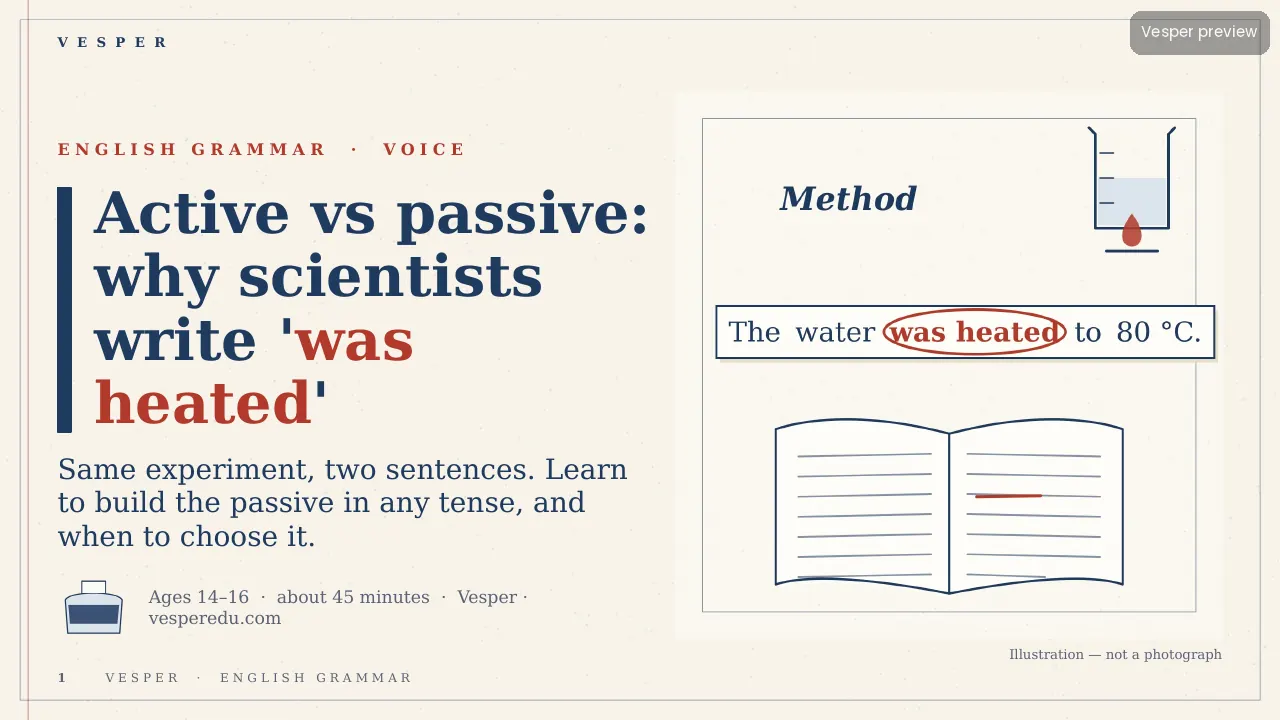
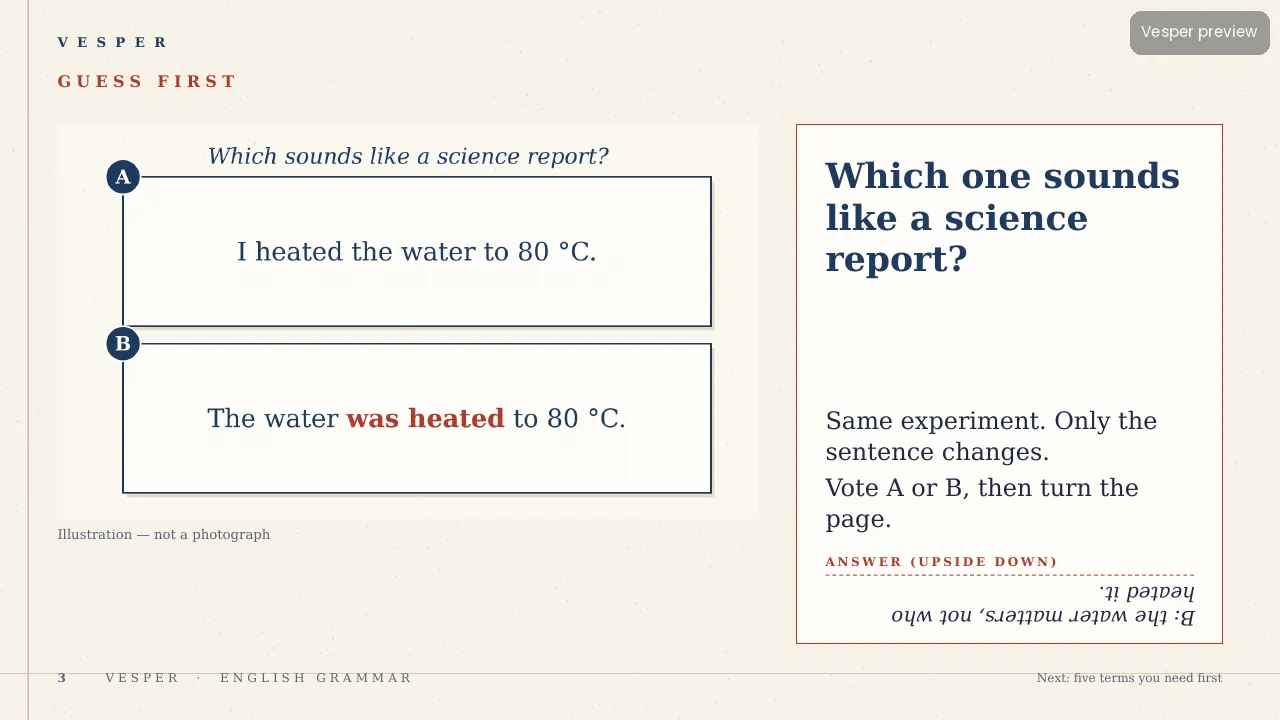
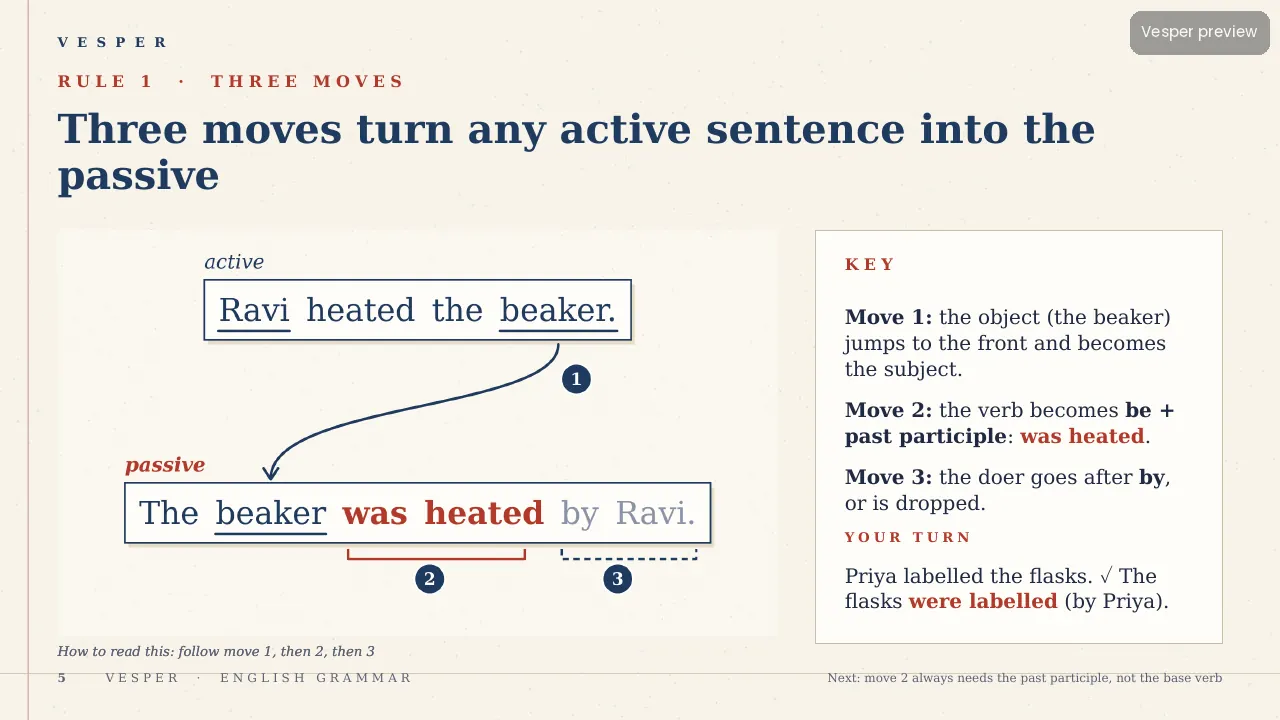
Same experiment, two sentences: ‘Ravi heated the beaker’ and ‘The beaker was heated’. Only one sounds like a lab report, and this lesson explains why. Students learn three numbered moves that turn any active sentence into the passive, then see that the be-verb carries the tense: is heated, is being heated, has been heated. A five-tense table puts active and passive side by side.
Then comes the judgement. The passive suits a sentence when the doer is unknown, obvious or unimportant, as in a method or a notice. It reads badly when the doer is the news (‘The winning goal was scored by Sofia’). Two classic errors get their own red-ink slides: a passive built from a verb with no object (‘The parcel was arrived’) and a ‘by me’ that adds nothing.
Inside the deck
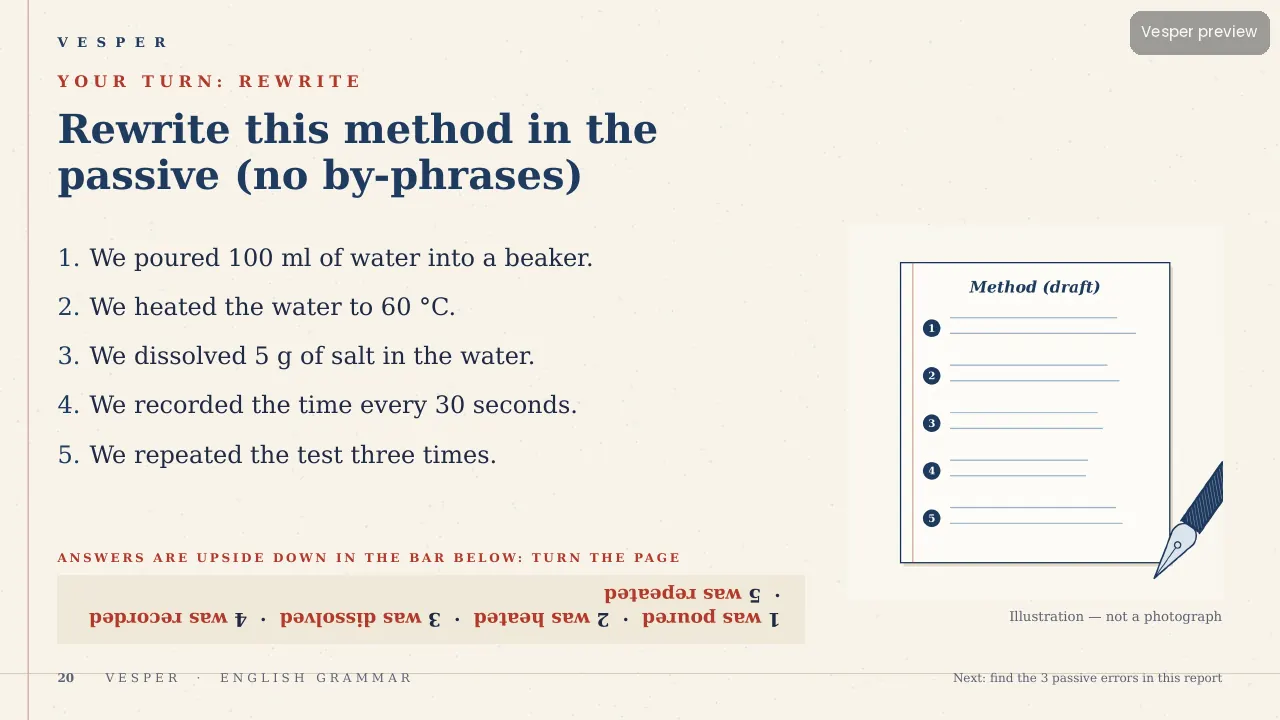
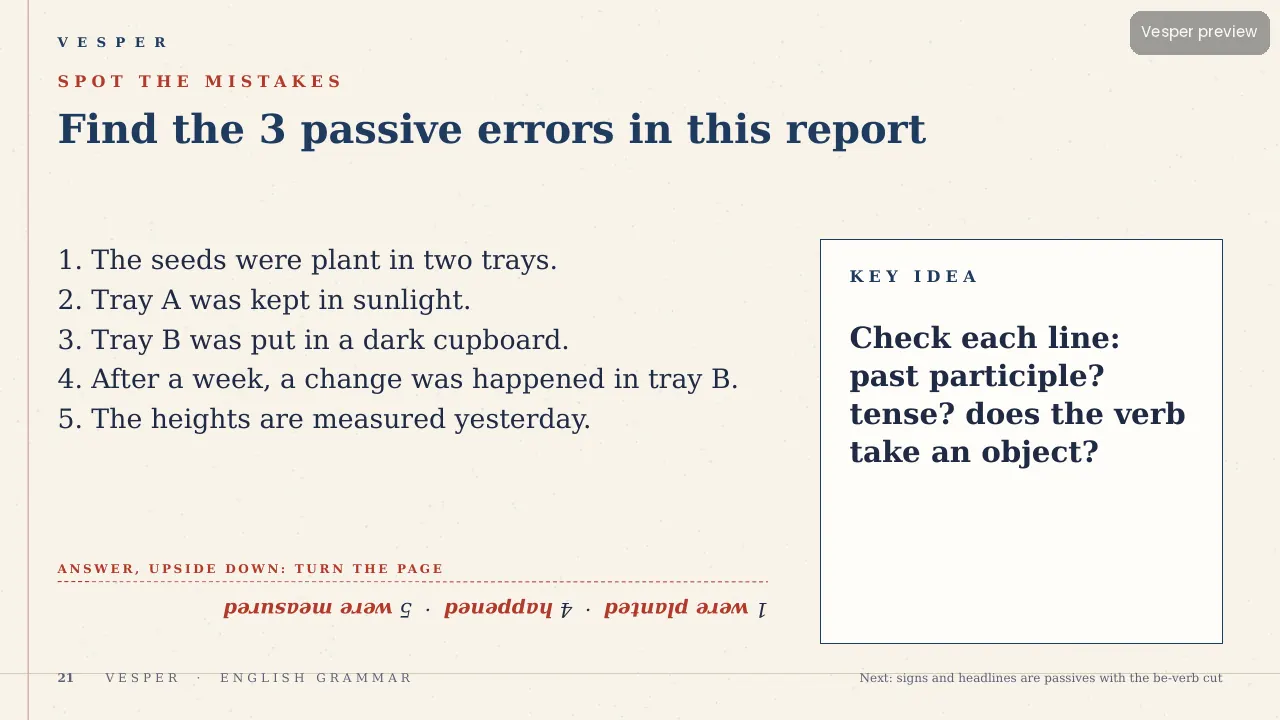
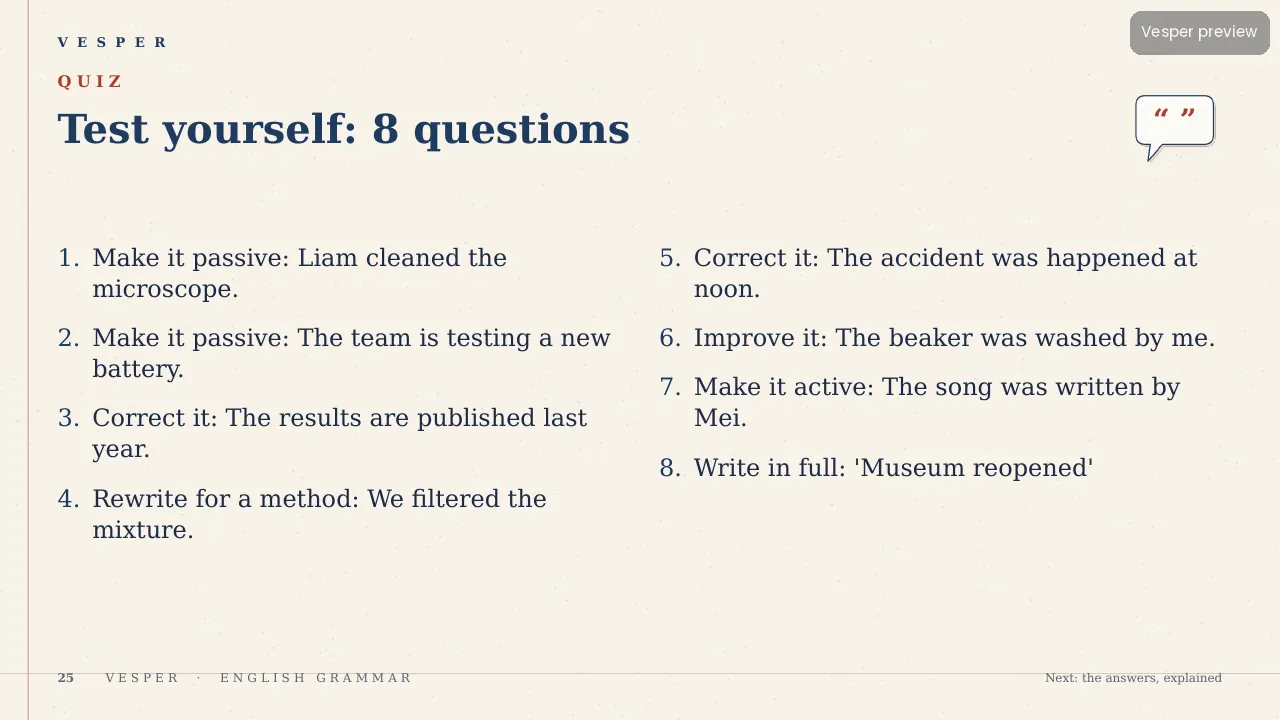
29 slides on the Inkwell template: a guess-first poll, a primer on five terms, seven your-turn tasks with answers, wrong/right pairs, two checkpoints and a myth slide on whether the passive is bad grammar (it isn’t; a guide for Nature authors is quoted on what to prefer). Students rewrite a whole method without by-phrases, hunt three errors in a short report and decode passive headlines such as ‘Museum reopened’. An eight-question quiz has explained answers, and every slide has speaker notes.
How to teach it
Plan about 45 minutes. Run the hook as a show of hands, then let the three-moves diagram do the heavy lifting. The method rewrite on slide 20 works well in pairs, and pairs well with a real practical write-up from science class.
Who it’s for
Learners aged 14–16, English teachers covering voice and register, and science teachers tired of lab reports that begin ‘I got a beaker’. Every example sentence is original.