Language Ages 13–16

Clauses decoded

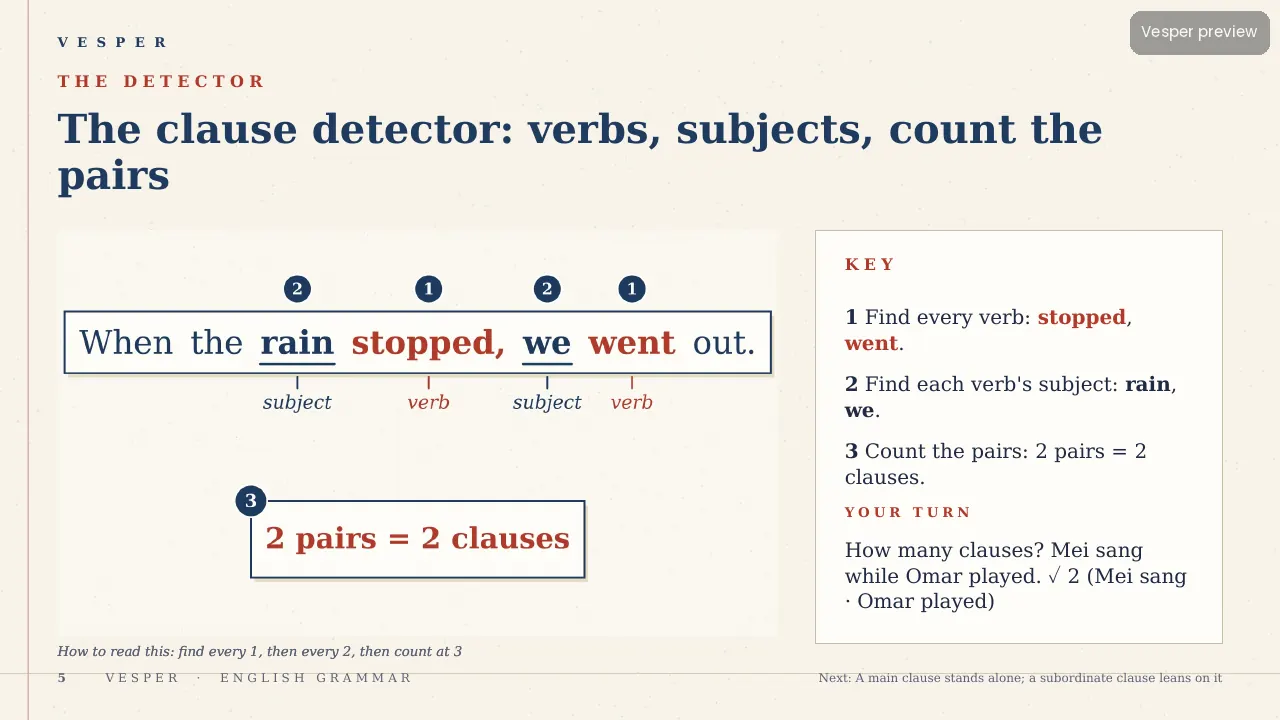
Find the verb. Find who does it. Ask its job.

A 29-slide lesson that decodes clauses: find subject + verb, tell main from subordinate, and name all three clause types. Students fix fragments, comma splices and which/who mix-ups as they go.

The short answer

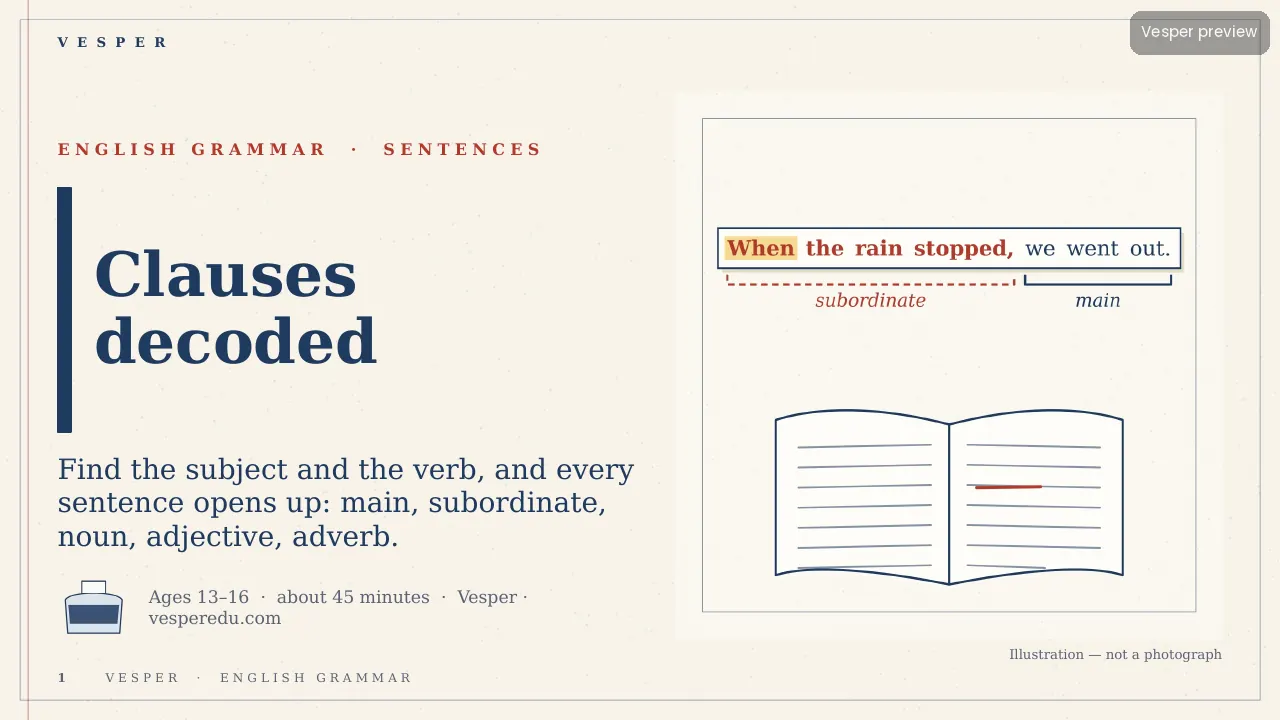
A clause is a group of words with a subject and a verb. A main clause makes sense alone; a subordinate clause, starting with a word such as because, when or which, leans on a main clause. Subordinate clauses do three jobs: adjective (describes a noun), noun (swap in 'it') and adverb (when, why, where).

Inside the deck

slides
29
quiz questions
8
minutes
45
your-turn tasks
8

Choose a format

  • Lesson Notes (PDF)Every slide with its teacher notes, as a PDF to read or print.
  • Teacher DeckThe editable PowerPoint with speaker notes on every slide, a PDF copy and the matching Vesper slide template, so you can add slides of your own.
Pricing coming soon

Pricing coming soon

We’ll email you pricing and launch offers shortly.

  • Finished and checked: buying opens soon
  • Sources listed at the end
  • Curriculum links under ‘Curriculum & specs’
  • For one classroom. Campus licences for whole schools

Key facts

  • A clause is a subject + verb; count the pairs to count the clauses.
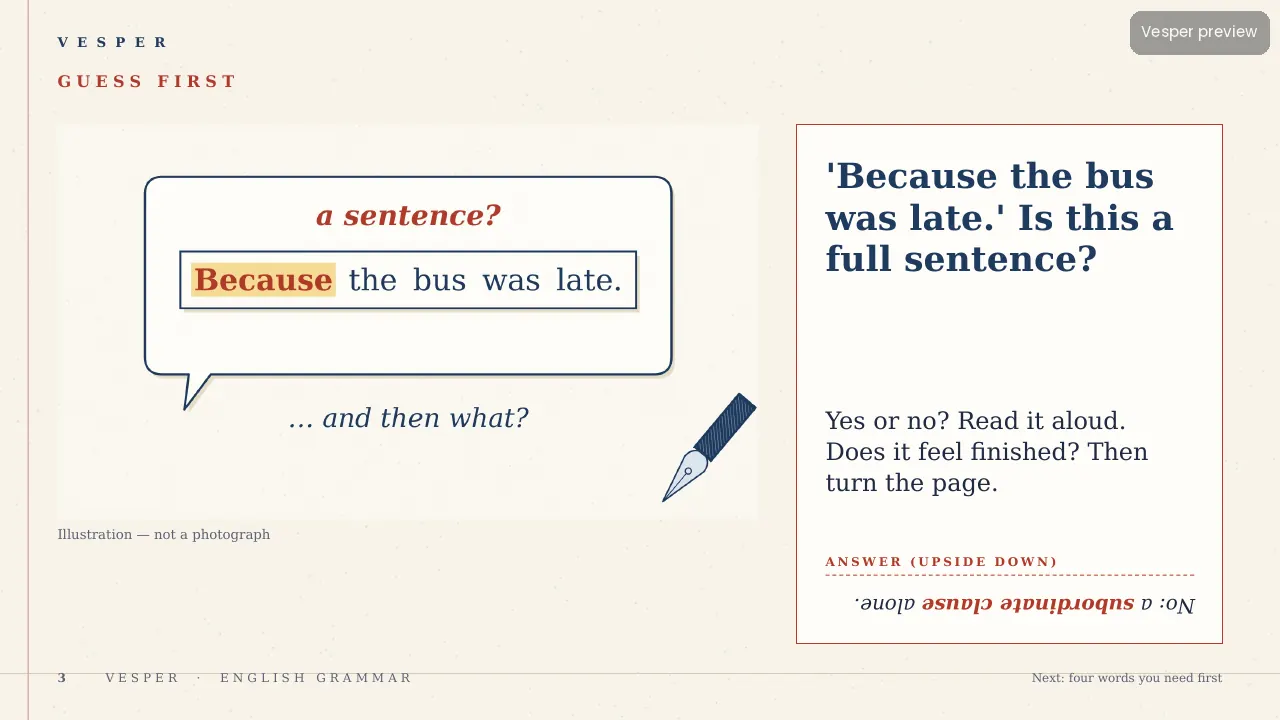
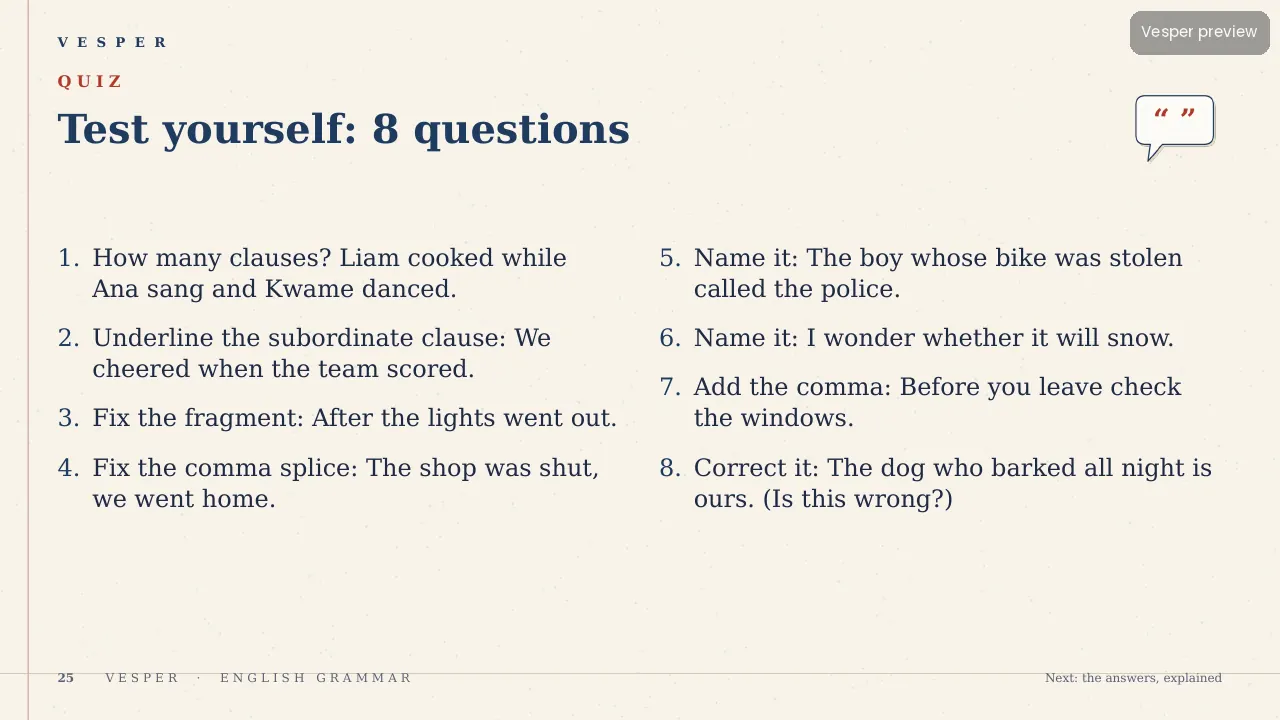
  • A subordinate clause on its own, such as 'After the lights went out.', is a fragment.
  • A comma alone cannot join two main clauses: that is a comma splice.
  • Noun clause test: swap in 'it'. Adjective clause test: ask 'which one?'.
  • A fronted adverb clause needs a comma after it: 'Before you leave, check the windows.'

What students will be able to do

  • Students can find each subject + verb pair and count the clauses in a sentence.
  • Students can tell a main clause from a subordinate clause and fix fragments.
  • Students can build compound and complex sentences and avoid comma splices.
  • Students can name noun, adjective and adverb clauses using a quick test for each.
  • Students can punctuate a fronted adverb clause and choose who or which correctly.

About this lesson

What students discover

‘Because the bus was late.’ Is that a sentence? Most students say yes. It isn’t, and this lesson shows why. Students learn the clause detector: find every verb, find its subject, count the pairs. They tell a main clause, which stands alone, from a subordinate clause, which leans on it, and see the difference between joining equals with ‘and’ and making one clause lean with ‘because’ or ‘when’.

Then the three jobs a subordinate clause can do, each with a quick test. An adjective clause describes a noun (‘the phone that I lost’). A noun clause passes the ‘swap in it’ test (‘what she said surprised me’). An adverb clause answers when, why, where or on what condition (‘when the rain stopped’). Along the way students fix fragments, comma splices, a missing comma after a fronted adverb clause, and ‘the dog who barked’.

Inside the deck

29 slides on the Inkwell template: a guess-first poll, a four-word primer, two diagram walks, eight your-turn tasks with answers, red-ink wrong/right pairs and two checkpoints. A myth slide settles whether you can start a sentence with ‘because’ (you can). Students combine three short sentences into one complex sentence and hunt three clause mistakes in a story opening. An eight-question quiz has explained answers. Every example sentence is original.

How to teach it

About 45 minutes. The one-table summary of three clause types and three tests makes a good wall chart. Speaker notes sit on every slide.

Who it’s for

Learners aged 13–16 who need complex sentences for writing marks, and English teachers who want a method students can apply to any sentence.
Curriculum & specs

CBSE/NCERT (India)Class 8-10 · CBSE English grammar (clauses; enrichment)
CambridgeLS English Wg (complex sentences)
IB MYPLanguage & Literature · KC Communication · RC Structure
Ages13–16
LevelSenior
Slide templateInkwell
Slides29
Teaching timeAbout 45 minutes
LanguageEnglish (UK)

Questions

Questions, answered

What is the difference between a main clause and a subordinate clause?

A main clause makes sense on its own. A subordinate clause starts with a word like because, when, if or which and needs a main clause to lean on.

What are the three types of subordinate clause?

Adjective (relative) clauses describe a noun, noun clauses do a noun's job, and adverb clauses say when, why, where or on what condition.

How do you identify a noun clause?

Replace the clause with 'it'. If the sentence still works ('It surprised me'), it is a noun clause.

Can you start a sentence with 'because'?

Yes, as long as a main clause follows: 'Because the bus was late, we missed the start.'

What is a comma splice and how do you fix it?

Two main clauses joined by a comma alone. Fix it with a full stop, a semicolon or a joining word: 'The shop was shut, so we went home.'

What age is this clauses lesson for?

Ages 13–16, about 45 minutes, with an eight-question quiz and answers.

Main sources

  1. Wren, P. C. and Martin, H. High School English Grammar and Composition. S. Chand (revised edition by N. D. V. Prasada Rao). Phrases and clauses; analysis of complex and compound sentences. Used for the order of topics only.
  2. Swan, M. (2016). Practical English Usage, 4th edition. Oxford University Press. Entries on clauses, conjunctions, relative clauses (who, which, that) and commas.
  3. Terminology follows common UK school use (main / subordinate clause; noun, adjective, adverb clause), with independent / dependent and relative clause given as alternatives.

The full source list is on the last slides of the deck. Spotted an error? Tell us.