Language Ages 13–16

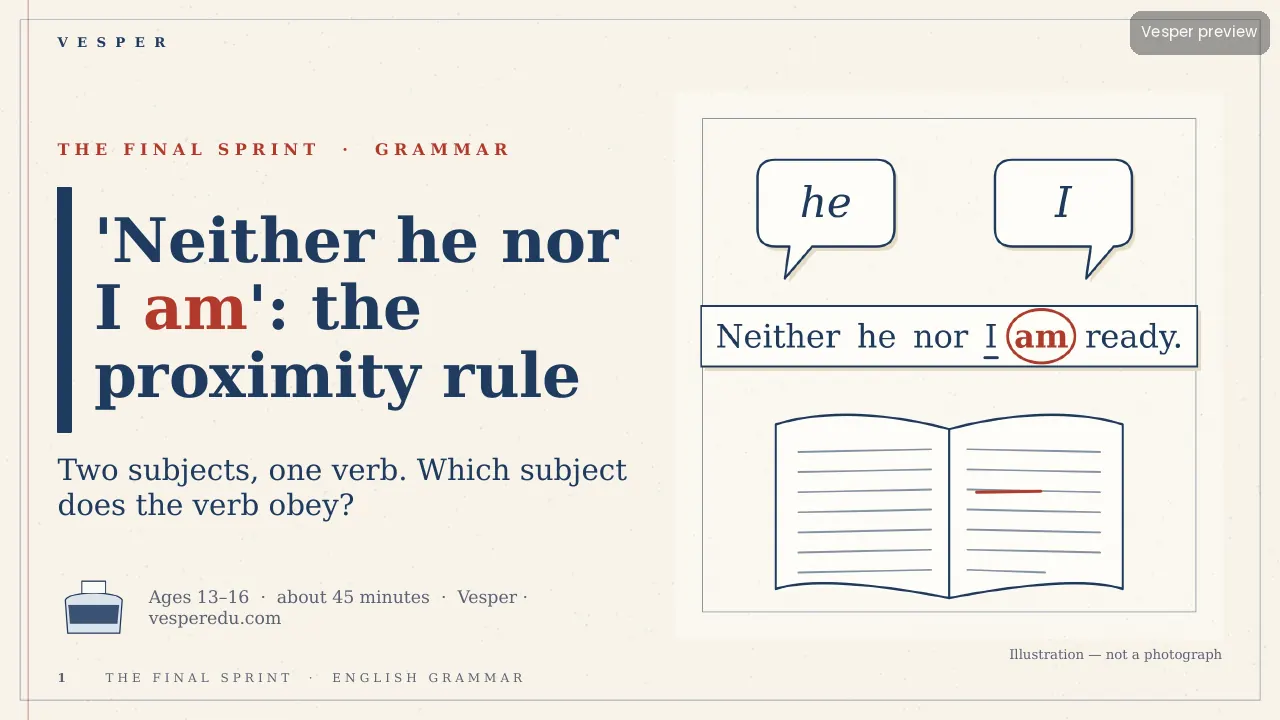
'Neither he nor I am': the proximity rule

And adds. Or picks the nearest. Six rules that settle the verb every time.

A 35-slide exam lesson on the verb after and, or, nor and not only … but also, with every rule shown, tested and marked in red ink. Ends with a 4-mark exam question.

The short answer

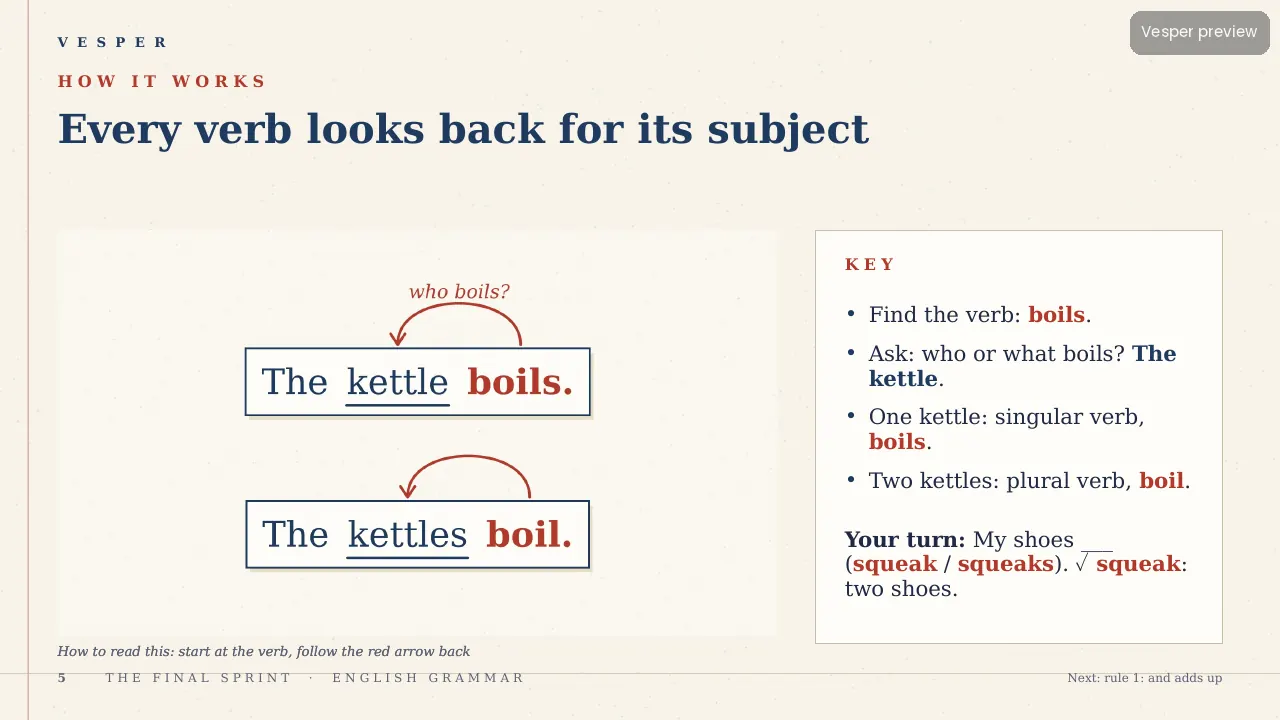
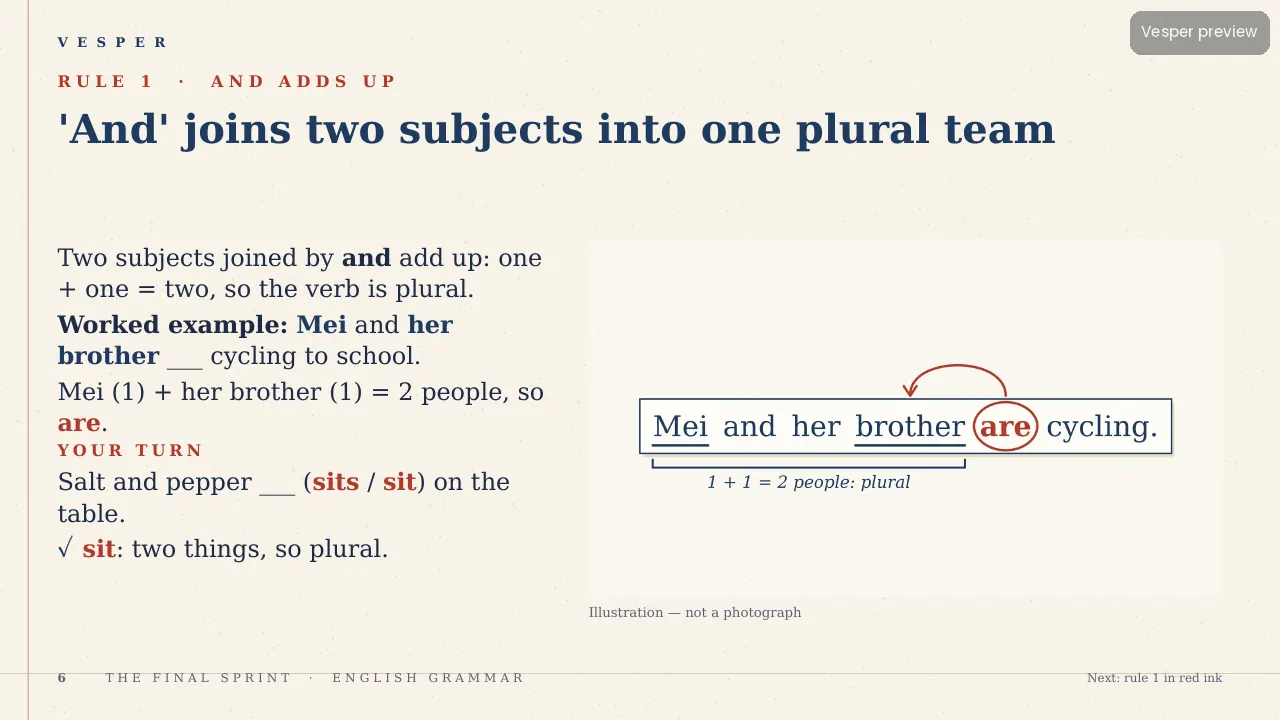
With either … or, neither … nor and not only … but also, the verb agrees with the nearer subject, in number and in person: 'Neither he nor I am ready.' And is different: it joins subjects into a plural, so 'he and I are'. Phrases such as as well as and along with do not change the verb.

Inside the deck

slides
35
quiz questions
6
minutes
45
your-turn tasks
8

Plenty to extend into a second lesson (about 74 minutes of activities in the notes).

Choose a format

  • Lesson Notes (PDF)Every slide with its teacher notes, as a PDF to read or print.
  • Teacher DeckThe editable PowerPoint with speaker notes on every slide, a PDF copy and the matching Vesper slide template, so you can add slides of your own.
Pricing coming soon

Pricing coming soon

We’ll email you pricing and launch offers shortly.

  • Finished and checked: buying opens soon
  • Sources listed at the end
  • Curriculum links under ‘Curriculum & specs’
  • For one classroom. Campus licences for whole schools

Key facts

  • Six agreement rules, each with a worked example and a your-turn
  • With or and nor, the nearer subject chooses the verb
  • Neither he nor I am: the nearer subject sets the person too
  • As well as adds information, not subjects
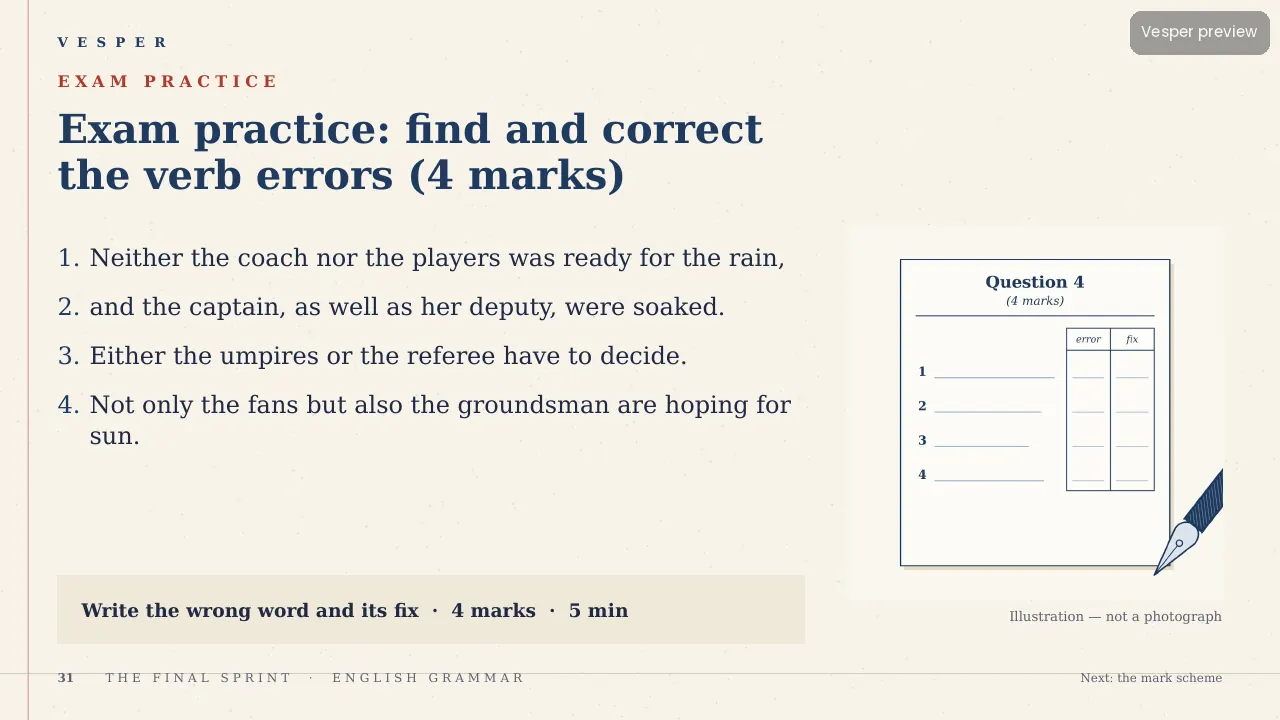
  • Ends with a 4-mark exam editing question and mark scheme

What students will be able to do

  • Students can explain why and makes a plural subject
  • Students can apply the proximity rule after or, nor and not only … but also
  • Students can match the verb to the nearer subject's person (I am, you are, she is)
  • Students can ignore as well as and along with when choosing the verb
  • Students can use a singular verb after neither of and either of

About this lesson

What students discover

‘Neither he nor I am ready’ sounds wrong to most people, yet it is correct. Students learn that and adds subjects, while or, nor and not only … but also let the nearer subject choose the verb, in number and in person (I am, you are, she is). A person table makes pronoun pairs, where most marks are lost, quick to check.

Then they meet the impostors that cost exam marks: as well as and along with, which add information but not subjects, and neither of, which takes a singular verb. They also learn that correct can still sound clunky, and how good writers rearrange a sentence instead.

Inside the deck

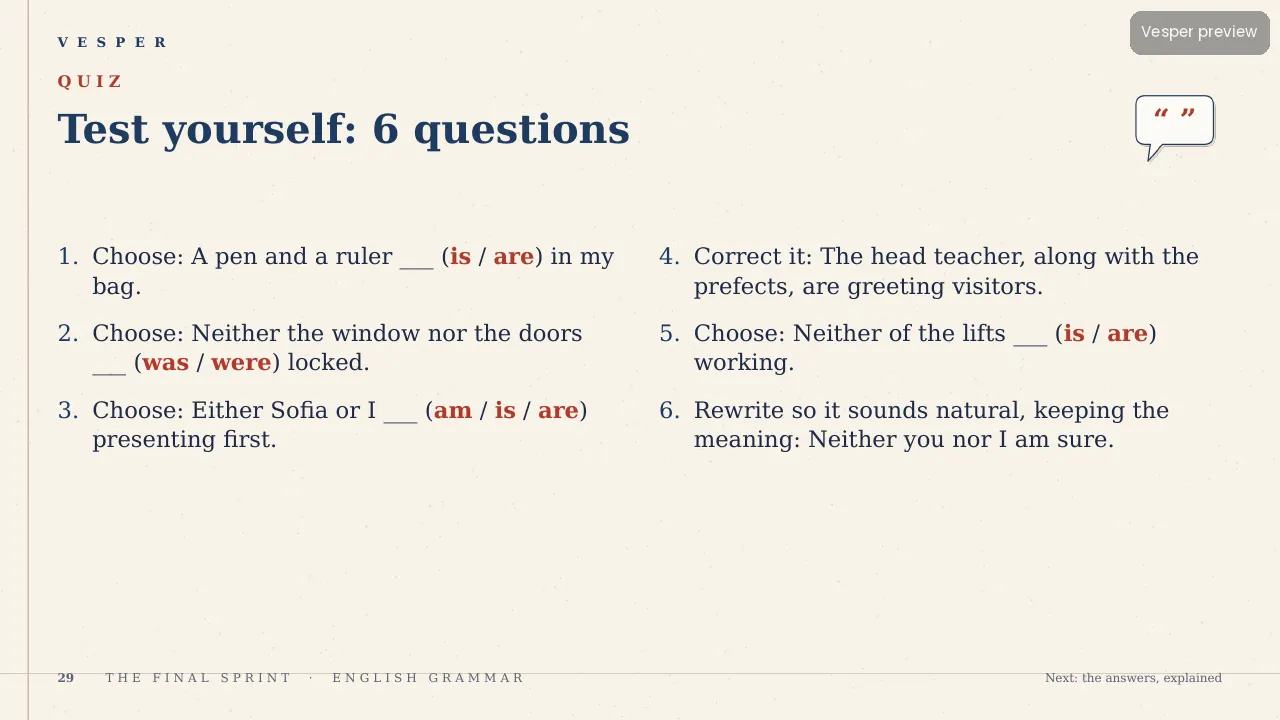
35 slides on the Inkwell template. Each of the six rules has a worked example, a your-turn question with its answer, a wrong/right pair in red ink and a spot-the-mistake task. There are two checkpoints, a quick poll, a myth buster (‘neither … nor always takes a singular verb’), a find-three-errors activity, a 6-question quiz with explained answers and a 4-mark exam editing question with its mark scheme.

How to teach it

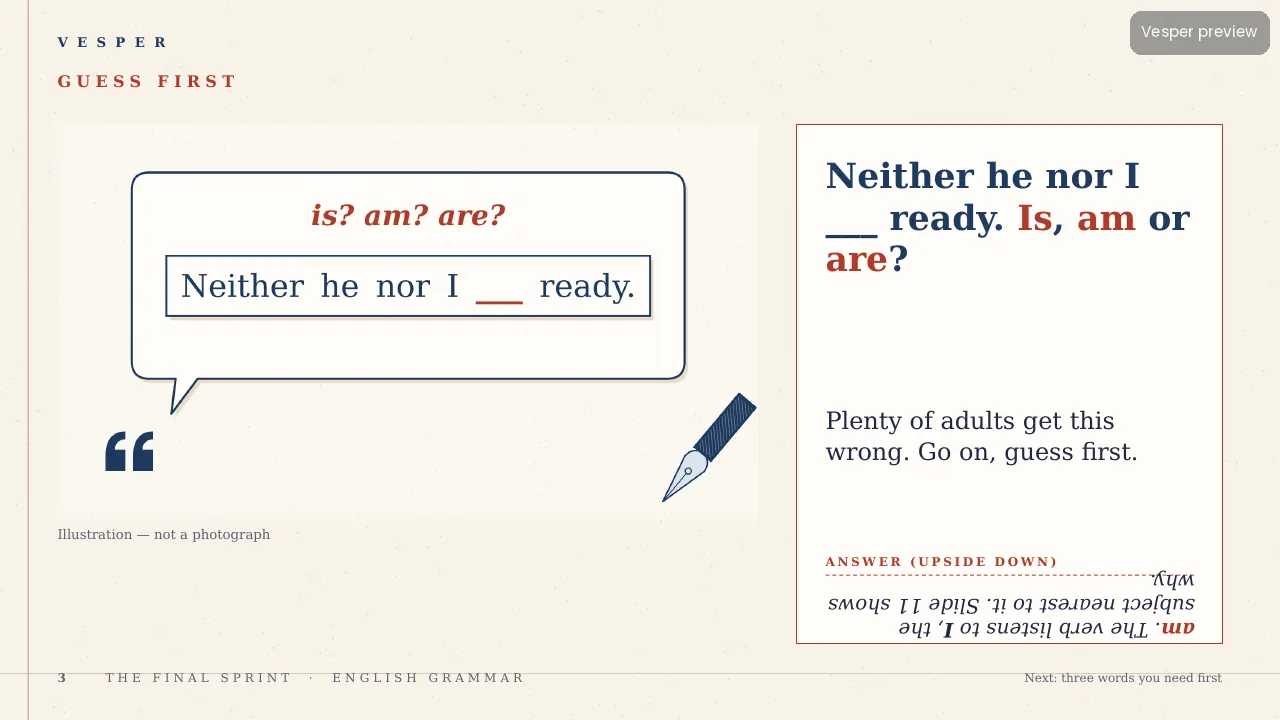
Allow about 45 minutes, as the cover says. With every activity in the notes it runs to about 74 minutes, so it can also fill one long lesson or one lesson plus homework. Use the hook (is, am or are?) as a vote, and come back to it after slide 11. The ‘cover the extra phrase with your finger’ trick on slide 20 is worth practising aloud. The mark scheme is Vesper’s own, not an official board scheme.

Who it’s for

For ages 13–16 preparing for grammar and editing questions in English exams. Part of The Final Sprint, 15 exam lessons that each end with an exam-style question and mark scheme. Every example sentence is original.
Curriculum & specs

CBSE/NCERT (India)Class 8-10 · CBSE English grammar (subject–verb concord)
CambridgeLS English Wg; IGCSE ESL accuracy
IB MYPLanguage & Literature · KC Communication · Crit D
Common Core (US)L.3.1f; L.9-10.1
Ages13–16
LevelSenior
Slide templateInkwell
Slides35
Teaching timeAbout 45 minutes
Exam-style questionYes, with a model answer
LanguageEnglish (UK)

Questions

Questions, answered

Is it 'neither he nor I am' or 'neither he nor I are'?

Neither he nor I am. With neither … nor, the verb agrees with the nearer subject, which is I.

Does either … or take a singular or plural verb?

It depends on the nearer subject: 'Either the teacher or the students are wrong', but 'Either the students or the teacher is wrong'.

Is 'neither of' singular or plural?

In formal and exam English, neither of and either of take a singular verb: 'Neither of the answers is right.'

Does 'as well as' make a plural subject?

No. As well as adds extra information but not a second subject, so 'The captain, as well as the players, is ready.'

What is the proximity rule in grammar?

The rule that with or, nor and similar pairs, the verb agrees with the subject closest to it.

Does this lesson include exam practice?

Yes. It ends with a 4-mark exam question where students find and correct verb errors, and a mark scheme giving 1 mark for each correct pair.

Main sources

  1. Wren, P. C. and Martin, H. High School English Grammar and Composition. S. Chand (revised edition by N. D. V. Prasada Rao). Chapter: agreement of the verb with the subject. Used for the order of the rules only.
  2. Swan, M. (2016). Practical English Usage, 4th edition. Oxford University Press. Entries on either … or, neither … nor and agreement. Used for the order of the rules and the note on awkward mixed-person pairs.
  3. Cambridge Dictionary (2026). English Grammar Today: 'Neither, neither … nor and not … either' and 'Either … or'. dictionary.cambridge.org/grammar/british-grammar. Accessed 17 Nov 2026.

The full source list is on the last slides of the deck. Spotted an error? Tell us.