Language Ages 15–16

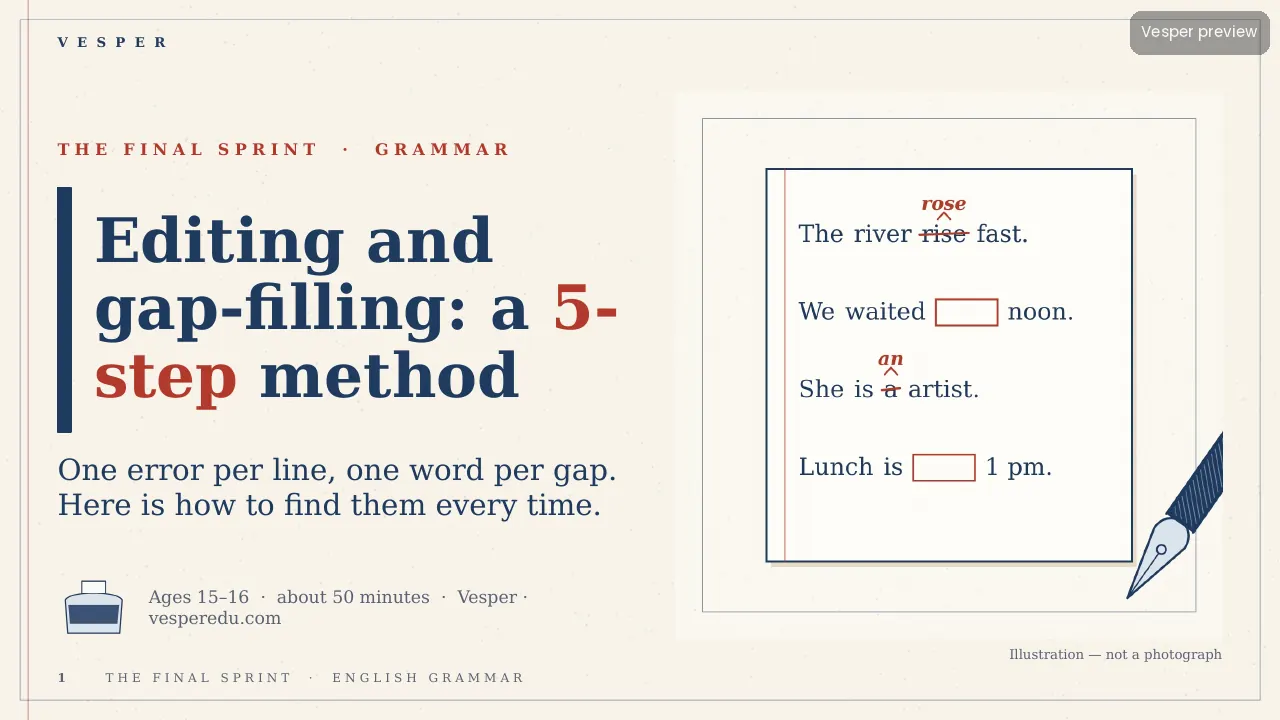
Editing and gap-filling: a 5-step method

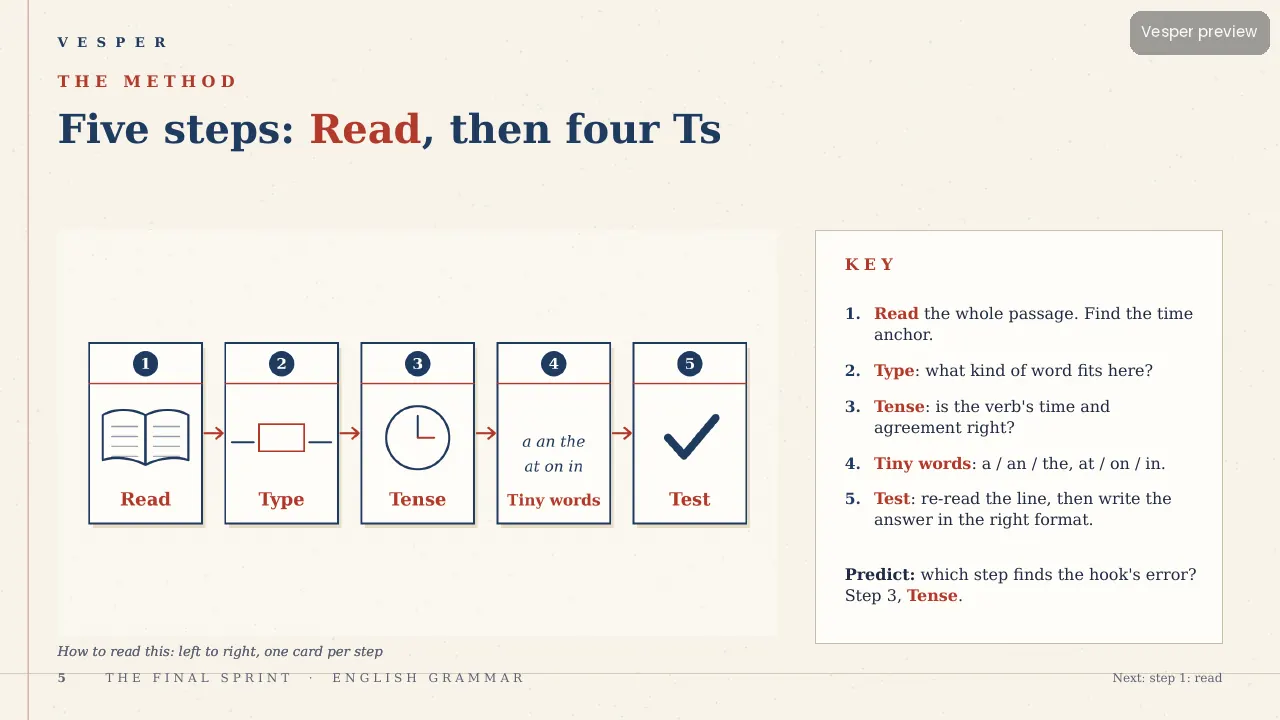
Read, then four Ts: Type, Tense, Tiny words, Test.

A 34-slide exam lesson that turns editing, omission and gap-filling questions into a five-step routine: Read, Type, Tense, Tiny words, Test. It ends with a 4-mark exam passage and its mark scheme.

The short answer

To answer editing and gap-filling questions, read the whole passage first and find the time anchor, such as 'last year'. Then run four checks on each line: the type of word the gap needs, the verb's tense and agreement, the tiny words (a, an, the, at, on, in) and a final test of the line and answer format.

Inside the deck

slides
34
quiz questions
6
minutes
50
your-turn tasks
8

Plenty to extend into a second lesson (about 78 minutes of activities in the notes).

Choose a format

  • Lesson Notes (PDF)Every slide with its teacher notes, as a PDF to read or print.
  • Teacher DeckThe editable PowerPoint with speaker notes on every slide, a PDF copy and the matching Vesper slide template, so you can add slides of your own.
Pricing coming soon

Pricing coming soon

We’ll email you pricing and launch offers shortly.

  • Finished and checked: buying opens soon
  • Sources listed at the end
  • Curriculum links under ‘Curriculum & specs’
  • For one classroom. Campus licences for whole schools

Key facts

  • Five steps: Read, Type, Tense, Tiny words, Test.
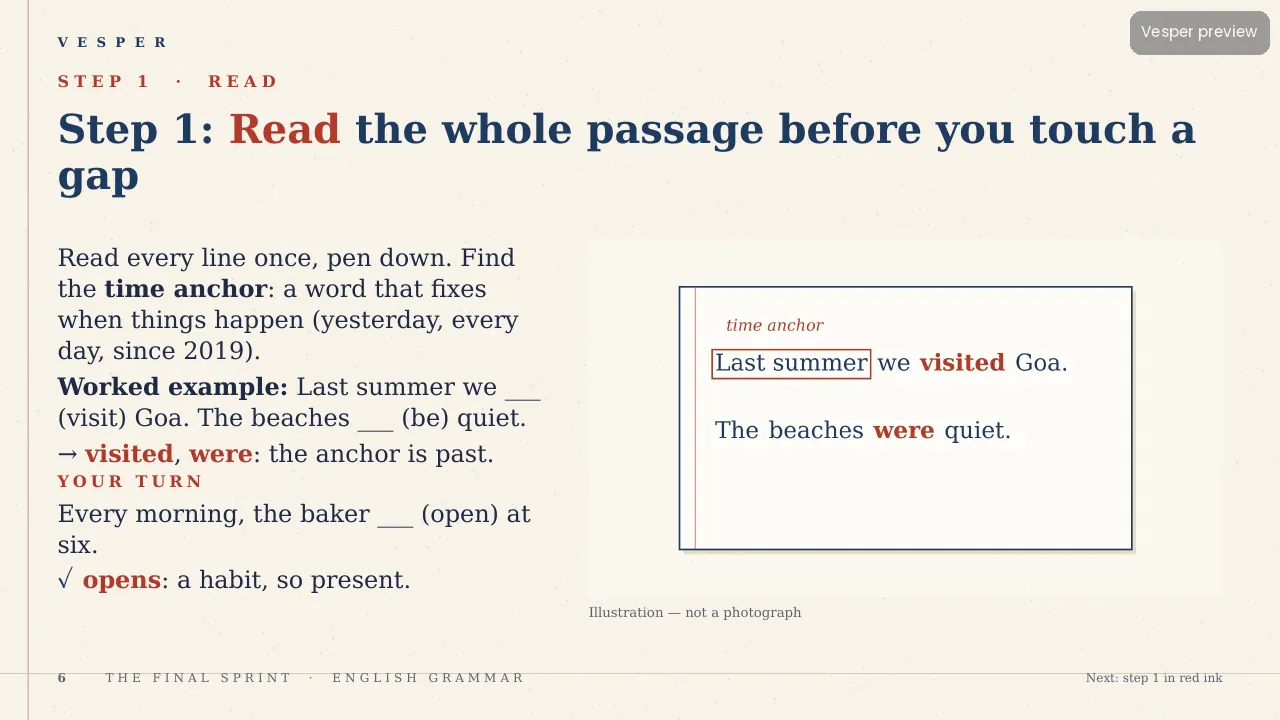
  • The time anchor ('last year', 'since 2019') fixes the tense for the whole passage.
  • A or an goes by sound: an hour, a university.
  • Time prepositions: at a clock time, on a day, in a longer stretch.
  • In most editing tasks each line has one error, so only that word earns the mark.

What students will be able to do

  • Students can find the time anchor in a passage and use it to fix verb tenses.
  • Students can name the word class a gap needs.
  • Students can check verbs for tense and subject–verb agreement.
  • Students can choose a or an by sound and at, on or in for time.
  • Students can answer editing and omission tasks in the format examiners expect.

About this lesson

What students discover

Editing and gap-filling questions feel like guesswork until you have a routine. This lesson gives students one: Read, then four Ts. First they read the whole passage, pen down, and find the time anchor, a word such as ‘last monsoon’ or ‘since 2019’ that fixes when things happen. Then four checks. Type: what kind of word fits the gap (‘He drives very carefully’, not ‘careful’). Tense: does the verb fit the anchor and agree with its subject? Tiny words: a or an by sound (an hour, a university), and at, on or in for time. Test: re-read the line and write the answer in the format the paper wants.

Students also meet the omission task, where a word is missing rather than wrong, apply all five steps to one marked passage, and bust a costly myth: in most editing tasks each line has one error, so rewriting the whole sentence earns nothing extra.

Inside the deck

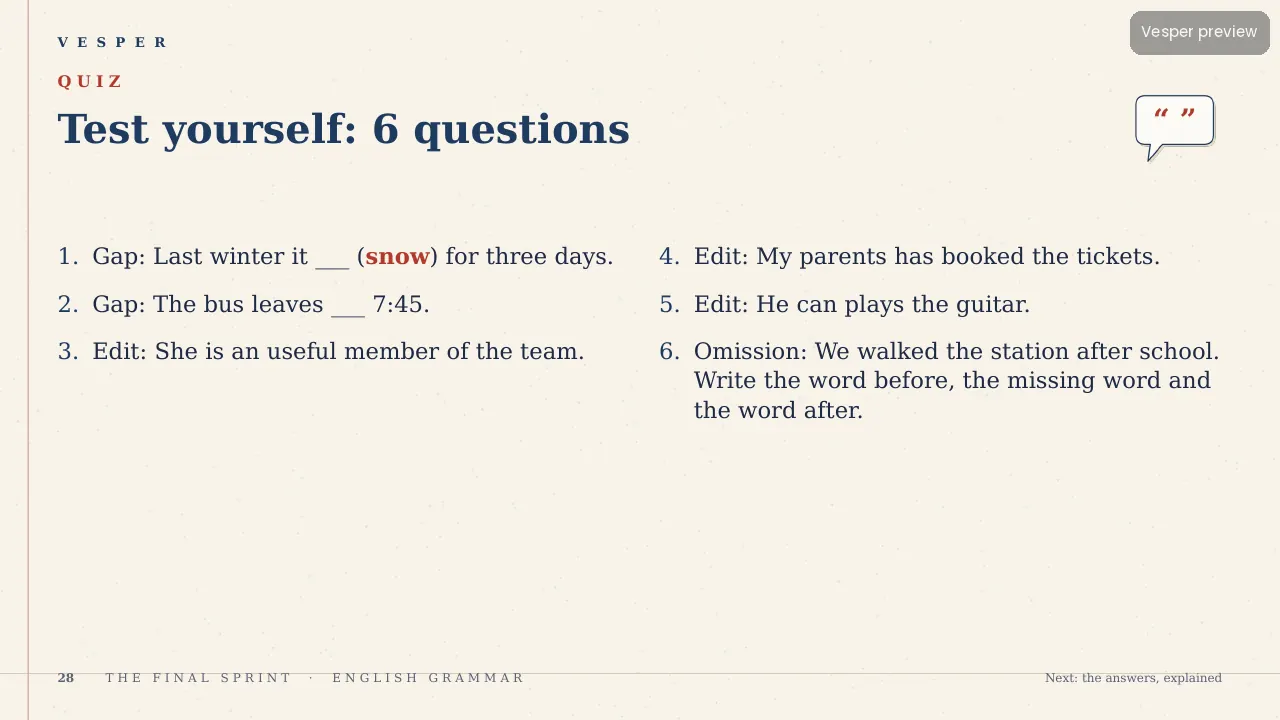
34 slides on the Inkwell template. Each step has a worked example, a your-turn with its answer, a wrong/right pair in red ink and a spot-the-mistake. There are two checkpoints, two practice activities (edit a note, fill the gaps) and a six-question quiz with explained answers. A 4-mark exam passage about a museum trip comes with a mark scheme, one mark per correct pair.

How to teach it

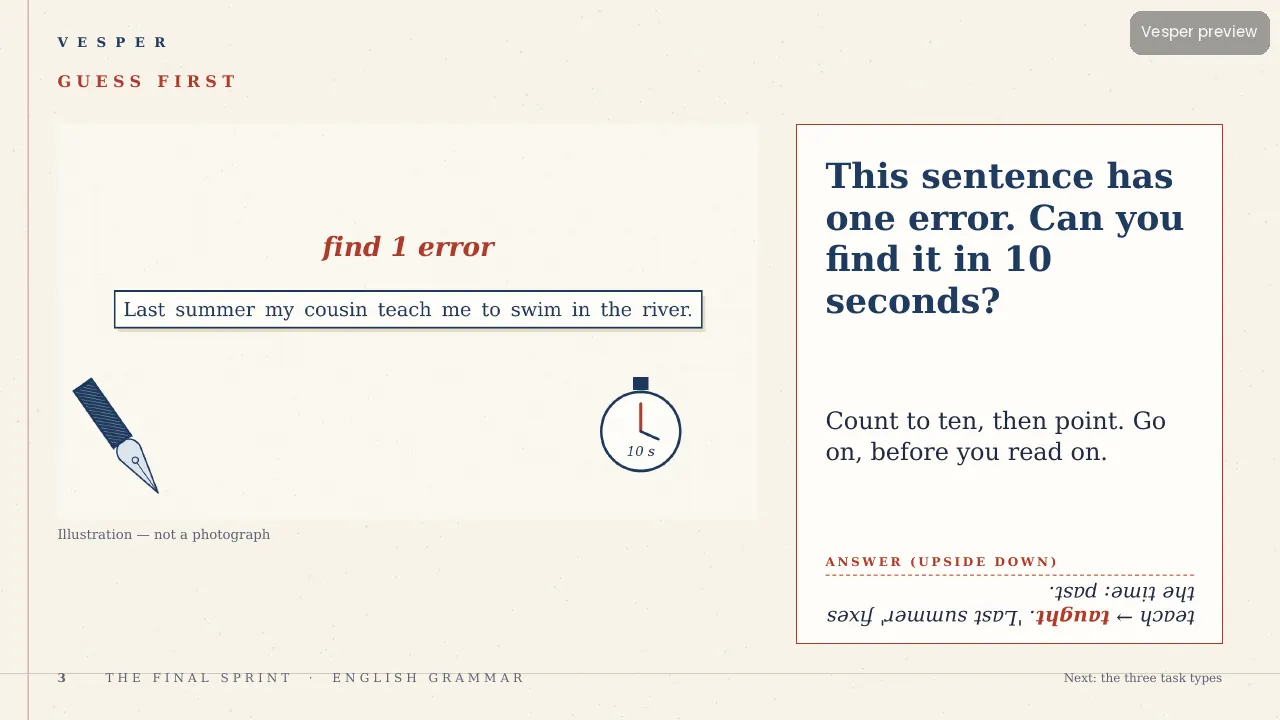
About 50 minutes. The 10-second challenge on slide 3 sets the tone; time it. Leave the one-card summary on the board for the next past paper. Part of the Final Sprint collection, with speaker notes on every slide.

Who it’s for

Learners aged 15–16 facing editing, omission or gap-filling questions in an English exam, and teachers who want a method students can run under time pressure.
Curriculum & specs

CBSE/NCERT (India)Class 10 · CBSE English grammar (editing / gap-filling question types)
CambridgeLS English Writing (proofreading); IGCSE ESL accuracy
IB MYPLanguage & Literature · KC Creativity · Crit B, D
Ages15–16
LevelSenior
Slide templateInkwell
Slides34
Teaching timeAbout 50 minutes
Exam-style questionYes, with a model answer
LanguageEnglish (UK)

Questions

Questions, answered

How do you do an editing exercise in an English exam?

Read the whole passage first and find the time anchor, then check each line for word type, tense and agreement, and tiny words such as articles and prepositions. Write the wrong word and its correction in the format asked.

What is an omission exercise?

A task where one word is missing from each line. You write the word before, the missing word and the word after.

How do I get better at gap-filling questions?

Look at the words either side of the gap to decide what type of word fits, then check it against the tense of the passage.

Is it 'an university' or 'a university'?

'A university'. A and an go by sound, and 'university' starts with a 'you' sound.

Should I rewrite the whole sentence in an editing question?

No. Each line usually has one error, and only that correction earns the mark.

Does this lesson include exam practice?

Yes: a 4-mark editing passage with a mark scheme, two practice activities and a six-question quiz.

Main sources

  1. Wren, P. C. and Martin, H. High School English Grammar and Composition. S. Chand (revised edition by N. D. V. Prasada Rao). Chapters on tenses, agreement of the verb with the subject, articles and prepositions. Used for the order of the grammar points only.
  2. Swan, M. (2016). Practical English Usage, 4th edition. Oxford University Press. Entries on a / an, at / on / in (time), since and for, and past participles. Used for the order of the points and to check usage.

The full source list is on the last slides of the deck. Spotted an error? Tell us.