Language Ages 14–16

The 6 format mistakes in a formal letter or notice

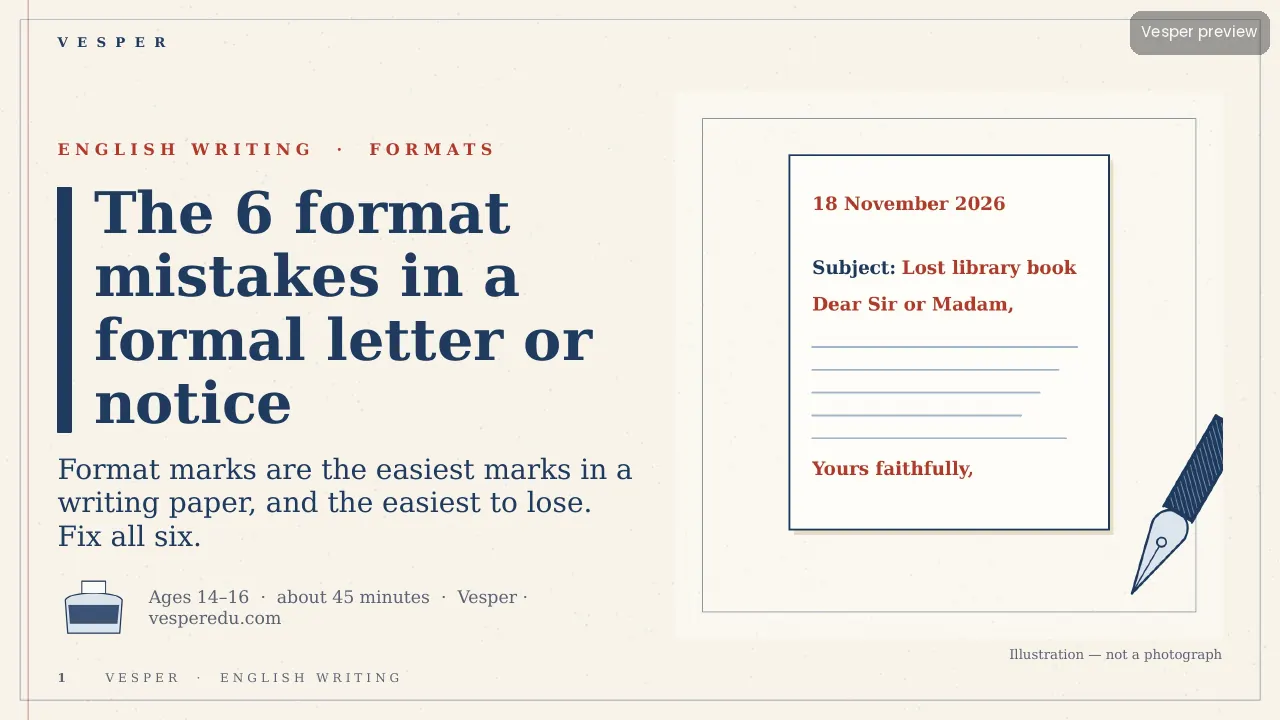
Date in words. Subject with a purpose. Sir means faithfully.

A 30-slide lesson that fixes the six format mistakes that cost easy marks in formal letters and notices. Each one has a worked example, a your-turn and a wrong/right pair.

The short answer

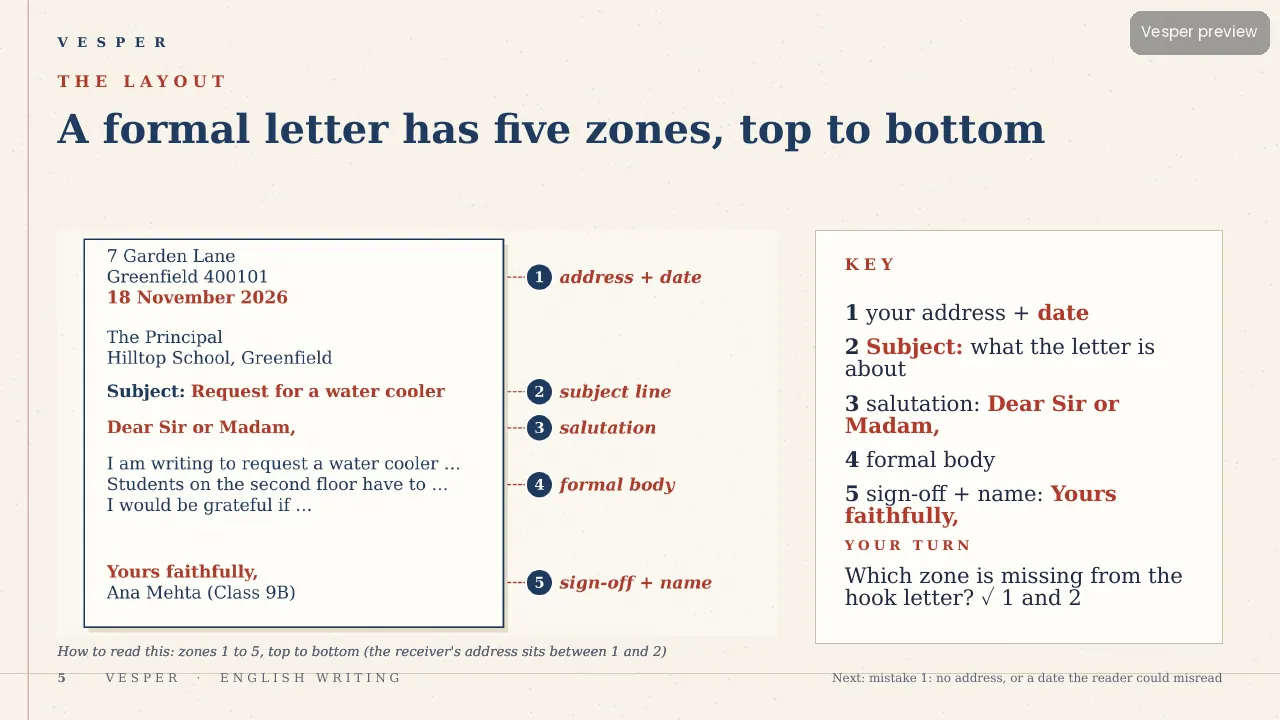
A formal letter has five zones: your address and the date in words (18 November 2026), a subject line naming the purpose, a formal greeting, a body in full words with a calm tone, and a sign-off that matches the greeting. 'Dear Sir or Madam' takes 'Yours faithfully'; 'Dear Ms Rao' takes 'Yours sincerely'.

Inside the deck

slides
30
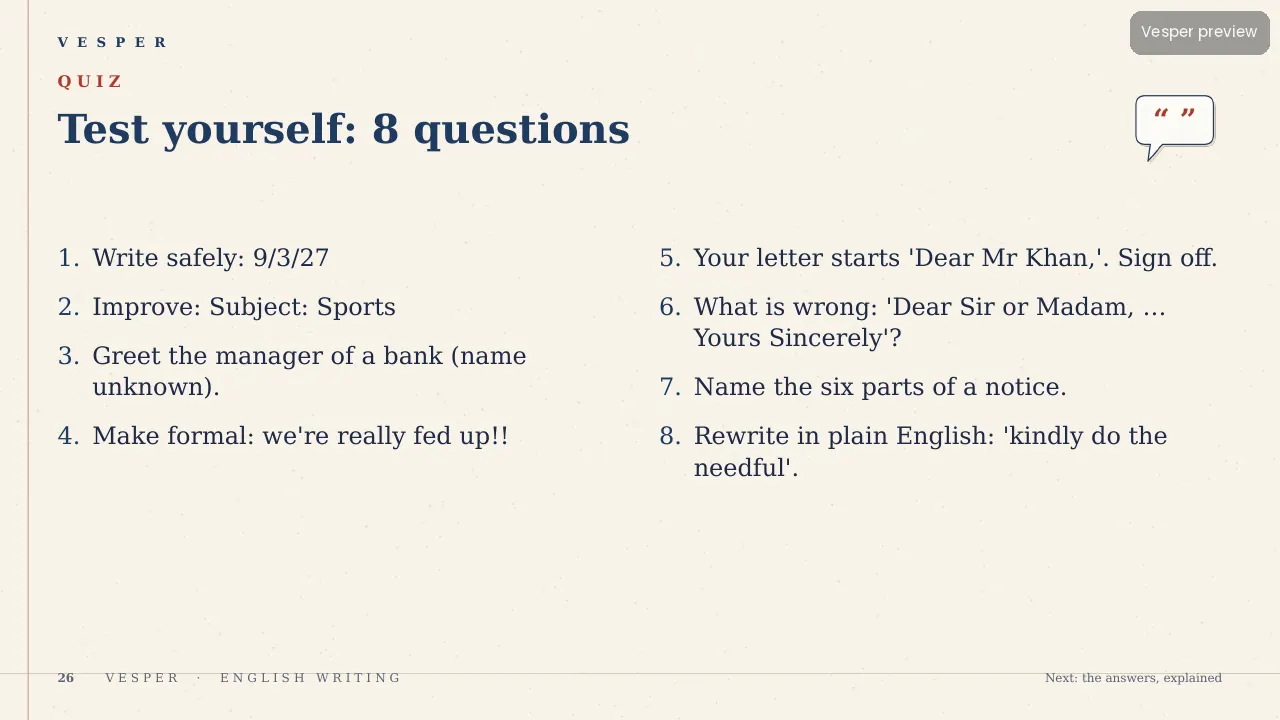
quiz questions
8
minutes
45
your-turn tasks
7

Choose a format

  • Lesson Notes (PDF)Every slide with its teacher notes, as a PDF to read or print.
  • Teacher DeckThe editable PowerPoint with speaker notes on every slide, a PDF copy and the matching Vesper slide template, so you can add slides of your own.
Pricing coming soon

Pricing coming soon

We’ll email you pricing and launch offers shortly.

  • Finished and checked: buying opens soon
  • Sources listed at the end
  • Curriculum links under ‘Curriculum & specs’
  • For one classroom. Campus licences for whole schools

Key facts

  • Write the date as 18 November 2026: day, month in words, year, no ordinals.
  • 'Dear Sir or Madam' goes with 'Yours faithfully'.
  • 'Dear Ms Rao' (a named person) goes with 'Yours sincerely'.
  • A subject line names the purpose and the topic: 'Request for more sports equipment'.
  • A notice has six parts and ends with a name and designation, not a sign-off.

What students will be able to do

  • Students can lay out a formal letter in five zones: address and date, subject, greeting, body, sign-off.
  • Students can write the date in words without ordinals.
  • Students can write a subject line that names the purpose.
  • Students can match the sign-off to the greeting.
  • Students can lay out a notice with its six parts, ending with a name and designation.

About this lesson

What students discover

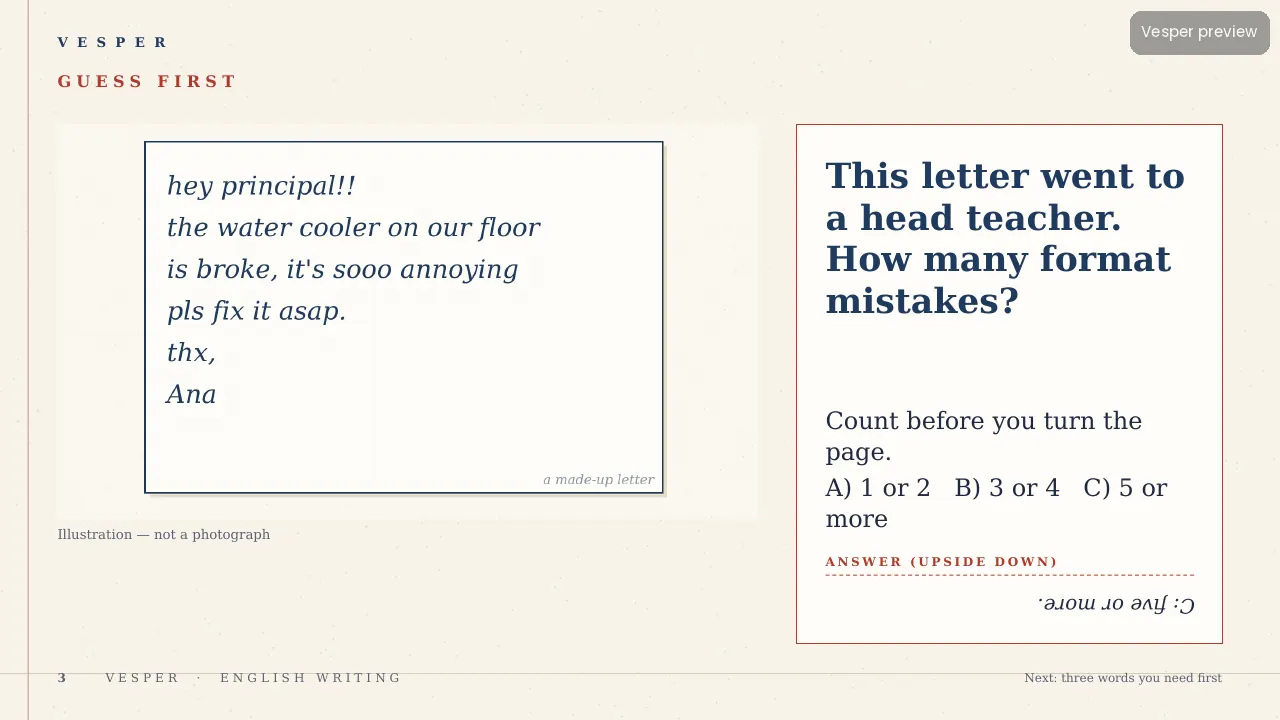
Format marks are the easiest marks in a writing paper, and the easiest to lose. The hook is a letter that went to a head teacher: how many format mistakes can students find? Then the lesson walks through a formal letter zone by zone and fixes five mistakes examiners see most often. A missing address or an ambiguous date (write 18 November 2026, not 18/11/26 or ’18th Nov, 26′). A missing or vague subject line (‘Subject: Library’ says nothing; name the purpose). An informal greeting such as ‘Hey principal’ or ‘Hi Priya’. Chat language in the body (pls, asap, it’s, !!). A sign-off that doesn’t match the greeting.

The sixth mistake belongs to the notice, which is not a letter: it has a different reader and six parts, and it ends with a name and designation rather than a sign-off. A myth slide clears out the old-fashioned phrases (‘I beg to state’, ‘kindly do the needful’) that students think make writing formal.

Inside the deck

30 slides on the Inkwell template: a guess-first poll, a primer, two diagram walks (the five letter zones, the six notice parts), seven your-turn tasks with answers, red-ink wrong/right pairs, two checkpoints and two bridges. The activity asks students to repair a letter with four format mistakes. An eight-question quiz has explained answers. Every example letter is original.

How to teach it

About 45 minutes. The one-card summary works as a checklist students tick before handing in any formal letter. Board samples differ in small details, such as date position, and the sources slide says so. Speaker notes sit on every slide.

Who it’s for

Learners aged 14–16 preparing for writing papers, and English teachers tired of marking ‘Yours sincerely’ under ‘Dear Sir or Madam’.
Curriculum & specs

CBSE/NCERT (India)Class 9-10 · CBSE English writing skills (formal letter; notice = Class 11–12 format – confirm)
CambridgeIGCSE ESL 0510 / FLE 0500 directed writing (formal register)
IB MYPLanguage & Literature · KC Communication · RC Audience imperatives, Purpose · Crit B, C
Ages14–16
LevelSenior
Slide templateInkwell
Slides30
Teaching timeAbout 45 minutes
LanguageEnglish (UK)

Questions

Questions, answered

What is the correct format for a formal letter?

Your address and the date in words, a subject line, a formal greeting, the body in full words, and a sign-off that matches the greeting, followed by your name.

When do you use 'Yours faithfully' and 'Yours sincerely'?

Use 'Yours faithfully' when you don't know the reader's name ('Dear Sir or Madam'). Use 'Yours sincerely' when you do ('Dear Mr Khan').

How should you write the date in a formal letter?

In words, without ordinals: 9 March 2027, not 9/3/27 or 9th March.

What should a subject line in a formal letter say?

The purpose as well as the topic, for example 'Request for more sports equipment' rather than 'Sports'.

Do formal letters need phrases like 'kindly do the needful'?

No. Formal means clear and polite, not old-fashioned. Say what you need in plain English.

How is a notice different from a formal letter?

A notice is a short public message with six parts. It ends with the writer's name and designation rather than a sign-off.

Main sources

  1. Swan, M. (2016). Practical English Usage, 4th edition. Oxford University Press. Entries on letters (Dear …, Yours faithfully / sincerely) and dates.
  2. New Oxford Style Manual (2016). Oxford University Press. Dates (day, month in words, year; no ordinals).
  3. Wren, P. C. and Martin, H. High School English Grammar and Composition. S. Chand. Letter-writing chapter. Used for the order of topics only.

The full source list is on the last slides of the deck. Spotted an error? Tell us.