Life Ages 12–13

A samosa's trip from mouth to exit

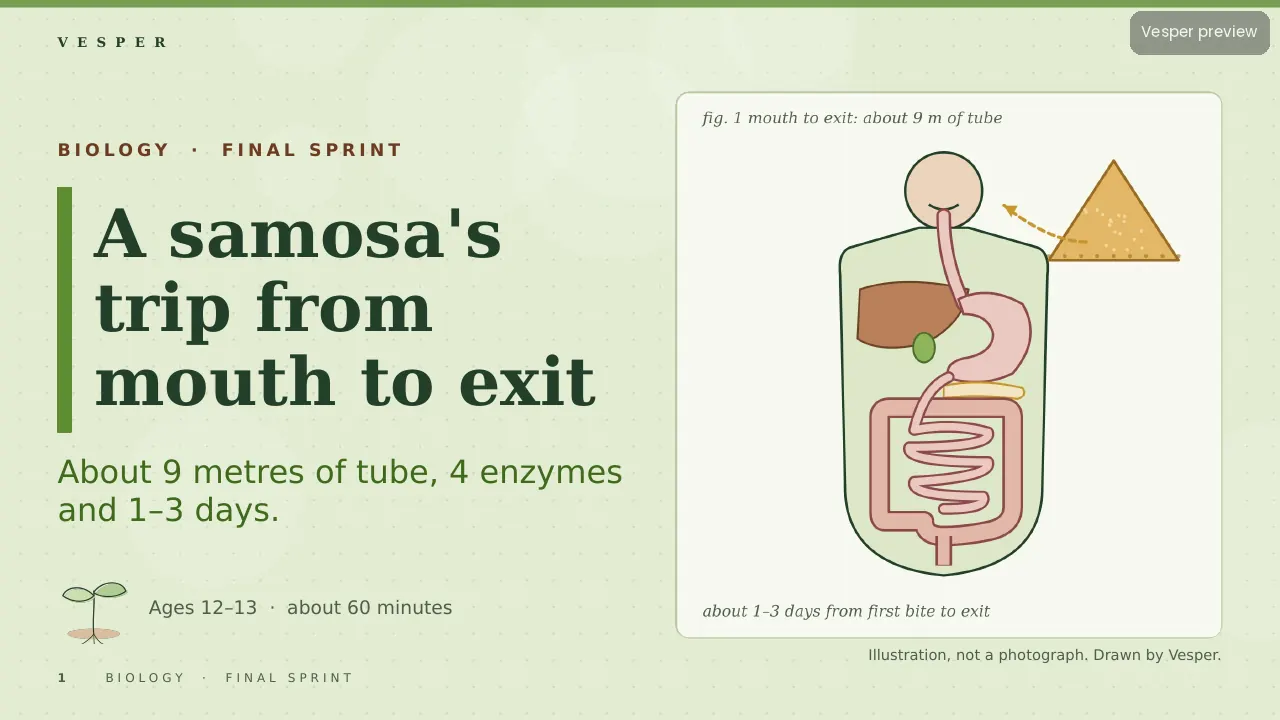
One samosa, 7 stops, about 1–3 days: digestion with real numbers.

Follow one samosa through 7 stops and 4 enzymes, from the first bite to the exit 1–3 days later. A 40-slide Final Sprint lesson that ends with a 6-mark exam question and mark scheme.

The short answer

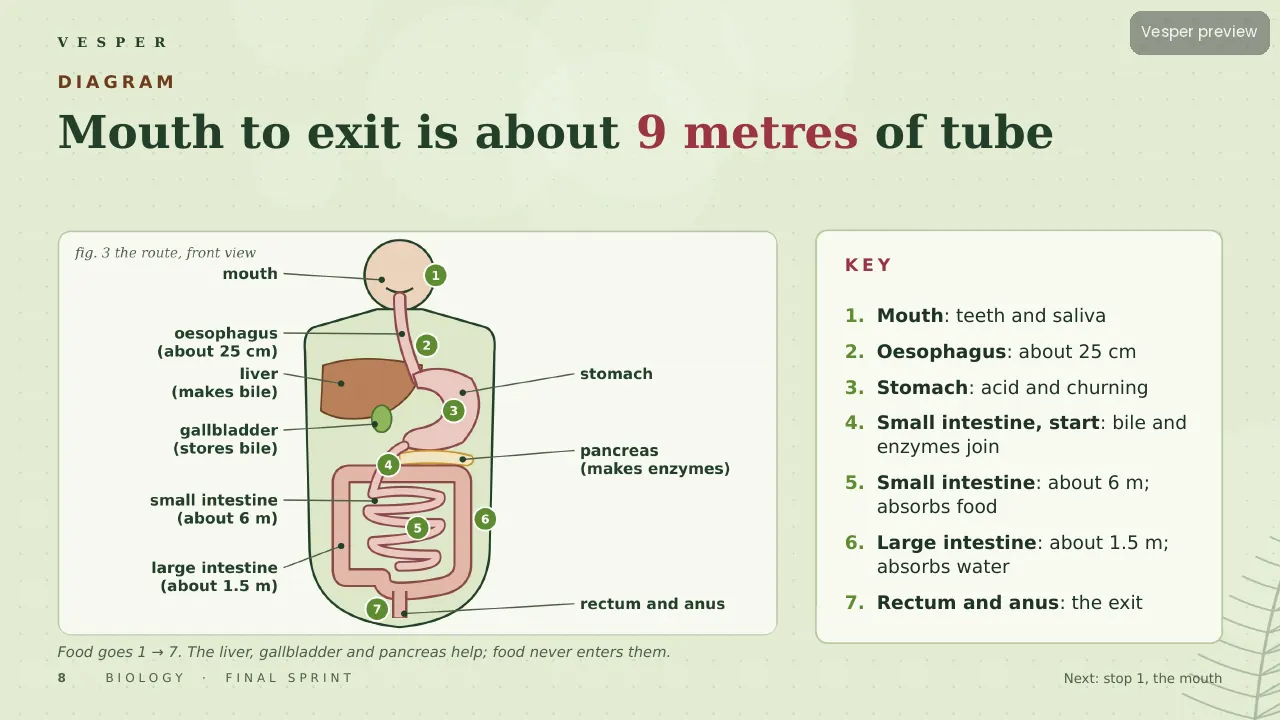
A samosa travels about 9 metres through the gut in 1–3 days. Amylase starts on the potato starch in the mouth, the stomach adds acid at pH 2, bile splits the frying oil into droplets, and enzymes turn starch into glucose, protein into amino acids and fat into fatty acids and glycerol. Villi absorb them; the rest is egested.

Inside the deck

slides
40
quiz questions
8
minutes
60
your-turn tasks
10

Choose a format

  • Lesson Notes (PDF)Every slide with its teacher notes, as a PDF to read or print.
  • Teacher DeckThe editable PowerPoint with speaker notes on every slide, a PDF copy and the matching Vesper slide template, so you can add slides of your own.
Pricing coming soon

Pricing coming soon

We’ll email you pricing and launch offers shortly.

  • Finished and checked: buying opens soon
  • Sources listed at the end
  • Curriculum links under ‘Curriculum & specs’
  • For one classroom. Campus licences for whole schools

Key facts

  • Mouth to exit is about 9 metres of tube and takes about 1–3 days
  • Stomach acid at pH 2 is 100,000 times more acidic than pH 7
  • Bile turns a 1 cm fat drop into 1,000 droplets with 10 times the surface
  • The gut lining is about 32 m², not a tennis court
  • Water in the gut drops from about 9 litres to 0.1 litres a day
  • Ends with a 6-mark exam question and mark scheme

What students will be able to do

  • Students can name the seven stops of the digestive system in order
  • Students can match amylase, protease and lipase to their substrates and products
  • Students can explain how bile helps fat digestion
  • Students can explain how villi help absorption
  • Students can tell egestion from excretion

About this lesson

What students discover

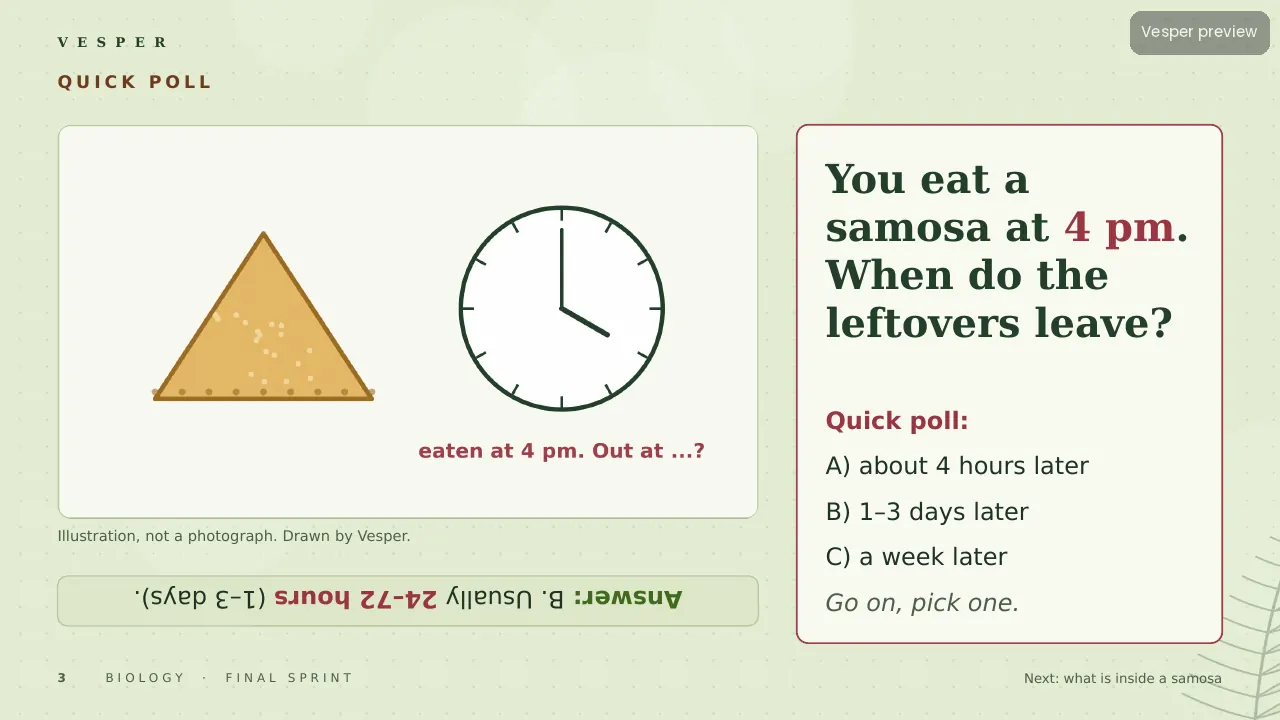
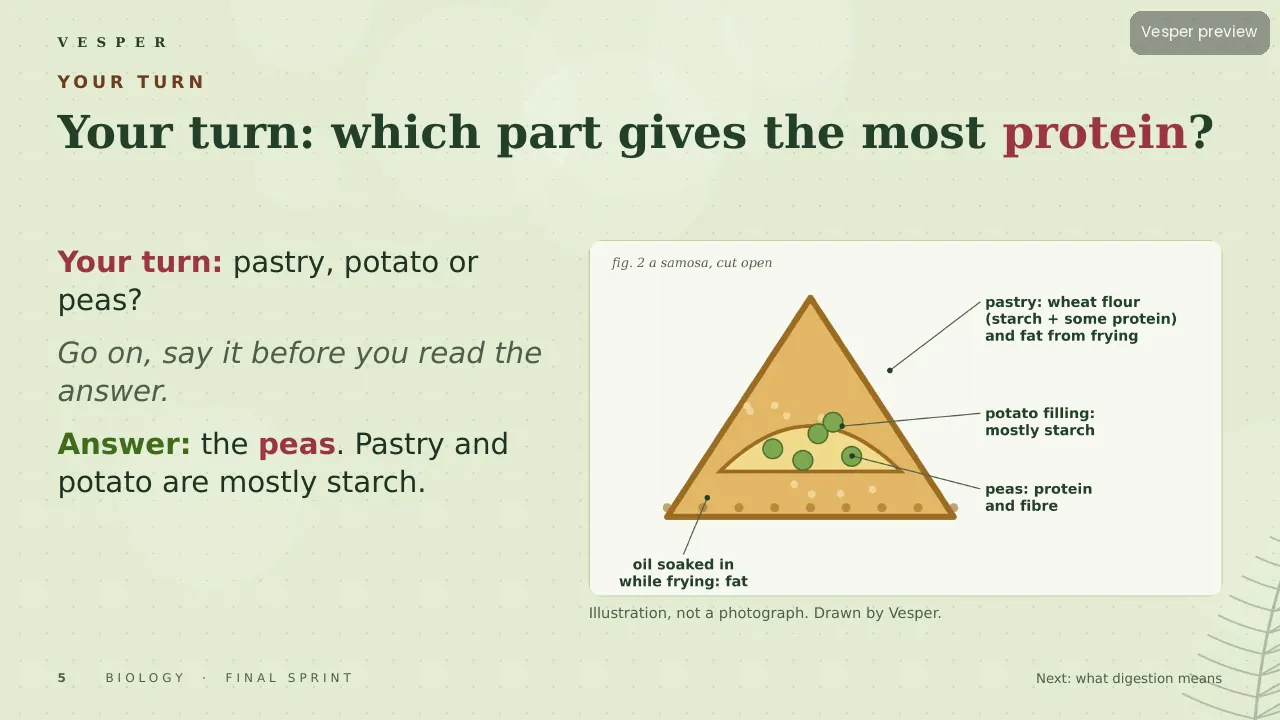
You eat a samosa at 4 pm. When do the leftovers leave? Students follow it stop by stop, along about 9 metres of tube, on a labelled map of the gut. They see what each part of the samosa becomes: potato starch to glucose, pea protein to amino acids, frying oil to fatty acids and glycerol, with each enzyme paired to its substrate and product.

Every idea comes with numbers. Stomach acid at pH 2 is 100,000 times more acidic than pH 7. Bile turns a 1 cm fat drop into 1,000 droplets with 10 times the surface. Villi give a measured 32 m² of lining, not the mythical tennis court. Water drops from 9 litres to 0.1 litres a day.

Inside the deck

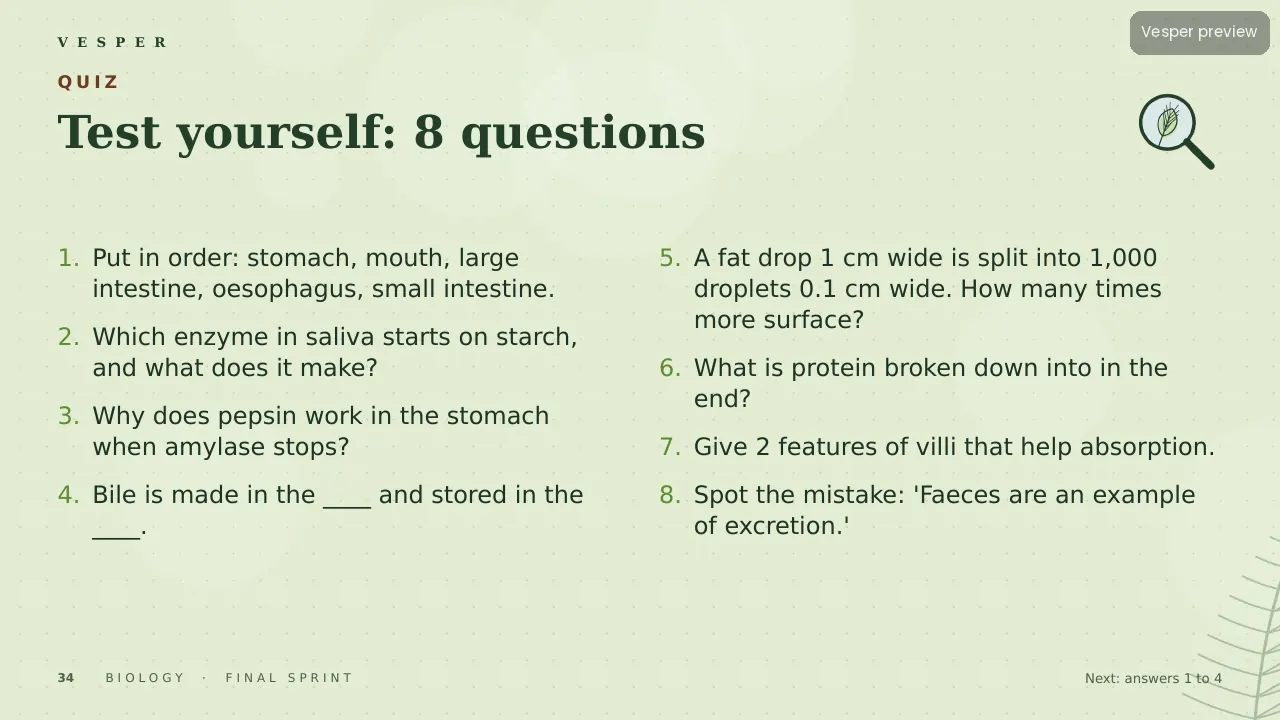
40 slides on the Field Notes template with ten your-turn questions, polls, a safe chew-a-cracker test of amylase, spot-the-mistake slides (egestion or excretion?), a frontier slide on 38 trillion gut bacteria, two checkpoints, an 8-question quiz with explained answers, and a 6-mark exam question on the fat in the samosa with its mark scheme.

How to teach it

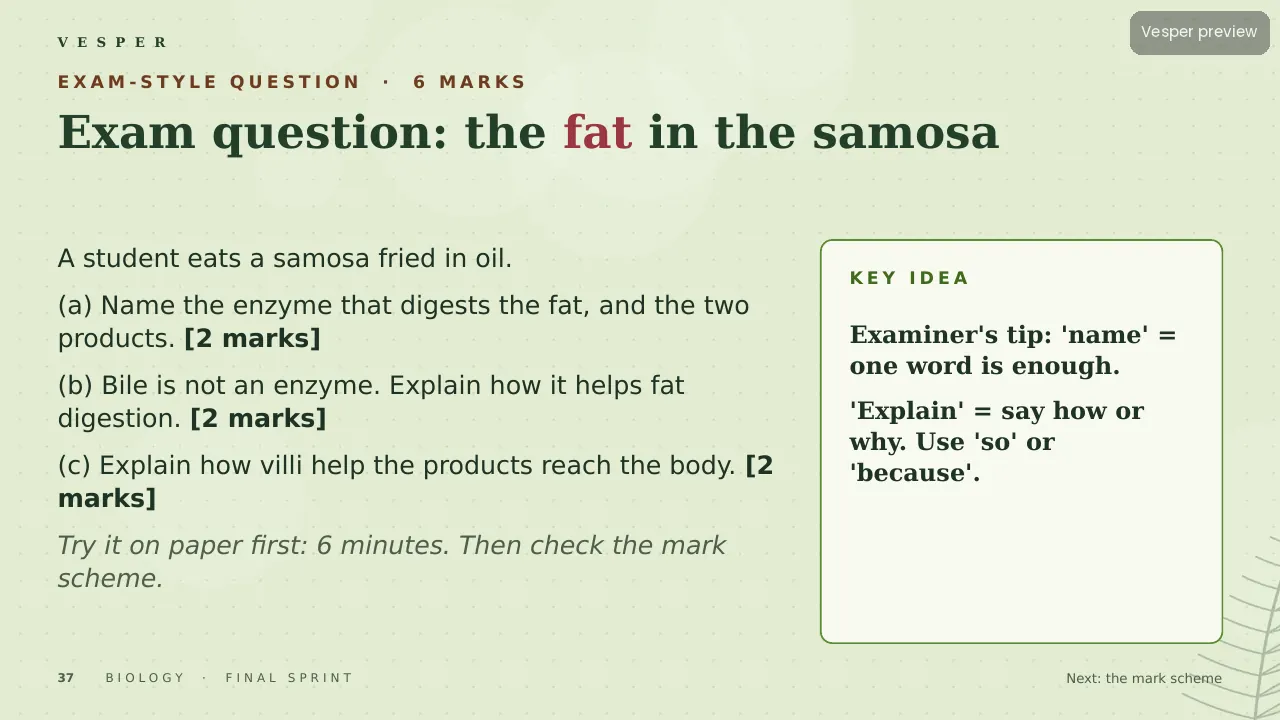
Allow about 60 minutes, or split at the second checkpoint (slide 25). The cracker test on slide 10 takes two minutes: chew a plain cracker for a minute and notice it taste sweeter. Give six minutes for the exam question on slide 37 before the mark scheme. Notes on every slide give Say, Ask, Watch for and Time.

Who it’s for

For ages 12–13 studying nutrition and the digestive system. Part of The Final Sprint, 15 exam lessons that each end with an exam-style question and mark scheme. The PowerPoint is editable, so you can swap the samosa for another meal.
Curriculum & specs

CBSE/NCERT (India)Class 7 · Class 7 Curiosity ch 9 Life Processes in Animals
CambridgeLS Stage 7–8 Biology (digestion); IGCSE 0610 §7 Human nutrition
NGSS (US)MS-LS1-7; MS-LS1-3
IB MYPSciences · KC Systems · RC Transformation, Function
Ages12–13
LevelMiddle
Slide templateField Notes
Slides40
Teaching timeAbout 60 minutes
Exam-style questionYes, with a model answer
LanguageEnglish (UK)

Questions

Questions, answered

How long does food take to pass through the body?

About 1–3 days from mouth to exit, as the lesson's samosa shows.

What enzymes digest a samosa?

Amylase breaks down the potato starch, protease the pea protein and lipase the frying oil. Each works on one substrate.

Is bile an enzyme?

No. Bile emulsifies fat, breaking it into tiny droplets with a much bigger surface so lipase can work faster.

Is the small intestine the size of a tennis court?

No. Measurements give about 32 m² of lining. The tennis-court figure is a myth the lesson corrects.

What is the difference between egestion and excretion?

Egestion is getting rid of undigested food as faeces. Excretion is removing waste made by the body's cells, such as urea.

Does this digestion lesson include an exam question?

Yes. It ends with a 6-mark question on digesting the fat in the samosa, with a mark scheme showing where each mark goes.

Main sources

  1. Betts, J. G. et al. (2022) Anatomy and Physiology, 2nd edn. OpenStax, Rice University, chapter 23 (the digestive system).
  2. Hall, J. E. and Hall, M. E. (2020) Guyton and Hall Textbook of Medical Physiology, 14th edn. Elsevier (saliva, secretions, transit times).
  3. Helander, H. F. and Fändriks, L. (2014) 'Surface area of the digestive tract – revisited'. Scandinavian Journal of Gastroenterology, 49(6), 681–689.

The full source list is on the last slides of the deck. Spotted an error? Tell us.