Life Ages 15–16

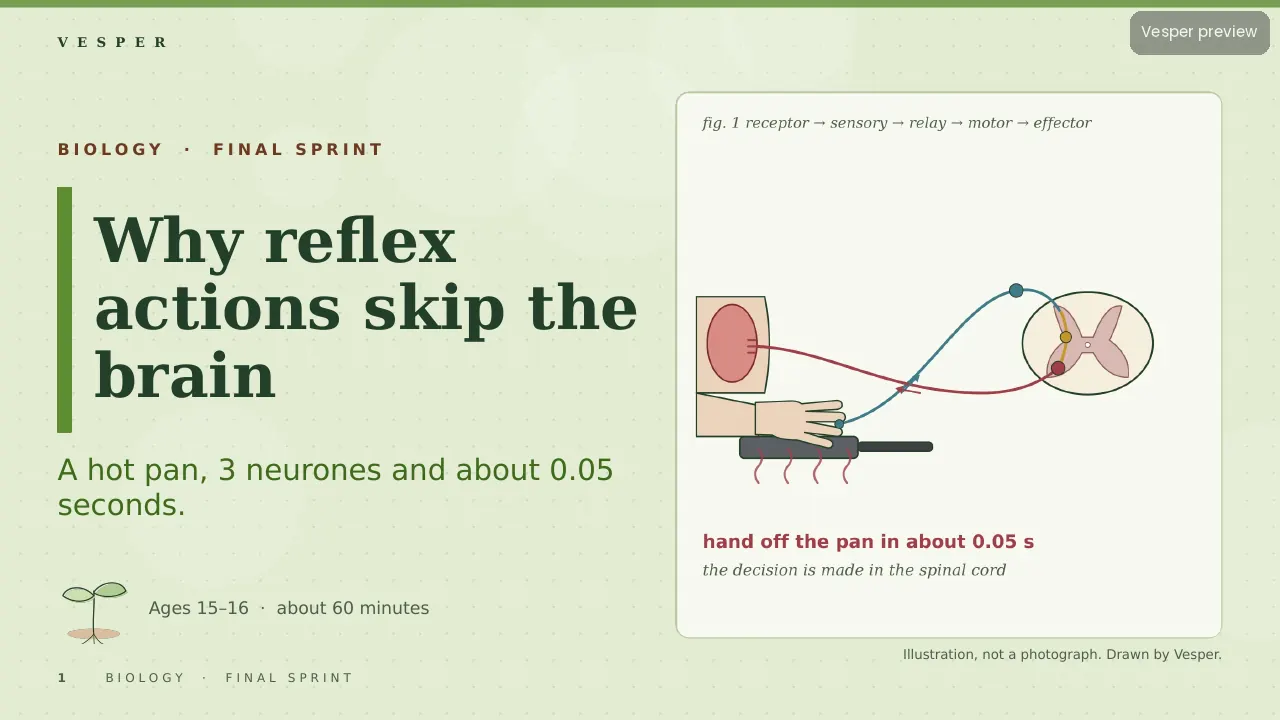
Why reflex actions skip the brain

Your spinal cord decides before you do: the reflex arc, step by step.

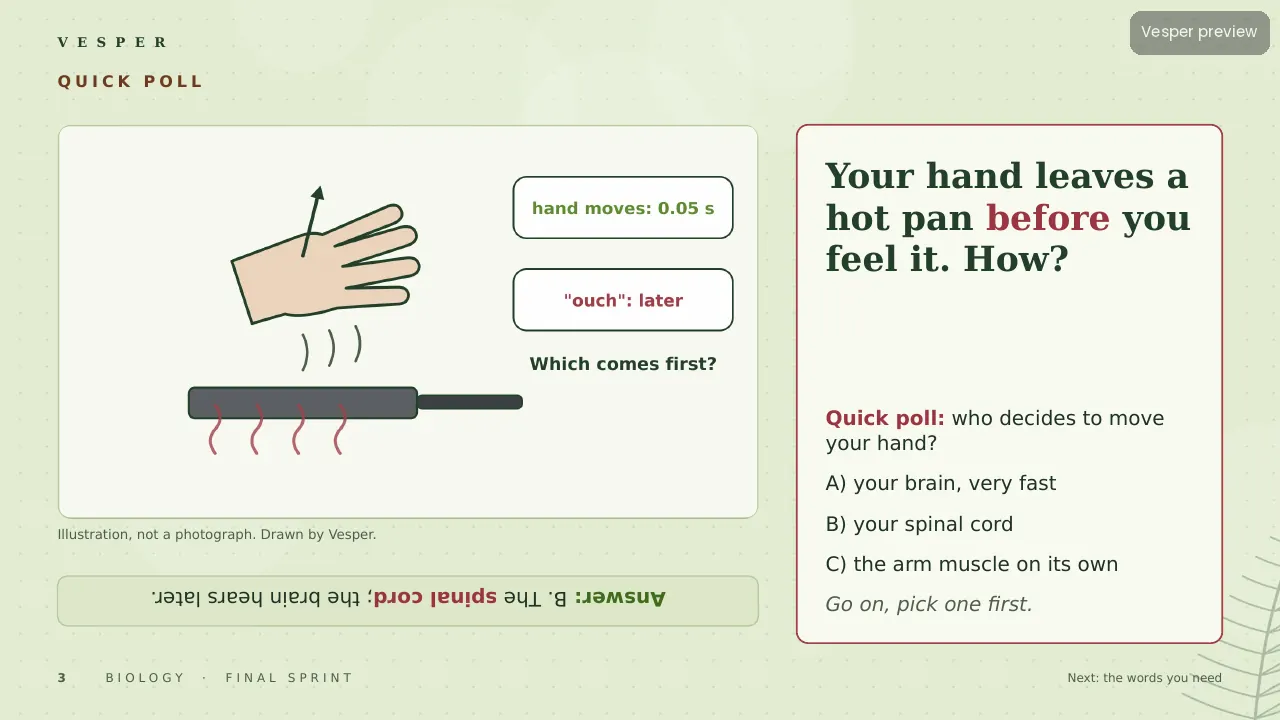
Your hand leaves a hot pan before you feel it. A 34-slide Final Sprint lesson on the reflex arc, with real timings, safe home tests and a 6-mark exam question with its mark scheme.

The short answer

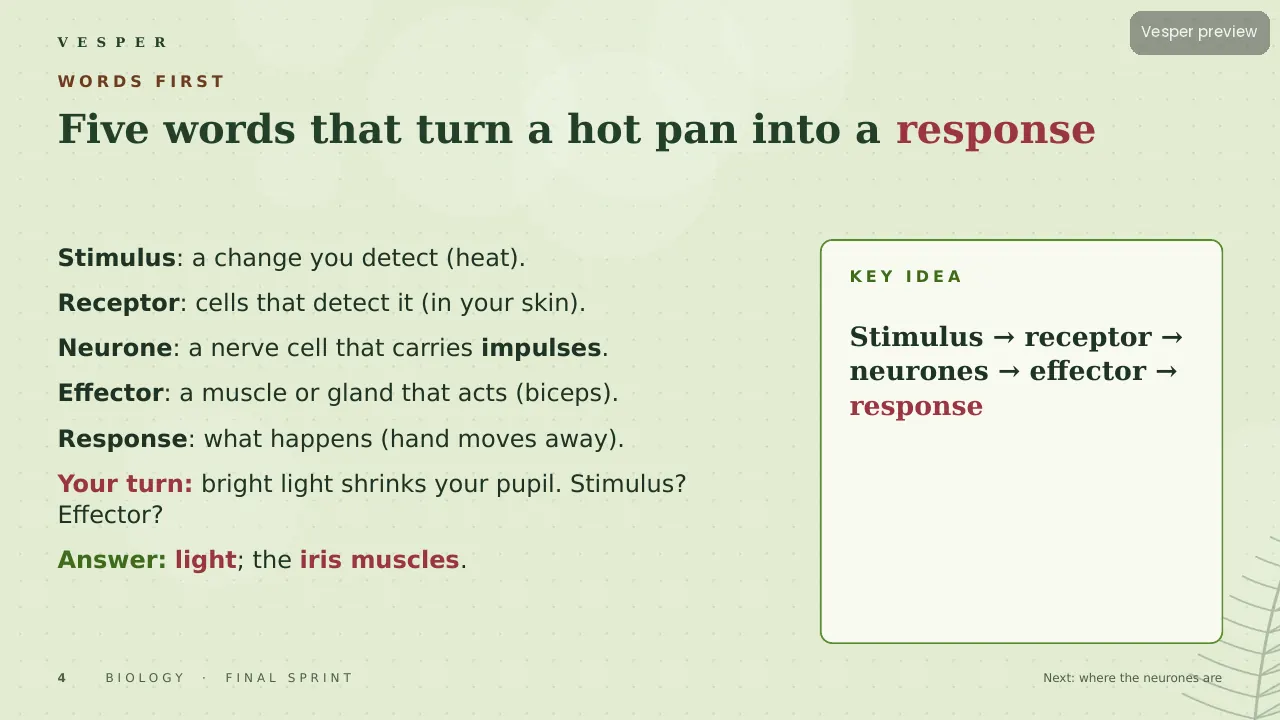
A reflex skips the thinking brain because the signal takes a shortcut through the spinal cord: receptor, sensory neurone, relay neurone, motor neurone, effector. The whole arc takes about 0.05 s, about four times faster than a 0.2 s decision, so your hand moves before the pain message reaches your brain.

Inside the deck

slides
34
quiz questions
8
minutes
60
your-turn tasks
11

Choose a format

  • Lesson Notes (PDF)Every slide with its teacher notes, as a PDF to read or print.
  • Teacher DeckThe editable PowerPoint with speaker notes on every slide, a PDF copy and the matching Vesper slide template, so you can add slides of your own.
Pricing coming soon

Pricing coming soon

We’ll email you pricing and launch offers shortly.

  • Finished and checked: buying opens soon
  • Sources listed at the end
  • Curriculum links under ‘Curriculum & specs’
  • For one classroom. Campus licences for whole schools

Key facts

  • Reflex arc: receptor → sensory → relay → motor → effector
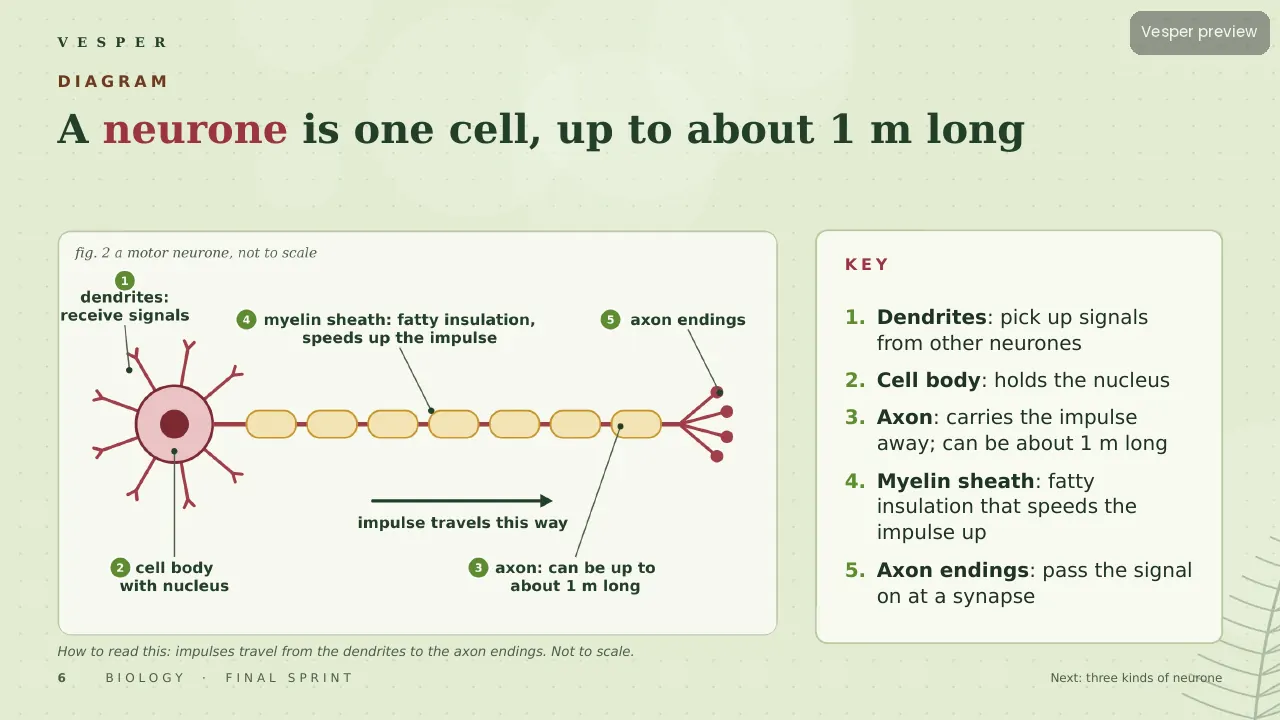
  • A neurone can be up to about 1 m long
  • 1 m at 25 m/s takes 40 ms; the whole arc takes about 0.05 s
  • A reflex is about four times faster than a 0.2 s decision
  • The knee-jerk uses just 2 neurones and 1 synapse
  • Ends with a 6-mark exam question and mark scheme

What students will be able to do

  • Students can name the five parts of a reflex arc in order
  • Students can describe sensory, relay and motor neurones and the synapse
  • Students can calculate the time a reflex takes from length and speed
  • Students can explain why a reflex is faster than a voluntary action
  • Students can tell reflex actions from voluntary ones

About this lesson

What students discover

Your hand leaves a hot pan before you feel the pain. Students follow how, step by step, on a labelled reflex arc: receptor, sensory neurone, relay neurone in the spinal cord, motor neurone, effector. They meet the neurone, the three neurone types and the synapse first, so every word is defined before it is used.

Then come the numbers. A sensory neurone 1 m long at 25 m/s takes 40 ms; add 1 ms for two synapses and 10 ms for the motor neurone, and the reflex takes about 0.05 s, about four times faster than a 0.2 s decision. Students see that the brain still finds out, just later, and that some reflexes run through the brainstem.

Inside the deck

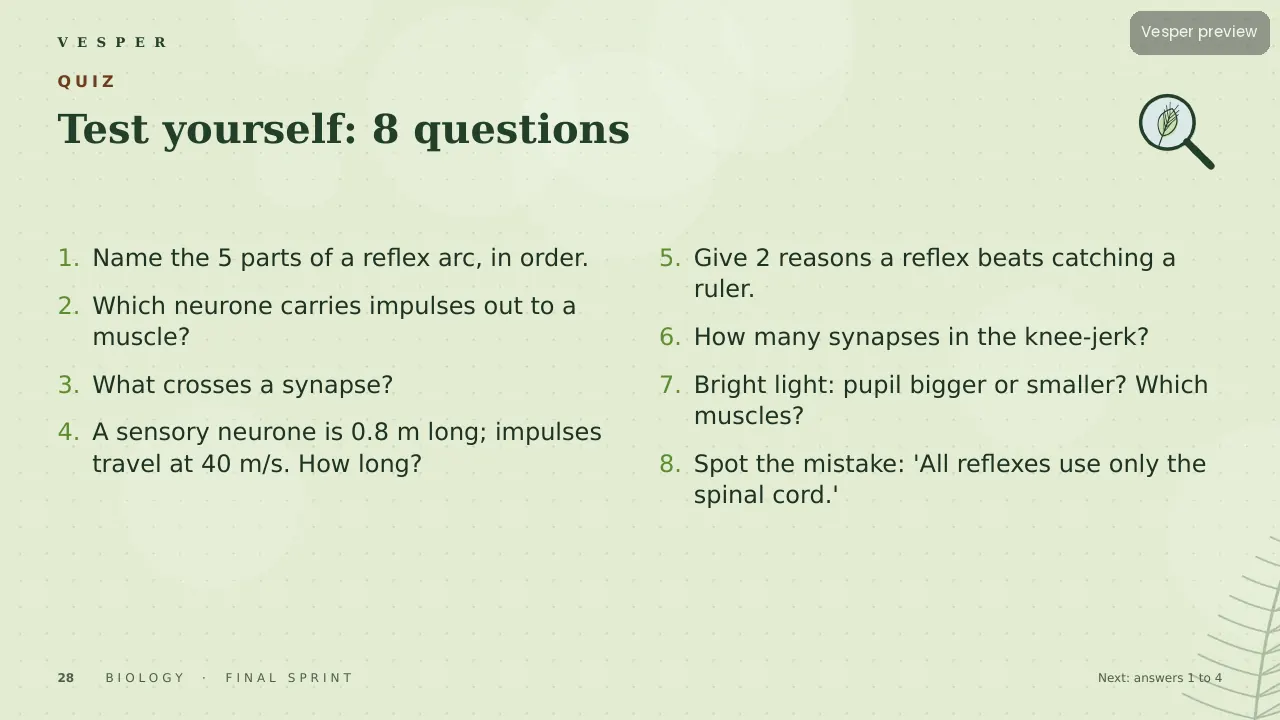
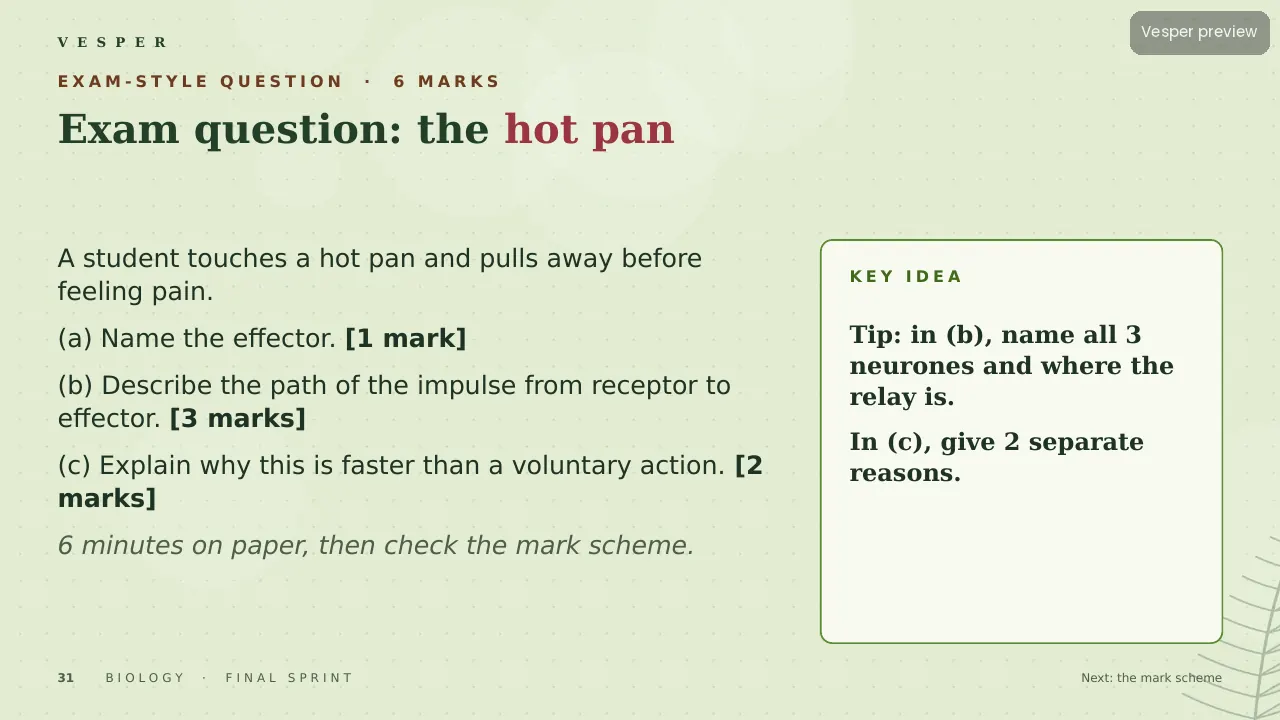
34 slides on the Field Notes template with eleven your-turn questions. Three safe home tests: a ruler-drop reaction table, the pupil reflex in a mirror and the knee-jerk. There are slides on doctors’ reflex tests, a frontier slide on training reflexes, two checkpoints, an 8-question quiz with explained answers, and a 6-mark exam question on the hot pan with its mark scheme.

How to teach it

Allow about 60 minutes. Run the ruler drop on slide 14 in pairs and collect the class’s times; slide 15 then uses them to show that catching a ruler is voluntary, not a reflex. Give six minutes for the exam question on slide 31 before showing the mark scheme. Notes on every slide give Say, Ask, Watch for and Time.

Who it’s for

For ages 15–16 studying the nervous system, coordination and response. Part of The Final Sprint, 15 exam lessons that each end with an exam-style question and mark scheme. The deck is editable, with named layouts.
Curriculum & specs

CBSE/NCERT (India)Class 10 · Class 10 Science ch 6 Control and Coordination
CambridgeIGCSE 0610 §14 Coordination and response
NGSS (US)MS-LS1-8; MS-LS1-3
IB MYPSciences · KC Systems · RC Function, Interaction
Ages15–16
LevelSenior
Slide templateField Notes
Slides34
Teaching timeAbout 60 minutes
Exam-style questionYes, with a model answer
LanguageEnglish (UK)

Questions

Questions, answered

Why do reflex actions skip the brain?

The signal goes from the sensory neurone to a relay neurone in the spinal cord and straight back out to a muscle. Skipping the thinking brain saves time, which protects you.

What are the parts of a reflex arc?

Receptor, sensory neurone, relay neurone (in the spinal cord), motor neurone and effector (a muscle or gland).

How fast is a reflex action?

About 0.05 s in the lesson's worked example, compared with about 0.2 s for a decision.

Is catching a falling ruler a reflex?

No. It is a voluntary action, because you choose to do it and your brain is involved. That is why it is slower.

Does the brain know about a reflex?

Yes, but later. A separate signal travels up to the brain, so you feel the pain after your hand has already moved.

Is the knee-jerk a reflex?

Yes. It is the shortest reflex, with just two neurones and one synapse.

Main sources

  1. Betts et al. (2022) Anatomy and Physiology 2e. OpenStax, ch. 12–14.
  2. Hall and Hall (2020) Guyton and Hall Medical Physiology, 14th edn.
  3. Azevedo et al. (2009) J Comp Neurol, 513, 532–541.

The full source list is on the last slides of the deck. Spotted an error? Tell us.