Life Ages 15–16

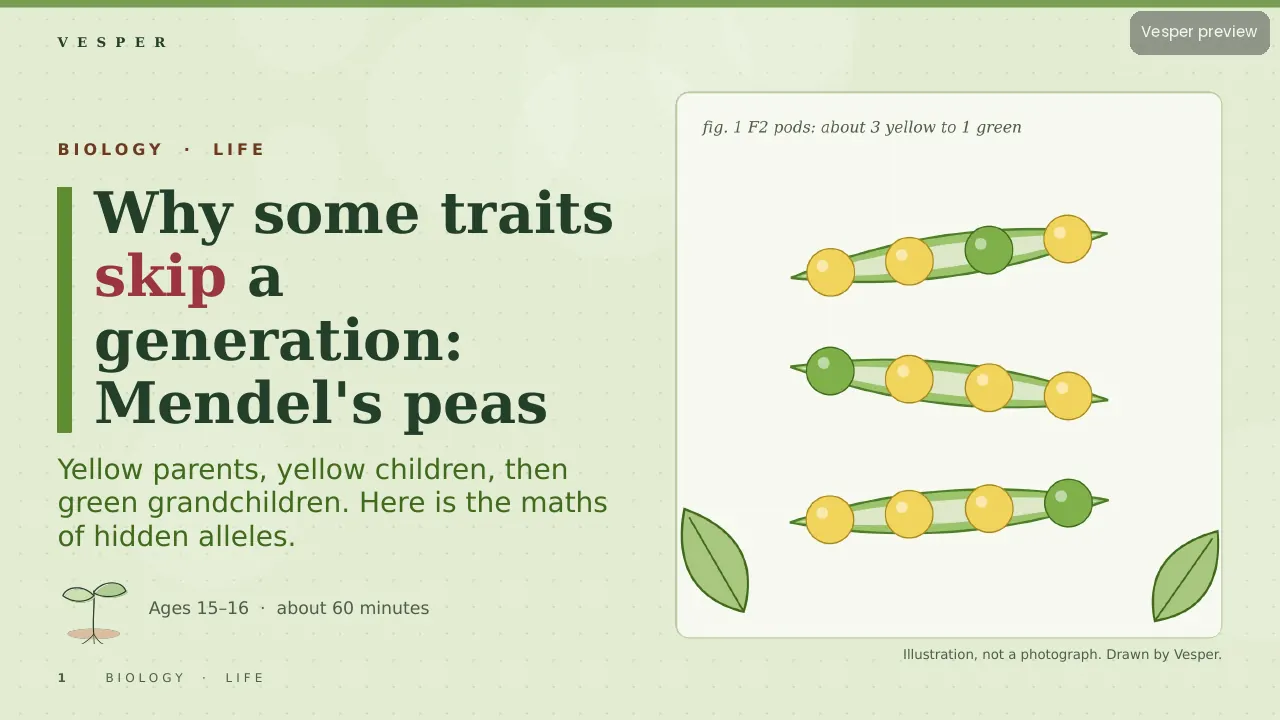
Why some traits skip a generation: Mendel's peas

Yellow parents, yellow children, green grandchildren. Here is the maths.

Mendel’s real pea counts (6,022 : 2,001), Punnett squares, carriers and probability: why a trait vanishes in one generation and returns in the next. 30 slides for ages 15–16.

The short answer

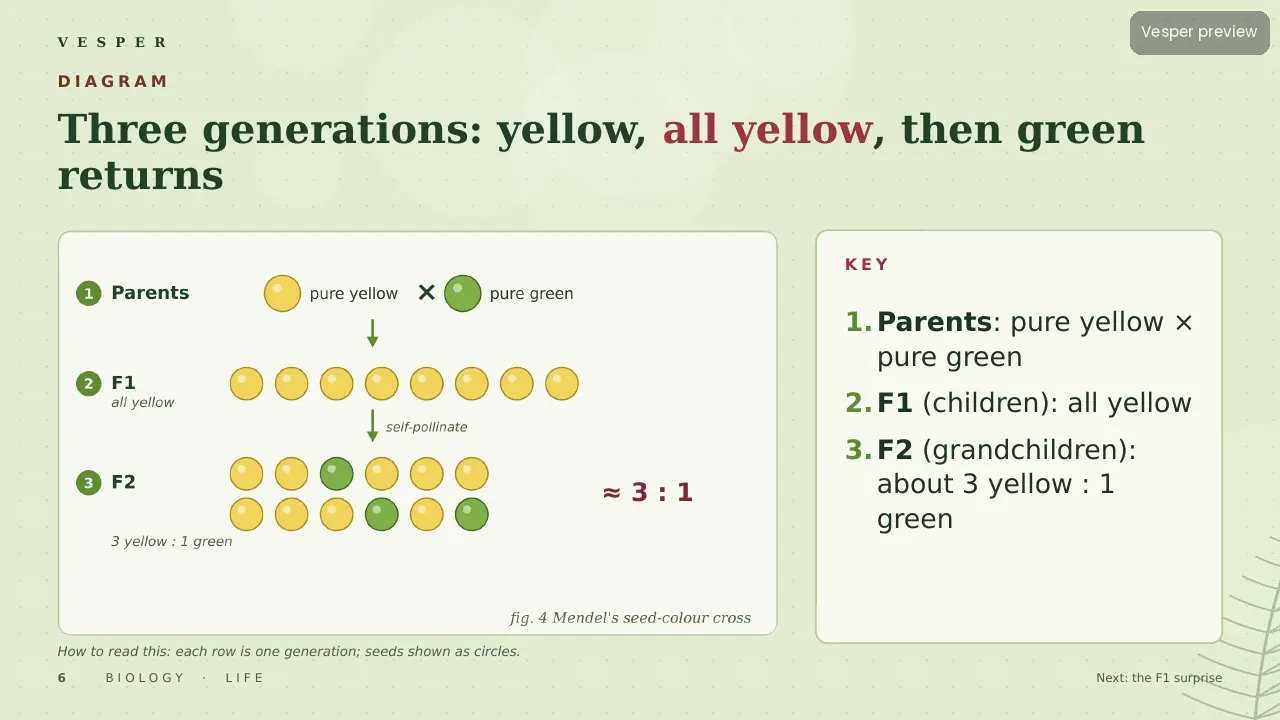
A trait skips a generation when it is recessive. The middle generation carry one hidden allele each (Yy) but show the dominant trait. When two carriers breed, each offspring has a 1 in 4 chance of getting two recessive alleles, so the trait returns. Mendel's peas showed it: 6,022 yellow to 2,001 green, about 3 : 1.

Inside the deck

slides
30
quiz questions
8
minutes
60
your-turn tasks
10

Choose a format

  • Lesson Notes (PDF)Every slide with its teacher notes, as a PDF to read or print.
  • Teacher DeckThe editable PowerPoint with speaker notes on every slide, a PDF copy and the matching Vesper slide template, so you can add slides of your own.
Pricing coming soon

Pricing coming soon

We’ll email you pricing and launch offers shortly.

  • Finished and checked: buying opens soon
  • Sources listed at the end
  • Curriculum links under ‘Curriculum & specs’
  • For one classroom. Campus licences for whole schools

Key facts

  • Mendel's F2 seed colours: 6,022 yellow to 2,001 green, a ratio of 3.01 : 1
  • Seed shape: 5,474 round to 1,850 wrinkled, about 2.96 : 1
  • Mendel grew about 28,000 pea plants from 1856 to 1863
  • Two green seeds in a row from Yy × Yy: ¼ × ¼ = 1/16
  • His paper (1866) waited 34 years for rediscovery in 1900
  • A 2022 study linked over 12,000 genetic variants to human height

What students will be able to do

  • Students can explain why a recessive trait can skip a generation
  • Students can draw a Punnett square and predict a 1 : 2 : 1 genotype ratio
  • Students can turn a Punnett square into probabilities and expected numbers
  • Students can use a test cross to find an unknown genotype
  • Students can explain why real counts wobble around 3 : 1

About this lesson

What students discover

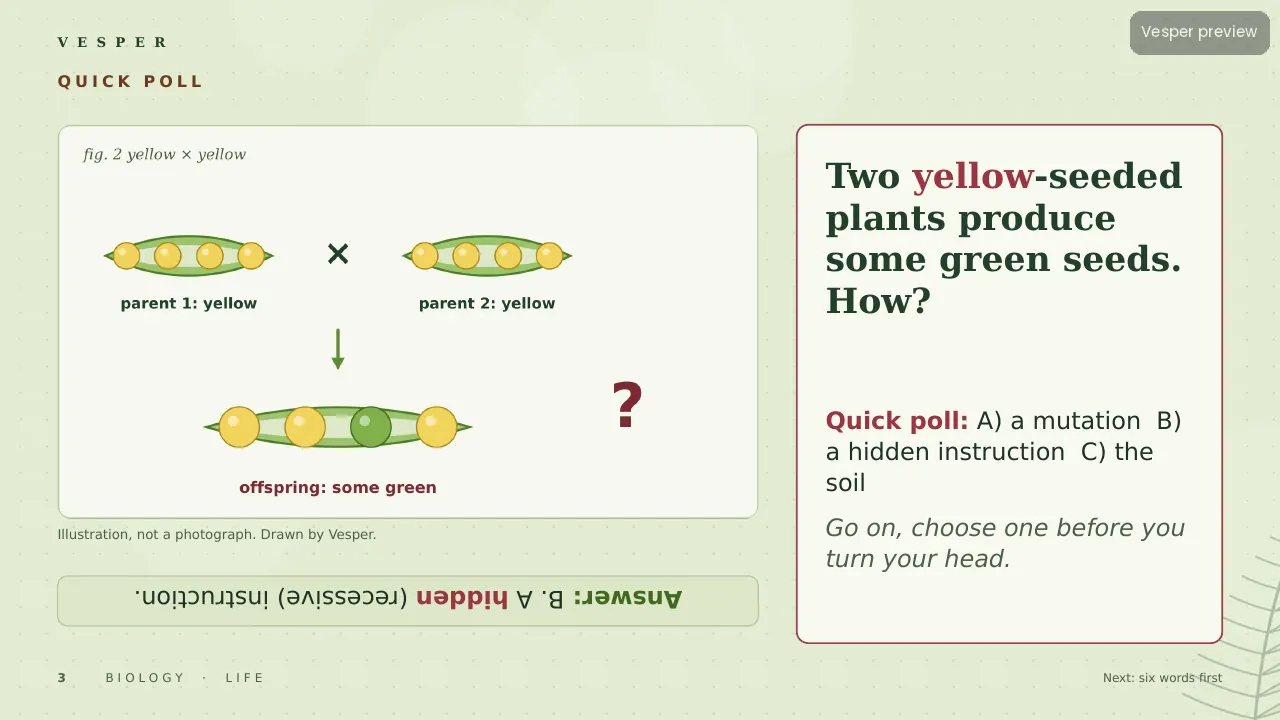
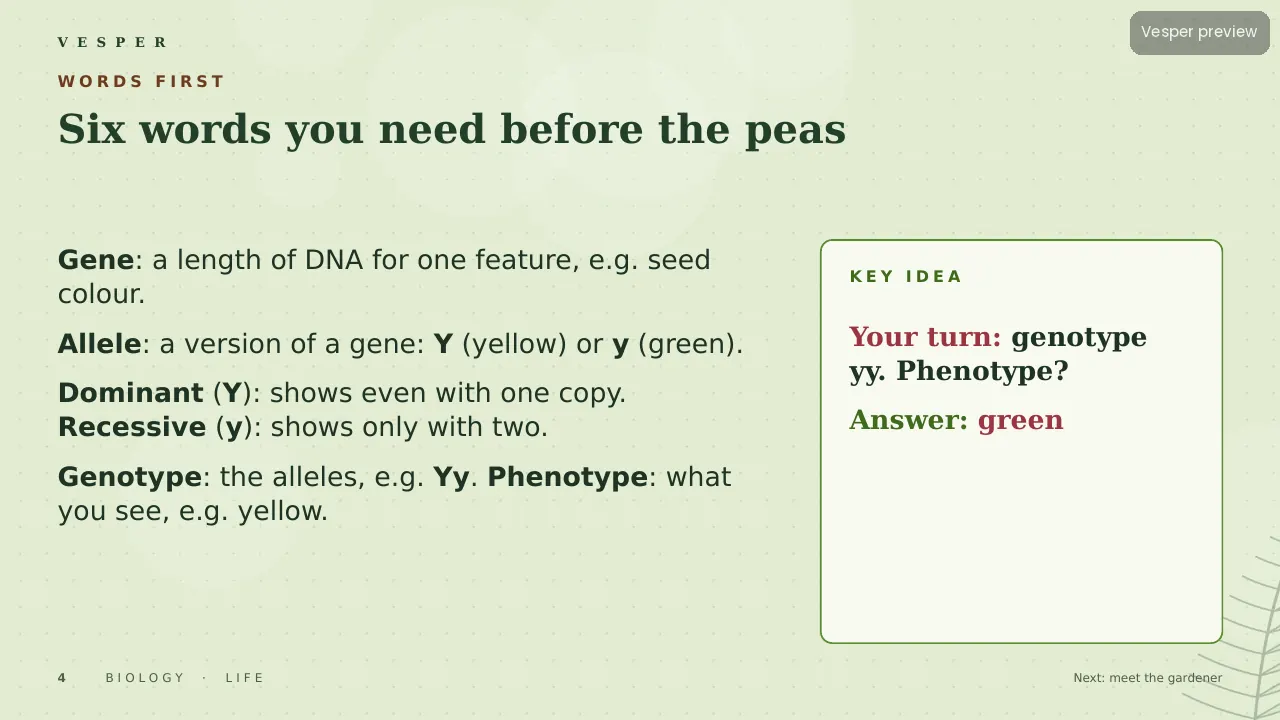
Two yellow-seeded pea plants can produce green seeds. Students follow Gregor Mendel’s seed-colour cross across three generations: pure yellow × pure green, an all-yellow F1, then about 3 : 1 in the F2. They calculate his published ratios for themselves (6,022 ÷ 2,001 = 3.01 and 5,474 ÷ 1,850 = 2.96) and learn genes, alleles, dominant and recessive, genotype and phenotype.

Punnett squares turn into probabilities: ¼ green, ½ carriers, so 400 seeds give about 100 green. A plant pedigree shows exactly what ‘skipping a generation’ means, and a probability tree shows why two greens in a row is 1/16.

Inside the deck

30 slides on the Field Notes template, with 16 code-drawn pictures of pods, crosses, Punnett squares and a pedigree. There is a spot-the-mistake slide on the gambler’s fallacy, a test cross that reveals a hidden allele, Mendel’s 787 : 277 to show why real counts wobble, and the 1990 discovery of the wrinkled-pea gene. Two checkpoints, polls with upside-down answers and an 8-question quiz with reasons.

How to teach it

Allow about 60 minutes. Run the poll on slide 3 before any terms appear, then let students predict the F2 share on slide 7. The people examples on slides 21–22 (carriers, two common myths) are handled calmly, and the notes advise keeping family health examples general. Each slide’s notes give Say, Ask, Watch for and Time.

Who it’s for

For ages 15–16 studying inheritance, monohybrid crosses and probability in biology. It also suits a maths teacher looking for real data on compound probability. The deck is editable, so you can swap in your own cross or add a class coin-toss simulation.
Curriculum & specs

CBSE/NCERT (India)Class 10 · Class 10 Science ch 8 Heredity
CambridgeLS Stage 9 Biology (inheritance); IGCSE 0610 §17 Inheritance
NGSS (US)MS-LS3-2; HS-LS3-3
IB MYPSciences · KC Relationships · RC Patterns, Evidence
Common Core (US)7.SP.C.8 (compound probability)
Ages15–16
LevelSenior
Slide templateField Notes
Slides30
Teaching timeAbout 60 minutes
LanguageEnglish (UK)

Questions

Questions, answered

Why do some traits skip a generation?

Because the trait is recessive. Parents in the middle generation carry one hidden copy and look normal; when two carriers have offspring, each has a 1 in 4 chance of inheriting two copies, so the trait reappears.

What ratio did Mendel get in his pea experiments?

About 3 : 1 in the second generation. For seed colour he counted 6,022 yellow and 2,001 green, which is 3.01 : 1.

How do you use a Punnett square?

Write each parent's possible sex cells along the edges and fill each box with one allele from each side. For Yy × Yy you get 1 YY : 2 Yy : 1 yy, and each box is a 1 in 4 chance.

What is a carrier in genetics?

A carrier has one recessive allele and one dominant allele (for example Yy). They do not show the recessive trait but can pass the allele on.

What is a test cross?

You cross an individual showing the dominant trait with a recessive one (yy). If any offspring show the recessive trait, the unknown parent was Yy; if all show the dominant trait across many offspring, it was almost certainly YY.

Does dominant mean more common?

No. Dominant only means the allele shows with one copy. Extra fingers (polydactyly) can be dominant and still rare.

Main sources

  1. Mendel, G. (1866) 'Versuche über Pflanzen-Hybriden'. Verh. naturf. Ver. Brünn, 4, 3–47 (F2 counts 6,022 : 2,001; 5,474 : 1,850; 787 : 277).
  2. Bhattacharyya, M. K. et al. (1990) Cell, 60, 115–122 (wrinkled allele: insertion in a starch-branching enzyme gene).
  3. Yengo, L. et al. (2022) Nature, 610, 704–712 (over 12,000 height variants).

The full source list is on the last slides of the deck. Spotted an error? Tell us.